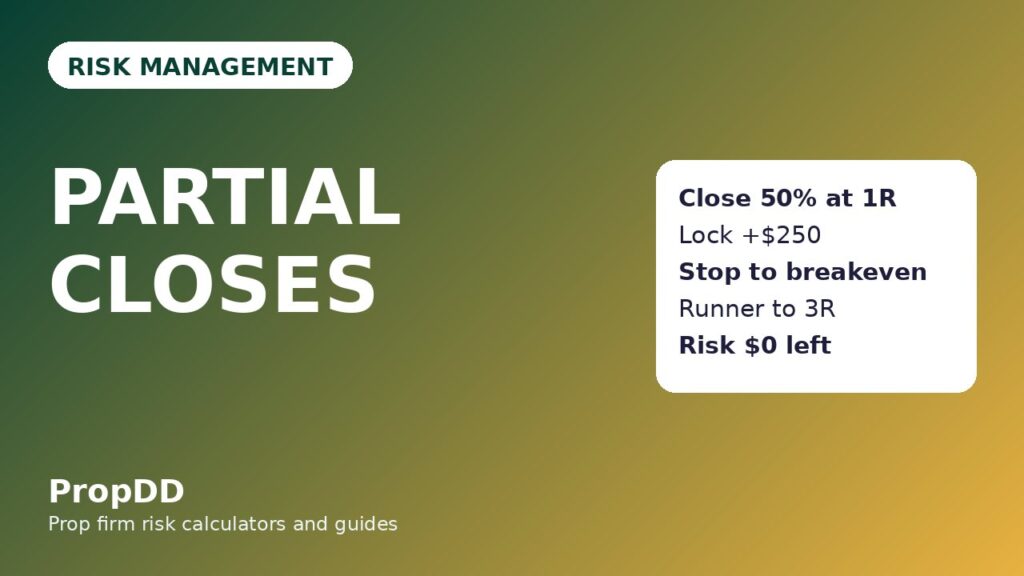
I watched nine hundred dollars of open profit turn into a five hundred dollar loss, and I did nothing the whole way down. It was a Thursday morning on EURUSD. I was long from 1.0850 with a stop at 1.0800 and a target at 1.0950, one lot, risking five hundred dollars. By mid-morning price had reached 1.0900. I was up fifty pips, five hundred dollars, exactly one times my risk. I told myself to let it run. Price stalled, turned, and by lunch it had come all the way back through my entry and stopped me out at 1.0800. A trade that had been five hundred dollars in profit ended five hundred dollars in loss, a one thousand dollar round trip, and the only decision I had made in between was no decision at all.
In this article
- What a partial close actually does
- The partial-close maths: locked profit against remaining risk
- My 50/30/20 ladder
- I tested it: ten trades, all-in exits against partial exits
- Where partial closes break funded rules
- The session routine: a partial-close checklist
- When not to partial-close
- Frequently asked questions
That afternoon I started closing part of my positions early, and I have done it ever since. A partial close means closing a fraction of a position while the rest keeps running. It is not a strategy on its own. It is an exit habit, and on a funded account it matters more than on a personal account, because the daily loss limit turns a round trip like mine into a day that is suddenly half spent, with the same risk rules and a worse mood for the trades that follow.
This article explains what a partial close actually does, the maths of locked profit against remaining risk, the 50/30/20 ladder I use, a ten-trade log comparing all-in exits with partial exits, and the funded-account traps to avoid. If you keep watching winning trades come back to your stop, this is the habit that stops the round trip.
What a partial close actually does
A partial close splits one trade into two outcomes. The closed part is finished: its profit or loss is banked, it can no longer grow, and it can no longer hurt you. The remaining part is still live, with its own stop and target, and it carries the rest of the trade’s risk. That split is the whole point. Before the partial close, the trade is all or nothing: it either reaches the target or it reaches the stop. After it, part of the trade is already a win, whatever happens next.
It helps to name the two numbers every partial close creates. The first is locked profit: the money banked by the closed portion, which no later price move can take away. The second is remaining risk: what the open portion can still lose from here. A good partial close improves both numbers at once. It banks something, and it lets you move the stop on the remainder to breakeven, so the remaining risk falls to zero. A bad partial close improves neither: it closes too little to matter, or it closes a losing portion and realises a loss that counts against the daily limit, which is a trap I cover below.
Note what a partial close does not do. It does not increase the trade’s expected value on its own. Closing half a winning trade early produces less total profit than holding the whole position to the target. That is the price of the habit, and it is worth paying on a funded account for a reason that has nothing to do with the single trade: it protects the day. A funded account dies by days, not by trades. One round trip that eats half the daily limit changes every decision after it. A partial close that banks half the win keeps the day intact.
The partial-close maths: locked profit against remaining risk
Take the trade from my story, because the numbers are clean. Account size one hundred thousand dollars, firm daily loss limit five thousand dollars, my personal daily stop two thousand five hundred dollars, base risk five hundred dollars per trade. EURUSD, one lot, entry 1.0850, stop 1.0800, target 1.0950. The stop is fifty pips, the target is one hundred pips, so the trade risks one unit and targets two. At ten dollars per pip for one lot, the planned loss is five hundred dollars and the planned win is one thousand dollars.
| Partial-close maths | Amount | What it means |
|---|---|---|
| Full position risk (1.0 lot, 50-pip stop) | -$500 | Planned loss if stopped out before any partial |
| Price reaches +50 pips (1R): close 0.5 lot | +$250 locked | Half the position banked at one times risk |
| Move stop on remaining 0.5 lot to breakeven (1.0850) | $0 remaining risk | Worst case from here is +$250, not -$500 |
| Remaining 0.5 lot reaches target (1.0950) | +$500 more | Total trade profit $750, against $1,000 all-in |
| Remaining 0.5 lot reverses to breakeven | +$250 total | A win banked, against a $500 loss all-in |
| Cost of the partial on a clean winner | -$250 | The upside given up for the locked profit |
The formula is simple enough to run before every trade. Locked profit equals closed size times pips banked times pip value. Remaining risk equals open size times pips from current price to the new stop times pip value. In the example, locked profit is 0.5 lots times 50 pips times ten dollars, which is two hundred and fifty dollars. Remaining risk after moving the stop to breakeven is zero. If you run your own numbers through the max daily drawdown calculator, you will see why the breakeven step matters as much as the close itself.
There is one more number worth checking before you use partial closes at all, and it is your firm’s daily limit in dollars, not percent. My personal stop is half the firm’s five thousand dollar limit, so a single five hundred dollar loss is ten percent of the firm’s limit and twenty percent of mine. A round trip from plus five hundred to minus five hundred is a one thousand dollar swing, twenty percent of the firm’s limit and forty percent of my personal stop, in a single trade. Framed that way, giving up two hundred and fifty dollars of upside on a clean winner looks cheap.
My 50/30/20 ladder
After testing several versions, I settled on a ladder that closes in three steps instead of one. One big partial at 1R leaves too much running and tempts you to move the goalposts. Three small steps force the decision at prices you chose in advance, when you are calm, instead of at prices the market chooses for you, when you are not.
| Ladder step | Close | Price | Profit banked at that step | Stop on the remainder |
|---|---|---|---|---|
| Step 1 | 50% (0.5 lot) | +50 pips (1R, 1.0900) | +$250 | Breakeven (1.0850) |
| Step 2 | 30% (0.3 lot) | +100 pips (2R, 1.0950) | +$300 | Locked at +50 pips on the runner |
| Step 3 | 20% runner (0.2 lot) | +150 pips (3R, 1.1000) or trailing stop | +$300 if 3R reached | Trailing behind structure |
| Ladder total if all steps hit | 100% | – | +$850 | Against $1,500 all-in at 3R |
Read that last row honestly. The ladder gives up six hundred and fifty dollars against holding the full lot to 3R. That is not a flaw in the table. It is the honest price of the habit, and any article that hides it is selling you something. The ladder’s job is not to maximise one trade. It is to make sure a trade that reaches 1R never becomes a loss, and a trade that reaches 2R never becomes a break-even.
The ladder also has a rule that matters more than the percentages: the steps are set before entry, written on the trade plan, and never moved mid-trade. If step 1 is at 1R, it fires at 1R, even if the chart looks strong. The moment you start deciding partials by feel, you are back to the Thursday morning problem, watching price and deciding nothing.
I tested it: ten trades, all-in exits against partial exits
I ran the same ten-trade sample through both exit rules, using my own journal from a two-week stretch of EURUSD London-session longs. The sample is small and the market was reversal-heavy, so treat it as a worked example, not as proof.
| Trade outcome in the sample | Count | All-in exit result | Partial-ladder exit result |
|---|---|---|---|
| Clean winner to target | 4 | 4 x +$1,000 = +$4,000 | 4 x +$750 = +$3,000 |
| Reached 1R, then reversed to the stop | 2 | 2 x -$500 = -$1,000 | 2 x +$250 = +$500 |
| Straight loss, never reached 1R | 4 | 4 x -$500 = -$2,000 | 4 x -$500 = -$2,000 |
| Sample total | 10 | +$1,000 | +$1,500 |
| Worst single-trade round trip | – | +$500 to -$500 (a $1,000 swing) | +$250 locked, $0 further loss |
The partial ladder lost on the clean winners, by two hundred and fifty dollars each, and won on the reversals, by seven hundred and fifty dollars each. In a trend-heavy sample the all-in column would win. In a reversal-heavy sample the ladder wins. Neither column is the lesson. The lesson is the bottom row: the ladder removed the round trip entirely. That is also why this habit pairs with the lock-in rules in my giving-back-profits article: both exist to stop a green day turning red, and a partial close is the trade-level version of a profit floor.
Where partial closes break funded rules
Partial closes are allowed by most firms, but they interact with funded rules in three ways that catch traders out. The first is the realised loss trap. A loss only counts against the daily limit when it is realised, and closing part of a losing position realises that part’s loss immediately. Close half a losing one-lot trade at minus twenty-five pips and you have banked a minus one hundred and twenty-five dollar loss against the day, even though the other half is still open. Traders who “trim losers to reduce risk” are often spending their daily limit in slices without noticing. My rule is simple: I never partially close a losing trade. If the trade is wrong, I take the full planned loss at the stop. Partial closes are for winners only.
The second trap is the consistency rule. A firm that caps your best day will notice if partial closes turn every day into small banked wins with one large runner day. Partial closes tend to shrink big days, which helps consistency, but a runner that hits 3R while every other day banks small partials can still stand out. Check your running best-day share before letting a runner go, the same way my consistency rule article describes. If the runner would break your cap, close it at step 2 and bank the day.
The third trap is trailing drawdown. On a trailing account, the drawdown floor follows your highest equity, and a partial close that banks profit raises that high-water mark. That is good for the payout and bad for breathing room: a later pullback that would have been safe on a static account can now touch the floor. Before using partial closes on a trailing account, work out your floor after each step, not just your profit. My drawdown buffer article walks through that check, and it is the one step I never skip on a trailing account.
The session routine: a partial-close checklist
A habit only works if it survives a bad morning, so mine is a checklist. It runs before the first trade and after every partial close, and it takes about a minute.
| Checklist step | When | Detail |
|---|---|---|
| Write the ladder on the plan | Before entry | Step prices, sizes and stop moves, in pips, before the trade opens |
| Confirm the daily limit headroom | Before entry | Planned loss as a share of the firm’s limit and of my personal stop |
| Fire step 1 at 1R, no discretion | At +50 pips | Close 50%, move the remainder’s stop to breakeven immediately |
| Recheck the drawdown floor | After each partial | On trailing accounts, confirm the new floor before letting the runner go |
| Check the best-day share | Before the runner step | If the runner would breach the consistency cap, close at step 2 |
| Log locked against given up | End of session | For each trade: locked profit, upside given up, round trips avoided |
The last row is the one that keeps the habit honest. If I only log locked profit, partial closes always look brilliant. Logging the upside given up alongside it shows the real cost, and over a month that cost tells me whether my market is trending or reversing. In a trending month the given-up column grows and I widen the ladder. In a reversing month the locked column grows and I tighten it. The ladder is a starting point, not a religion, and the log is how it adapts without becoming a mood.
When not to partial-close
There are three situations where I do not partial-close at all. The first is a trade with a very tight stop, where the first partial would bank so little that the remaining position is not worth managing. On a fifteen-pip stop, half a position at 1R banks a trivial amount and doubles my workload for nothing. The second is a news-driven trade, where price can gap through every step price at once; a ladder built on clean price levels is meaningless when the first print after the release is already past step 3. The third is any trade where I cannot state the ladder in advance. If I cannot write the steps down before entry, I do not have a plan, I have a hope, and no exit habit fixes that.
The Wikibit partial close strategy guide makes a similar point from the platform side: partial closes are most useful as pre-set levels, because a level set in advance removes the emotional decision in the moment. That matches my experience exactly. The traders I know who hate partial closes usually tried them as mid-trade improvisation, closing a bit here and a bit there because the chart felt scary. Done that way, partial closing is just nervousness with extra steps. Done as a ladder written before entry, it is the cheapest insurance a funded account has.
Frequently asked questions
Do partial closes count against the daily loss limit?
Only the realised part counts. Closing part of a winning trade banks profit, which helps the day. Closing part of a losing trade realises that part’s loss immediately, and that loss counts against the daily limit even though the rest of the position is still open. That is why partial closes should be used on winners, not as a way to trim losers.
How much should I close at the first partial?
Half the position at one times risk is a sound starting point: on a one-lot trade risking five hundred dollars, closing 0.5 lots at 1R locks two hundred and fifty dollars and lets you move the remainder’s stop to breakeven. Closing less than a third at the first step rarely changes the day enough to matter.
Do partial closes hurt the consistency rule?
Usually they help, because they shrink oversized winning days into steadier banked amounts. The exception is a large runner left after several small partial days: if that runner would push one day above your firm’s best-day cap, close it at the second step instead of letting it run.
Should I move my stop to breakeven after a partial close?
Yes, on the remainder, immediately. A partial close without a stop move banks a little profit and still risks the full remaining loss, which is the worst of both worlds. The breakeven move is what turns a partial close from a smaller win into a trade that can no longer lose.
When should I not use partial closes?
Skip them on very tight stops where the first partial banks almost nothing, on news trades where price can gap through every step at once, and on any trade where you cannot write the ladder down before entry. A partial close decided mid-trade by feel is not a system, it is nervousness.
Do partial closes reduce overall profit?
On clean winners, yes, by design. In my worked example, a ladder that banks at 1R, 2R and 3R returns eight hundred and fifty dollars against one thousand five hundred dollars for holding the full lot to 3R. What it buys with that difference is the removal of round trips, where a winning trade reverses all the way to a full loss.
Risk disclaimer: Trading funded accounts involves substantial risk of loss, and past results, including the ten-trade sample described here, do not predict future results. Partial closes are a personal exit habit, not a guarantee of profit or of keeping a funded account. Always trade within your firm’s current daily loss, drawdown, consistency and payout rules, and never risk money you cannot afford to lose.



44 comments
[…] stop to breakeven, and let the second half run to 2R. The partial-close habit is the same one in my partial closes guide: it banks something on every winner, which keeps the equity curve boring, and boring is what funded […]
[…] account: locking in profits instead of letting winners run back to breakeven, which I covered in my partial closes guide, and the discipline of stopping after a win streak instead of handing the money back, which is the […]
[…] to be, the stop is an afterthought, and the risk is whatever the market decided for you. I also close part of the position at the first target when the trade runs, which locks in the 1R win and lets the rest run to the second target without […]
[…] it is how I keep a winning trade from becoming a losing one, and it pairs naturally with the partial closes routine I already use. If the 2R target is not reachable before the next level, rule 5 fails and I […]
[…] is 1R, where I close half, and the second target is 2R, where I close the rest, following the same partial closes routine I use for every pattern. If the 2R target is not reachable before the next level, the trade […]
[…] it is how I keep a winning trade from becoming a losing one, and it pairs naturally with the partial closes routine I already use. If price never retraces to the midpoint, I let the trade go: a marubozu that […]
[…] EPA never arrives, the trade has already banked more than it risked. The same discipline that makes partial closes work on any pattern is what makes the EPA target safe to aim for […]
[…] bank 1.25R, and the day is a winner either way. For the exit itself, I use the same thinking as my partial closes routine: scale out on a plan, not on a […]
[…] at a far higher rate than the patient ones, because I was grading them on hope instead of rules. Partial closes help here too: banking half at TP1 on the good diamonds meant a single bad diamond could never undo […]
[…] next two candles, and I did what my bearish-kicker habit says not to do on a bullish one: I took a partial close at the first target, banking half the position for about 250 dollars, and let the rest run to the […]
[…] target, move the stop to breakeven on the rest, and let the runner aim for the second target. The partial closes guide covers why half at 1R is the right split on a funded account, but the short version is that funded […]
[…] giving back profits guide covers the win-streak trap that follows any payout-sized high, and the partial closes guide explains why banking half at the first target, as I did on days two, five and nine, keeps a reset […]
[…] ten minutes after a bad trade, and the stop-proximity alert is what breaks that chain. I also close part of the position at the first target when the target alert fires, which locks in the 1R win and lets the rest run to the second target […]
[…] target, move the stop to breakeven on the rest, and let the runner aim for the second target. The partial closes guide covers why half at 1R is the right split on a funded account, but the short version is that funded […]
[…] wick dressed up as a pattern. One loss, one day, move on. That discipline is also why I keep a partial closes plan for winning trades: banking Target 1 early means a trade that later reverses still pays, and a […]
[…] clean S1 bounce counts as a trading day without forcing me to overtrade, which pairs with the partial closes approach I use to bank profit early. The one rule pivots do not help with is news trading restrictions: most […]
[…] The account will still be there tomorrow, which is the whole point. This is also where the partial closes approach earns its keep: banking half at 1R on a silver trade removes the loss from the trade before […]
[…] The volume profile article covers the level-reading side of this kind of range trade, and the partial closes article covers taking the first target while letting the rest run, which is exactly what trade one and […]
[…] point of control, where price has already done its business. That cross-check, plus the habit of taking partial closes at the first target, is what turns a single indicator into a funded-account routine rather than a […]
[…] to breakeven, then let the second half run to the second target or the breakeven stop — the same partial-close routine I use on every funded trade, because it is what turns a 1R winner into a trade that cannot become a […]
[…] first target in the London morning, I took half off and moved the stop to breakeven — the same partial-close routine I use on every funded trade — and the second half reached the second target before New York […]
[…] The fix for all four is boring and identical: check the broker specification, run the formula, cap the risk at 10 percent of the daily limit, and let the trade go if the setup needs a stop you cannot afford. Partial closes help here more than on most markets, because banking the first target removes the spread cost from the remaining risk — which is why the template takes half at 1R and only then lets the rest run, the same approach I use in my partial closes guide. […]
[…] management follows the same discipline as my other strategies: take a partial close at TP1, move the stop to breakeven, and let the remainder run to TP2 or to a close back below a […]
[…] follow the classic measured move, split into two parts. Take a partial close at 1R, move the stop to breakeven, and let the remainder run to the measured target — neckline […]
[…] at the first target and move the stop to breakeven, then let the rest run to the second target. The partial close is not about being clever; it is about banking a 1R win on a market that can reverse 100 dollars in […]
[…] improvising a size in the heat of a signal. I take the first half off at one times risk using the partial closes habit covered on this site, because banking half the trade turns a good reclaim into a free trade […]
[…] point of splitting the exit: the first half pays for the patience the second half needs. I also use partial closes this way on other markets, for the same reason: a funded account rewards banked profit, not open […]
[…] is what makes a modest win rate survivable. I manage the trade with partial closes, the habit in my partial closes guide, because banking half at the first target lets me hold the second half through a normal pullback […]
[…] long before the firm’s limit. I manage the open trade with partial closes, the habit in my partial closes guide, because banking half at 1R turns the rest of the trade into a free look at the 2R […]
[…] two-to-one reward. I split the exit because cattle trends run in bursts and then chop for days — partial closes are how I bank the burst without giving the whole trade back to the […]
[…] For the live cattle version of this plan, read the live cattle guide; for the exit routine, see partial closes on a funded account and the consistency rule explained. The commodity series continues with cotton and lumber if you […]
[…] 2R — and it is the result you can actually repeat, which is what a funded account pays for. The partial closes guide covers this exit in […]
[…] exited at the 1.0850 breakeven stop instead of at a loss — that is the ratchet doing its job. The partial closes guide covers this exit structure in detail, and it pairs with the Chandelier Exit better than a single […]
[…] split exit matters here, and it pairs with the same logic as the partial closes guide. Taking half at 1R banks 249 dollars and removes the psychological pressure to babysit the trade; […]
[…] split exit matters here, and it pairs with the same logic as the partial closes guide. Taking half at 1R banks 250 dollars and removes the psychological pressure to babysit the trade; […]
[…] funded account. And if you ever wonder whether a rice loss has already eaten too much of your day, partial closes are worth reading before you trade again — banking part of a winner is often what keeps the daily […]
[…] 1R is banked, the worst remaining outcome on the trade is a small net win. For the same reason, the partial closes guide on this site is worth reading alongside this […]
[…] the max daily drawdown calculator on this site runs the same division for any account size, and the partial closes guide explains why the half-close matters more on a heavy contract like this […]
[…] to shrink the risk cap in my head until it fit. The same partial-close discipline is covered in the partial closes guide, and it matters more here than on any liquid contract, because a thin market rarely gives you a […]
[…] risks more than 500 dollars, so you either use a fractional CFD product or skip the trade. The partial closes guide explains why half off at 1R matters here too: it banks 250 dollars before uranium can retrace, […]
[…] risks more than 500 dollars, so you either use a fractional CFD product or skip the trade. The partial closes guide explains why half off at 1R matters here too: it banks 250 dollars before aluminium can retrace, […]
[…] risks more than 500 dollars, so you either use a fractional CFD product or skip the trade. The partial closes guide explains why half off at 1R matters here too: it banks 250 dollars before zinc can retrace, which […]
[…] risks more than 500 dollars, so you either use a fractional CFD product or skip the trade. The partial closes guide explains why half off at 1R matters here too: it banks 250 dollars before tin can retrace, which […]
[…] the max daily drawdown calculator on this site runs the same division for any account size, and the partial closes guide explains why the half-close matters more on a fast index like this […]