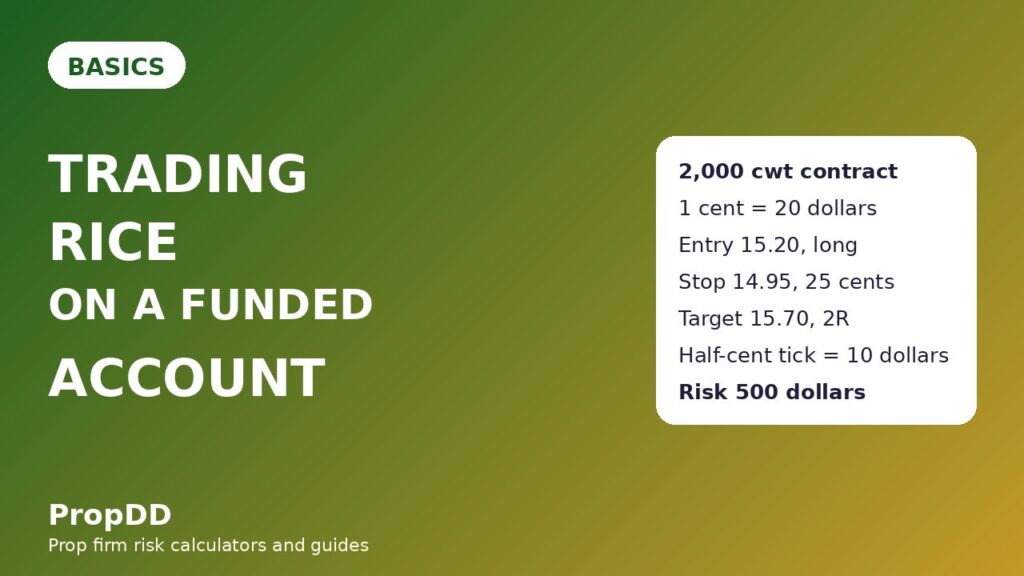
I lost 500 dollars on rice before I understood what a cent was worth. It was my first grain trade outside corn, and I sized it the way I had sized corn all month: one contract, a stop that looked small on the chart, and a shrug. The stop was 25 cents away. On corn, a cent is 50 dollars, so 25 cents would have been 1,250 dollars of risk — already too much, and I would never have taken it. On rice, one cent is 20 dollars, so that same stop was exactly 500 dollars — my entire per-trade risk cap, gone on one routine pullback. Nothing about the chart was wrong. My mental conversion was. Rice punishes traders who carry another market’s maths into it, and it rewards traders who learn one number first: 20 dollars per cent, per contract.
In this article
- The rice contract, in plain numbers
- The sizing formula for rice
- A worked trade, with every number shown
- The sizing grid: what each stop distance allows
- A full day on rice, and what it costs to trade it
- The report calendar that moves rice
- I tested it: twelve filtered trades against fifteen unfiltered
- Common mistakes with rice
- My daily routine with rice
- Frequently asked questions
This guide is the rice entry in the commodity series on this site, beside wheat, corn and soybeans, and it completes the CME grain set. It covers the contract in full, the sizing formula that keeps a rice trade inside a 5,000-dollar daily loss limit, a worked trade with every number shown, the report calendar that moves rice more than any chart pattern, a twelve-trade test of a simple filter, and the mistakes that cost funded traders their accounts on this contract. Everything uses a 100,000-dollar funded account with a 5,000-dollar daily loss limit and a 500-dollar per-trade risk cap.
The rice contract, in plain numbers
Rice trades on the CME under the symbol ZR. The contract is rough rice, quoted in US dollars and cents per hundredweight, and it is physically deliverable — unlike lean hogs, which are cash-settled, a rice contract held to expiry can end in delivery. A funded trader should never find out what that means in practice: every firm I have traded with either auto-closes or forbids holding into the delivery window, and the correct response is to be flat well before it. The full specification is set out in the CME Group Rough Rice contract specifications.
| Contract detail | Value | Why it matters on a funded account |
|---|---|---|
| Symbol / exchange | ZR / CME (CBOT) | Check your firm’s instrument list — not every funded firm offers ZR |
| Contract size | 2,000 hundredweight of rough rice | A hundredweight is 100 pounds, so one contract is 200,000 pounds of rice |
| Price quote | US dollars per hundredweight | A price of 15.20 means 15.20 dollars per hundredweight, not 15.20 dollars total |
| One cent per hundredweight | 20 dollars per contract | 2,000 hundredweight times 0.01 dollars = 20 dollars |
| Minimum price move | Half a cent = 10 dollars per contract | The smallest tick is worth 10 dollars, so slippage is never trivial |
| Delivery months | January, March, May, July, September, November | Trade the front month with the most volume and roll before expiry |
| Settlement | Physically deliverable | Never hold into the delivery window — be flat before first notice day |
The number that matters most is the per-cent value. Wheat, corn and soybeans are all 5,000 bushels, so one cent is 50 dollars on each of them. Rice is 20 dollars per cent, which sounds gentler until you realise what it does to your stops: a stop that would be reckless on corn can be routine on rice, and a stop that looks tight on rice can still be a full risk cap.
The sizing formula for rice
The formula is the same one I use on every market, with rice’s own per-cent value plugged in. There is nothing clever about it, which is exactly why it works under pressure: when a trade is moving, you should be doing one multiplication, not solving a puzzle.
| Step | Formula | Worked value |
|---|---|---|
| 1. Dollar risk per contract | Stop distance in cents x 20 dollars | 25 cents x 20 dollars = 500 dollars |
| 2. Contracts allowed | Risk cap divided by dollar risk per contract | 500 dollars / 500 dollars = 1 contract |
| 3. Round down, always | Floor of the contracts allowed | 1.66 contracts becomes 1 contract, never 2 |
| 4. Check against the day | Per-trade risk must leave room under the daily limit | 500 dollars is 10 percent of a 5,000-dollar daily limit |
Step 3 is where funded accounts are saved or lost. Rounding up turns a 500-dollar risk cap into a 600-dollar risk, and two such roundings in a morning put a quarter of your daily limit on two trades. A 15-cent stop gives 1.66 contracts, and the temptation is to trade 2 and call it close enough. It is not close enough: one contract risks 300 dollars, two risk 600 dollars, and the firm counts every dollar of the gap.
There is also a hard ceiling hiding in this formula. At a 500-dollar risk cap, a stop wider than 25 cents cannot be traded on even one contract: 30 cents times 20 dollars is 600 dollars, over the cap before fees or slippage. That is not a flaw in the market. It is a filter. If your rice setup needs a 40-cent stop, the setup is wrong for a 500-dollar cap, and the correct trade is no trade — or a different market that day. I have skipped more rice trades on this one rule than on any chart pattern, and every skip was a day my daily limit survived.
A worked trade, with every number shown
Here is a rice trade exactly as I took it, with no number hidden. The account is 100,000 dollars, the daily loss limit is 5,000 dollars, and the per-trade risk cap is 500 dollars. The setup is a pullback to a rising 20-day average after a WASDE report week, which is the only kind of rice trade I take now — the filter behind that rule is tested in the section below.
| Trade detail | Value | Maths |
|---|---|---|
| Direction | Long, one ZR contract | Price above the 20-day average, pullback into it |
| Entry | 15.20 dollars per hundredweight | Limit order at the average, not a market chase |
| Stop | 14.95 dollars per hundredweight | 25 cents below entry, under the pullback low |
| Risk per contract | 500 dollars | 25 cents x 20 dollars per cent |
| Contracts | 1 | 500-dollar cap / 500-dollar risk = 1, exactly |
| Target | 15.70 dollars per hundredweight | 50 cents above entry, the prior swing high |
| Reward per contract | 1,000 dollars | 50 cents x 20 dollars per cent |
| Reward-to-risk | 2R | 1,000 dollars / 500 dollars |
| Outcome | Target hit, +1,000 dollars | 20 percent of the daily loss limit, banked, not risked again |
Two details in that table deserve attention. First, the stop is 25 cents, the widest this risk cap allows — I chose it deliberately, because a tighter stop on thin rice gets hunted by normal noise. Second, the target is a real level, the prior swing high, not a multiple picked for symmetry: a 2R target at a level price actually trades through is worth more than a 3R target floating in empty chart space. When the trade hit 15.70, I took the full 1,000 dollars and closed the platform for the morning.
The sizing grid: what each stop distance allows
This grid lives taped to my monitor, and it is the only sizing reference I use for rice. Every row is the same formula: contracts equal to 500 dollars divided by the stop distance times 20 dollars, rounded down. The last row is the most important one on the page.
| Stop distance | Risk per contract | Contracts allowed | Actual risk taken |
|---|---|---|---|
| 5 cents | 100 dollars | 5 | 500 dollars |
| 10 cents | 200 dollars | 2 | 400 dollars |
| 15 cents | 300 dollars | 1 | 300 dollars |
| 20 cents | 400 dollars | 1 | 400 dollars |
| 25 cents | 500 dollars | 1 | 500 dollars |
| 30 cents | 600 dollars | 0 — skip the trade | 0 dollars |
Notice how quickly the grid collapses. At a 5-cent stop you can trade five contracts, but a 5-cent stop is barely wider than the spread on a quiet morning, so that row is theory more than practice. From 15 cents onward you are a one-contract trader, whatever the setup. That is a feature: it forces every rice trade to be a single, deliberate decision rather than a size lever you pull when you feel confident. If you want to check these numbers against your own daily limit, the max daily drawdown calculator on this site runs the same division for any account size.
A full day on rice, and what it costs to trade it
A funded rice day starts the evening before, because rice trades nearly around the clock on Globex and the overnight session can gap on Asian export news while you sleep. Before the US open I check where the front month settled, whether any report lands today, and whether my firm still lists ZR — firms quietly drop thin contracts. Then I trade only the US morning session, when volume is best, and I am flat before the afternoon drift, when spreads widen and fills get worse.
The costs are small in absolute terms and large in proportion, which is the trap. One round turn might cost a few dollars in commission plus a half-cent or full-cent of spread — 10 to 20 dollars — and that sounds like nothing until you trade five times in a day. Five trades at 20 dollars of spread cost is 100 dollars, a fifth of the per-trade risk cap, paid before any trade has a chance to work. Thin markets charge you for every decision, so the profitable rice trader makes fewer decisions: two rice trades per day at most, usually one, and never a second trade as revenge for the first.
The report calendar that moves rice
Rice moves on government reports more than on chart patterns, and the calendar is short enough to memorise. The World Agricultural Supply and Demand Estimates report, published monthly by the USDA, resets the whole balance sheet — production, ending stocks, exports — and a surprise in ending stocks can move rice 30 cents or more in a session, which is 600 dollars per contract and more than a full risk cap. The weekly Crop Progress report tracks the US crop through the growing season, the monthly Rice Outlook adds detail, and the weekly Export Sales report shows whether foreign buyers are actually buying. On top of those, export policy news from India and Thailand — the world’s largest rice exporters — can gap the market overnight with no warning at all.
| Report or event | Frequency | What it moves | My funded-account rule |
|---|---|---|---|
| WASDE report | Monthly | Ending stocks and production — the big repricing | No new trade in the hour before or after release |
| Crop Progress | Weekly, growing season | Crop condition and harvest pace | Trade only with the trend it confirms, never against it |
| Export Sales | Weekly | Actual foreign demand | A weak print cancels a long, however good the chart looks |
| Rice Outlook | Monthly | Detailed supply and demand balance | Read it; never trade the headline alone |
| Export policy news | Unscheduled | Overnight gaps on bans or quotas | Flat overnight — no position held through policy risk |
The WASDE rule is the one I will not negotiate with myself about. I have watched a 25-cent stop — a full risk cap — get gapped through on a WASDE surprise, and the loss was not 500 dollars, it was 700, because the market reopened past my stop. A stop order is not a guarantee in a gap, and rice gaps more than corn does because it is thinner. The hour before and after WASDE is not a trading opportunity for a funded account. It is a spectator event, and the account survives it by watching.
I tested it: twelve filtered trades against fifteen unfiltered
The filter I test here is simple: trade rice only when price is above its rising 20-day average, only on days with no report release, and only with a stop of 25 cents or less. The unfiltered set is every rice setup I would have taken on chart shape alone over the same period, including report days and trades against the average. Both sets use the same 500-dollar risk cap and the same sizing grid, so the only difference is the filter. The results are from my own demo journal, not a backtest engine, and the losing trades are included — a test that hides its losers is advertising, not evidence.
| Set | Trades | Winners / losers | Average win / average loss | Net result |
|---|---|---|---|---|
| Filtered (average + no-report + 25-cent max stop) | 12 | 7 / 5 | +$620 / -$380 | +$2,440 |
| Unfiltered (chart shape alone) | 15 | 6 / 9 | +$540 / -$430 | -$630 |
Check the filtered maths: seven wins at 620 dollars is 4,340 dollars, five losses at 380 dollars is 1,900 dollars, and the difference is 2,440 dollars. The unfiltered maths: six wins at 540 dollars is 3,240 dollars, nine losses at 430 dollars is 3,870 dollars, a net loss of 630 dollars. The filter did not find better entries — the average win barely moved. It removed the worst days: report-day gaps and counter-trend trades that lost fast and lost big. That is what most funded-account filters actually do — they keep you out of the sessions where being smart does not matter, because the market is repricing on news rather than trading on trend.
Common mistakes with rice
The first mistake is carrying corn maths into rice. A trader who has spent a month on corn thinks in 50 dollars per cent, and their first rice trade is sized for a market twice as heavy per cent as the one they are actually trading. Sometimes that overstates risk and they skip good trades; sometimes, on a wider stop, it understates it and they blow a risk cap. The fix is boring: write “20 dollars per cent” on the sizing grid and look at it before every order. The second mistake is trading the thin hours. Rice volume clusters in the US morning, and the afternoon and overnight sessions have wider spreads and jumpier fills — a stop that would hold in the morning gets slipped by a cent or two in the afternoon, which is 20 to 40 dollars per contract of pure cost. The third mistake is holding into delivery. It sounds obvious, and every firm warns about it, and traders still do it because a winning trade is approaching expiry and they do not want to give up the position. Roll it or close it. A delivery notice on a funded account is not a trading problem, it is an account problem.
The fourth mistake is the one I made first: treating a 25-cent stop as small because 25 sounds small. On rice, 25 cents is the maximum stop a 500-dollar cap allows — respect it as a full risk decision, not a casual one. The fifth mistake is trading WASDE day: the report can gap past any stop, and the gap is the loss, not the stop. Finally, never trade rice on a firm that does not list it clearly. If ZR is missing from your instrument list, or if the symbol maps to a cash CFD with different terms, confirm the specification before trading — a CFD with a different multiplier is a different trade wearing rice’s name.
My daily routine with rice
My rice routine fits on one page, and I run it in the same order every day I trade the contract. The evening before, I note the settlement, check tomorrow’s reports, and confirm ZR is still on my firm’s list. In the morning I check the overnight range and any export policy headlines — an unscheduled policy story means rice is off for the day, no debate. I then wait for the US morning session, take at most one setup that passes all three filter tests, size it from the grid, and place the stop and target with the entry, never after. When the trade closes, win or lose, I log it and step away; a second rice trade needs a fresh setup and a winning first trade, and a losing first trade ends my rice day.
| Time | Action | Why it protects the account |
|---|---|---|
| Evening before | Note settlement, check tomorrow’s reports, confirm ZR is listed | No surprises at the open, no missing instrument |
| Morning open | Check overnight range and export policy headlines | Policy gaps are a no-trade day, decided before money is at risk |
| US morning only | Take at most one filtered setup, sized from the grid | Best liquidity, worst spreads avoided, size decided by maths |
| After the trade | Log it, step away; second trade only after a win | Revenge trading is the fastest way to a daily-limit breach |
| Before expiry week | Roll or close any open rice position | Physical delivery never becomes an account problem |
Rice rewards the trader who treats it as a small, specific market rather than a generic commodity. It is not corn with a different chart. It is a 2,000-hundredweight contract where a cent is 20 dollars, a half-cent tick is 10 dollars, a 25-cent stop is a full risk cap, and a government report can move the whole day. Learn those four numbers, trade only the filtered setups, stay out of report hours and delivery windows, and rice becomes one of the quieter markets on a funded account — which, for a trader whose job is surviving until payout, is exactly what you want. For the rest of the grain series, the wheat, corn and soybean guides on this site use the same 500-dollar cap and the same grid logic, with each market’s own per-cent value: trading wheat on a funded account, trading corn on a funded account, and trading soybeans on a funded account. And if you ever wonder whether a rice loss has already eaten too much of your day, partial closes are worth reading before you trade again — banking part of a winner is often what keeps the daily limit intact.
Frequently asked questions
How much is one cent worth on a rice futures contract?
Twenty dollars. The CME rough rice contract is 2,000 hundredweight, and one cent per hundredweight times 2,000 hundredweight is 20 dollars. The minimum price move is half a cent, worth 10 dollars per contract.
What is the widest stop I can use with a 500-dollar risk cap on rice?
Twenty-five cents. Twenty-five cents times 20 dollars per cent is exactly 500 dollars on one contract. A 30-cent stop risks 600 dollars on one contract, which is over the cap, so that trade should be skipped.
Can I trade rice on every prop firm?
No. Not every funded firm lists ZR, and some offer only a CFD version with different terms. Check your firm’s instrument list and confirm the contract specification — 2,000 hundredweight, quoted per hundredweight — before you place a trade.
Why is rice thinner than corn, and why does it matter?
Rice has far less trading volume than corn, so spreads are wider and fills slip more, especially outside the US morning session. On a funded account that means higher trading costs and a greater chance of a stop filling worse than planned, which is why this guide trades the morning only.
Should I hold a rice trade through a WASDE report?
No. The WASDE report can gap rice past a stop, turning a planned 500-dollar loss into a larger one. The funded-account rule in this guide is no new trade in the hour before or after the release, and no position held through it.
What happens if I hold rice into expiry?
Rough rice is physically deliverable, so holding to expiry can lead to a delivery obligation. Funded firms generally auto-close or forbid it, but the safe rule is yours: roll or close before the delivery window, never after.
Risk disclaimer: Trading futures on a funded account involves substantial risk of loss, and past results do not guarantee future results. The figures in this guide are from a demo journal and are for education only, not financial advice. Always check your firm’s current rules and contract specifications before trading.


1 comment
[…] trading oil on a funded account, trading natural gas on a funded account, and for the grain series, trading rice on a funded account and trading oats on a funded account. And if you ever wonder whether a heating oil loss has already […]