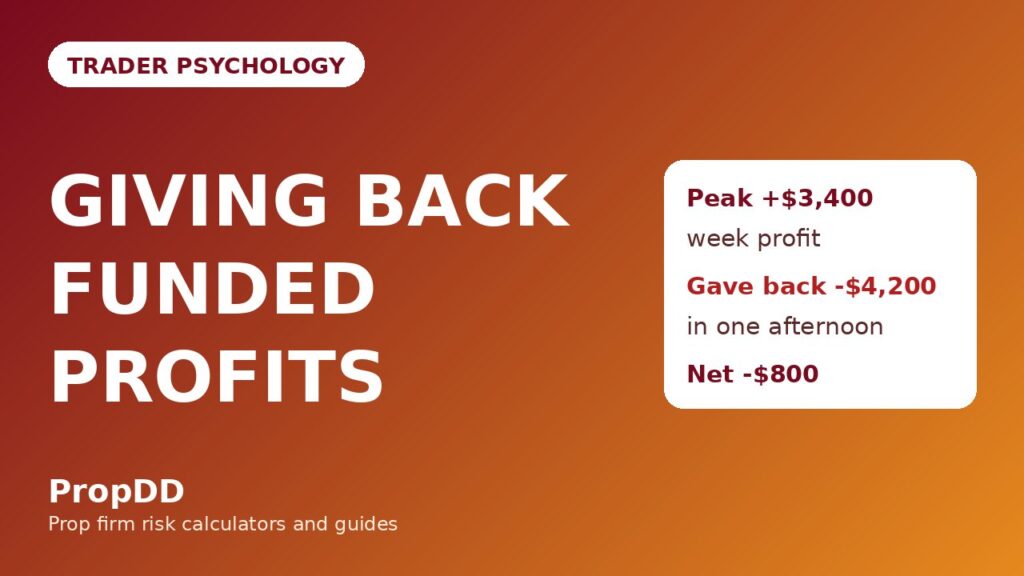
Tuesday started with my funded account 3,400 dollars up for the week. By one in the afternoon I felt untouchable. I had read the London session perfectly, my entries had been clean, and every decision had worked. Then I gave it all back before the New York close, and then I gave back 800 dollars more that was never profit at all. The week ended 800 dollars red, and the worst part was that none of the four losing trades was a bad setup. They were good setups traded with a brain that had stopped respecting risk.
In this article
- Why a winning streak changes your brain
- The give-back maths: three trades erase a week
- The five give-back traps I kept falling into
- My lock-in rules: the profit floor and the daily cap
- I tested it: two weeks, same strategy, different rules
- The payout-protection routine
- When locking in goes wrong
- Frequently asked questions
That afternoon taught me something the losing-streak articles never cover. Losing streaks hurt, but they also make you careful. Winning streaks do the opposite. They quietly convince you that the rules were holding you back, that your edge is bigger than it is, and that one bigger trade is a reasonable reward for a good week. On a funded account, where the daily loss limit turns a bad afternoon into a terminated account, that feeling is the most expensive emotion in trading.
This article explains why funded traders give back their profits, the maths of how three oversized trades erase a week of good work, the five traps I kept falling into, and the lock-in rules that stopped my give-backs. If you have ever watched a green week turn red and wondered what happened, this is the article I wish I had read before that Tuesday.
Why a winning streak changes your brain
A winning streak does not change the market. It changes the trader. After several wins in a row, three quiet shifts happen, and they happen to disciplined traders too. First, confidence inflates: recent wins feel like evidence of skill, even when they are partly luck, so the next trade feels safer than it is. Second, the money stops feeling real: profits sitting in the account feel like house money, and losing house money hurts less than losing your own, so stops get wider and sizes get bigger. Third, patience evaporates: when every recent trade has worked, waiting for the next clean setup feels like leaving money on the table, so marginal setups start looking good enough.
Psychologists call the second shift the house-money effect: people take bigger risks with money they have just won than with money they started with. On a funded account the effect is worse, because the money was never yours in the first place. It is the firm’s capital, and your brain files it under “free”. That is exactly backwards. On a funded account, unrealised profit is the only thing standing between you and the payout you actually want, and every dollar of it deserves more protection than the starting balance, not less.
The Larsa Capital guide on funded-account win streaks describes the same pattern: winning streaks trigger overconfidence, traders start to feel invincible, and they ignore risk rules or increase lot sizes impulsively. The guide’s advice matches what I learned the hard way: review your strategy, not your equity curve, and keep following the structured plan even after consistent profits. A winning streak is not a reason to change anything. It is a reason to change nothing.
The give-back maths: three trades erase a week
The give-back is so shocking because the maths is so uneven. Good weeks are built from many small wins. Give-backs are built from a few large losses. On my 100,000 dollar account, my base risk was 500 dollars per trade, which is 0.5 percent. My personal daily stop was 2,500 dollars, half the firm’s 5,000 dollar daily loss limit. Those numbers held all week, and then they did not.
| Give-back maths | Amount | Share of the daily limit |
|---|---|---|
| Week peak profit before Tuesday afternoon | +$3,400 | – |
| Trade 1: doubled size, stopped out | -$900 | 18% of the $5,000 limit |
| Trade 2: chased entry, no patience | -$1,400 | 28% of the $5,000 limit |
| Trade 3: moved stop, hoped for recovery | -$1,100 | 22% of the $5,000 limit |
| Trade 4: revenge trade after the give-back | -$800 | 16% of the $5,000 limit |
| Total given back in one afternoon | -$4,200 | 84% of the $5,000 limit |
| Week net after the give-back | -$800 | Give-back ratio: 124% of peak profit |
The formula that matters is simple. Net kept equals peak profit minus give-back, and the give-back ratio equals give-back divided by peak profit, times one hundred. My ratio that week was 124 percent, which means I returned every dollar of profit and then lost 800 dollars of the starting balance on top. Three oversized trades did what ten disciplined trades had built, and the fourth trade, the revenge trade, is what turned a flat week into a red one. If you run your own numbers through the max daily drawdown calculator, you will see the same shape: a handful of trades at double size consumes most of a daily limit, while a full week of base-size trades barely moves it.
The five give-back traps I kept falling into
After that Tuesday I went back through my journal and found the same five traps in every give-back week I had ever had. They never arrived labelled. They arrived looking like reasonable decisions.
| Give-back trap | What it looks like | What it costs |
|---|---|---|
| Doubling size after wins | “I am hot, so 1.0 lot becomes 2.0 lots” | One loss erases two wins instead of one |
| Chasing the next setup | Entering late because the last three entries worked | Worse price, wider stop, same risk, lower reward |
| Moving the stop to “give it room” | Widening a stop mid-trade instead of accepting the loss | Turns a planned 500 dollar loss into a 1,100 dollar loss |
| Trading past the daily profit peak | Staying at the screen after a great morning, hunting for more | Afternoon trades with tired judgement and no edge |
| The revenge trade | One more trade to “get the week back to green” | Converts a flat week into a red week, every time |
The trap that surprised me most was the fourth one. My best mornings were followed by my worst afternoons, not because the market changed, but because I changed. After a profitable morning I was mentally spent and emotionally high at the same time, which is the worst combination for judgement. The trades I took after lunch were not my strategy. They were my ego looking for an encore. The losing-streak article I wrote earlier covers the mirror image: after losses, traders tighten up and revenge-trade. After wins, traders loosen up and encore-trade. Both end in the same place.
My lock-in rules: the profit floor and the daily cap
The fix was not willpower. Willpower fails at exactly the moment you need it, which is after a win, when you feel you do not need it. The fix was rules that trigger automatically, written down before the session, so the decision is already made when the emotion arrives.
| Lock-in rule | My setting | Why it works |
|---|---|---|
| Profit floor | Lock 50% of the day’s peak profit | Once the floor is set, the day cannot go red from that peak |
| Daily profit cap | Stop trading at +$2,000 on the day | Protects the win from the encore-trade trap |
| Size freeze after wins | Never increase size mid-day, whatever the run | Kills the doubling-size trap at its root |
| Two-loss rule | After two consecutive losses, session over | Stops the revenge chain before it starts |
| Stop-loss immovable | A stop set at entry is never widened | Caps every loss at the planned 500 dollars |
The profit floor is the rule that changed everything. If the day peaks at 2,000 dollars of profit, the floor is 1,000 dollars: I am allowed to give back half, and no more. When equity touches the floor, I close everything and stop. It feels strange to stop on a green day, and that is the point. The floor turns “protect the win” from a feeling into a number. The daily profit cap works the same way from the other side: at 2,000 dollars I stop trading for the day, bank the win, and go and do something else. A capped green day beats an uncapped green day that turns red, and it also keeps my best day small enough to stay inside the firm’s consistency rule, which punishes one giant day the same way it punishes one giant loss.
I tested it: two weeks, same strategy, different rules
I ran the same strategy for two weeks, the first without lock-in rules and the second with them. The market did not cooperate by being identical, so this is not a laboratory test, but the shape of the two weeks is the whole lesson.
| Measure | Week 1: no lock-in rules | Week 2: lock-in rules on |
|---|---|---|
| Peak profit during the week | +$3,400 | +$3,100 |
| Profit given back | -$4,200 | -$600 |
| Give-back ratio | 124% of peak profit | 19% of peak profit |
| Week net result | -$800 | +$2,500 |
| Worst single afternoon | -$4,200 (84% of daily limit) | -$600 (12% of daily limit) |
| Trades taken after the daily peak | 4 (all losers) | 0 (session closed at the floor) |
Week 2 did not make more gross profit. It made slightly less at peak, 3,100 dollars against 3,400. It kept 2,500 dollars of it, while week 1 kept less than nothing. The difference between the two weeks was 3,300 dollars, and it came entirely from trades that week 2 never took. That is the part traders miss about give-backs: the money is not lost by bad trading. It is lost by extra trading. The lock-in rules did not improve my entries. They removed my encore.
The payout-protection routine
Lock-in rules protect a day. The payout-protection routine protects the payout, which is the only profit that actually pays you. Funded profit that sits in the account is not income yet. It becomes income when you request it and the firm pays it, and anything that happens between now and that request can still take it away. So my routine treats every week as a countdown to the next payout request, not as an open-ended score.
| Routine step | When | Detail |
|---|---|---|
| Set the day’s floor and cap | Before the first trade | Floor at 50% of expected peak, cap at +$2,000 |
| Check the drawdown buffer | Before the first trade | Keep a cushion between my stop and the firm’s limit, per my drawdown buffer plan |
| Close at the cap or the floor | Whichever comes first | No “one more trade” exceptions, ever |
| Log the give-back ratio | End of session | Peak, given back, net, ratio — four numbers, every day |
| Request payout at the threshold | As soon as eligible | Profit in my bank beats profit in the account |
| Halve size after any payout | First session after payout | Resets the overconfidence that follows a win |
The last step is the one nobody talks about. A payout feels like proof that you have made it, and the session after a payout is the most dangerous session in funded trading, because the house-money effect doubles: you have just been paid, and the account still shows profit. Halving size for one session after a payout is my circuit breaker for that feeling. It costs almost nothing and it has saved me twice.
When locking in goes wrong
Lock-in rules have two failure modes, and I have hit both. The first is setting the cap too tight: a 500 dollar daily cap on a 100,000 dollar account meant I stopped on days when my strategy had more clean setups left, and my weekly profit fell enough that the consistency rule started flagging my small days instead. The cap has to leave room for a normal good day. Mine is 2,000 dollars, which is 2 percent of the account, and I arrived there by testing, not by guessing.
The second failure mode is treating the floor as a target: once I knew the floor was 50 percent of peak, I caught myself trading loosely up to the floor, as if giving back half was free. It is not free. It is half the day’s work. The floor is a fire exit, not a budget. The rule that fixed that was logging the give-back ratio every day and refusing to accept a ratio above 30 percent for two days running. A number on a page is harder to lie to than a feeling in your head, and that is why the routine includes it. If your ratio is climbing, your rules are not failing. Your discipline around them is, and that is a cheaper problem to fix than a blown account.
Frequently asked questions
Why do funded traders give back their profits?
Winning streaks trigger overconfidence and the house-money effect: recent wins feel like skill, profits feel like free money, and patience disappears. Traders increase size, chase late entries, widen stops, and trade past their peak, so a few large losses erase many small wins.
What is a profit floor on a funded account?
A profit floor locks a share of the day’s peak profit, usually 50 percent. If the day peaks at 2,000 dollars, the floor is 1,000 dollars: when equity touches the floor, you close everything and stop. The day stays green no matter what happens after the peak.
Should I stop trading after hitting a daily profit target?
Yes, if the target is part of a written plan. A daily profit cap, such as 2 percent of the account, protects the win from encore trades taken with tired judgement. It also keeps your best day modest, which helps with consistency rules that punish one oversized day.
How much of a daily loss limit does a give-back usually consume?
In my case, one afternoon consumed 84 percent of a 5,000 dollar daily limit. Three oversized trades at double size, plus one revenge trade, did what ten disciplined trades had built. That is the normal shape of a give-back: few trades, large size, most of the limit gone.
Does locking in profits hurt the consistency rule?
Done badly, it can: a cap set too tight produces many tiny days that look inconsistent against a normal day. Done well, it helps, because steady capped days are exactly what consistency rules reward. Set the cap at a normal good day for your strategy, not at a small one.
What is the first lock-in rule a new funded trader should adopt?
The immovable stop. Before any floor or cap, make one rule absolute: a stop set at entry is never widened. That single rule caps every loss at its planned size, and it removes the largest single give-back mechanism, the loss that grows because you refused to take it.
Risk disclaimer: Trading funded accounts involves substantial risk of loss, and past results, including the two weeks described here, do not predict future results. The lock-in rules in this article are personal risk controls, not a guarantee of profit or of keeping a funded account. Always trade within your firm’s current daily loss, drawdown, consistency and payout rules, and never risk money you cannot afford to lose.



6 comments
[…] McGinley line, the choppiness filter covers the flat-line problem from a different angle, and the give-back article explains why a quiet, filtered week beats a busy, profitable-looking one that ends red. Together […]
[…] five rules, one base risk: that is what keeps a good pattern from becoming an overtrading habit. My give-back-profits article covers what happens when the routine […]
[…] removed the round trip entirely. That is also why this habit pairs with the lock-in rules in my giving-back-profits article: both exist to stop a green day turning red, and a partial close is the trade-level version of a […]
[…] rest of the log: one setup a day, full size only at real levels, no doubling down after a loss. The give-back-profits trap is what happens when a winning log makes you feel […]
[…] half at TP1 on the good diamonds meant a single bad diamond could never undo a whole week, and giving back profits after a winning streak was the habit I had to break before diamonds worked at […]
[…] rather than a feeling I indulged. If you want the psychology behind why that patience matters, the giving back profits guide covers the win-streak trap that follows any payout-sized high, and the partial closes guide […]