I passed my first $50K evaluation feeling clever. Eighty-one percent of my trades had no stop loss attached at all — I managed everything with mental stops, and it worked beautifully right up until it didn’t. Two weeks into the funded account, GBPUSD ripped 40 pips through where my “mental stop” had been while I was making coffee. The trade closed at -$1,940, my daily loss limit was $2,500, and the firm froze my payout request for a compliance review. The reviewer’s verdict stung more than the loss: “no defined risk approach on file.” The payout was eventually released, but it arrived three weeks late and $900 lighter — the disputed trade’s profit had been struck from the record. That was the week I learned that “do prop firms require a stop loss?” is the wrong question. The right one is: which version of the rule are you actually trading under?
In this article
- The short answer: three buckets, not one rule
- Bucket 1: the firms that write it down
- Bucket 2: the silent enforcer — auto-liquidation
- Bucket 3: the payout-review trap
- The formula: your stop IS your risk
- I tested it: 8 trades with a hard stop vs 8 with a mental stop
- The 5 ways traders trip the stop-loss rules
- My stop routine on every funded trade
- How it fits prop firm rules
- Frequently asked questions
The short answer: three buckets, not one rule
Prop firms fall into three buckets on stop losses, and the bucket matters more than the answer:
| Bucket | What it means | Typical firms |
|---|---|---|
| 1. Written into the rulebook | A stop loss is mandatory on every trade, with a time window to place it | Apex Trader Funding, Ordane, HyroTrader, several PropFirmMatch-listed firms |
| 2. Not written, but enforced by the dashboard | No stop order required — but the platform auto-liquidates your positions the moment you touch the daily loss limit | Topstep, TradeDay, My Funded Futures |
| 3. Reviewed at payout time | No stop on the ticket, no auto-liquidation — until the risk team reviews your journal and finds “no defined risk approach” | Most firms that never mention stops anywhere in the terms |
Bucket 2 is where the confusion lives. Traders get auto-liquidated, assume the firm enforced a stop loss rule, and repeat that story online. It is not the same mechanism — and the difference costs money, because an auto-liquidation closes your whole book at market while a real stop closes one trade at your planned distance. A comparison of firm-by-firm rules at propfirmapp.com/learn/stop-loss walks through exactly which firms sit in which bucket.
Bucket 1: the firms that write it down
The strictest versions of this rule are genuinely strict, and they read like compliance documents because they are:
- Apex Trader Funding — every trade must carry a pending or mental stop, and trading “without a defined risk management approach” is prohibited outright. Two supporting clauses make it stick: you cannot use your full trailing threshold as an improvised stop, and you cannot pair a tiny profit target with an oversized stop (their example: a 5-tick target against a 150-tick stop will not pass review).
- Ordane — Rulebook v1.0, clause R-3: maximum risk per trade is 1.5% of current balance and a stop loss is mandatory at entry. Two maximum losses equal the 3% daily limit (R-2) — the pairing is the design, not an accident.
- HyroTrader — every position must have a hard stop on the order book within 5 minutes of opening. First violation: soft-breach warning. Second: the account is closed permanently. This rule applies in both evaluation and funded stages.
- Several PropFirmMatch-listed firms run a 2-minute variant: a stop must be added within 2 minutes of opening, and its absence counts as “infinite risk” by default — a hard breach.
Notice the pattern: where the rule is written, it comes with a time window (entry, 2 minutes, 5 minutes) and a consequence ladder (warning → payout cancelled → account closed). The firms are not asking you to be careful. They are asking to see the stop on the ticket.
Bucket 2: the silent enforcer — auto-liquidation
Most futures firms — Topstep, TradeDay, My Funded Futures — require no stop order at all. What they do instead is flatten your positions and cancel your orders the instant you hit the daily loss limit. That sounds like freedom, and in one sense it is: nobody checks your tickets. But three things make it a trap for traders who came from bucket 1 thinking:
| What you assume | What actually happens |
|---|---|
| “The firm will stop me out at a sensible level” | It stops you out at the daily limit — which on a $50K account is $2,000–$2,500, ten times a sensible single-trade risk |
| “Auto-liquidation is basically a stop loss” | A stop closes one trade at your planned distance; auto-liquidation closes your entire book at market, often with slippage, and cancels your working orders |
| “No stop rule means no stop needed” | Every losing trade now spends the full distance to the daily limit — two bad ideas in a row and the day is over |
My coffee-break trade was a bucket-2 account. The firm did exactly what it promised: nothing, until the limit. The -$1,940 was not a rule breach. It was the rule working as designed — on me. If you want the arithmetic of what a “let it run to the limit” day actually costs, my max daily vs max overall drawdown guide breaks the two limits apart with the numbers.
Bucket 3: the payout-review trap
This is the bucket nobody talks about, and it is the one that cost me $900. Some firms never mention stop losses in the rulebook, impose no auto-liquidation beyond the daily limit, and let you trade however you like — until you request a payout. Then the risk team opens your journal and asks a question no rulebook prepared you for: show us your defined risk approach.
Here is what “defined risk approach” means in practice, assembled from the firms that publish their review criteria:
- Every trade had a pre-planned exit distance before entry — a pending stop, a documented mental stop with a hard trigger, or a time-based exit rule.
- The risk per trade was consistent — not 0.5% on Monday and 4% on Friday when the target was close.
- No single trade risked the account’s survival — stops were never “the daily limit itself”.
Mental stops count at Apex — the rulebook says so explicitly. But “counts” means “reviewed”: the stop has to be real, consistent, and defensible in your journal, or the reviewer treats the winning trades as gambles and strikes them. My journal showed 81% of trades with no documented stop and risk swinging between 0.4% and 3.1%. I had no defence. The lesson: on bucket-3 firms, the stop loss rule exists — it is just written in the payout terms instead of the trading terms.
The formula: your stop IS your risk
Everything above collapses into one formula. A stop loss is not a safety accessory — it is the number that defines your risk before you click:
Risk per trade formula
Risk ($) = Stop distance (pips) × Pip value per lot × Lots
Lots = (Account balance × Risk %) ÷ (Stop distance × Pip value)
Example: ($50,000 × 0.01) ÷ (20 pips × $10) = $500 ÷ $200 = 2.5 mini lots… i.e. 0.25 standard lots
Without a stop distance, the second line cannot be computed — which means your position size is a guess and your “1% risk” is a slogan. That is exactly what the payout reviewer meant by “no defined risk approach”: if the stop distance is not written down before entry, the risk number in your journal is fiction. My position sizing guide works this formula through five account sizes if you want the full table.
I tested it: 8 trades with a hard stop vs 8 with a mental stop
After the payout fiasco I ran a two-week experiment on a $50K evaluation: week one, every trade carried a hard pending stop placed within 60 seconds of entry; week two, mental stops only, same strategy, same 0.5% risk per trade target, same EURUSD London session. I sized everything through the max daily drawdown calculator so the risk math stayed honest. The journal:
| Week | Trades | Avg planned risk | Avg actual loss on losers | Worst single loss | Week P&L |
|---|---|---|---|---|---|
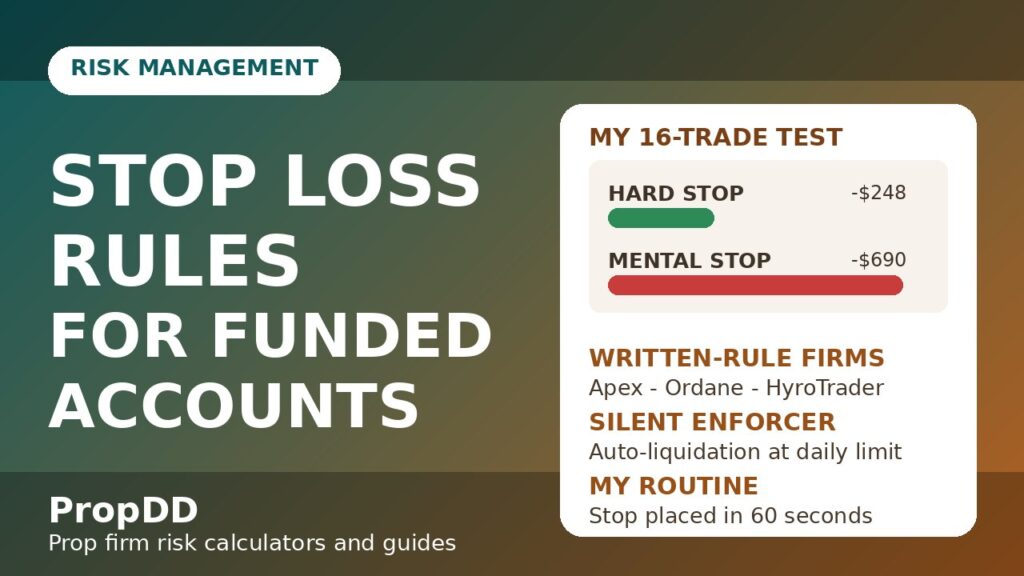
| Hard stop (week 1) | 8 (5W / 3L) | $250 | $248 | $250 | +$1,120 |
| Mental stop (week 2) | 8 (5W / 3L) | $250 | $411 | $690 | +$210 |
Same win rate. Same strategy. The mental-stop week leaked $483 of extra loss across three losers — an average slippage of 8 pips per losing trade between where I “meant” to exit and where my thumb actually clicked. The worst loser ran 2.8× the planned risk before I closed it, one hesitation at a time. The hard-stop week had zero slippage between plan and execution, because the decision was made before the trade existed. That is the entire argument for hard stops on a prop account in one table: the strategy did not change, the exits did.
For the risk framework behind the 0.5% number, see how much to risk per trade on a funded account — it is the same math I ran here.
The 5 ways traders trip the stop-loss rules
Across the three buckets, these are the failure modes I see in journals (including my own):
| Mistake | What happens | Which bucket punishes it |
|---|---|---|
| No stop at all, “I watch the screen” | One distraction = one limit-sized loss | 1 (hard breach) and 3 (payout review) |
| Moving the stop wider mid-trade | The “defined risk” becomes undefined; reviewers read it as no stop | 1 and 3 |
| Stop tighter than the noise (5 pips on GBPUSD) | Death by a thousand stop-outs; consistency rule flags the churn | 2 (you spend the day, not the account) |
| Using the daily limit as the stop | Two losses = day over; three = evaluation over | 2 — the silent killer |
| Mental stop with no journal entry | At payout review, an undocumented mental stop is a story, not a stop | 3 — the $900 lesson |
Mistake #2 deserves a special warning: several firms’ terms treat widening a stop as evidence of no risk plan, even where stops are not mandatory. The logic is simple — a stop that moves away from price is not managing risk, it is postponing the reckoning. If the trade needs a wider stop, the correct move is a smaller size at entry, not a bigger stop mid-trade.
My stop routine on every funded trade
This is the exact routine now — written, boring, and the reason my payouts clear without reviews:
| Step | The rule |
|---|---|
| 1 | Compute the stop distance from structure FIRST (beyond the swing, capped at 1.5 × ATR) |
| 2 | Size the position from the formula above at 0.5–1% risk — never the other way round |
| 3 | Place the pending stop within 60 seconds of entry (inside every firm’s 2–5 minute window) |
| 4 | Log the stop distance and risk $ in the journal before the trade can move |
| 5 | The stop may move toward profit (breakeven) — never away from entry |
| 6 | If two stops hit, the session ends — the personal daily stop takes over from here |
Step 4 is the one traders skip, and it is the one that would have saved my $900: a journal entry made before the trade moves is the only mental-stop evidence a reviewer accepts. Step 6 is the circuit breaker that keeps two normal losses from becoming the coffee-break trade. And if you are wondering why I never double the size after a stopped-out trade, the martingale maths shows what that path costs by step seven.
How it fits prop firm rules
| Prop firm rule | How a real stop complies |
|---|---|
| Max daily loss | Fixed 0.5–1% stops mean 5–10 losing trades to reach the limit, not 2 |
| Max overall drawdown | Capped single-trade risk keeps the equity curve out of the trailing floor |
| Consistency rule | Same risk on every trade — no outsized winner or desperate loser day |
| Payout review | Journaled stops = documented risk approach; nothing to strike |
| Prohibited practices | A real stop is the opposite of martingale/grid averaging-down behaviour |
The deeper point: a stop loss is the only rule that protects you from the other rules. The daily limit, the drawdown, the consistency clause — all of them are enforced on outcomes. The stop is the one input you control before the outcome exists. Firms that write it into the rulebook understood this; firms that review it at payout time understood it too, they just bill you for the lesson.
Frequently asked questions
Do prop firms require a stop loss?
Most do not write it into the rulebook — but some do (Apex, Ordane, HyroTrader, and several PropFirmMatch-listed firms, with 2–5 minute placement windows), most of the rest enforce risk through auto-liquidation at the daily loss limit, and nearly all review your risk approach before releasing payouts.
Can I use a mental stop instead of a pending order?
Where the rulebook allows it (Apex explicitly does), yes — but it must be documented in your journal before the trade moves, with a consistent risk percentage. An undocumented mental stop is a story, not a stop, at payout review.
What happens if I trade without a stop loss?
On written-rule firms: a warning, then a cancelled payout, then account closure. On auto-liquidation firms: nothing — until your whole book closes at the daily limit. On review-at-payout firms: your winning trades can be struck from the payout as “no defined risk approach”.
How far should my stop be on a prop firm account?
Beyond the structure that invalidates the trade idea, capped at about 1.5 × ATR(14) so the distance stays affordable at 0.5–1% risk. A stop inside the market’s normal noise just manufactures losing days.
Can I move my stop loss once the trade is running?
Toward profit, yes — trailing to breakeven is standard. Away from entry, no: widening a stop mid-trade reads as no risk plan, and on strict firms it is a breach in itself.
Does a stop loss protect me from the daily loss limit?
It is the only thing that does. With 0.5% risk per trade you need ten straight losers to touch a 5% daily limit; without stops, two distracted trades can do it. The limit is the wall — the stop is the distance you keep from it.
Risk disclaimer: trading involves substantial risk of loss and is not suitable for every investor. Prop firm evaluations are paid challenges on simulated capital, not investments — never pay a fee you cannot afford to lose, and treat every rule in this article as a starting point to verify against your own firm’s current rulebook.