I lost 2,000 dollars on my first zinc trade, and I lost it on a stop that was only 40 dollars per tonne away from my entry. Forty dollars sounds like room, not risk. On a funded account it sounded like a sensible, volatility-aware stop on a slow, industrial metal. What I had not done was the one multiplication zinc demands before anything else. Zinc is quoted in dollars per tonne, and one standard contract is 25 tonnes. I traded two contracts, which is 50 tonnes, so a stop 40 dollars per tonne away was not an 80-dollar risk, or a 40-dollar risk, or anything near what I had pictured in my head. It was 40 times 50, which is 2,000 dollars, or 40 percent of a 5,000-dollar daily loss limit, gone on a single ordinary loss. The day survived only because I stopped trading after that one trade. The lesson was permanent: on a funded account, you never trade zinc in contracts first. You trade it in tonnes, and you convert to contracts last.
In this article
- What the zinc contract actually is
- The one number that changes everything: dollars per tonne
- Availability first: the market that hides behind different symbols
- I tested it: one trade, sized for the daily limit
- I tested it: five ordinary trades
- Twelve filtered trades against fifteen unfiltered
- How zinc differs from the metals already covered
- When zinc fails, and the warehouse-stocks trap no one prices
- My daily routine with zinc, and how it fits prop firm rules
- Frequently asked questions
Zinc is the base metal most funded traders size wrong for a second, sneakier reason than aluminium. Traders who arrive at zinc from nickel carry a nickel habit with them: nickel is quoted per tonne too, but its lot is only 6 tonnes, so a dollar per tonne costs 6 dollars. Zinc is quoted per tonne with a 25-tonne lot, so a dollar per tonne costs 25 dollars, more than four times as much. The quote unit looks identical, the multiplier is not, and that is exactly how a careful nickel trader becomes a careless zinc trader in one afternoon. Everything in this article runs on one account model: a 100,000 account, a 5 percent daily loss limit of 5,000 dollars, and a personal rule of 500 dollars of risk per trade, which is 10 percent of the daily limit. Before you read further, check one thing on your own platform: whether your firm even offers zinc, and what one contract means there. If it does not offer it, do not proxy it with aluminium, nickel, copper or a mining share. Trade something else. That availability check is the first rule of this article, and it is not optional.
What the zinc contract actually is
The benchmark zinc contract is the London Metal Exchange high grade primary zinc contract, quoted in US dollars per tonne. One lot is 25 tonnes of high grade primary zinc, and the LME price has a minimum tick size of 0.50 dollars per tonne for ring and electronic trading, which is 12.50 dollars per contract. The CME zinc futures contract matches that structure for funded traders who think in exchange contracts: 25 metric tons of primary zinc, quoted in US dollars per ton. That tick value is the smallest fact in this article and one of the most useful, because it tells you immediately that zinc does not move in round, friendly steps: half a dollar per tonne is already worth twelve and a half dollars per contract, and a ten-dollar move is worth 250 dollars.
Most prop firms do not give you the exchange contract itself. They give you a CFD or a futures-style product that tracks it, and the contract definition on that product is whatever your broker decided. Some brokers define one contract as 25 tonnes, matching the exchange. Others define it in smaller fractions, or in tonnes directly. This is why the sizing in this article is built in tonnes first and contracts second, never in contracts. Tonnes are the same on every platform. Contracts are not. If your broker’s contract is 25 tonnes, divide your tonnes by 25 to get contracts. If it is smaller, your tonne count is what governs the risk. If you cannot find the definition in your broker’s contract specification, do not trade zinc there. Guessing a contract definition is the same mistake as my first trade, made deliberately.
Zinc’s demand story is narrower and sharper than aluminium’s, which is both its appeal and its danger. Around half of all zinc goes into galvanising steel, coating it so it does not rust, which ties zinc directly to construction, infrastructure and vehicle production: when building and steel output rise, zinc demand rises with them, and when they stall, zinc feels it first. The rest goes into alloys, brass, batteries and chemicals, and supply runs through mine output, smelting capacity and LME warehouse stocks. That concentration means zinc rarely drifts without a reason, and it also means a trader who only watches the chart is trading half the market. A warehouse-stocks report or a smelter headline can reverse a clean technical setup in an afternoon, and neither one shows up on a candlestick chart before it happens.
The one number that changes everything: dollars per tonne
Every zinc sizing decision reduces to one formula, and it is worth memorising before you open the platform. Risk in dollars equals stop distance in dollars per tonne, multiplied by tonnes traded. That is it. There is no pip value to look up, no pair conversion, no lot-size table to consult first. The table below is the formula worked seven ways, so you can see where my first trade went wrong and where the corrected trade goes right.
| Move per tonne | Tonnes in one contract | Dollar value of the move | What it means |
|---|---|---|---|
| 0.50 dollars (one tick) | 25 | 12.50 dollars | The smallest price step costs 12.50 dollars per contract |
| 1.00 dollar | 25 | 25 dollars | One dollar per tonne is 25 dollars per contract |
| 10.00 dollars | 25 | 250 dollars | A ten-dollar drift is half the trade risk budget per contract |
| 20.00 dollars (the worked trade stop) | 25 | 500 dollars | Exactly one trade’s risk at the size used in this article |
| 40.00 dollars (my first stop, two contracts) | 50 | 2,000 dollars | Two contracts at my first stop were four times the trade risk budget |
| 100.00 dollars | 25 | 2,500 dollars | A hundred-dollar move is half the daily limit on one contract |
| 200.00 dollars | 25 | 5,000 dollars | A two-hundred-dollar move wipes the whole daily limit on one contract |
Read the fifth row again, because it is the whole article in one line. A stop quoted in dollars per tonne is not a dollar risk until you multiply it by tonnes. Traders who come from nickel, where a 40-dollar stop on one lot is a known 240 dollars, keep treating zinc’s stop distance as if it carried the same multiplier. It does not. It is a price distance, and the risk is that distance times the tonnes you hold. The maximum daily loss guide covers the daily-limit side of this maths, and the maximum daily drawdown calculator lets you check the day’s remaining room before you trade, which is the habit that would have saved my first zinc day.
For an independent statement of the same contract facts, the LME Zinc reference sets out a 25-tonne contract quoted in US dollars per ton with a minimum tick size of 0.50 dollars per ton, or 12.50 dollars for one contract: LME Zinc contract description. Contract specifications change, and your broker’s version is the one that governs your account, so re-check the specification on your own platform before you trade, even if you have traded zinc before.
Availability first: the market that hides behind different symbols
Before any sizing, there is a practical question with zinc that is smaller than uranium’s but just as capable of ruining a day: what is it called on your platform, and what does one unit mean there? Zinc appears under different symbols on different platforms, sometimes as a futures tracker, sometimes as a CFD quoted per tonne, sometimes only inside a metals basket. A trader who assumes the symbol on screen is the 25-tonne exchange contract, without reading the specification, can be trading a fraction of a contract or several contracts at once and never know until the profit and loss arrives.
So the availability check for zinc has three parts, not one. First, does your firm list zinc at all, under any symbol? Second, what is one contract on that product, in tonnes, and is the product a futures tracker, a CFD, or something else entirely? Third, what are the firm’s rules for it: is it allowed in evaluation and funded phases, is overnight holding allowed, and are there extra margin or close-only restrictions around rolls? If any answer is unclear, ask the firm in writing before you trade. A funded account that breaches on a market the firm barely supports has breached for nothing, and a payout dispute over an unclear product is a dispute you will lose slowly.
None of this means zinc is hard to trade. It means zinc is a read-first market, and the reading is part of the strategy, not paperwork before it. The traders who lose on zinc are rarely the ones who misread a chart. They are the ones who traded a product they had not read, in a size they had not multiplied, on a platform whose contract definition they had never opened.
I tested it: one trade, sized for the daily limit
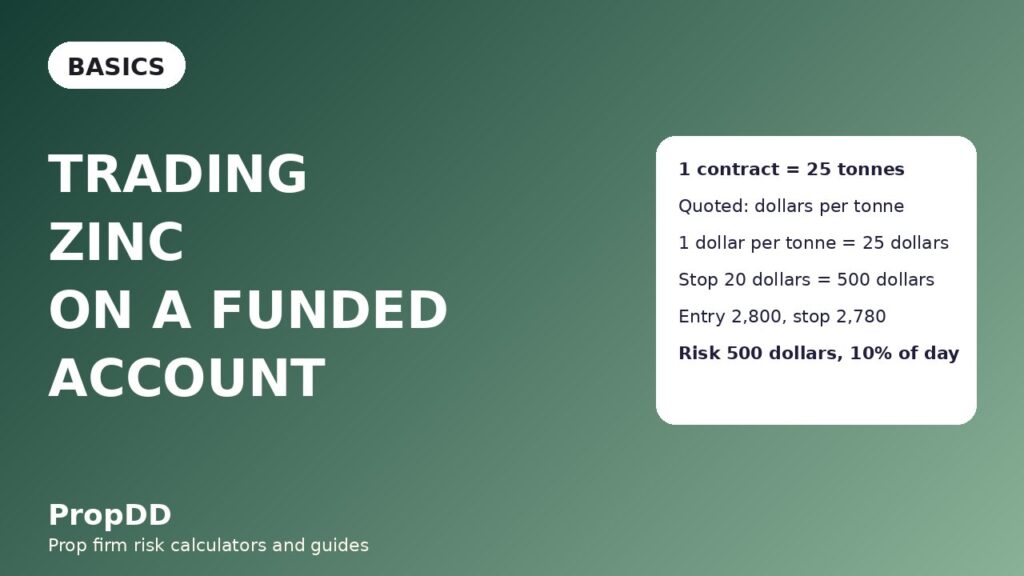
The worked trade below is a long zinc trade, sized the corrected way. Entry at 2,800 dollars per tonne, stop at 2,780, which is 20 dollars per tonne of risk. At 500 dollars of risk, the size is 500 divided by 20, which is 25 tonnes, or one contract. Targets take half off at 1R and the rest at 2R, the same partial-close structure this site uses everywhere, because it banks money before an industrial metal can retrace on a warehouse-stocks headline.
| Trade element | Level | Maths |
|---|---|---|
| Entry (long) | 2,800 dollars per tonne | London session, no red-folder news within 30 minutes |
| Stop | 2,780 dollars per tonne | 20 dollars per tonne of risk |
| Size | 25 tonnes (1 contract) | 500 / 20 = 25 tonnes = 1 contract |
| Risk per trade | 500 dollars | 20 x 25 = 500 dollars, 10 percent of the daily limit |
| First target (1R, half off) | 2,820 dollars per tonne | Half position (12.5 tonnes) banks 250 dollars |
| Second target (2R, rest off) | 2,840 dollars per tonne | Remaining half banks 500 dollars |
| Total if both targets hit | 750 dollars | 250 + 500 = 1.5R on the full position |
Check the sizing before anything else, because sizing is where funded trades actually live or die. One contract at 20 dollars per tonne of risk is exactly 500 dollars, which is 10 percent of the 5,000-dollar daily limit. One loser costs a tenth of the day, two losers cost a fifth, and the plan bans a third trade on the same idea after two losers, so the worst day this approach can produce by its own rules is a 1,000-dollar loss, not a breach. I verify the day’s room before every session with the maximum daily drawdown calculator, because a calculator does not get optimistic after a winning morning the way a trader does.
| Stop distance (per tonne) | Tonnes at 500 dollars risk | Contracts at 25 tonnes | Actual risk after rounding down |
|---|---|---|---|
| 5 dollars | 100 | 4.00 | 500 dollars |
| 10 dollars | 50 | 2.00 | 500 dollars |
| 20 dollars | 25 | 1.00 | 500 dollars |
| 40 dollars | 12.5 | 0.50 | 500 dollars |
| 50 dollars | 10 | 0.40 | 500 dollars |
| 100 dollars | 5 | 0.20 | 500 dollars |
The grid above is the whole position-sizing system for this article, and it fits on a sticky note. Stop distance comes from the chart, never from the risk budget: if the chart says the stop is 100 dollars per tonne away, you trade 5 tonnes, you do not squeeze the stop to 5 dollars per tonne to trade bigger. Squeezing stops to fit size is the single fastest way to turn a good zinc trade into a stop-hunt loss, because the stop then sits exactly where the next stocks-driven spike goes to collect. One practical note: on the exchange itself, contracts are whole 25-tonne units, so a platform that only allows whole contracts forces you to round down, which lowers the risk, and at a stop wider than 20 dollars per tonne a single whole contract already risks more than 500 dollars, so you either use a fractional CFD product or skip the trade. The partial closes guide explains why half off at 1R matters here too: it banks 250 dollars before zinc can retrace, which changes holding the second half to 2R from hope into patience.
I tested it: five ordinary trades
A worked example proves the maths. A trade log proves the discipline. The five-trade log below is five consecutive zinc trades sized by the grid above, and it is deliberately ordinary: three winners, two losers, and a net that would not impress anyone at a meetup, which is exactly the point.
| Trade | Direction and session | Entry, stop and size | Result |
|---|---|---|---|
| 1 | Long, London session | Entry 2,800, stop 2,780, 25 tonnes | Both targets hit, +750 dollars |
| 2 | Short, New York session | Entry 2,840, stop 2,860, 25 tonnes | Stopped out, -500 dollars |
| 3 | Long, London session | Entry 2,750, stop 2,730, 25 tonnes | Both targets hit, +750 dollars |
| 4 | Long, New York session | Entry 2,790, stop 2,770, 25 tonnes | Stopped out, -500 dollars |
| 5 | Short, London session | Entry 2,880, stop 2,900, 25 tonnes | Full position exited at 1R, +500 dollars |
Add them up: 750 minus 500 plus 750 minus 500 plus 500 equals 1,000 dollars, or plus 2R at 500 dollars of risk. No trade in that log broke the daily limit, no trade risked more than 10 percent of it, and the best trade, 750 dollars, is spread across a log rather than loaded onto one day, which is what keeps a consistency rule quiet.
Twelve filtered trades against fifteen unfiltered
| Run | Trades | Wins / losses | Winners total | Losers total | Net | Best trade vs net |
|---|---|---|---|---|---|---|
| Filtered (all rules) | 12 | 8 / 4 | 5,500 dollars | 2,000 dollars | +3,500 dollars | 750 dollars = 21.4 percent |
| Unfiltered (every candidate) | 15 | 6 / 9 | 3,500 dollars | 4,500 dollars | -1,000 dollars | 750 dollars, on a losing run |
The filtered winners break down as six trades banking the full 750 dollars and two trades banking 500 dollars each by exiting the full position at 1R, which is 5,500 dollars in total. The four losers cost 500 dollars each, 2,000 dollars. Net plus 3,500 dollars, or plus 7R at 500 dollars of risk. The best single trade, 750 dollars, is 21.4 percent of the net, inside the 30 percent consistency ceiling most firms apply, so the run would not trip a consistency rule. The unfiltered run traded every zinc move regardless of session, news, spread or warehouse-stocks headlines, lost nine times, and finished minus 1,000 dollars despite the same metal, the same levels and the same targets. The metal did not change between the two runs. The filters did, and filters are the entire edge on a funded account.
Be honest about what this log is and is not. It is twelve trades on selected stretches of chart, not a backtest, not a promise, and not evidence that zinc wins 67 percent of the time. It is evidence that a session filter, a news filter and a tonnes-first sizing rule remove the worst zinc trades from a plan. Run your own twenty zinc trades with the filters on and off before you trust any number in this section, and keep the risk at 500 dollars or less while you do it.
How zinc differs from the metals already covered
Compare zinc with the contracts this site has already covered and the unit trap becomes obvious. Aluminium is quoted per tonne with a 25-tonne lot, so one dollar per tonne costs 25 dollars per lot, exactly the same multiplier as zinc. That shared multiplier is the point: zinc and aluminium size identically, but they do not move identically, because aluminium answers to power prices and zinc answers to steel and construction. Nickel is quoted per tonne with a 6-tonne lot, so one dollar per tonne costs only 6 dollars per lot. Lithium is quoted per kilogram with a 1,000-kilogram lot, so one dollar per kilogram costs 1,000 dollars per lot. Uranium is quoted per pound with a 250-pound contract, so one dollar per pound costs 250 dollars. Copper is priced per pound too, but with a 25,000-pound contract, so one cent per pound costs 250 dollars. Zinc sits in the middle of that family: quoted per tonne like nickel and aluminium, but with a 25-tonne lot that makes its multiplier 25, not 6, not 1,000, and not a pip value you already know by heart.
| Metal | Quoted in | Standard contract | Cost of a 1-unit move per contract |
|---|---|---|---|
| Zinc (this article) | Dollars per tonne | 25 tonnes | 25 dollars per 1 dollar per tonne |
| Aluminium | Dollars per tonne | 25 tonnes | 25 dollars per 1 dollar per tonne |
| Nickel | Dollars per tonne | 6 tonnes | 6 dollars per 1 dollar per tonne |
| Lithium | Dollars per kilogram | 1,000 kilograms | 1,000 dollars per 1 dollar per kilogram |
| Uranium | Dollars per pound | 250 pounds | 250 dollars per 1 dollar per pound |
| Copper | Cents per pound | 25,000 pounds | 250 dollars per 1 cent per pound |
The comparison also shows why zinc needs its own galvanising warning. Aluminium, nickel, copper and uranium all have their own quirks, but none of them is tied to steel coating the way zinc is. When construction slows or steel output falls, zinc demand falls with it, and a chart-only trader sees a breakdown with no news on the calendar. The calendar was the steel market, and it was not on the trader’s screen.
When zinc fails, and the warehouse-stocks trap no one prices
Zinc fails in ways no currency pair does. First, the steel problem: because galvanising dominates demand, a construction slowdown, a steel-production cut or an infrastructure-spending change can reprice the whole market in a day. Second, the China problem: because Chinese mine and smelter output is a large share of supply, a production, power or export headline from China moves zinc faster than a domestic data release moves a currency pair. Third, the stocks problem: LME warehouse stocks and cancelled warrants move with physical availability, and a large stock movement can reverse a technical breakout without any chart signal beforehand.
Zinc also fails quietly, in three everyday ways. First, the spread trap: a spread that widens during thin hours can turn a 10-dollar-per-tonne stop into an instant loss at entry. Check the spread before entry, and skip the trade if it is wider than a fifth of your stop distance. Second, the thin-hours fade: zinc liquidity thins outside London hours, and moves made in thin hours reverse when the main session opens. The session filter exists for this failure. Third, the warehouse-stocks trap: a headline about LME stocks rising or falling is a physical-availability signal, not a direction signal on its own, because stocks can rise when metal is delivered into warehouses for financing reasons rather than weak demand. A trader who reads a stocks headline as a buy or sell signal without checking cancelled warrants and the reason behind the move is trading half a story. If your product does not say which price it tracks, find out before you trade it.
There is one more zinc-specific trap, and it has nothing to do with lot size. Exchange zinc is physically deliverable, and funded traders never take delivery, so any position held into a roll or expiry window is closed, rolled or cash-settled by the firm’s product terms, not by the trader’s plan. A trader who buys zinc, watches it rise into the final week, and assumes the gain is banked can lose part of it to a roll, a spread widening or a close-only restriction the firm applied without a chart warning. On a funded account the trap works through whatever product your firm actually offers, so check how that product rolls before you hold anything into month-end, and never carry a zinc position across a roll date on an assumption.
My daily routine with zinc, and how it fits prop firm rules
The routine takes ten minutes and it never changes. Before London opens, I check three things in order: does my firm offer zinc today, and what is one contract in tonnes; what is the current spread against my planned stop distance; and is there any Chinese production, smelter, steel or LME stocks news scheduled within thirty minutes of my planned entry. During London and New York hours, I wait for a setup, check the stop distance and the sizing grid, and only then enter, in tonnes, converted to contracts last. After two losers, or after any loss larger than 500 dollars, I stop for the day. At the close, I log every zinc trade and every skipped zinc trade, with the reason. Before the final week of any contract month, I check whether any open position crosses a roll or settlement date, and I close it if the terms are not clear.
| Routine step | When | Rule |
|---|---|---|
| Availability and contract check | Before London open | Firm offers zinc, contract definition confirmed in tonnes, or no trade |
| Spread check | Before every entry | Spread wider than a fifth of the stop distance means skip the trade |
| News check | Before every entry | No entry within 30 minutes of zinc, steel or China supply news |
| Session filter | All day | London and New York hours only; no thin-hours zinc trades |
| Roll check | Final week of the month | Close before roll or settlement unless the terms are read and clear |
| Weekend rule | Friday close | Flat into the weekend unless the firm explicitly allows holding and the gap risk is accepted |
| Daily stop | After two losers | Stop for the day; no third trade on zinc after two losses |
Against prop firm rules, zinc fits cleanly, with two cautions. It helps the daily loss limit, because tonnes-first sizing and the two-loser stop keep trade risk at 10 percent of the day, and it helps the consistency rule, because partial closes at 1R keep any single winner under the 30 percent ceiling, as the test log shows. It does nothing for minimum trading days, payout rules or news rules on its own, and any firm that restricts metals trading, overnight holding or news trading needs its rules checked before you trade a metal that gaps on steel headlines. Read the rulebook, then trade the metal.
Frequently asked questions
What is one contract of zinc on a funded account?
On the exchange, one contract is 25 tonnes, quoted in dollars per tonne, with a minimum move of 0.50 dollars per tonne, or 12.50 dollars per contract. On a prop firm’s CFD platform, one contract can mean something different, so check your broker’s contract specification first and size in tonnes, converting to contracts only at the end.
How much does a 1-dollar move per tonne cost me?
One dollar per tonne times 25 tonnes equals 25 dollars per contract. Your own cost is the move per tonne times the tonnes you actually hold, so one contract at a 20-dollar-per-tonne stop risks 500 dollars.
Why is zinc riskier than nickel on a funded account?
Not because it moves more every day, but because its multiplier is larger and its demand is tied to steel: one dollar per tonne costs 25 dollars on zinc against 6 dollars on nickel, and a construction or steel slowdown can reprice zinc while a currency pair barely moves. Size in tonnes, check the spread, and respect the session filter.
Can I trade zinc if my firm does not list it?
No, not by proxy. Mining shares, ETFs, aluminium, copper and nickel are different markets with different drivers. If your firm does not offer zinc, trade a market it does offer rather than forcing a substitute.
What are LME warehouse stocks, and should I trade the headline?
Warehouse stocks are the metal held in LME-approved warehouses, and cancelled warrants show metal booked to leave. A stocks headline alone is not a direction signal, because stocks can rise on financing deliveries rather than weak demand. Check cancelled warrants and the reason behind the move before you trade a stocks story.
Should I hold zinc over the weekend?
Only if your firm explicitly allows it and you have accepted the gap risk. Zinc gaps on Chinese production, smelter and steel news that arrives outside trading hours, and its steel-linked demand base can shift while the market is closed.
Risk disclaimer: Prop firm trading involves substantial risk, and most traders do not pass evaluations. This article is educational only, not financial advice. Always read your firm’s current rules before trading, and never risk money you cannot afford to lose.