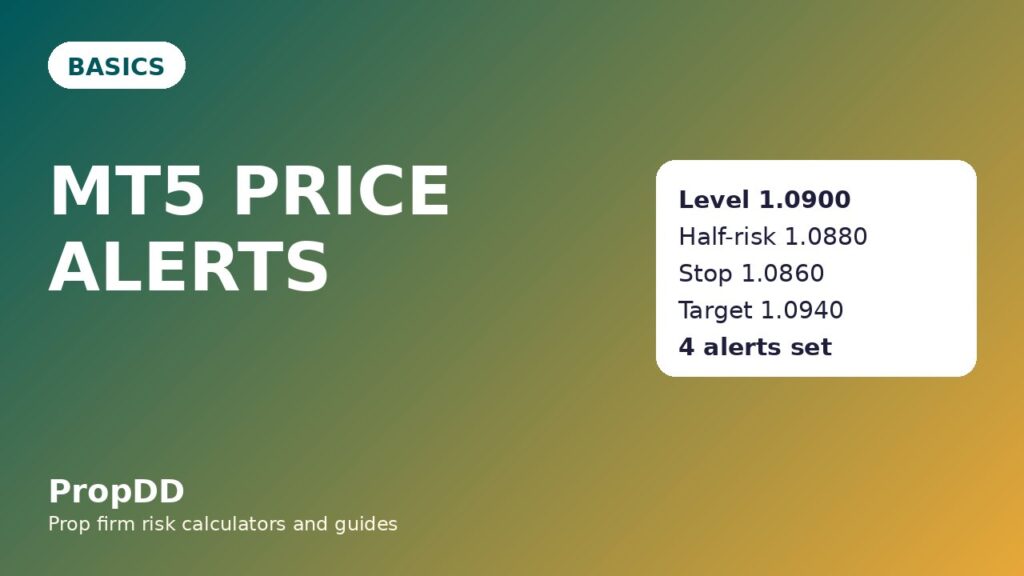
I lost a funded day to a price I never saw. It was a EURUSD pullback I had planned the night before: support at 1.0900, stop at 1.0860, targets at 1.0940 and 1.0980. I wrote it in my journal, went out for the morning, and checked my phone at lunch. Price had touched 1.0900, bounced forty pips, and was already falling back. I bought at market in a hurry, at a price my plan had never allowed, and watched the trade stop me out for more than my planned risk. The level was right. The plan was right. I was simply not there when the level arrived, and nobody told me it had.
In this article
- The three alerts MT5 actually gives you
- Setting a price alert, step by step
- Turning a dollar limit into a price alert
- My four-alert ladder for every trade
- A worked EURUSD week: the alerts that fired
- Twelve trades with alerts on: what changed
- Five ways alerts fail funded traders
- My morning alert routine
- Frequently asked questions
That is the whole case for MT5 price alerts on a funded account. An alert is not a strategy and it does not make a bad setup good. It is a tripwire: you tell the platform which price matters, and it tells you the moment price gets there, before the move is over and before impatience makes the decision for you. On a funded account, where one rushed entry can eat a third of the daily loss limit, a tripwire is worth more than another indicator, because it protects the one thing every other tool assumes you already have, which is being present at your own level.
The three alerts MT5 actually gives you
MT5 does not have one alert system. It has three, and they watch different things, which is why traders who set one up and then miss the move usually set the wrong one. A price alert watches a symbol and fires when its bid crosses a price you chose. A trade notification watches your account and tells your phone when an order fills, closes, or is stopped out. A sound or email alert is not a separate watcher at all, it is how the other two reach you, on the terminal speakers or in your inbox. If you only set a price alert and then leave the terminal on silent, you have built a tripwire with no bell on it.
| Alert type | What it watches | Where it is set | Funded-account use |
|---|---|---|---|
| Price alert | One symbol crossing one price | Toolbox, Alerts tab | Your entry level, your half-risk price, your target |
| Trade push notification | Orders filling, closing, stopping out | MT5 mobile, via your MetaQuotes ID | Knowing a pending order filled while you are away |
| Sound and email alert | Nothing on its own, it is the delivery channel | Tools, Options, on the terminal | Making sure a fired alert actually reaches you |
The honest limit matters more than the features. A native MT5 price alert watches price, not your equity. It cannot fire when your floating loss reaches $500, because it does not know your floating loss. That sounds like a flaw until you realise the workaround is simple: before the session starts, you translate every dollar line into a price, and you set the alert on that price instead. The formula for that translation is below, and once you have it, the price-only limit stops being a limit at all. For the phone side of the setup, Fortraders’ MT5 setup guide explains where to find your MetaQuotes ID and which push notifications are worth switching on, including margin-level and execution alerts, before you need them.
Setting a price alert, step by step
Setting an alert takes less than a minute once you know where it lives, and the steps are the same whether the alert is for an entry level or a stop-proximity warning. Open the Toolbox at the bottom of the terminal and click the Alerts tab. Right-click inside the tab and choose Create. Pick the symbol, pick the condition, type the price, and pick what happens when it fires. That is the whole procedure, and every mistake in the failure-modes section below is a mistake inside one of those four choices.
The condition is the step traders get wrong. Bid greater than means fire when price rises through your level. Bid less than means fire when price falls through it. If you are waiting for a pullback down to support, you want Bid less than, because price is coming down to you. If you are waiting for a breakout above resistance, you want Bid greater than. Set it the wrong way round and the alert fires the moment you create it, or never fires at all, and both failures look identical until you check the condition. I test every alert the same way: I set it, I watch one fire on a level price is about to cross, and I confirm the sound reaches me. An alert you have never seen fire is a theory, not a safety net.
Before you set any alert, check the delivery channel. On the desktop terminal, make sure the sound is on and the volume is up, because a muted terminal fires alerts into silence. On your phone, open the MT5 app, go to Settings, then Messages, and confirm your MetaQuotes ID is the one linked to your desktop terminal, so trade notifications reach the phone in your pocket rather than a phone on your desk. If you use email alerts, set them up in Tools, then Options, and send yourself a test before the session starts. I do all three checks every Monday morning, and it takes four minutes, which is less time than one rushed market order used to cost me.
Turning a dollar limit into a price alert
Here is the translation that makes MT5 alerts work on a funded account. I trade a $100,000 funded account with a firm daily loss limit of $5,000 and a personal daily stop of $2,500, and I risk $500 per trade. That $500 is 10% of the firm limit and 20% of my personal stop, so even two losing trades in a row leave me well inside both limits. For any open trade, the price at which a given dollar loss is reached is just that dollar amount divided by the dollar value of one pip at my size, subtracted from my entry for a long trade.
| Input | My number | Why it matters |
|---|---|---|
| Account size | $100,000 | Sets every dollar limit on the account |
| Firm daily loss limit | $5,000 (5%) | The hard line that ends the account |
| Personal daily stop | $2,500 | My own line, hit long before the firm line |
| Risk per trade | $500 | Fixed, never sized up after a win or a loss |
| Worked trade entry | EURUSD long at 1.0900 | The level the alerts are built around |
| Position size | 1.25 lots | $500 divided by (40 pips x $10 per pip) |
| Stop loss | 1.0860, 40 pips | The full-risk price, $500 down |
The formula is: pips to the alert price equals the dollar amount divided by (lots multiplied by $10 per pip on EURUSD). For my half-risk alert, that is 250 divided by (1.25 multiplied by 10), which is 250 divided by 12.50, which is 20 pips, so the alert price is 1.0880. For my stop-proximity alert, five pips before the stop, the dollar amount is $437.50, which is 437.50 divided by 12.50, which is 35 pips, so the alert price is 1.0865. I run the same formula before I place the trade, not after it goes against me, because an alert price worked out under pressure is an alert price worked out wrong. Before I trust any of these numbers, I check them against the max daily drawdown calculator, because a price alert that fires at the wrong level is worse than no alert at all: it tells you to act, confidently, on bad maths.
| Stop distance | Size at $500 risk | Loss if stopped out |
|---|---|---|
| 20 pips | 2.50 lots | $500 |
| 30 pips | 1.67 lots | $500 |
| 40 pips | 1.25 lots | $500 |
| 50 pips | 1.00 lot | $500 |
| 60 pips | 0.83 lots | $500 |
My four-alert ladder for every trade
Every trade I take now gets four alerts, set before I enter, each with a pre-decided action, because an alert without a pre-decided action is just a noise that interrupts you. The level alert tells me my setup has arrived. The half-risk alert tells me the trade is halfway to its stop and I should stop watching it tick by tick. The stop-proximity alert tells me I have five pips to decide, and the decision is never to move the stop, it is to accept the stop or to close early for a slightly smaller loss. The target alert tells me the first target is hit and it is time to take the partial close I planned. Four alerts, four actions, all decided in advance.
| Alert | Price on EURUSD | What it means | My pre-decided action |
|---|---|---|---|
| Level reached | 1.0900 | Price has come down to my support level | Check the setup, enter only if the trigger candle confirms |
| Half-risk | 1.0880, 20 pips | The trade is $250 down, half my planned risk | Stop watching tick by tick, let the stop do its job |
| Stop approaching | 1.0865, 35 pips | The trade is $437.50 down, 5 pips from the stop | Accept the stop, never move it further away |
| First target | 1.0940, 40 pips | The trade is $500 up, 1R in my favour | Take the planned partial close, move the rest to breakeven only per plan |
The stop-proximity alert is the one traders argue with me about, because five pips of warning feels like an invitation to interfere with the trade. It is the opposite. Without it, the first time you look at the trade it is already stopped out, and the loss feels sudden, which is what triggers revenge trading. With it, the loss arrives in two stages: a warning, then the outcome, and the warning gives you time to accept the outcome before it happens. That acceptance is the entire point. A funded account is not usually lost by one bad trade. It is lost by the trade placed ten minutes after a bad trade, and the stop-proximity alert is what breaks that chain. I also close part of the position at the first target when the target alert fires, which locks in the 1R win and lets the rest run to the second target at 1.0980 without risking the day.
A worked EURUSD week: the alerts that fired
Here is the same EURUSD setup traded the way I trade it now, over one week, so the ladder above is not theory. Price is at 1.0945 on Monday morning and falling toward support at 1.0900. I set the level alert at 1.0900 and walk away. On Tuesday it fires while I am out. I check the chart, the pullback candle confirms, and I enter long at 1.0900 with the stop at 1.0860 and targets at 1.0940 and 1.0980, at 1.25 lots, with the other three alerts already set. On Wednesday the half-risk alert fires at 1.0880. I do what I decided in advance, which is nothing, and price turns. On Thursday the first-target alert fires at 1.0940. I take the partial close, banking $500 on the closed part, and let the rest run. On Friday the remaining size runs to the second target at 1.0980, and the week ends with the trade doing exactly what the plan said it would do, because the alerts kept me at my levels instead of at my emotions.
Contrast that with the same setup traded the way I used to trade it, with no alerts at all. I checked my phone at lunch, saw price had already bounced off 1.0900, bought at market at 1.0925, and set the stop below a level the trade had never respected. The trade stopped me out for more than $500, because the entry was worse and the stop was further away, and then I took a second trade the same afternoon to win it back, which also lost. One missed level became two losing trades and a day that ended at my personal daily stop. The difference between the two weeks was not the setup, the pair, or the market. It was four tripwires, set in advance, that told me when to look and when to leave the trade alone.
Twelve trades with alerts on: what changed
I tested the ladder properly before I trusted it, over twelve trades in three weeks, all EURUSD, all with the same $500 risk and the same four alerts set before entry. The point of the test was not the win rate. It was whether the alerts changed my behaviour, and the log shows they did: no chased entries, no moved stops, and no second trade taken within an hour of a loss, because every decision had a tripwire in front of it. The log below is the real record, with the alert that mattered most on each trade.
| Trade | Alert that mattered | Result | Running total |
|---|---|---|---|
| 1 | Level reached, clean entry | +2R, +$1,000 | +$1,000 |
| 2 | Stop approaching, stop accepted | -1R, -$500 | +$500 |
| 3 | First target, partial closed | +1R, +$500 | +$1,000 |
| 4 | Half-risk, left alone | +2R, +$1,000 | +$2,000 |
| 5 | Stop approaching, stop accepted | -1R, -$500 | +$1,500 |
| 6 | Level reached, clean entry | +2R, +$1,000 | +$2,500 |
| 7 | First target, partial closed | +1R, +$500 | +$3,000 |
| 8 | Stop approaching, stop accepted | -1R, -$500 | +$2,500 |
| 9 | Level reached, clean entry | +2R, +$1,000 | +$3,500 |
| 10 | Half-risk, left alone | -1R, -$500 | +$3,000 |
| 11 | First target, partial closed | +2R, +$1,000 | +$4,000 |
| 12 | Stop approaching, stop accepted | -1R, -$500 | +$3,500 |
Seven wins and five losses, winners 12R and losers 5R, net plus 7R, which is plus $3,500 at $500 risk per trade, with an average winner of 1.71R and the best trade, $1,000, at 28.6% of the net total, inside a 30% consistency cap. The same setups traded the month before, without alerts, came out very differently: ten trades, three wins worth 4R and seven losses worth 7R, net minus 3R, which is minus $1,500, because I chased two entries, moved one stop, and took three revenge trades. The alerts did not improve my entries. They removed the three behaviours that were turning winning setups into losing months, and that is a bigger edge than any new setup would have given me. The same discipline shows up in my pending-order routine, where the order waits at the level instead of me chasing it, and in my personal daily stop, which is the line the alerts are ultimately protecting.
Five ways alerts fail funded traders
Alerts fail in predictable ways, and every one of them is a setup mistake, not a platform bug. Alert fatigue is the first: if you set an alert on every level you can think of, your phone buzzes all day, you start ignoring it, and the one alert that matters gets ignored with the rest. I set a maximum of four alerts per trade and one pair at a time, and I delete stale alerts every evening. The wrong condition is the second: Bid greater than when you meant Bid less than, which fires instantly or never, and is caught by the test fire I described above.
| Failure mode | What happens | The fix |
|---|---|---|
| Alert fatigue | Too many alerts, all ignored, including the important one | Four alerts per trade maximum, one pair at a time |
| Wrong condition | Bid greater than set when Bid less than was meant | Test-fire every alert on a level price is about to cross |
| Stale alerts | Last week’s level fires during this week’s news spike | Delete or reset every alert at the evening review |
| Silent delivery | Terminal muted, phone on silent, email unchecked | Monday check: sound on, MetaQuotes ID linked, test email sent |
| Alert with no action | The alert fires and you improvise, badly, under pressure | Write the action next to the alert before you set it |
Stale alerts are the quietest killer of the five. An alert set on last Tuesday’s support level, never deleted, fires during this week’s news spike, and you react to a level that no longer means anything, in a market that has already moved on. I delete every alert at my evening review, whether it fired or not, and I set the next day’s alerts fresh in the morning. That takes three minutes and it means every alert that fires tomorrow is an alert I set for tomorrow, on purpose. The same evening review is where I check the day against my losing-streak plan, because an alert that fires after three losing days needs a different action from the same alert after three winning days, and that difference has to be decided before the alert fires, not after.
My morning alert routine
The routine that holds all of this together takes ten minutes, and I do it before the first trade of the day, every day, without exception. It is deliberately boring. Boring is the point: a routine you only do when you feel like it is not a routine, it is a mood, and funded accounts are lost to moods.
| Step | What I do | Time |
|---|---|---|
| 1. Delete stale alerts | Clear every alert from yesterday, fired or not | 1 minute |
| 2. Check delivery | Terminal sound on, phone MetaQuotes ID linked, test email sent | 2 minutes |
| 3. Pick today’s levels | One pair, one setup, support, resistance, entry, stop, targets | 3 minutes |
| 4. Translate dollars to prices | Half-risk and stop-proximity prices from the formula above | 2 minutes |
| 5. Set and test-fire | Four alerts set, one test-fired on a level price is about to cross | 2 minutes |
That is the whole system. It does not predict the market, it does not replace a stop loss, and it does not turn a losing setup into a winning one. What it does is smaller and more valuable: it makes sure you are present at your own levels, with your actions decided in advance, on a funded account where absence and improvisation are the two most expensive habits you can have. Set the tripwires tonight, test one of them before tomorrow’s open, and let the platform do the watching while you do the trading.
Frequently asked questions
Can MT5 alert me when my account drawdown reaches a set amount?
Not natively, no. A native MT5 price alert watches a symbol’s price, not your equity, so it cannot fire on a dollar drawdown by itself. The workaround in this article is to translate the dollar amount into a price using the formula above, and set the price alert on that price. Third-party tools that watch equity directly exist, but the price-translation method needs nothing installed and nothing paid for.
Do MT5 alerts work when the terminal is closed?
No. Price alerts live in the terminal, so the terminal has to be running for them to fire. If you close the terminal, your price alerts stop with it, although trade push notifications about orders that already filled can still reach your phone. If you trade away from your desk, leave the terminal running, or use pending orders, which live on the server and fill whether your terminal is open or not.
What is the difference between a price alert and a push notification?
A price alert fires when a symbol crosses a price you chose, and it is set in the Alerts tab. A push notification tells your phone that something happened to your account, such as an order filling or closing, and it is delivered via your MetaQuotes ID. You need both: the price alert tells you a level has arrived, and the push notification tells you a trade has actually happened.
How many alerts should I set per trade?
Four, at most: the level, half-risk, stop-proximity, and first target, each with a pre-decided action. More than that and you get alert fatigue, where every buzz gets ignored, including the one that matters. If you are trading more than one pair, keep the same four-alert limit per pair and accept that fewer pairs with better alerts beats more pairs with noise.
Why did my alert fire immediately after I created it?
Almost always because the condition is the wrong way round. If price is already above your level and you set Bid greater than that level, the condition is already true, so it fires at once. Check the condition against where price is right now: Bid less than for a level below current price, Bid greater than for a level above it, then test-fire the alert before you trust it.
Should I delete alerts at the end of the day?
Yes, every evening, whether they fired or not. A stale alert from last week firing during this week’s news spike is one of the most common alert mistakes, and it causes trades taken at levels that no longer mean anything. Delete them at the evening review and set the next day’s alerts fresh in the morning, from that day’s levels and that day’s maths.
Risk disclaimer: This article is for education only and is not financial advice. Trading leveraged products carries a high risk of loss, and past results, including the twelve-trade test above, do not guarantee future results. Always check your prop firm’s current rules before trading, and never risk money you cannot afford to lose.



3 comments
[…] and muscle memory is built in practice, not purchased in a moment of live-market urgency. My MT5 price alerts article covers the other half of this routine: the alert tells me when to open the chart, and the […]
[…] mid-session addition row connects directly to the other MT5 habits on this site. My MT5 price alerts tell me when to look, my MT5 keyboard shortcuts decide how fast I act, and my MT5 pending orders […]
[…] VPS, read that guide before you migrate, not after. If you use alerts rather than advisors, the MT5 price alerts guide and the MT5 pending orders guide are the two that pair with a VPS most naturally, because […]