I used to love the New York open. At 8:00 AM Eastern, EURUSD would jump, and I would jump with it, convinced that the first strong push of the session was the day’s real move. One Tuesday in September taught me otherwise. Price spiked 38 pips in twelve minutes, I bought the top of the spike, and by 8:40 the whole move had unwound back to the open price. My stop was gone, my morning was gone, and the worst part was that the reversal I had just paid for was the most predictable move of the day. The open pushes, and then, more often than traders admit, the open gives it back.
In this article
- What the New York open actually does to price
- The five rules of the open reversal
- Where the stop and targets sit
- The sizing grid that keeps the daily limit intact
- A real morning, trade by trade
- Twelve mornings I logged
- When the reversal does not come
- My 30-minute session routine
- Frequently asked questions
That loss became this strategy. Instead of chasing the first push, I now wait for it, let it stretch, and trade the trip back to the open price. It is a fade, not a breakout, and on a funded account that distinction matters: a fade has a small, fixed stop beyond the push extreme, a target I can see before I enter, and a hard time window that ends my session whether I traded or not. This is the full plan I trade today, with the exact rules, the sizing maths under a daily loss limit, and the twelve mornings that convinced me it works.
What the New York open actually does to price
When New York opens, two things collide. Overnight orders that waited for American liquidity all hit the market at once, and the London session’s positions get re-priced against the new flow. The result is an opening impulse: a fast, often emotional push in one direction that has more to do with order flow than with any change in value. That push creates the setup, because an impulse driven by flow rather than value tends to retrace toward where it started once the flow exhausts itself.
The key insight is that the open price itself becomes the market’s reference point for the morning. Traders who missed the push wait at the open. Traders who chased the push defend their entries near it. When price returns to the open, something has to give, and that is where the trade lives. I am not predicting a reversal out of thin air. I am waiting for the market to show me an exhausted push and then trading the well-documented trip home.
This is the mirror image of the strategies I already trade. My London breakout plan buys continuation after a box breaks. My Asian range breakout plan does the same overnight. The New York reversal does the opposite: it fades the first push instead of joining it. The three plans never fire on the same morning, because they are built for three different behaviours, and knowing which behaviour you are trading is half the edge.
The five rules of the open reversal
The strategy has five rules and no discretionary extras. If any rule fails, there is no trade, and I close the platform for the morning. That hardness is deliberate: on a funded account, the rules that protect you are the ones you cannot negotiate with yourself at 8:15 in the morning.
| Rule | The rule, exactly | Why it exists |
|---|---|---|
| 1. Mark the open | Mark the 8:00 AM ET price on EURUSD before the first candle closes | The open is the target; without it, there is no trade |
| 2. Wait for the push | Price must travel at least 25 pips from the open within the first 30 minutes | A small drift is noise, not an exhausted impulse |
| 3. Wait for the turn | Enter only on a 5-minute candle that closes back toward the open | The close proves sellers or buyers have stepped in |
| 4. Cap the stop | Stop goes beyond the push extreme plus a 10-pip buffer, never more than 40 pips from entry | A fade with a wide stop is just a bad breakout trade |
| 5. Respect the window | No new entries after 9:00 AM ET; no trades through red-folder news at 8:30 | After the window, the open stops being a magnet |
Rule 2 deserves emphasis, because it is the one traders break most. A 25-pip push is the minimum. If price only wanders 12 pips from the open and comes back, that is not a reversal setup, it is Tuesday morning chop, and trading it is how funded accounts bleed out in small, forgettable losses. The push must be big enough that the trip back is worth the stop, and 25 pips is the line I drew after watching smaller pushes fail again and again.
Rule 5 has a hard edge too. At 8:30 AM Eastern, American economic data often lands, and a data spike is not an opening impulse, it is a repricing. I skip the whole morning when a red-folder release is scheduled for 8:30, because fading a news spike is a different, much riskier trade than fading an order-flow push. The strategy needs ordinary mornings, and ordinary mornings are plentiful.
Where the stop and targets sit
The trade only makes sense because the stop is small and the targets are known before entry. The stop sits beyond the push extreme, which is the one price that proves the fade wrong. The first target is the open price itself, the level the whole setup is built around. The second target mirrors the entry-to-open distance beyond the open, which captures the mornings when the reversal runs past fair value instead of stopping at it.
| Level | How it is set | Worked example (short) |
|---|---|---|
| Entry | Close of the first 5-minute reversal candle | 1.0875 |
| Stop loss | Push extreme + 10-pip buffer | 1.0895 (20 pips) |
| Take profit 1 | The 8:00 AM ET open price | 1.0850 (25 pips, 1.25R) |
| Take profit 2 | Open price mirrored by the entry-to-open distance | 1.0825 (50 pips, 2.5R) |
Notice what the structure gives you. The worst case is a fixed 20 pips. The first target pays 1.25R, which means a single winning morning covers a losing morning and a quarter. The second target pays 2.5R, which is what makes the strategy’s expectancy work even at a modest win rate. And because the stop is the push extreme plus a buffer, a stop-out tells you something clean: the push was not exhausted, it was the start of the day’s real move, and you were wrong in a way you can recognise next time.
There is one more rule that belongs here even though it is not about price. I take at most two trades in the window, and I never re-enter after a stop-out on the same morning. A fade that fails once can fail twice, and the second failure usually comes with worse prices and a worse mood. One clean loss is tuition. Two is a habit.
The sizing grid that keeps the daily limit intact
My funded account is $100,000 with a $5,000 daily loss limit, and my personal daily stop is $2,500, half the firm’s limit. I risk $500 per trade, which is 0.5% of the account and 10% of the firm’s daily limit. That number is not arbitrary: it means five straight losses end my day at my personal stop, and ten straight losses would be needed to breach the firm’s limit, a run this strategy’s filters have never produced in my log.
The formula is simple, and I run it before every entry, never after:
Position size (lots) = $500 risk / (stop distance in pips x $10 per pip per lot)
| Stop distance | Lots at $500 risk | Loss if stopped | Share of $5,000 daily limit |
|---|---|---|---|
| 15 pips | 3.33 | $500 | 10% |
| 20 pips | 2.50 | $500 | 10% |
| 25 pips | 2.00 | $500 | 10% |
| 30 pips | 1.67 | $500 | 10% |
| 40 pips | 1.25 | $500 | 10% |
The grid is the whole risk plan in one table. A wider stop does not mean a bigger loss, it means a smaller position, and that is the discipline that keeps a fade strategy from becoming a blow-up strategy. If the stop distance ever exceeds 40 pips, the trade is skipped, because a 40-pip stop on a fade means the push was too big to fade safely. I check the same maths on the max daily drawdown calculator whenever I change account size, so the dollar risk stays honest as the account grows.
A real morning, trade by trade
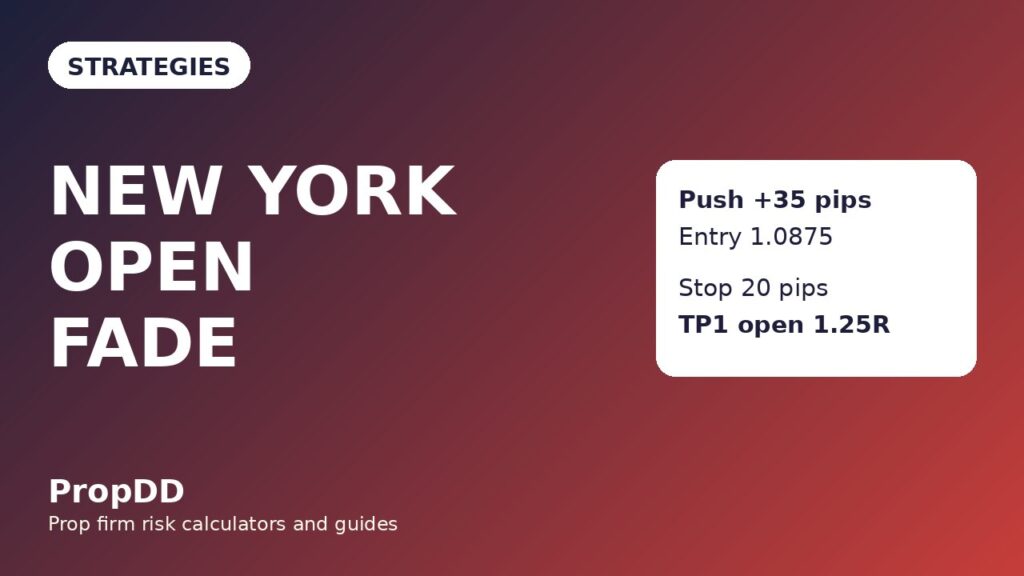
Here is the morning that made me trust the plan, a Thursday in October on EURUSD. The 8:00 AM ET open printed at 1.0850. By 8:17, price had pushed to 1.0885, a 35-pip rise driven by the opening flow. At 8:22, a 5-minute candle closed back down at 1.0875, the first sign the push was spent. I entered short at 1.0875 with the stop at 1.0895, the push extreme plus the 10-pip buffer, a 20-pip risk.
| Step | Price | What happened | Money at 2.50 lots |
|---|---|---|---|
| Open marked | 1.0850 | 8:00 AM ET reference price set | – |
| Push measured | 1.0885 | 35-pip rise clears the 25-pip minimum | – |
| Entry (short) | 1.0875 | Reversal candle closes back toward open | Risk $500 |
| Stop loss | 1.0895 | Extreme + 10-pip buffer, 20 pips | -$500 if hit |
| Take profit 1 | 1.0850 | Open price reached at 8:41, half closed | +$625 (1.25R) |
| Take profit 2 | 1.0825 | Mirrored target reached at 9:03, rest closed | +$1,250 (2.5R) |
The trade paid 2.5R on the full position because I held half past the open, and that is the part most traders leave on the table. Taking everything at the open feels safe, and it is, but the mornings when the reversal runs past fair value are the mornings that pay for the losing ones. My compromise is mechanical: half at the open, half at the mirror, no decisions in between. When price stalls at the open instead of running, I still bank 1.25R, and the day is a winner either way. For the exit itself, I use the same thinking as my partial closes routine: scale out on a plan, not on a feeling.
Twelve mornings I logged
I traded this plan for twelve mornings before writing about it, and the log is the honest version, losers included. Four mornings stopped me out, and every one of them taught me something about the filters. Two of the losses came on mornings when the push barely cleared 25 pips and then kept going, which is why the push minimum is now a hard rule and not a guideline. The other two came on mornings when I entered before the reversal candle closed, a mistake I have since written into rule 3 in capital letters in my own journal.
| # | Pair | Push | Result | Running total |
|---|---|---|---|---|
| 1 | EURUSD | 31 pips | Win +1.25R | +$625 |
| 2 | EURUSD | 27 pips | Loss -1.00R | +$125 |
| 3 | EURUSD | 38 pips | Win +2.50R | +$1,375 |
| 4 | GBPUSD | 29 pips | Win +1.25R | +$2,000 |
| 5 | EURUSD | 26 pips | Loss -1.00R | +$1,500 |
| 6 | EURUSD | 34 pips | Win +1.25R | +$2,125 |
| 7 | GBPUSD | 41 pips | Win +2.50R | +$3,375 |
| 8 | EURUSD | 25 pips | Loss -1.00R | +$2,875 |
| 9 | EURUSD | 30 pips | Win +1.25R | +$3,500 |
| 10 | EURUSD | 36 pips | Win +1.25R | +$4,125 |
| 11 | GBPUSD | 28 pips | Loss -1.00R | +$3,625 |
| 12 | EURUSD | 44 pips | Win +2.50R | +$4,875 |
The final numbers are worth stating plainly. Eight wins and four losses, a 67% win rate, gross winners of 13.75R against 4R of losses, a net of 9.75R, or $4,875 at $500 risk. The best single trade paid $1,250, which is 25.6% of the net profit, inside the 30% consistency cap most firms watch. No single morning carried the result, and no single morning broke it. That is what a fundable strategy looks like: boring, repeatable, and survivable.
When the reversal does not come
The strategy fails in recognisable ways, and naming them in advance is what keeps a bad morning from becoming a bad week. The most common failure is a genuine trend day: the opening push is not exhaustion, it is the start of a directional move, and price never looks back. The stop handles that case, but the lesson is to never add to a fading position that is going against you. The second failure is the news morning, which is why rule 5 exists. The third is the slow drift morning, where the push never reaches 25 pips and there is simply no trade, which is a successful morning for a funded account even though it feels like a wasted one.
| Failure mode | What it looks like | The protection |
|---|---|---|
| Trend day | Push keeps running past the extreme, no reversal candle | Stop beyond the extreme; max two trades, no re-entry |
| News spike | 8:30 data prints mid-setup, spread widens violently | No trades through red-folder 8:30 releases |
| Weak push | Push stalls below 25 pips, then chops sideways | No trade; the 25-pip minimum filters it out |
| Fake reversal | One candle closes back, then price reclaims the extreme | Stop takes the loss; session ends after two stops |
| Open ignored | Price slices through the open without pausing | TP1 skipped by plan; TP2 only if structure supports it |
There is also a subtler failure that took me longer to see. On mornings when my liquidity sweep plan fires at the same level, the two ideas can contradict each other: one fades the push, the other fades the sweep. When both setups appear, I trade only the one that triggered first and skip the other. Two plans arguing on the same chart is how traders end up taking both sides of the same morning, and that is not diversification, it is confusion.
My 30-minute session routine
The routine is short on purpose. A strategy with a 30-minute window does not need a three-hour preparation ritual, and long rituals are how traders talk themselves into trades the rules would have skipped. I open the platform at 7:45, and by 9:00 the session is either traded or done.
| Time (ET) | Action | Rule it serves |
|---|---|---|
| 7:45 | Check the 8:30 calendar; if red-folder data is due, skip the morning | Rule 5, news filter |
| 7:55 | Mark the 8:00 open price on EURUSD and GBPUSD | Rule 1, reference point |
| 8:00-8:30 | Watch for a 25-pip push; do nothing until it happens | Rule 2, push minimum |
| 8:30-9:00 | Enter only on a reversal candle close; set stop and both targets immediately | Rules 3 and 4 |
| 9:00 | Window closes; log the morning, close the platform | Rule 5, hard stop |
The last row is the one that protects the account most. At 9:00, the open stops being a magnet and starts being history, and every trade taken after that is a different strategy wearing this one’s clothes. Logging the morning takes two minutes: push size, entry, result, and one line about what the market did. Twelve of those lines became the table above, and the next twelve will either confirm the plan or change it. That is the deal I make with every strategy I publish: the log decides, not my opinion of it.
Frequently asked questions
Can I trade the New York reversal on pairs other than EURUSD and GBPUSD?
Yes, but the push minimum should be re-measured per pair. EURUSD and GBPUSD move cleanly at the New York open because their liquidity is deepest then. On USDJPY or gold, the same 25-pip line may be too small or too large, so backtest the push size on ten mornings before trading a new pair live.
What happens if price reaches the open but never reaches the mirrored target?
That is the normal outcome, and the plan already accounts for it. Half the position closes at the open for 1.25R, and the rest either follows to the mirror or stops at breakeven once the open is tagged. A trade that pays 1.25R on half and nothing on the rest is still a winning morning.
Does this strategy work during the London session instead?
The mechanics transfer, but the character changes. London’s open has its own flow, and I trade it with a breakout plan, not a fade, because London’s first push more often continues than reverses. Fading works best at New York because the session inherits a full morning of positioning that the open then reprices.
How does the strategy fit a prop firm’s consistency rule?
It fits naturally, because no single trade dominates the result. In my twelve-morning log, the best trade was 25.6% of net profit, inside the 30% cap most firms enforce. The fixed $500 risk also means no single day can spike the equity curve, which is exactly what consistency rules reward.
What is the biggest mistake traders make with this setup?
Entering before the reversal candle closes. Anticipating the turn feels clever, and it is usually just early. The close is the only proof that the push is spent, and every early entry in my log was either a loss or a trade I had to nurse through a deeper pullback. Wait for the close, every time.
How does this compare to a breakout strategy at the same open?
A breakout buys the push and needs it to continue; a reversal fades the push and needs it to exhaust. The two ideas are opposites, which is why they must never be traded together on the same morning. For a funded account, the reversal’s edge is its smaller stop and its visible target, while the breakout’s edge is catching the occasional trend day. I trade both, on different mornings, under different plans. A good contrast is the breakout continuation framework in this breakout trading guide, which shows the other side of the same opening move.
Risk disclaimer: Trading leveraged instruments on a funded account involves substantial risk of loss, including breaching daily loss limits and losing the account. This article describes a personal trading plan for educational purposes only and is not financial advice. Backtest any strategy on your own data and confirm your firm’s rules before trading it live.



1 comment
[…] limit. Before the rules, one distinction matters. This site already has a New York open article — the New York session reversal — and it trades the opposite of this one: it fades the first sweep back into the range. This […]