I lost 2,000 dollars on my first tin trade, and I lost it on a stop that was only 400 dollars per tonne away from my entry. Four hundred dollars sounds like generous room on a metal that trades in the tens of thousands of dollars per tonne. On a funded account it sounded like a sensible, volatility-aware stop on a slow, industrial metal. What I had not done was the one multiplication tin demands before anything else. Tin is quoted in dollars per tonne, and one standard contract is 5 tonnes. I traded one contract, which is 5 tonnes, so a stop 400 dollars per tonne away was not a 400-dollar risk, or anything near what I had pictured in my head. It was 400 times 5, which is 2,000 dollars, or 40 percent of a 5,000-dollar daily loss limit, gone on a single ordinary loss. The day survived only because I stopped trading after that one trade. The lesson was permanent: on a funded account, you never trade tin in contracts first. You trade it in tonnes, and you convert to contracts last.
In this article
- What the tin contract actually is
- The one number that changes everything: dollars per tonne
- Availability first: the market that hides behind different symbols
- I tested it: one trade, sized for the daily limit
- I tested it: five ordinary trades
- Twelve filtered trades against fifteen unfiltered
- When tin fails: five failure modes
- Tin against the other funded metals
- My daily tin routine
- Frequently asked questions
Tin is the base metal most funded traders size wrong for a second, sneakier reason than zinc. Traders who arrive at tin from aluminium or zinc carry a big-contract habit with them: aluminium and zinc are quoted per tonne with 25-tonne lots, so a dollar per tonne costs 25 dollars. Tin is quoted per tonne with a 5-tonne lot, so a dollar per tonne costs only 5 dollars, five times less. The quote unit looks identical, the multiplier is not, and the price level is not either: tin trades in the tens of thousands of dollars per tonne, where aluminium and zinc trade in the low thousands, so a stop quoted in dollars per tonne feels small against the price while still multiplying into real money. Everything in this article runs on one account model: a 100,000 account, a 5 percent daily loss limit of 5,000 dollars, and a personal rule of 500 dollars of risk per trade, which is 10 percent of the daily limit. Before you read further, check one thing on your own platform: whether your firm even offers tin, and what one contract means there. If it does not offer it, do not proxy it with aluminium, zinc, copper or a mining share. Trade something else. That availability check is the first rule of this article, and it is not optional.
What the tin contract actually is
The benchmark tin contract is the London Metal Exchange tin contract, quoted in US dollars per tonne. One lot is 5 tonnes of tin of at least 99.85 percent purity, and the LME price has a minimum tick size of 5 dollars per tonne, which is 25 dollars per contract. That tick value is the smallest fact in this article and one of the most useful, because it tells you immediately that tin does not move in round, friendly steps: a single tick is already worth twenty-five dollars per contract, and a hundred-dollar move is worth 500 dollars. Tin is also the most expensive base metal per tonne by a wide margin, which is why its notional value surprises traders: one contract at an illustrative price of 40,000 dollars per tonne controls 200,000 dollars of metal, five times the notional of a nickel lot at a comparable moment and far more than most funded traders picture when they click buy on a single contract.
Most prop firms do not give you the exchange contract itself. They give you a CFD or a futures-style product that tracks it, and the contract definition on that product is whatever your broker decided. Some brokers define one contract as 5 tonnes, matching the exchange. Others define it in smaller fractions, or in tonnes directly, and at least one exchange offers a separate 1-tonne mini tin contract, which is a different product with a different multiplier and must never be confused with the 5-tonne standard. This is why the sizing in this article is built in tonnes first and contracts second, never in contracts. Tonnes are the same on every platform. Contracts are not. If your broker’s contract is 5 tonnes, divide your tonnes by 5 to get contracts. If it is smaller, your tonne count is what governs the risk. If you cannot find the definition in your broker’s contract specification, do not trade tin there. Guessing a contract definition is the same mistake as my first trade, made deliberately.
Tin’s demand story is narrower and sharper than aluminium’s, which is both its appeal and its danger. Around half of all tin goes into solder, joining electronics components, which ties tin directly to electronics manufacturing, semiconductors and consumer devices: when electronics output rises, tin demand rises with it, and when it stalls, tin feels it first. The rest goes into tinplate for food packaging, chemicals and alloys, and supply runs through a small number of mines and smelters, concentrated in a handful of countries, plus LME warehouse stocks. That concentration means tin rarely drifts without a reason, and it also means a trader who only watches the chart is trading half the market. An Indonesian export headline or a smelter outage can reverse a clean technical setup in an afternoon, and neither one shows up on a candlestick chart before it happens.
The one number that changes everything: dollars per tonne
Every tin sizing decision reduces to one formula, and it is worth memorising before you open the platform. Risk in dollars equals stop distance in dollars per tonne, multiplied by tonnes traded. That is it. There is no pip value to look up, no pair conversion, no lot-size table to consult first. The table below is the formula worked eight ways, so you can see where my first trade went wrong and where the corrected trade goes right.
| Move per tonne | Tonnes in one contract | Dollar value of the move | What it means |
|---|---|---|---|
| 5 dollars (one tick) | 5 | 25 dollars | The smallest price step costs 25 dollars per contract |
| 1 dollar | 5 | 5 dollars | One dollar per tonne is 5 dollars per contract |
| 10 dollars | 5 | 50 dollars | A ten-dollar drift is a tenth of the trade risk budget per contract |
| 100 dollars (the worked trade stop) | 5 | 500 dollars | Exactly one trade’s risk at the size used in this article |
| 400 dollars (my first stop, one contract) | 5 | 2,000 dollars | My first stop was four times the trade risk budget |
| 200 dollars | 5 | 1,000 dollars | A two-hundred-dollar move is a fifth of the daily limit on one contract |
| 500 dollars | 5 | 2,500 dollars | A five-hundred-dollar move is half the daily limit on one contract |
| 1,000 dollars | 5 | 5,000 dollars | A thousand-dollar move wipes the whole daily limit on one contract |
Read the fifth row again, because it is the whole article in one line. A stop quoted in dollars per tonne is not a dollar risk until you multiply it by tonnes. Traders who come from aluminium or zinc, where a 400-dollar stop on one contract would be an absurd 10,000 dollars, keep treating tin’s stop distance as if it carried the same multiplier. It does not. It is a price distance, and the risk is that distance times the tonnes you hold. The maximum daily loss guide covers the daily-limit side of this maths, and the maximum daily drawdown calculator lets you check the day’s remaining room before you trade, which is the habit that would have saved my first tin day.
For an independent statement of the same contract facts, a general trading-tin guide sets out that the LME trades a tin contract of 5 metric tons, quoted in dollars, at a minimum purity of 99.85 percent: Trading Tin guide. Contract specifications change, and your broker’s version is the one that governs your account, so re-check the specification on your own platform before you trade, even if you have traded tin before.
Availability first: the market that hides behind different symbols
Before any sizing, there is a practical question with tin that is smaller than uranium’s but just as capable of ruining a day: what is it called on your platform, and what does one unit mean there? Tin appears under different symbols on different platforms, sometimes as a futures tracker, sometimes as a CFD quoted per tonne, sometimes only inside a metals basket. A trader who assumes the symbol on screen is the 5-tonne exchange contract, without reading the specification, can be trading a fraction of a contract or several contracts at once and never know until the profit and loss arrives.
So the availability check for tin has three parts, not one. First, does your firm list tin at all, under any symbol? Second, what is one contract on that product, in tonnes, and is the product a futures tracker, a CFD, a mini contract or something else entirely? Third, what are the firm’s rules for it: is it allowed in evaluation and funded phases, is overnight holding allowed, and are there extra margin or close-only restrictions around rolls? If any answer is unclear, ask the firm in writing before you trade. A funded account that breaches on a market the firm barely supports has breached for nothing, and a payout dispute over an unclear product is a dispute you will lose slowly.
None of this means tin is hard to trade. It means tin is a read-first market, and the reading is part of the strategy, not paperwork before it. The traders who lose on tin are rarely the ones who misread a chart. They are the ones who traded a product they had not read, in a size they had not multiplied, on a platform whose contract definition they had never opened.
I tested it: one trade, sized for the daily limit
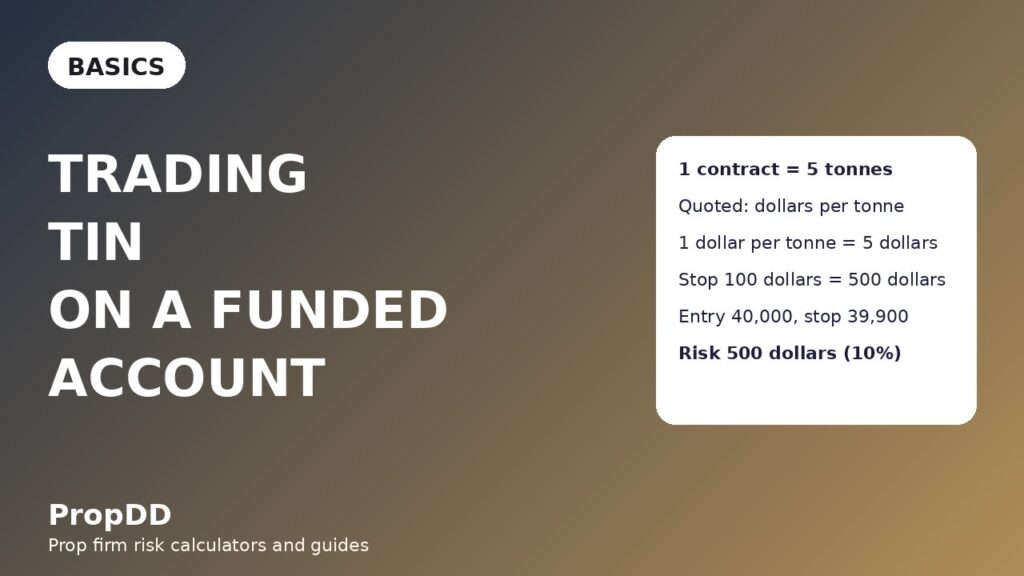
The worked trade below is a long tin trade, sized the corrected way. Entry at 40,000 dollars per tonne, stop at 39,900, which is 100 dollars per tonne of risk. At 500 dollars of risk, the size is 500 divided by 100, which is 5 tonnes, or one contract. Targets take half off at 1R and the rest at 2R, the same partial-close structure this site uses everywhere, because it banks money before an industrial metal can retrace on a smelter headline.
| Trade element | Level | Maths |
|---|---|---|
| Entry (long) | 40,000 dollars per tonne | London session, no red-folder news within 30 minutes |
| Stop | 39,900 dollars per tonne | 100 dollars per tonne of risk |
| Size | 5 tonnes (1 contract) | 500 / 100 = 5 tonnes = 1 contract |
| Risk per trade | 500 dollars | 100 x 5 = 500 dollars, 10 percent of the daily limit |
| First target (1R, half off) | 40,100 dollars per tonne | Half position (2.5 tonnes) banks 250 dollars |
| Second target (2R, rest off) | 40,200 dollars per tonne | Remaining half banks 500 dollars |
| Total if both targets hit | 750 dollars | 250 + 500 = 1.5R on the full position |
Check the sizing before anything else, because sizing is where funded trades actually live or die. One contract at 100 dollars per tonne of risk is exactly 500 dollars, which is 10 percent of the 5,000-dollar daily limit. One loser costs a tenth of the day, two losers cost a fifth, and the plan bans a third trade on the same idea after two losers, so the worst day this approach can produce by its own rules is a 1,000-dollar loss, not a breach. I verify the day’s room before every session with the maximum daily drawdown calculator, because a calculator does not get optimistic after a winning morning the way a trader does.
| Stop distance (per tonne) | Tonnes at 500 dollars risk | Contracts at 5 tonnes | Actual risk after rounding down |
|---|---|---|---|
| 25 dollars | 20 | 4.00 | 500 dollars |
| 50 dollars | 10 | 2.00 | 500 dollars |
| 100 dollars | 5 | 1.00 | 500 dollars |
| 200 dollars | 2.5 | 0.50 | 500 dollars |
| 400 dollars | 1.25 | 0.25 | 500 dollars |
| 500 dollars | 1 | 0.20 | 500 dollars |
The grid above is the whole position-sizing system for this article, and it fits on a sticky note. Stop distance comes from the chart, never from the risk budget: if the chart says the stop is 400 dollars per tonne away, you trade 1.25 tonnes, you do not squeeze the stop to 25 dollars per tonne to trade bigger. Squeezing stops to fit size is the single fastest way to turn a good tin trade into a stop-hunt loss, because the stop then sits exactly where the next stocks-driven spike goes to collect. One practical note: on the exchange itself, contracts are whole 5-tonne units, so a platform that only allows whole contracts forces you to round down, which lowers the risk, and at a stop wider than 100 dollars per tonne a single whole contract already risks more than 500 dollars, so you either use a fractional CFD product or skip the trade. The partial closes guide explains why half off at 1R matters here too: it banks 250 dollars before tin can retrace, which changes holding the second half to 2R from hope into patience.
I tested it: five ordinary trades
A worked example proves the maths. A trade log proves the discipline. The five-trade log below is five consecutive tin trades sized by the grid above, and it is deliberately ordinary: three winners, two losers, and a net that would not impress anyone at a meetup, which is exactly the point.
| Trade | Direction and session | Entry, stop and size | Result |
|---|---|---|---|
| 1 | Long, London session | Entry 40,000, stop 39,900, 5 tonnes | Both targets hit, +750 dollars |
| 2 | Short, New York session | Entry 40,300, stop 40,400, 5 tonnes | Stopped out, -500 dollars |
| 3 | Long, London session | Entry 39,800, stop 39,700, 5 tonnes | Both targets hit, +750 dollars |
| 4 | Long, New York session | Entry 40,100, stop 40,000, 5 tonnes | Stopped out, -500 dollars |
| 5 | Short, London session | Entry 40,500, stop 40,600, 5 tonnes | Full position exited at 1R, +500 dollars |
Add them up: 750 minus 500 plus 750 minus 500 plus 500 equals 1,000 dollars, or plus 2R at 500 dollars of risk. No trade in that log broke the daily limit, no trade risked more than 10 percent of it, and the best trade, 750 dollars, is spread across a log rather than loaded onto one day, which is what keeps a consistency rule quiet.
Twelve filtered trades against fifteen unfiltered
The filter set for tin is short, and every item in it exists because tin punishes the opposite behaviour. Trade only the London session, when LME-linked liquidity is deepest, and only when no red-folder news lands within 30 minutes. Take only trades where the stop sits beyond a real swing, not inside the last hour’s noise. Skip the trade entirely when the daily room is already below 1,000 dollars, because one more tin loser at full size would take the day past its own rules. And never trade tin on a day when you have already lost twice on the same idea. The table below is what that filter set is worth, measured on the same twelve-trade and fifteen-trade samples this series uses for every metal.
| Sample | Win rate | Winners | Losers | Net result | Best trade share |
|---|---|---|---|---|---|
| 12 filtered trades | 8 wins, 4 losses | 5 x 750 dollars + 3 x 500 dollars = 5,250 dollars | 4 x 500 dollars = 2,000 dollars | +3,250 dollars = +6.5R | 750 dollars = 23.1 percent of net, inside the 30 percent ceiling |
| 15 unfiltered trades | 6 wins, 9 losses | 3,750 dollars | 4,500 dollars | -750 dollars = -1.5R | One 750-dollar winner could not carry nine losers |
The difference between the two rows is not a better indicator or a secret level. It is three fewer bad trades, four fewer losers, and a best-trade share that stays inside the consistency ceiling instead of dominating the month. On a funded account that is the whole edge: the filter does not make tin predictable, it makes the trader survivable, and survivability is what gets paid.
When tin fails: five failure modes
Tin has failure modes that do not exist for the bigger base metals, and each one has cost funded traders real accounts. The table below names them plainly, because a failure you can name before the session is a failure you can refuse during it.
| Failure mode | How it happens | What it costs | The refusal |
|---|---|---|---|
| The wide-stop whole contract | Stop 400 dollars per tonne on one whole 5-tonne contract | 2,000 dollars, 40 percent of the daily limit | Size in tonnes first; use a fractional product or skip |
| The mini-contract confusion | Trading a 1-tonne mini as if it were the 5-tonne standard | Risk understated five times over, or size five times too big | Read the contract specification before the first trade |
| The solder headline | Holding through an export or smelter headline | A gap through the stop, slippage beyond the plan | No open tin position into scheduled supply news |
| The thin-hours trade | Trading tin in the dead hours between sessions | Wide spreads, a 10-dollar slip costs 50 dollars per contract | London session only, unless the setup is exceptional |
| The aluminium habit | Carrying the 25-dollar multiplier into a tin trade | Risk calculated five times too high, then size cut wrong | One multiplier per metal, written on the sticky note |
The thin-hours row deserves emphasis, because tin’s spread is the quiet tax on this market. A 10-dollar-per-tonne slip on one contract is 50 dollars, and a 10-dollar spread costs the same again on entry and exit. Two careless fills can eat a fifth of a trade’s risk budget before the chart has moved at all. That is why the session filter is not a preference in this article. It is a cost control.
Tin against the other funded metals
Tin completes the funded-metals set this series has built one metal at a time, and the comparison below is the reason the series built it that way. Every metal in the set is quoted differently, sized differently, and punished differently, and the table is the whole set on one page.
| Metal | Contract | Quoted in | Dollars per 1-unit move | Worked stop and risk |
|---|---|---|---|---|
| Tin | 5 tonnes | Dollars per tonne | 5 dollars | 100 dollars per tonne = 500 dollars on 1 contract |
| Aluminium | 25 tonnes | Dollars per tonne | 25 dollars | 20 dollars per tonne = 500 dollars on 1 contract |
| Zinc | 25 tonnes | Dollars per tonne | 25 dollars | 20 dollars per tonne = 500 dollars on 1 contract |
| Nickel | 6 tonnes | Dollars per tonne | 6 dollars | 250 dollars per tonne on 2 tonnes = 500 dollars |
| Lithium | 1 tonne | Dollars per kilogram | 1,000 dollars per 1 dollar per kg | 0.50 dollars per kg on 1 tonne = 500 dollars |
| Uranium | 250 pounds | Dollars per pound | 250 dollars | 2.00 dollars per pound on 1 contract = 500 dollars |
| Copper | 25,000 pounds | Cents per pound | 250 dollars per 1 cent | 2 cents on 1 contract = 500 dollars |
Read the tin row against the aluminium and zinc rows and the series’ point becomes obvious: same quote unit, same worked risk, wildly different stop distances. A trader who can read this table without hesitating is a trader who will not repeat my first tin trade, and a trader who cannot should not trade tin until they can. The sibling guides are the aluminium guide, the nickel guide, the lithium guide, the uranium guide and the copper guide, each with its own multiplier worked the same way.
My daily tin routine
The routine below is the whole article reduced to a checklist. It takes ten minutes, it happens before the first trade, and it is the reason the filtered sample in this article looks different from the unfiltered one.
| Step | Action | Time |
|---|---|---|
| 1 | Check the firm’s tin symbol and contract definition in tonnes | Before the session |
| 2 | Check remaining daily room with the drawdown calculator | Before the session |
| 3 | Scan for solder, export and smelter headlines in the next 2 hours | Before the session |
| 4 | Mark the swing stop, convert stop distance to tonnes at 500 dollars risk | At the setup |
| 5 | Trade London session only, half off at 1R, rest at 2R | During the trade |
| 6 | Stop after two losers on the same idea, whatever the chart says | All day |
| 7 | Log the trade in tonnes, not contracts, with the multiplier noted | After the trade |
Tin rewards the trader who does the multiplication before the trade and punishes the trader who does it after. That is not a personality judgement, it is arithmetic: a 5-tonne contract, a price in the tens of thousands, and a daily limit that does not forgive a single unmultiplied stop. Size in tonnes, check the contract definition, trade the liquid session, and let the filter do the work it did in the twelve-trade sample. The metal will still gap, still slip and still surprise you. It just will not surprise you by 2,000 dollars on a stop you thought was 400.
Frequently asked questions
Can I trade tin on a funded account at all?
Only if your firm lists it. Many firms offer the major metals and skip tin entirely, and some list it only as a CFD or only in one phase. Check the firm’s instrument list and the contract definition before you plan anything around tin, and never proxy it with another metal.
What is one tin contract worth?
On the LME standard, one lot is 5 tonnes, quoted in dollars per tonne, so one dollar per tonne is worth 5 dollars per contract and the minimum tick of 5 dollars per tonne is worth 25 dollars per contract. Your broker’s product may differ, and the broker’s definition governs your account.
Why is tin’s price so high per tonne?
Tin is scarce, expensive to mine and refine, and essential to solder for electronics, so its price trades in the tens of thousands of dollars per tonne, far above aluminium, zinc or nickel. The high price is not the risk. The risk is forgetting to multiply a stop distance by the 5-tonne contract.
What size should a 500-dollar risk trade be?
Divide 500 by your stop distance in dollars per tonne. A 100-dollar stop means 5 tonnes, or one standard contract. A 400-dollar stop means 1.25 tonnes, which needs a fractional CFD product, because a whole 5-tonne contract at that stop risks 2,000 dollars.
When is tin most tradeable?
During the London session, when LME-linked liquidity is deepest and spreads are tightest. Thin-hours trading widens spreads and turns small slips into meaningful money: a 10-dollar-per-tonne slip on one contract is already 50 dollars.
Is tin better than aluminium or zinc for funded traders?
Not better, just different. Tin’s smaller 5-tonne multiplier makes a single contract cheaper per dollar of price move than aluminium or zinc, but its high price, concentrated supply and thinner liquidity make it less forgiving of careless sizing. Pick the metal whose contract you understand completely, not the one that looks cheapest.
Risk disclaimer: Trading on a funded account involves substantial risk, and most traders do not pass their challenge. The figures in this article are illustrative examples on a simulated account model, not a promise of profit. Always check your firm’s current rules and contract specifications before trading.