My first funded account lasted eleven days. Not because the strategy broke — it was the same strategy that passed the challenge — but because I walked into day one risking 1% per trade on a $100,000 account with a 5% daily limit and a 10% trailing max. Day one: -$2,300. A normal bad day. Except on a fresh funded account a normal bad day does something a challenge never does — it eats into the only money that matters: the distance between your equity and the max-loss floor. The buffer is the account’s immune system. On day two I had $7,700 of breathing room instead of $10,000, and every decision I made from then on was smaller, tenser, and worse. Eleven days later I was back to buying another challenge.
In this article
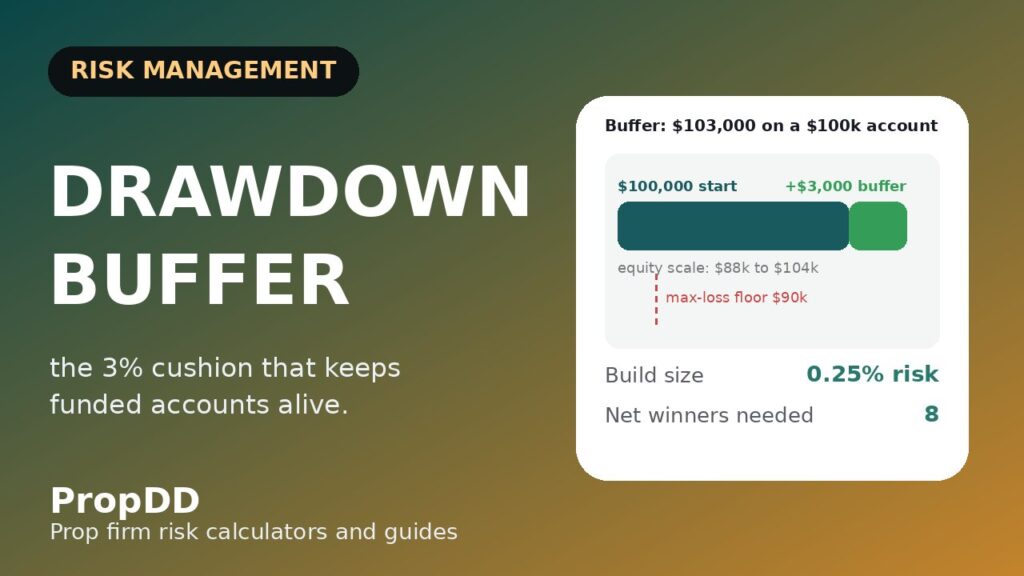
The second funded account, I did one thing differently: I built a prop firm drawdown buffer first — a 3% profit cushion banked on tiny 0.25% risk trades before I ever touched my normal size. Three weeks of boring, tiny trades. Then a -2.1% day hit, the kind that killed account number one, and I shrugged: the buffer absorbed it, my equity never dropped below the starting balance, and the trailing floor kept climbing. That account is still alive. This guide is the full playbook — what the buffer is, the exact maths I use to size it, the build phase routine, how it behaves under static versus trailing drawdown, and the mistakes that eat buffers for breakfast.
What a Drawdown Buffer Actually Is
A drawdown buffer is funded-account equity sitting above your starting balance, built on purpose before you trade at full size. It is not a profit target, it is not your payout stack, and it is not the same thing as your daily budget. Three different layers, three different jobs:
| Layer | What it is | Its job |
|---|---|---|
| Daily budget | How much you can lose today before you stop (my personal daily stop, set at 50–60% of the firm’s limit) | Keeps any single day survivable |
| Max-loss floor | The firm’s hard line — 10% below start (or trailing) — where the account dies | Defines the absolute end |
| Drawdown buffer | Profit banked above the starting balance before normal trading begins | Keeps normal bad days from touching the real account equity |
Think of it this way: the daily budget protects your days, the max-loss floor is the cliff edge, and the buffer is the fence you build before the cliff. Without a buffer, your first normal bad day on a funded account permanently moves your equity closer to the floor. With a 3% buffer, the same bad day just erases some of the fence — your starting balance is untouched, your psychology is untouched, and the account’s effective life is unchanged.
The reason this matters more on funded accounts than on challenges is simple: on a challenge, a bad early day costs you the fee and a restart. On a funded account, a bad early day costs you distance you can never buy back — especially on trailing drawdown, where an early dip can drag the floor down with it for the rest of the account’s life.
The Buffer Maths: How Big and How Long
I size the buffer at 3% of the account — enough to absorb a full worst-case daily-stop day and still have room, small enough to build in a few weeks without forcing trades. The build formula is one I now run before every funded account:
| Variable | My value ($100,000 account) | The formula |
|---|---|---|
| Buffer target | $3,000 (3%) | Account × 0.03 |
| Build-phase risk per trade | $250 (0.25%) | Quarter of my normal 1% risk |
| Average win (1.5R) | $375 net per winner | Risk × 1.5 |
| Net winners needed | 8 | $3,000 ÷ $375 = 8 |
| Realistic calendar time | 3–4 weeks | 8 net winners at ~3 net winners/week on my trade plan |
| Buffer coverage | ~1.2 full daily-stop days | $3,000 ÷ $2,500 personal daily stop |
That last line is the one I stare at: eight net winners at quarter size buys the fence. It is not glamorous, it does not impress anyone on social media, and it is the single highest-ROI month I ever spent in trading. Note what the maths does not ask for: a hot streak. At a modest 40% win rate with 1.5R average winners, the expectancy is +0.2R per trade — $50 a trade at 0.25% risk — so the buffer accumulates through normal grinding, not heroics. Anyone telling you to “make it back fast” on a fresh funded account is selling you a second challenge fee.
My 0.25% Build Phase: The Four Rules
The build phase is the boring part, which is why most traders skip it and why it works. Here is my exact routine — the same four rules I run on every fresh funded account:
| Rule | What I do | Why |
|---|---|---|
| 1. Quarter size only | 0.25% risk per trade, no exceptions, until the 3% buffer is banked | A full losing week at quarter size costs ~1% — a bad day costs nothing structural |
| 2. Same strategy, same sessions | Trade the exact plan that passed the challenge — London/New York sessions only | The build phase proves the strategy transfers to live conditions; changing the plan breaks the proof |
| 3. Buffer is sacred | Any dip below the starting balance = back to build-phase sizing until the buffer is restored | This is the rule that matters: the buffer is never “spent” on revenge trades |
| 4. No payouts yet | Nothing leaves the account until the 3% cushion exists (my payout rules guide covers the timing after that) | Withdrawing early turns the buffer into a withdrawal — the account starts naked |
Rule 3 deserves a second look because it is the one that saved my second account twice. In month three, a news-spike day took me to −1.8% — inside my daily budget, but it ate $1,800 of the $3,000 buffer. My ego said “normal size tomorrow, make it back.” The rule said quarter size until the fence was rebuilt. Three more boring weeks, buffer restored, then full size. The traders who lost funded accounts that month were not the ones with bad strategies — they were the ones who treated a dented buffer as permission to swing harder.
I Tested It: the $100k Buffer Experiment on Demo
Before trusting this on real firm capital, I ran the whole playbook on a $100,000 demo with the same 5% daily / 10% trailing rules, over two identical 30-day periods — once with the buffer build, once without. Same strategy, same sessions, same trade plan. The only difference was the first three weeks:
| Metric (30 days) | No buffer (full size day 1) | 3% buffer built first |
|---|---|---|
| Worst single day | −$2,300 (day 1) | −$2,100 (day 24) |
| Distance to max-loss floor at worst | $7,700 | $10,900 |
| Trailing floor after worst day | Dragged down $2,300 | Unchanged — buffer absorbed it |
| Trades taken in “tired/tight” state | 11 (chasing after day-1 damage) | 2 |
| Recovery needed after worst day | +2.35% just to get back to start | 0% — equity never went below start |
| 30-day net result | +$1,400 (with two blown-up weeks) | +$4,600 |
The recovery line is the whole argument in numbers: without a buffer, a −2.3% day means the recovery gain calculator says you need +2.35% just to get back to zero — and the trailing floor has already moved against you. With the buffer, that same day is a fence repair, not a hole. If you want to feel the maths yourself, punch your own account size and buffer into the recovery calculator and compare the “gain needed to recover” with and without a 3% cushion — the difference is what your first month of funded trading is really buying.
Buffer Under Static vs Trailing Drawdown
The buffer behaves differently depending on the drawdown model, and getting this wrong is how people build a cushion that does not actually protect them:
| Behaviour | Static drawdown (floor fixed at start − max) | Trailing drawdown (floor follows equity highs) |
|---|---|---|
| Buffer build effect | Pure cushion — the floor never moves, so every dollar of buffer is extra life | Floor rises with the buffer — the cushion lifts the whole account’s safety line |
| A −2% day WITH buffer | Equity back near start, floor untouched, nothing lost structurally | Floor stays at its high-water mark — the buffer just gave up some of the lift |
| A −2% day WITHOUT buffer | Equity $2,000 closer to the fixed floor, permanently | Floor itself can drag DOWN — the account’s safe line falls with you |
| Buffer size verdict | 3% is comfortable; 2% works on small accounts | 3% minimum, 4% if the trail is tight — early dips hurt more here |
The trailing case is where my first account actually died: the −$2,300 day one did not just eat equity, it dragged the trailing floor down $2,300 — and the floor never comes back up. Every subsequent trade on that account fought a narrower corridor. On a trailing model, the buffer is not just a cushion, it is floor insurance: profits locked in early raise the floor, and the buffer absorbs the days that would otherwise drag it down. Know which model your firm uses before day one — this breakdown of how firms structure daily vs max drawdown is the clearest public explainer I have found — and my max daily drawdown calculator lets you map the exact dollar floor for your account size under both models.
How Traders Kill Their Buffer (I Did Three of These)
A buffer is only as good as the discipline around it. The four fastest ways to destroy one:
| Mistake | What happens to the $3,000 buffer | The fix |
|---|---|---|
| Sizing up “because I’m up” | One 2% revenge trade after a win streak wipes two weeks of building | Buffer exists → THEN normal size; never oversized because of the buffer |
| Early withdrawal | $1,500 withdrawn = half the fence gone on day one of real trading | No payouts until 3% is banked — firm money first, your money second |
| Ignoring the daily budget | A −$4,000 day blows through the buffer AND the starting balance in one session | Personal daily stop still rules during the build — the buffer is not a licence |
| Counting unrealised profit | Open-trade profit vanishes overnight; the “buffer” was never real | Only closed, settled profit counts — if it can disappear, it is not a buffer |
That last row is the sneakiest: on equity-based daily drawdown, a floating +$2,800 “buffer” is a mirage — the firm measures your equity, and an open trade can erase it in one candle. I only count the buffer at the daily reset, on closed balance. It slows the build by a few days. It also makes it real.
Frequently Asked Questions
How big should a prop firm drawdown buffer be?
3% of the account is my standard — enough to absorb one full personal-daily-stop day and keep trading, small enough to build in 3–4 weeks at quarter size. On tight trailing drawdown, I go to 4%. Below 2% the buffer stops covering a genuinely bad day, which defeats the purpose.
Should I build the buffer on a demo first?
Yes — I proved the routine on demo before trusting it on firm capital, and the 30-day comparison above is from that test. The build phase is as much about proving your challenge strategy transfers to live conditions as it is about the money.
Does the buffer count toward the firm’s consistency rule?
It can actually help: steady quarter-size winners during the build phase keep any single day small relative to total profit, which is exactly what consistency rules reward. Just do not try to build the buffer in one giant day — that is the opposite of what the rule measures.
What if I dip into the buffer during the build phase?
That is normal — a losing week at 0.25% risk costs about 1%, which the maths already assumes. The rule is only about the starting balance: if equity drops below it, stay at quarter size until the buffer is rebuilt. Never size UP to “recover” a dented buffer.
Can I take payouts from the buffer?
Not until it is fully built — withdrawing early turns the fence into a withdrawal and the account starts naked. Once the 3% cushion exists, surplus above it is the natural payout pool. The upcoming payout-after-drawdown logic in my toolkit treats exactly this: profit first refills the hole, only surplus is split.
Is a drawdown buffer the same as a personal daily stop?
No — the personal daily stop is today’s spending limit (how much you can lose before you quit for the day), while the buffer is equity banked above the starting balance. They stack: the daily stop keeps any single day survivable, the buffer keeps a survivable day from damaging the account’s structure. I run both.
Risk disclaimer: I am a trader sharing what worked on my own funded accounts, not a financial adviser. Prop firm rules change often — always check your firm’s current drawdown model before day one. Past demo results do not guarantee live results, and no buffer size removes the risk of losing the account.



6 comments
[…] rules and drawdown guide for how the payout threshold and the drawdown floor interact, and my drawdown buffer guide for keeping a cushion in the account so a payout request never leaves you trading on the edge […]
[…] where my EA stops and where the firm terminates, so one bad sequence never becomes a final one. The drawdown buffer guide shows how that cushion is built in […]
[…] same logic applies to sizing. A drawdown buffer keeps a cushion between where I stop and where the firm terminates, so even a bad TSI week cannot become a final week. Indicators do not save accounts. Systems do: a […]
[…] a cushion between my stop and the firm’s limit, per my drawdown buffer […]
[…] partial closes on a trailing account, work out your floor after each step, not just your profit. My drawdown buffer article walks through that check, and it is the one step I never skip on a trailing […]
[…] routine that worked for me is deliberately boring, and it is the same routine I recommend in the drawdown buffer guide for protecting a funded account. Each morning I check three numbers before opening a chart: profit […]