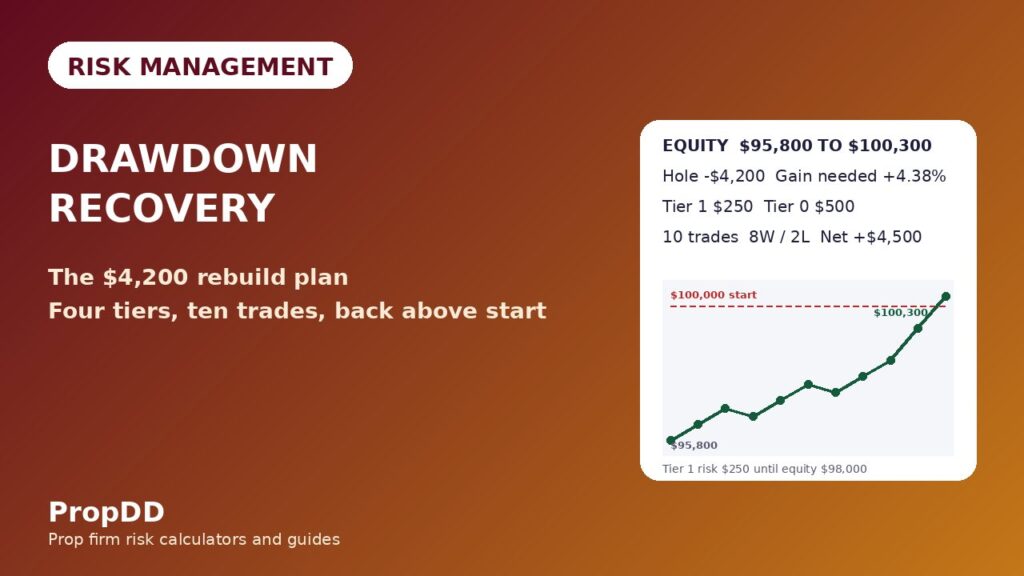
On a Monday in late October I lost one thousand nine hundred dollars before lunch. Tuesday cost me one thousand one hundred more, Wednesday another one thousand two hundred, and by the close my one hundred thousand dollar funded account sat at ninety-five thousand eight hundred. Four thousand two hundred dollars gone in three days — forty-two percent of my ten thousand dollar maximum drawdown used up, and only five thousand eight hundred dollars of room left above the ninety thousand dollar floor. My first instinct was the one that kills funded accounts: double the size on Thursday and win it all back in one trade. I did the opposite. I cut my risk in half, wrote a recovery plan on one page, and rebuilt the account over nine trading days without a single day breaching my personal stop. This is that plan, with every number from the account it saved.
In this article
- What recovery actually means on a funded account
- The recovery maths: every percent down costs more than a percent back
- The four tiers: risk shrinks as the hole deepens
- The ten-trade rebuild, trade by trade
- Filtered vs unfiltered: the same ten trades, two endings
- When recovery is impossible — stop and reset
- My daily recovery routine
- Five mistakes that turn a dent into a breach
- Frequently asked questions
I trade a one hundred thousand dollar account with a five thousand dollar daily loss limit and a ten percent maximum drawdown, risking five hundred dollars per trade at full size. Every number here comes from that account and the ten-trade rebuild that followed the bad week. A drawdown recovery plan is not a revenge strategy. It is a schedule for getting back to zero without ever putting the account at risk of a breach.
What recovery actually means on a funded account
On a funded account it means three things at once, and traders who only count the first one get breached. First, the dollars: earn back the four thousand two hundred. Second, the rules: do it without touching the daily limit or the overall floor, and without breaking the consistency rule that caps your best day at thirty percent of total profit. Third, the clock: every day you spend recovering is a day you are not compounding forward, so the plan has to be fast enough to matter and slow enough to survive.
My drawdown-buffer article covers the other side of this coin: building a cushion above your starting balance before damage happens. This article is what you do when there is no cushion left and the hole is real. The buffer keeps you safe. The recovery plan gets you back.
The hole: equity ninety-five thousand eight hundred, five thousand eight hundred dollars above the floor. At full five hundred dollar risk, twelve consecutive losses would have breached it; at half risk, twenty-four. That decided everything: no full size again until the drawdown was under two percent.
The recovery maths: every percent down costs more than a percent back
Losses and gains are measured on different bases: a four percent loss needs more than a four percent gain to recover, because the gain is calculated on the smaller balance that is left. The formula is simple: gain needed equals the loss divided by one minus the loss. My hole was four thousand two hundred dollars on a ninety-five thousand eight hundred dollar balance — four point three eight percent — and four point three eight percent of ninety-five thousand eight hundred is four thousand two hundred, exactly the hole. The table below shows how the maths punishes deeper holes, and why small drawdowns must be fixed early.
| Drawdown from peak | Dollars down on $100,000 | Gain needed to recover | What it feels like |
|---|---|---|---|
| 1% | $1,000 | +1.01% | One normal week |
| 2% | $2,000 | +2.04% | A careful week |
| 3% | $3,000 | +3.09% | Two careful weeks |
| 4% | $4,000 | +4.17% | My hole, roughly |
| 5% | $5,000 | +5.26% | A full month of good trading |
| 6% | $6,000 | +6.38% | Grinding, not trading |
| 8% | $8,000 | +8.70% | Nearly impossible under a 30% cap |
| 10% | $10,000 | +11.11% | Breached — the floor is gone |
Run your own numbers through the drawdown recovery gain calculator before you size a single trade. If the gain needed is above six percent, read the section on impossible recoveries before you trade at all — the maths may already have decided for you.
The second piece of maths is time. A recovery plan is a daily pace, not a hope. My hole was four thousand two hundred dollars, and my tested net pace at half risk was about four hundred fifty dollars a day — ten trading days to close it. At two hundred fifty dollars a day it would have taken seventeen days, and at one hundred twenty-five a day, thirty-four: more than a month of grinding, during which one more bad week would have finished the account. If your honest daily pace cannot close the hole inside three weeks, your risk tiers are too small or your strategy is not ready, and the right move is to stop and reset instead of grinding.
The four tiers: risk shrinks as the hole deepens
The core of the plan is four risk tiers tied to how deep the drawdown is, not to how confident I feel. The idea of sizing as a percentage of the remaining buffer rather than the account size comes from the dynamic sizing work on managing prop firm drawdown with dynamic sizing: you do not own a one hundred thousand dollar account, you own the ten thousand dollar buffer above the floor, and your risk should shrink as that buffer shrinks.
| Tier | Drawdown depth | Risk per trade | Lots at a 25-pip stop (EURUSD) | Losses to breach the floor | Daily cap |
|---|---|---|---|---|---|
| Tier 0 — full size | 0% to 2% | $500 | 2.00 | 20 | 2 trades |
| Tier 1 — half size | 2% to 4% | $250 | 1.00 | 24 | 2 trades |
| Tier 2 — quarter size | 4% to 6% | $150 | 0.60 | 27 | 1 trade |
| Tier 3 — survival size | Deeper than 6% | $100 | 0.40 | 30 | 1 trade |
The sizing maths is the same every time: lots equal risk divided by stop distance in pips times ten dollars per pip per lot. At two hundred fifty dollars of risk and a twenty-five pip stop, that is two hundred fifty divided by two hundred fifty, which is one lot exactly. At one hundred fifty dollars it is zero point six lots, and at one hundred dollars it is zero point four. I use the position sizing guide table for every tier change so I never do this maths in my head after a loss. Two rules never bend: I move up a tier only when the equity curve crosses the boundary, never because I feel the bad luck is over, and I move down a tier the same day the drawdown crosses a boundary, even mid-session. My hole was four point two percent deep, which put me in Tier 2 on paper — but I started in Tier 1 at two hundred fifty dollars because the hole had stopped growing and I wanted a pace that could close it inside two weeks. That was a judgement call, written down with its reason before the trade, never after.
The ten-trade rebuild, trade by trade
Here is the rebuild exactly as it happened, over nine trading days: only my best setup, EURUSD London pullbacks, one setup a day at most, and I stopped after two trades whether they won or lost.
| Trade | Day | Tier / risk | Result | P&L | Equity after | Drawdown |
|---|---|---|---|---|---|---|
| 1 | Thu | Tier 1 / $250 | Win, +2R | +$500 | $96,300 | -3.70% |
| 2 | Thu | Tier 1 / $250 | Win, +2R | +$500 | $96,800 | -3.20% |
| 3 | Fri | Tier 1 / $250 | Loss, -1R | -$250 | $96,550 | -3.45% |
| 4 | Fri | Tier 1 / $250 | Win, +2R | +$500 | $97,050 | -2.95% |
| 5 | Mon | Tier 1 / $250 | Win, +2R | +$500 | $97,550 | -2.45% |
| 6 | Mon | Tier 1 / $250 | Loss, -1R | -$250 | $97,300 | -2.70% |
| 7 | Tue | Tier 1 / $250 | Win, +2R | +$500 | $97,800 | -2.20% |
| 8 | Tue | Tier 1 / $250 | Win, +2R | +$500 | $98,300 | -1.70% |
| 9 | Wed | Tier 0 / $500 | Win, +2R | +$1,000 | $99,300 | -0.70% |
| 10 | Thu | Tier 0 / $500 | Win, +2R | +$1,000 | $100,300 | +0.30% |
Ten trades, eight wins and two losses, net plus four thousand five hundred dollars — the hole closed, plus three hundred above start. Average net per trade was four hundred fifty dollars. My worst day was minus two hundred fifty dollars, five percent of the daily limit. My best day was plus one thousand dollars, twenty-two point two percent of the net — inside the thirty percent consistency cap, checked in the consistency rule guide before I sized trade nine. Trades nine and ten ran at full risk only after equity crossed ninety-eight thousand and the drawdown fell under two percent; at half size for all ten trades, the same results would have netted plus three thousand five hundred, leaving the hole open by seven hundred.
Filtered vs unfiltered: the same ten trades, two endings
To test whether the tiers actually helped, I replayed the same nine days without them: flat five hundred dollar risk on every trade, no daily trade cap, no stop after two trades. The market gave the same setups, but without the filters I took four extra trades — two revenge entries after the Friday loss and two late entries I would normally have skipped.
| Measure | Filtered (tiers + caps) | Unfiltered (flat $500, no caps) |
|---|---|---|
| Trades taken | 10 | 14 |
| Wins / losses | 8 / 2 | 6 / 8 |
| Net result | +$4,500 | +$2,000 |
| Best day | +$1,000 (22.2% of net — passes) | +$2,000 (100% of net — fails 30% cap) |
| Worst day | -$250 (5% of daily limit) | -$1,500 (30% of daily limit) |
| Closest to the floor | $5,800 above it | $4,300 above it |
| Account recovered? | Yes, +$300 above start | No, still -$2,200 in the hole |
The unfiltered version earned less, broke the consistency rule, and came closer to the floor — with four more trades of effort. The four extra trades were the whole difference: they lost a combined two thousand dollars, which is exactly the gap between the two endings. The tiers did not make my entries better. They stopped me from paying for entries I should never have taken.
When recovery is impossible — stop and reset
Not every hole can be climbed out of, and the honest part of this plan is knowing the line. The table below uses my account’s numbers: a ten thousand dollar maximum drawdown and a five hundred dollar daily limit. Find your row, then act on it instead of hoping.
| Drawdown depth | Equity left | Gain needed | Buffer to the floor | Verdict |
|---|---|---|---|---|
| -3% ($3,000) | $97,000 | +3.09% | $7,000 | Recoverable — Tier 1, two weeks |
| -5% ($5,000) | $95,000 | +5.26% | $5,000 | Recoverable — Tier 2, slow and strict |
| -7% ($7,000) | $93,000 | +7.53% | $3,000 | Borderline — Tier 3 only, one trade a day; twelve losses at $250 breach it |
| -9% ($9,000) | $91,000 | +9.89% | $1,000 | Stop — four losses at $250 breach it; reset is cheaper than grinding |
At minus nine percent you need almost ten percent just to get back to zero, and you have one thousand dollars of room to do it in. One normal losing day ends the account. A reset fee is typically forty to seventy percent of a new challenge price — far less than the months of careful trading a nine percent recovery demands — and the reset starts you at full size with a clean consistency record instead of a best-day problem. I have reset once in my trading life, at minus eight percent, and it was the cheapest lesson I ever bought. Read the challenge reset rules before you pay for one, so you know what carries over and what does not.
My daily recovery routine
A plan that lives in your head dies on the first red day. Mine lives on one page next to the screen and takes eleven minutes — without it, the tiers are just numbers I ignore when I am angry.
| Time | Step | What I write down |
|---|---|---|
| 07:00 | Open the account, not the charts | Equity, drawdown %, tier for today, buffer to floor |
| 07:02 | Set the day’s risk from the tier table | Risk per trade, lots at my stop distance, daily loss cap |
| 07:04 | Check the personal daily stop | My stop is $1,000 — one fifth of the firm’s $5,000 limit |
| 07:05 | Pick ONE setup for the day | Pair, session, entry trigger, invalidation — nothing else trades |
| 07:10 | Trade, maximum two entries | After two trades I am done, win or lose |
| 16:00 | Close the log, close the platform | Trades, P&L, new equity, tomorrow’s tier — then stop |
The personal daily stop is what makes the tiers survivable: one thousand dollars a day, set below the firm’s limit, so a bad day costs a fifth of what the firm allows and never puts the floor in play. Two trades maximum is the second guardrail — the third trade of a losing day is almost always a revenge trade, and the comparison table above shows exactly what revenge trades cost. If a day ends at the personal stop, I do not open the platform again until the next morning.
Five mistakes that turn a dent into a breach
A losing streak does not breach accounts; the behaviour after it does.
Doubling size to win it back in one trade. At four point two percent down, one doubled trade at one thousand dollars of risk is twenty percent of the remaining buffer. Two of them in a row and the floor is in sight. Recovery is a schedule, not a single trade.
Sizing from the account balance instead of the buffer. Five hundred dollars is half a percent of one hundred thousand, which sounds safe. It is eight point six percent of the five thousand eight hundred dollars I actually had left above the floor. Size from the buffer, never from the headline number.
Trading a second pair to “diversify” the recovery. A second pair is not diversification when both pairs move on the same dollar news. It is two positions of the same bet, and a bad dollar day takes both stops at once.
Moving the stop because the trade “has to” come back. A stop moved is a risk tier abandoned. My stop sits beyond the invalidation level, and if price reaches it, the idea was wrong — the recovery plan does not include paying extra for wrong ideas.
Withdrawing profit before the hole is closed. A payout from an account still in drawdown is money taken out of the recovery. I take nothing until equity is back above the starting balance for five consecutive trading days.
Frequently asked questions
How long should a drawdown recovery take on a funded account?
Two to three weeks for a hole under five percent, at a realistic net pace of two hundred fifty to four hundred fifty dollars a day on a one hundred thousand dollar account. If your honest pace cannot close the hole inside three weeks, stop and reset rather than grind for a month.
Should I reduce my risk after a drawdown, or keep it the same?
Reduce it, and tie the reduction to the depth of the hole, not to your mood. My tiers cut risk to half at two percent down, to thirty percent at four percent, and to twenty percent past six percent. Flat risk after a drawdown is how a four percent hole becomes a breach.
What is the formula for the gain needed to recover a loss?
Gain needed equals the loss divided by one minus the loss. A five percent loss needs a five point two six percent gain, an eight percent loss needs eight point seven percent, and a ten percent loss needs eleven point one one percent.
Can I still pass a challenge while recovering from a drawdown?
Yes, if the hole is under five percent and the challenge has no hard time limit pressing you. The recovery plan works in a challenge exactly as on a funded account — but if the challenge clock is short, the slow pace of a real recovery may not fit, and a reset is usually the better spend.
When should I reset instead of recovering?
Past seven percent drawdown, recovery becomes borderline: you need over seven and a half percent while holding only three thousand dollars of buffer. Past nine percent, stop — four normal losses breach the account, and a reset fee is cheaper than the months a real recovery would take.
Does a drawdown recovery break the consistency rule?
It can, and that is the trap. Small, steady recovery days are fine, but one big winning day that makes up most of your total profit fails the thirty percent best-day cap. My best recovery day was one thousand dollars, twenty-two point two percent of the four thousand five hundred net — inside the cap because the wins were spread across nine days.
Risk disclaimer: this article describes my own funded-account experience for education only. It is not financial advice. Prop firm trading can lose the full challenge fee, and no recovery plan guarantees an account survives. Always read your firm’s exact drawdown, consistency and reset rules before trading.