A break of structure is the moment price closes beyond the most recent significant swing high or swing low and keeps going — the market telling you the trend is continuing with fresh momentum. The break of structure strategy guide covers the full five-rule confirmation filter; this calculator does the fiddly part for you. Feed it the broken level, your retest entry and the prior swing extreme, and it returns your stop beyond the broken level, your exact lot size from your chosen risk, 1.5R and 2R targets, a measured-move projection — and a TRADE IT or SKIP verdict with the reasons spelled out.
In this article
What the calculator works out
The maths mirrors the strategy’s own rules. The entry is your retest fill at the broken level — never a chase of the initial spike. The stop sits beyond the broken level plus your buffer, on the invalidation side: for a long, below the broken high; for a short, above the broken low. If price closes back inside past that buffer, the break has failed and you are out — that is the whole point of a structural stop, and it is why the calculator refuses a retest that is already back inside. Targets are pure R-multiples of the stop distance — 1.5R for the first scale, 2R for the runner — plus a measured-move projection that throws the prior swing range forward from your entry as a sanity check on the 2R target. If the measured move falls short of 2R, think twice before holding for the runner.
Worked example: buying a break-and-retest on EURUSD
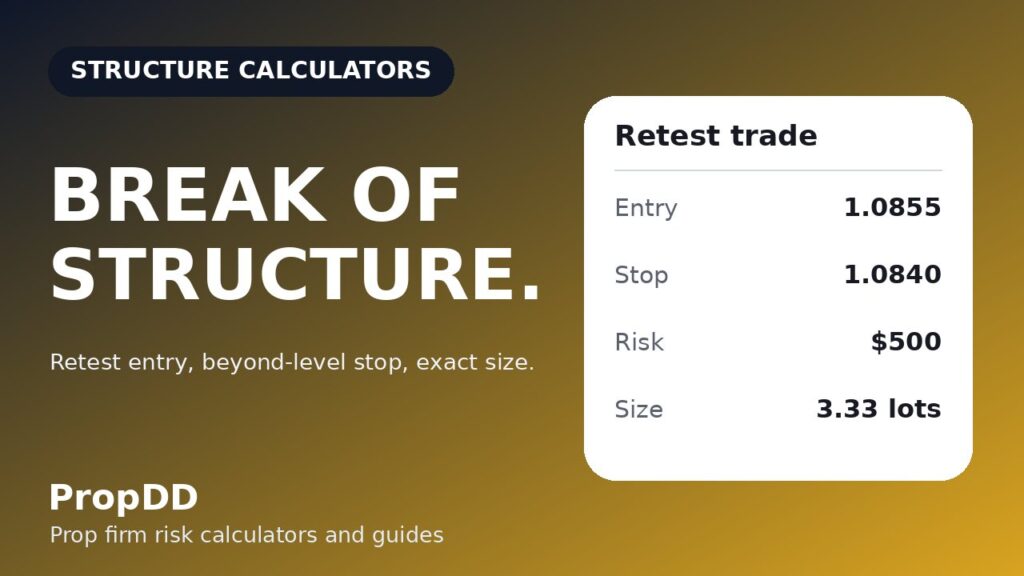
Defaults loaded in the widget above, so you can press Calculate and follow along. EURUSD breaks the swing high at 1.0850, retests at 1.0855, prior swing low 1.0750 (a 100-pip range), buffer 10 pips, $100,000 account risking 0.5% with a $2,500 personal daily stop:
| Output | Value | How it was computed |
|---|---|---|
| Entry | 1.0855 | Retest price — your entry fill |
| Stop | 1.0840 | Broken level 1.0850 − 0.0010 buffer |
| Stop distance | 15.0 pips | |1.0855 − 1.0840| ÷ 0.0001 |
| Risk | $500 | $100,000 × 0.5% |
| Position size | 3.33 lots | $500 ÷ (15.0 × $10) |
| Target 1 (1.5R) | 1.08775 | 1.0855 + 1.5 × 0.0015 |
| Target 2 (2R) | 1.0885 | 1.0855 + 2 × 0.0015 |
| Measured move | 1.0955 | 1.0855 + 0.0100 prior swing range — clears the 2R target, so the runner has room |
| Verdict | TRADE IT | 15-pip stop is 0.14% of entry, $500 well under the $2,500 daily stop |
When the calculator says SKIP
The verdict is the part that protects a funded account. It refuses the trade — with the exact reason — when any of these fire:
| Gate | Rule | Why it exists |
|---|---|---|
| Failed back inside | Retest already past the broken level + buffer on the wrong side → SKIP | A break that closes back inside is not a break any more — the thesis is dead, not discounted |
| Oversized pattern | Stop wider than 1% of entry → SKIP | On a $100k account a 1% stop forces either tiny size or real daily-stop danger |
| Daily-stop breach | Risk above your personal daily stop → SKIP | One trade must never be able to end your day on its own |
| Dust size | Lots under 0.01 → SKIP | If the maths says 0.004 lots, the pattern does not fit this account — move on |
| Inconsistent origin | Broken level on the wrong side of the prior swing extreme → SKIP | A “long break” whose origin sits above the level is not a structure break at all — check your inputs |
How this fits prop firm rules
Break-of-structure trades are a natural funded-account pattern for one reason: the stop has a structural home — beyond the broken level — instead of a round-number guess. That keeps stop distances tight, which keeps lot sizes honest under your personal daily stop. Two disciplines from the strategy guide matter more than the calculator itself: never chase a break that runs without a retest (a missed trade costs nothing, a chased one pays spread at the worst moment), and never trade a break in thin hours or inside red news — BOS needs volume, and thin sessions produce the fake displacement the guide’s filter exists to reject. Size every retest through this calculator, not by feel — feel is how traders turn a clean 15-pip structural stop into a 150-pip hold-and-hope.
Frequently asked questions
What counts as a real break?
A close beyond the level with strong displacement — a wide-bodied candle that shows real order flow behind the move. A wick piercing the level with a close back inside is not a break, and a one-pip close on a normal candle is a candidate at best. The full filter is in the break of structure strategy guide.
How is this different from the turtle soup calculator?
Opposite intent. The turtle soup calculator fades a failed breakout: price sweeps a level, raids the stops, closes back inside, and you trade the reversal with your stop beyond the sweep extreme. This calculator trades the opposite outcome: price breaks a level, holds it on the retest, and you trade the continuation with your stop beyond the broken level. Same chart area, mirror-image trades — different maths, different verdicts, no overlap.
How is this different from the order block calculator?
The order block calculator enters at a zone — the last opposite-coloured candle before a displacement leg — with the stop beyond the block extreme. This calculator enters at a broken level, not a zone: the level is a single price, the stop sits just beyond it, and the measured move comes from the prior swing range rather than a displacement leg.
What if price never retests the broken level?
Then there is no trade. Chasing the initial spike is a different strategy with worse R-multiples and fills at the moment of maximum emotion. Let it go; the calculator only prices the retest.
Can I use this on gold or indices?
Yes — switch the pip-size selector to 1 for XAUUSD or 0.1 for indices and enter prices in the instrument’s own units. The 1% stop-width gate still applies, so on volatile instruments a 10-point buffer may need raising before the maths looks sane.
Risk note: a break that fails back inside the level invalidates the setup — if price closes back inside past your buffer, the trade is over, whatever the calculator said at entry. Nothing here is financial advice. Demo every new setting for two weeks before it touches a funded account.