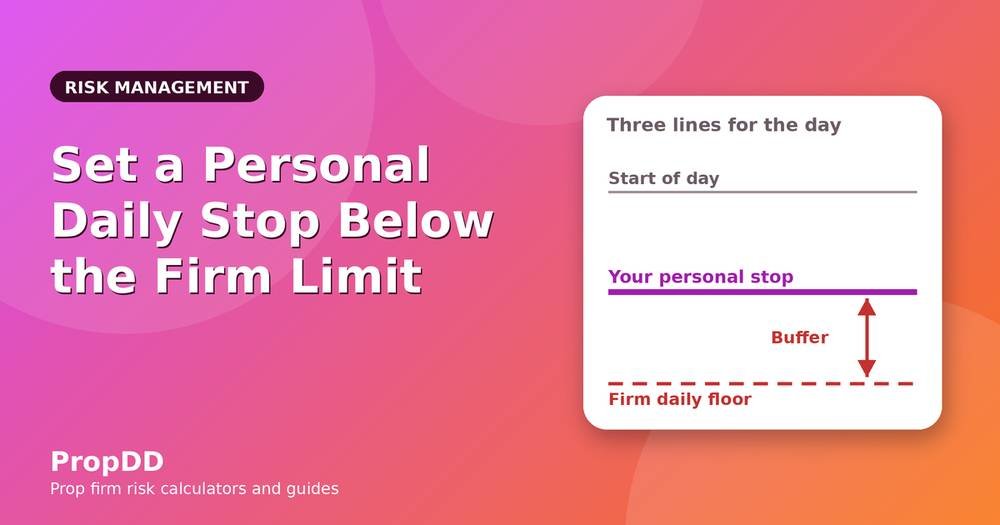
The firm’s daily loss limit is the edge of a cliff. A personal daily stop is the fence you put up well before you reach it. It is the cheapest, simplest habit you can borrow from traders who keep their accounts for years, and it costs nothing except the willingness to stop trading when you’d rather not.
In this article
- Why not trade right up to the limit?
- How far below the limit should it be?
- Choosing your level
- Three types of personal stop
- Express it in R as well
- Worked examples
- Don't forget the open trades
- What to do when it triggers
- How to enforce it
- A daily profit stop too
- A weekly stop as backup
- The psychology of respecting it
- Common mistakes
- Three traders, three styles
- What if you hit the stop before 10 a.m.?
- Adjusting the stop as you gain experience
- Measure what the stop saved you
- Putting it into your trading plan
- Further reading
- Frequently asked questions
- The short version
- A personal stop at 50% to 80% of the firm’s daily limit protects you from slippage, spreads and bad judgement near the real floor.
- Choose one clear rule type, a dollar amount, a number of losing trades or both, and write it down before the session.
- When it triggers, close everything and stop. The rule only works if it is enforced the same way every time.
In this guide you’ll learn why a soft stop beats trading to the limit, how to choose your percentage, three rule types you can use, and a routine for enforcing it. The drawdown calculator already shows a soft stop at 80% of your limit, so you can use it as a starting point and tighten from there.
Why not trade right up to the limit?
Because the last few percent are exactly where things go wrong. Spreads widen, stops slip, fast moves overshoot, and your own decisions get worse as the wall gets closer. Traders who use the firm’s line as their only stop have no margin for any of that. A surprise of just a few hundred dollars becomes a breach.
There’s a second reason, less obvious: a personal stop turns a catastrophic event into a routine one. Hitting your own stop means “a bad day, I’ll try again tomorrow”. Hitting the firm’s limit means “the account is gone”. The first is a Tuesday. The second is a loss of fees, time and confidence.
How far below the limit should it be?
Most traders land somewhere between 50% and 80% of the daily limit. Here’s how different levels look on a $100,000 account with a 5% limit.
| Personal stop | Share of limit | Loss allowed | Equity at stop | Buffer to firm floor |
|---|---|---|---|---|
| Tight | 50% | $2,500 | $97,500 | $2,500 |
| Moderate | 60% | $3,000 | $97,000 | $2,000 |
| Standard | 70% | $3,500 | $96,500 | $1,500 |
| Loose | 80% | $4,000 | $96,000 | $1,000 |
The buffer column is what matters. It’s the amount of money standing between a normal “stopped for the day” and a breach. A $1,000 buffer is roughly what a single slipped stop can consume during a volatile move.
Choosing your level
Pick based on your style, not on what feels brave.
- Scalpers and high-frequency traders: go tighter (50% to 60%), because costs and rapid sequences of losses add up quickly.
- Day traders with a few setups: 60% to 70% is a good middle.
- Swing traders with wide stops: 70% to 80%, but make sure one full-stop loss doesn’t take you beyond it.
A useful test: your personal stop should be at least two to three full-risk losses above the firm’s floor. If a single trade’s stop plus slippage could carry you from your personal stop through the floor, the buffer is too thin.
Three types of personal stop
1. Dollar or percentage stop
“I stop for the day when my equity is down 3% from the start of the day.” Easy to measure, easy to alert on. It works best with a clear start-of-day figure, which you get from the calculator.
2. Trade-count stop
“I stop after two losing trades in a row” or “after four trades total.” It guards against sequences that drain the day slowly, and against emotional chains of trades, as in revenge trading.
3. Combined rule
Whichever comes first. Many traders use “down 3%, or three losses, or four trades” and find it the most protective. It’s also the easiest to remember because each part is simple.
Express it in R as well
If you track results in R multiples (where 1R is your risk per trade), your stop can be “−4R for the day”. At 0.5% risk per trade that’s 2% down; at 0.75%, 3%. Thinking in R keeps the rule consistent when your risk per trade changes. It also makes it easy to see whether the stop sits comfortably inside the firm’s limit. Our guide to how much to risk per trade explains how to set that number.
Worked examples
$25,000 account, 5% limit, day trader
Max daily loss $1,250. Personal stop at 70%, so $875. Risk per trade 0.4%, or $100. That gives about eight full losses before the personal stop. Combined rule: stop at −$875, or two consecutive losses followed by a 60-minute break, or four trades total.
$100,000 account, 4% limit, swing trader
Max daily loss $4,000. Personal stop at 75%, so $3,000. Risk per trade 0.5%, or $500. That allows six full losses. Because swing stops are wide, the combined rule adds a cap on open risk: total stops across all open trades never exceed $1,500.
Don’t forget the open trades
Your stop shouldn’t only be triggered by closed losses. If you hold open positions, the equity-based picture can reach your stop before anything closes. Under many firms’ rules, floating losses count, as we explain in floating losses and open trades. Set your alert on equity, not balance.
What to do when it triggers
This is where most plans fail, so make it mechanical.
- Close every open position. Don’t “wait for it to come back”.
- Delete all pending orders.
- Take a screenshot of your equity and trade list.
- Close the trading platform and step away.
- Write three lines in your journal: what happened, what the stop saved, what you’d change.
- Don’t reopen the platform until tomorrow.
The most common failure is “just checking the chart” after the stop. That’s the first step back into the same behaviour.
How to enforce it
- Alerts: most platforms let you set a price or equity alert. Set one at your soft-stop equity.
- Write the number: floor, soft stop and maximum trades on a sticky note by the monitor.
- Use the calculator before each trade: check the room left and whether you’re close.
- Accountability: tell a friend or fellow trader your rules and report when you hit them.
- Lock-out habits: log out and, if you can, close the terminal fully after the stop.
A daily profit stop too
Stopping after a big win is as important as stopping after a loss, and almost nobody does it. After a strong morning, confidence rises and size creeps up. Many traders set a profit stop, such as +1.5R to +2R, and finish early. It doesn’t have to be rigid, but a rule like “after a winning day, I may only take one more trade at half size” protects gains from afternoon giveback.
A weekly stop as backup
A bad week can erode both the daily margin and the overall cushion, as described in daily versus overall drawdown. A simple weekly rule: if you’re down more than twice your personal daily stop in a week, cut size by half for the next week. It’s boring, effective and rarely discussed.
The psychology of respecting it
Stopping when you feel you could “make it back” is uncomfortable. That discomfort is the price of the rule, and it’s smaller than the price of a breach. A helpful reframe: you’re not quitting, you’re protecting tomorrow’s trader from today’s emotional one. After a few weeks of sticking to it, most people find the stop becomes a relief, because the decision has already been made.
Common mistakes
- Setting the stop at 95% of the firm’s limit, which is barely a stop at all.
- Moving the personal stop during the day “just this once”.
- Ignoring floating losses when checking it.
- Reopening the platform after the stop to “just look”.
- Using a stop so tight that you’re stopped out by normal variance every second day.
Three traders, three styles
It helps to see how different people use the same idea. Imagine three traders on $50,000 accounts with a 5% limit ($2,500).
- Nadia, a scalper: stops at 50%, which is $1,250, and after any three consecutive losses. Her trades are quick and frequent, so she wants early protection.
- Omar, a day trader: stops at 70%, which is $1,750, with a cap of four trades. He takes fewer, bigger setups.
- Hira, a swing trader: stops at 80%, which is $2,000, but also limits total open stop distance to $1,000, because her positions stay open for days.
None of them is “right”. Each rule fits the way the person actually trades, and each can be explained in one sentence. If you can’t explain your rule in a single breath, it’s probably too complicated to follow when you’re stressed.
What if you hit the stop before 10 a.m.?
It happens. Maybe two quick stop-outs and a spike, and you’re done for the day before the main session starts. That’s annoying, and it’s also exactly why the rule exists: a bad start is the most dangerous time to keep trading, because the pull to recover is strongest. Use the free time. Review the trades, update the journal and plan tomorrow. Many traders find that their best weeks include a day or two when the stop fired early, because it kept a small loss small.
Adjusting the stop as you gain experience
Don’t change it daily, but do review it monthly. If your stop never triggers and your daily results always finish well above it, you may be too conservative, and could loosen it slightly. If it triggers twice a week, either your risk per trade is too high or the stop is too tight for your strategy’s normal variance. Look at your journal for the pattern and make small changes, one at a time.
Measure what the stop saved you
This is a surprisingly motivating exercise. On days the stop triggers, write down what happened afterwards: did the market keep going against you, or would you have recovered? Over time, you’ll build a picture. Keep it honest, including the days it cost you a winner. Even so, the value of the rule isn’t in each individual day. It’s in the one day a year it prevents the breach.
Putting it into your trading plan
Write the rule in one paragraph at the top of your plan: the personal stop in dollars and percent, the trade-count limit, what you do when it triggers and what you do the next morning. Add the firm’s floor beneath it as a reminder of what the stop is protecting. Print it, or keep it pinned on your screen. When the rule is visible, you’re far more likely to follow it than when it’s something you remember vaguely.
Review it every Sunday for two minutes. Did it trigger? Did you follow it? Is the level still right? That small habit is how a rule becomes part of how you trade, rather than something you resent at the worst possible moment.
Further reading
For background on protecting capital in general, see Investopedia’s overview of risk management and its explanation of a stop-loss order. If you want to track how often your personal stop triggers, Myfxbook or a simple spreadsheet will do the job.
Frequently asked questions
Is 80% too loose?
It can be fine for slow, wide-stop styles, but make sure a single slipped stop can’t carry you from 80% to 100%. Many traders find 60% to 70% is safer.
Should I set the stop in percent or dollars?
Whichever you’ll follow. Percentages scale with account size; dollars feel concrete. Both work if applied consistently.
Does the stop reset daily?
Yes, it follows the same start-of-day figure as the firm’s daily limit. Check the reset time, as explained in the daily drawdown reset time guide.
What about a trailing stop on profits?
That’s a different tool, used on individual trades. You can read the basics of a trailing stop, but a personal daily stop is about your whole day, not a single position.
The short version
Decide your personal stop before the session, in a form you’ll follow, at a distance from the firm’s floor that can absorb a slipped trade. Alert it, enforce it and log off when it triggers. It’s the least glamorous skill in prop trading and one of the most valuable. To see the number for your own account, enter your details in the calculator, and if you want the wider rule behind it, read the prop firm max daily drawdown explained.