You pass the profit target in nine days, and the dashboard doesn’t say congratulations. It says the consistency rule hasn’t been met. One of your days made more than a certain share of your total profit, and that’s a problem. It’s one of the stranger moments in prop trading, because you did what the challenge asked and still aren’t done.
In this article
- What a consistency rule is for
- The common forms
- A worked example of a best-day rule
- Check the exact definition
- How it interacts with the daily drawdown
- Plan for it from day one
- What to do after a very big day
- Track it in a sheet
- Swing traders and the consistency rule
- Minimum trading days
- Funded accounts and payouts
- The psychology of being too good
- Questions to ask support
- Mistakes to avoid
- Three imaginary traders, one rule
- A quick way to estimate your daily ceiling
- When the rule changes
- Keep perspective
- A short note for part-time traders
- Frequently asked questions
- The short version
Consistency rules are not the same as drawdown rules, though the two interact in ways worth understanding. This article explains the common forms, shows the arithmetic with a worked example, and gives you a way to plan so you don’t discover the rule by tripping over it. Rules differ between firms, so use this as a map, and confirm every detail in your own rulebook. For the daily loss side, keep the drawdown calculator open.
What a consistency rule is for
From the firm’s point of view, it’s a way to separate steady trading from lucky trading. A trader who makes the whole target in one large, risky day looks very different from one who makes the same amount across ten ordinary days, even though the account balance ends up the same. The first might have been one gamble that happened to pay. The firm would prefer to fund the second kind of person.
Whether you like the rule or not, it exists for a reason, and understanding the reason makes it easier to live with. It rewards the habits that help you anyway: modest risk, many small decisions, no heroics.
The common forms
Names and details vary, but a few patterns come up often. A best-day rule says that no single day can account for more than some percentage of your total profit. A minimum trading days rule requires a certain number of days on which you traded. A minimum daily profit rule counts a day only if it reaches a threshold. And some programs require profit distribution across weeks. Check which of these apply, how they’re worded and whether they apply in the evaluation, the funded phase or both.
A worked example of a best-day rule
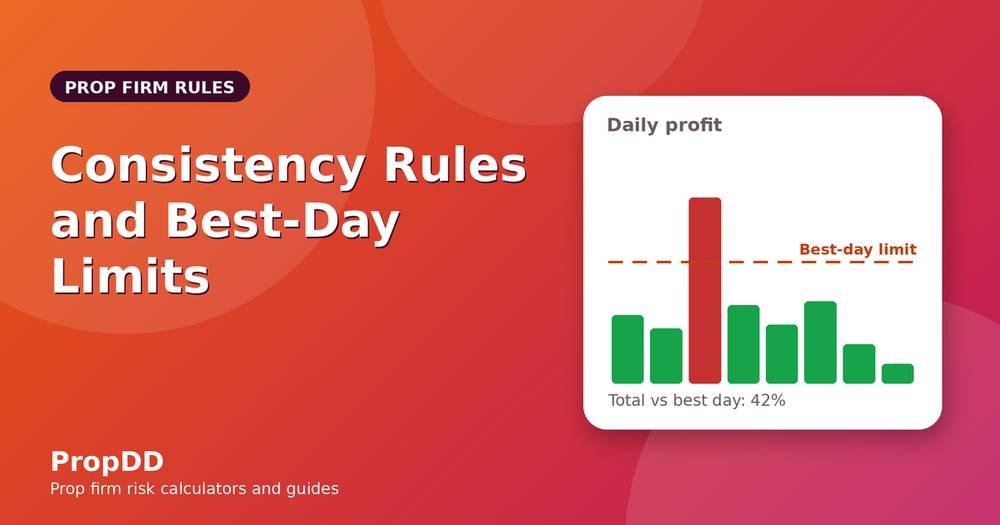
Suppose the rule says your best day can’t be more than 40% of your total profit, and the target is $4,000 on a $50,000 account. You trade for eight days and make $400, $300, $1,700, $500, $350, $450, $200 and $100. Total: $4,000. The best day was $1,700, which is 42.5% of the total. You’ve hit the target, but you’ve broken the rule by 2.5 points.
How do you fix it? Not by cancelling the big day, which has already happened. You’d need to increase the total profit while the best day stays the same. For the best day to be 40% or less, the total needs to be at least $1,700 ÷ 0.4 = $4,250. So you need another $250 of profit over the following days, without a single new day exceeding $1,700. That’s a perfectly achievable target, and it shows why one very big day makes everything else harder.
Check the exact definition
Small wording differences change the arithmetic. Is it measured against total profit, or net profit after losing days? Does it consider closed profit only? Is a “day” a calendar day or a server day, and when does it reset? Is the rule about the best single day or the best few days? Does it apply to the account’s lifetime or to each payout period? Put the answer to each in your notes. The reset question is the same one covered in the daily drawdown reset time guide.
How it interacts with the daily drawdown
This is where the two rules meet. A trader who’s behind schedule may be tempted to take a bigger risk to produce a big day, which raises the chance of hitting the daily limit. A trader who has had a very large day may feel the pressure of the consistency rule and start forcing small ones, which is how overtrading begins. In both cases, the temptation pushes against the risk habits that keep an account alive. Our article on the prop firm max daily drawdown explains why those habits matter.
Plan for it from day one
The simplest approach is to cap how much you aim to make in a day. If the target is 8% and the best-day rule is 40%, no single day should produce more than about 3% on the way. In practice, you’d aim for a typical day of 0.5% to 1% and treat anything beyond 1.5% as a signal to stop. This fits neatly with a daily profit stop, a rule that sensible traders often use anyway. It also fits the pace described in how to pass a prop firm challenge with small daily risk.
What to do after a very big day
You’ve had a day that makes up half the target. It’s a nice problem, and it needs a clear head. First, stop trading for the day. Second, work out the arithmetic: what total do you now need so that the best day falls within the limit? Third, plan the next days at normal risk, aiming for steady gains. Don’t try to dilute it quickly by taking big risk elsewhere. The consistency rule doesn’t mind how long you take, and the daily drawdown absolutely minds how fast you try.
Track it in a sheet
You need three columns: date, profit for the day and running total. Then two formulas: the maximum of the profit column, and that maximum divided by the running total. Add a conditional format that turns the cell red when the share is within five points of the limit. It takes two minutes to build, and it replaces a worry with a number. If you already keep a trading journal, add the columns there.
Swing traders and the consistency rule
If you hold trades for days, your profit arrives in lumps: a few winners close and a week’s results show up on one day. That can make a best-day rule awkward, because a single closing trade might be most of your profit. Options include closing positions in stages, taking partial profits over several days, or choosing a program without such a rule. Be honest about whether a firm’s rule suits your style before you pay for it. The checklist in daily drawdown rules: what to check before you buy includes this question.
Minimum trading days
If there’s a minimum number of trading days, check what counts as one. Some programs require a trade of a certain size, some require a minimum profit or loss and some count any day on which a position was opened. Don’t place pointless trades to tick the box, since each trade has costs and each costs a little of the daily room. A small, rule-following trade at normal risk is better than a token one at odd size.
Funded accounts and payouts
Some consistency rules apply again when you request a payout, measured over the payout period. That can matter if you’ve had a lucky week and want to withdraw. Read the payout terms next to the profit rules, and see prop firm payout rules and drawdown for what else to check. If a rule can delay or reduce a payout, plan your trading in the weeks before it.
The psychology of being too good
There’s something odd about a rule that penalises success. A great day makes you tense, and a tense trader makes worse decisions. The antidote is to treat the great day as a fact, not a verdict. Write down what happened, work out the number you now need and go back to your routine. If you feel the urge to “balance things out” with a big losing trade, that’s not discipline, it’s anxiety looking for an outlet.
Questions to ask support
Four will do. What exactly is the consistency threshold and how is it calculated? Does it use closed profit or equity? Does it apply in the evaluation, the funded phase or both? Is there an example in the terms or the FAQ? Ask in writing, and keep the answer with your notes. If the example doesn’t match the written rule, ask which one the firm applies.
Mistakes to avoid
Discovering the rule after passing the target. Forcing a big day to catch up. Placing token trades to meet minimum days. Ignoring how the rule is worded. Assuming it’s the same at every firm. Letting the arithmetic push you into more risk than your plan allows.
Three imaginary traders, one rule
Take a 40% best-day rule and a $4,000 target. Trader A makes $500 a day for eight days: the best day is 12.5% of the total, no problem. Trader B makes $300 for seven days and $1,900 on the eighth: total $4,000, best day 47.5%, over the limit. Trader C holds swing trades and books $3,200 on one day with small results on the others, adding up to $4,100: best day 78%, far over. All three reached the same number. Only one of them is finished.
The lesson isn’t that you must trade like A. It’s that the shape of your profits matters as well as the size, and that the shape is something you can see coming if you look at it each day.
A quick way to estimate your daily ceiling
Multiply the target by the best-day percentage. With an $4,000 target and a 40% rule, no day should exceed $1,600 by the time you finish, and more safely, aim to stay well under it. If you’re mid-way and a day goes above your ceiling, you know you need extra profit across the other days to compensate. Write the ceiling on your daily card next to the floor and the personal stop. It’s one more number, and it prevents an unpleasant discovery.
When the rule changes
Firms adjust their terms, and a rule that applied when you bought may differ by the time you request a payout. Save the version of the rules you signed up under, check for updates before each period and ask which version applies to you if they differ. It’s a small piece of admin that protects you from a large amount of confusion.
Keep perspective
A consistency rule is one more constraint, and constraints are what you trade inside anyway. The daily limit, the overall limit, the news windows, the trade caps: all of them shape what a good trading day looks like. Seen that way, the best-day rule is just another guide telling you the sort of trader the firm wants, and that trader looks a lot like the one who survives in any market: steady, patient and not in a hurry.
A short note for part-time traders
If you only trade a couple of days a week, a best-day rule can bite harder, because each day carries a bigger share of the total. Plan around it by choosing a target pace that spreads your profit over more sessions, and don’t compress a month of ambition into two big days. A steady small gain, repeated, is easier on both the consistency rule and your nerves.
Frequently asked questions
Is a consistency rule the same as a drawdown rule?
No. Drawdown rules limit how much you can lose. Consistency rules limit how lumpy your profits can be. You can break either without breaking the other.
Can I fix a broken consistency rule?
Usually by making more profit across later days so that the best day becomes a smaller share, without creating a new, bigger best day. Check whether your firm allows it.
Do all firms have one?
No. Many do, in different forms, and some don’t. That’s why it belongs on your pre-purchase checklist.
Should I avoid big days?
Not by refusing profit, but by not forcing risk to create them. If a big day happens inside your plan, take it and adjust the following days.
The short version
A consistency rule limits how much of your profit can come from one day. Read the exact definition, do the arithmetic in advance, aim for steady days, stop after an unusually big one and keep your daily risk rules intact. For the rule that sits next to it, see daily versus overall drawdown, and for general background on managing risk, Investopedia’s risk management page and the free lessons at BabyPips are worth your time.