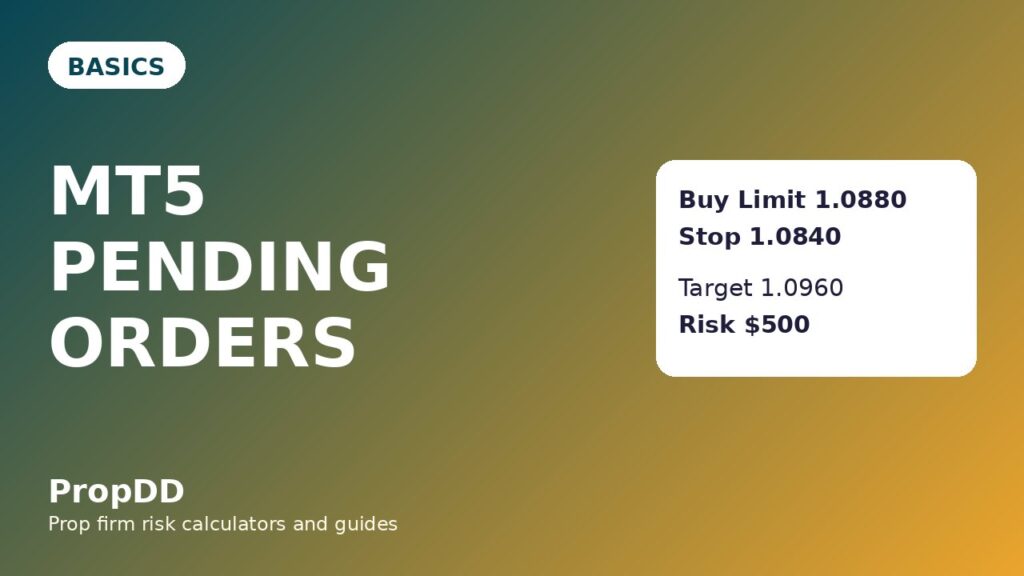
I used to chase every funded entry with a market order, and I paid for it in slippage, in spread, and in pride. The trade that finally changed my mind was a EURUSD pullback I had planned for two days. Price came back to my level at 1.0880 while I was away from the desk, filled me at 1.0897 on a market order I placed in a hurry when I got back, and then stopped me out at a level my plan had never allowed. I had the right idea, the right level, and the wrong order type. A pending order would have waited at 1.0880 for me, or not filled at all, and either outcome would have been better than the rushed fill I actually got.
In this article
- The market order that cost me a funded day
- The four pending orders, in plain English
- How I size a pending order under a daily limit
- A worked buy-limit trade, level by level
- The expiry rule that saves funded accounts
- Five ways pending orders still blow up
- My pending-order routine before I press place
- I tested it: twelve pending-order trades
- Frequently asked questions
MT5 pending orders on a funded account are worth learning precisely because they remove the worst part of funded trading: the moment when a good plan meets a fast market and you abandon the plan to get in. A pending order is an instruction you leave with the platform: buy or sell only if price reaches this level, with this stop and this target already attached. On a funded account that discipline is not cosmetic. Every rushed market entry risks the daily loss limit, and a pending order is the simplest way to make sure you only trade the price you actually planned.
The market order that cost me a funded day
The setup was a trend pullback on EURUSD, the kind I had traded a dozen times. My level was 1.0880, my stop was 1.0840, and my targets were 1.0920 and 1.0960. I wrote all of it in my journal the night before, then went out for the morning. When I checked my phone, price had touched 1.0880 and bounced to 1.0895. I panicked, bought at market, and watched price fall back through my level and hit what would have been my stop, except my stop was now placed below a worse entry, so the loss was bigger than the plan allowed. One trade, one moment of impatience, and my funded day was over before lunch.
The lesson was not that pullbacks do not work. The lesson was that a plan written in a journal is useless if the platform does not enforce it while you are away. A buy limit at 1.0880 would have done exactly that. It would have filled at my level, or it would have stayed unfilled and expired, and I would have kept my daily loss limit intact. That is the whole case for pending orders: they trade your plan when you are not there to sabotage it.
The four pending orders, in plain English
MT5 gives you four pending order types, and the only thing you need to remember is whether you are buying below the current price or above it, and whether you expect price to turn or to break through. A limit order expects a turn. A stop order expects a breakout. Mix those two up and you will buy strength when you meant to buy a dip, which is how most pending-order mistakes start.
| Order type | Placed where | What it expects | Funded-account use |
|---|---|---|---|
| Buy Limit | Below current price | Price falls to your level, then turns up | Pullback entries, support buys |
| Sell Limit | Above current price | Price rises to your level, then turns down | Resistance sells, range tops |
| Buy Stop | Above current price | Price breaks up through your level | Breakout entries, momentum continuation |
| Sell Stop | Below current price | Price breaks down through your level | Breakdown entries, breakdown continuation |
My rule is simple: if I would be happy to see price touch my level and immediately reverse, I use a limit. If I only want in when price proves it can break the level, I use a stop. Everything else in this article, the sizing, the expiry, the failure modes, follows from that one distinction. If you are still placing market orders for setups you planned hours ago, you are choosing the order type that gives you the least control at the exact moment control matters most. For the platform steps themselves, FunderPro’s MT5 setup guide walks through choosing a pending order type in the trading ticket before you set your lot size, stop and target.
How I size a pending order under a daily limit
A pending order does not change your risk maths, and that is the point. The stop distance is known before the order is placed, so the position size is fixed before anything fills. I trade a $100,000 funded account with a firm daily loss limit of $5,000 and a personal daily stop of $2,500, and I risk $500 per trade. That $500 is 10% of the firm limit and 20% of my personal stop, so even two losing pending trades in a row leave me well inside both limits.
| Input | My number | Why it matters |
|---|---|---|
| Account size | $100,000 | Sets every dollar limit on the account |
| Firm daily loss limit | $5,000 (5%) | The hard line that ends the account |
| Personal daily stop | $2,500 | My own line, hit long before the firm line |
| Risk per trade | $500 | Fixed, never sized up after a win or a loss |
| Stop distance | 40 pips | Measured from entry level to stop level |
| Position size | 1.25 lots | $500 divided by (40 pips x $10 per pip) |
The formula is the same one I use for every trade, and I run it before I place the order, not after it fills: lots = risk in dollars divided by (stop distance in pips multiplied by $10 per pip per lot on EURUSD). For a 40-pip stop that is 500 divided by 400, which is 1.25 lots. If the stop were 20 pips, the size would be 2.50 lots. If it were 60 pips, it would be 0.83 lots. The dollar risk never changes. Only the lot size moves, and it moves in the opposite direction to the stop distance, which is exactly how a funded account survives.
| Stop distance | Size at $500 risk | Loss if stopped out |
|---|---|---|
| 20 pips | 2.50 lots | $500 |
| 30 pips | 1.67 lots | $500 |
| 40 pips | 1.25 lots | $500 |
| 50 pips | 1.00 lot | $500 |
| 60 pips | 0.83 lots | $500 |
Before I trust any sizing grid, I check it against the max daily drawdown calculator, because a pending order that fills during a fast move still counts against the daily limit the moment it goes underwater. The calculator is not a substitute for the formula above, but it is a fast second check that my $500 risk and my $2,500 personal stop leave real room on a $5,000 firm limit.
A worked buy-limit trade, level by level
Here is the same EURUSD pullback, traded the way I trade it now. Price is at 1.0930 and falling toward support. I do not chase it. I place a buy limit at 1.0880, a stop at 1.0840, a first target at 1.0920 and a second target at 1.0960, and I walk away. If price never reaches 1.0880, nothing happens, and that is a good outcome, not a missed trade. If it does, I am filled at the level I chose, with the stop and targets I chose, at the size I calculated in advance.
| Level | Price | Distance from entry | Dollar result at 1.25 lots |
|---|---|---|---|
| Stop loss | 1.0840 | 40 pips against me | -$500 (1R loss) |
| Entry (buy limit) | 1.0880 | 0 pips | $0 at fill |
| First target | 1.0920 | 40 pips in my favour | +$500 (1R win) |
| Second target | 1.0960 | 80 pips in my favour | +$1,000 (2R win) |
The trade either loses $500, wins $500 at the first target, or wins $1,000 at the second target, and I know all three numbers before I place it. That certainty is what makes pending orders so useful on a funded account. A market order placed in a hurry has none of it: the entry is wherever price happens to be, the stop is an afterthought, and the risk is whatever the market decided for you. I also close part of the position at the first target when the trade runs, which locks in the 1R win and lets the rest run to the second target without risking the day.
The expiry rule that saves funded accounts
The most dangerous pending order is the one you forgot. MT5 lets you set an expiry, and on a funded account I treat that expiry as part of the trade, not as an optional extra. A buy limit left open over a weekend can fill on a Monday gap at a price that has nothing to do with your original setup, and a stop order left open through a news release can trigger on a spike and reverse before you even see it. Both of those fills count against your daily loss limit, and neither of them was a trade you would have taken on purpose that day.
My rule is that every pending order gets an expiry, and the expiry matches the setup. A session pullback gets an expiry at the end of that session. A daily-level order gets an expiry at the end of the day. A swing order that genuinely needs a week gets a written note in my journal with the date I will review it, and I review it, even if the market has done nothing. Good-till-cancelled is the default in MT5, and it is the default I almost never use, because a funded account does not need orders that outlive the idea behind them.
Before I place any pending order I also check whether I already have an open position or another pending order on the same pair. Two pending orders on EURUSD, one limit and one stop, can both fill in a whipsaw and leave me with double the exposure I planned, and double the floating loss against my daily limit. One pair, one pending order, one risk unit: that is the rule, and it has saved me more money than any indicator I have ever used.
Five ways pending orders still blow up
Pending orders fix chasing, but they do not fix bad trading. They just move the mistakes to a different part of the process, and funded traders need to know where those mistakes live. Every one of these has cost me money at least once, and the fix for each one is a check I now run before I place the order, not a lesson I relearn after the loss.
| Failure mode | What happens | The check that prevents it |
|---|---|---|
| Gap through the stop | Price jumps past your stop and fills worse than planned | Size for the gap, not the print; never risk more than $500 on a gap-prone pair |
| News spike trigger | A stop order fills on a spike, then price reverses | No pending stop orders into a scheduled release; check the calendar first |
| Forgotten GTC order | An old order fills days later on a dead setup | Every order gets an expiry; review open orders every morning |
| Stop too tight | Normal noise triggers the pending order, then stops it out | Stop beyond the swing, not just beyond the level; 40 pips, not 10 |
| Double exposure | Two orders fill and double your planned risk | One pending order per pair; cancel the other side when one fills |
The news-spike failure deserves special attention, because it is the one that looks like bad luck and is actually bad planning. A buy stop placed above a resistance level will fill on almost any strong release, and if the release reverses, you are filled at the worst price of the move with a stop that is now far away. I check the calendar before every pending stop order, and if a major release lands inside the order’s life, the order either gets an expiry before the release or it does not get placed. News and the daily drawdown are linked on a funded account in a way they never are on a demo, and pending orders do not break that link.
My pending-order routine before I press place
I run the same five-minute routine for every pending order, and I run it in the same order, because a routine that changes every day is not a routine. It starts with the setup, not the platform: is this a level I would trade if I were watching the screen, or am I placing the order because I am afraid of missing out? If the answer is fear, the order does not get placed. If the answer is a real level, the rest of the routine is mechanical.
| Step | What I check | Done when |
|---|---|---|
| 1. Level | Support, resistance or breakout level from my plan | The level is written in my journal, not invented on the spot |
| 2. Order type | Limit for a turn, stop for a breakout | I can say out loud why it is a limit or a stop |
| 3. Stop and targets | Stop beyond the swing, targets at 1R and 2R | Both targets and the stop are attached before placing |
| 4. Size | $500 risk divided by stop distance | The lot size matches the sizing grid above |
| 5. Expiry and exposure | Expiry matches the setup, no other order on the pair | Expiry is set and other orders are checked |
The routine also includes a hard stop on my own behaviour: if I have already lost $1,000 in a day, no new pending orders get placed, because my personal daily stop is doing its job and my job is to stop trading, not to find a cleverer way to keep trading. Pending orders are a tool for patience, and patience includes knowing when the day is over. A pending order placed after two losses is rarely a setup. It is usually a revenge trade with better paperwork.
I tested it: twelve pending-order trades
I tested this properly, on a demo account first and then at small size on a funded account, with twelve pending-order trades over three weeks: buy limits on pullbacks, sell limits at resistance, and two buy stops on clean breakouts. I did not change the size, the stop distance or the expiry rule during the test, because a test where you change the rules halfway through tells you nothing. The results below are the full log, wins and losses, with no trade removed.
| Trade | Order type | Result | R multiple |
|---|---|---|---|
| 1. EURUSD pullback | Buy limit | Win to second target | +2R |
| 2. GBPUSD resistance | Sell limit | Loss | -1R |
| 3. EURUSD pullback | Buy limit | Win to first target | +1R |
| 4. EURUSD breakout | Buy stop | Win to second target | +2R |
| 5. XAUUSD resistance | Sell limit | Loss | -1R |
| 6. EURUSD pullback | Buy limit | Win to first target | +1R |
| 7. GBPUSD pullback | Buy limit | Win to second target | +2R |
| 8. EURUSD resistance | Sell limit | Loss | -1R |
| 9. EURUSD breakout | Buy stop | Win to second target | +2R |
| 10. GBPUSD resistance | Sell limit | Loss | -1R |
| 11. EURUSD pullback | Buy limit | Win to second target | +2R |
| 12. XAUUSD pullback | Buy limit | Loss | -1R |
Seven wins and five losses, with winners totalling 12R and losers totalling 5R, for a net of +7R, which is +$3,500 at $500 of risk per trade. The average winner was 1.71R, and the best single trade was $1,000, which is 28.6% of the $3,500 net, inside the 30% consistency cap I trade under. The number that matters most to me is not the profit, though. It is that none of the twelve trades was a chase. Every entry was a level I chose in advance, every stop was placed before the fill, and not one trade was placed after a loss to win the loss back. That is what pending orders actually buy you on a funded account: not a better win rate, but a cleaner process, and a cleaner process is what keeps the account alive long enough for the edge to show up.
The contrast with market orders is worth stating plainly, because it is the reason I wrote this article. One-click trading on MT5 is fast, and speed has its place, but speed without a level is just a faster way to break your own rules. A pending order is slow by design. It waits. On a funded account, waiting is not a weakness. It is the skill.
Frequently asked questions
What is the difference between a buy limit and a buy stop on MT5?
A buy limit sits below the current price and expects price to fall to your level and turn up. A buy stop sits above the current price and expects price to break up through your level. Use a limit when you want to buy a dip, and a stop when you only want in after a breakout is confirmed.
Do pending orders count against the daily loss limit before they fill?
No, an unfilled pending order counts for nothing. Once it fills, the open position counts immediately, because most firms measure the daily loss limit on equity, which includes floating losses. That is why the stop and the size must be set before the order is placed, not after it fills.
Should I use good-till-cancelled for pending orders on a funded account?
Almost never. A good-till-cancelled order can fill days later on a setup that no longer exists, and that fill counts against your daily limit. Give every pending order an expiry that matches the setup, and review your open orders every morning.
Can a pending order fill at a worse price than I set?
Yes, on a gap or a fast news move, especially with stop orders. A limit order will generally not fill worse than your price, but a stop order becomes a market order once triggered, so it can fill beyond the trigger price. Size for that possibility, and do not place stop orders into scheduled releases.
How many pending orders should I have open at once on a funded account?
One per pair, and never two orders on the same pair that could both fill. Two fills on one pair double your planned risk and your floating loss against the daily limit, which is exactly the outcome the pending order was supposed to prevent.
Are pending orders better than market orders for funded trading?
For planned setups, yes, because they enforce your level, your stop and your size before the market moves. Market orders still have a place for fast exits and for managing a position that is already open. The mistake is using a market order to enter a setup you planned hours ago, when a pending order would have traded the plan for you.
Risk disclaimer: trading funded accounts involves risk, and a pending order does not remove that risk. It only controls where you enter, how much you risk, and when the order dies. Always check your firm’s rules on pending orders, news trading and expiry, and never risk money you cannot afford to lose.


3 comments
[…] that is a bigger edge than any new setup would have given me. The same discipline shows up in my pending-order routine, where the order waits at the level instead of me chasing it, and in my personal daily stop, which […]
[…] slip, and no shortcut improves the price you get; the right move is usually the one I covered in my pending orders article, which is to have the order already working rather than to chase the move by hand. When […]
[…] My MT5 price alerts tell me when to look, my MT5 keyboard shortcuts decide how fast I act, and my MT5 pending orders decide where I wait. Templates and profiles sit underneath all three, because an alert, a shortcut, […]