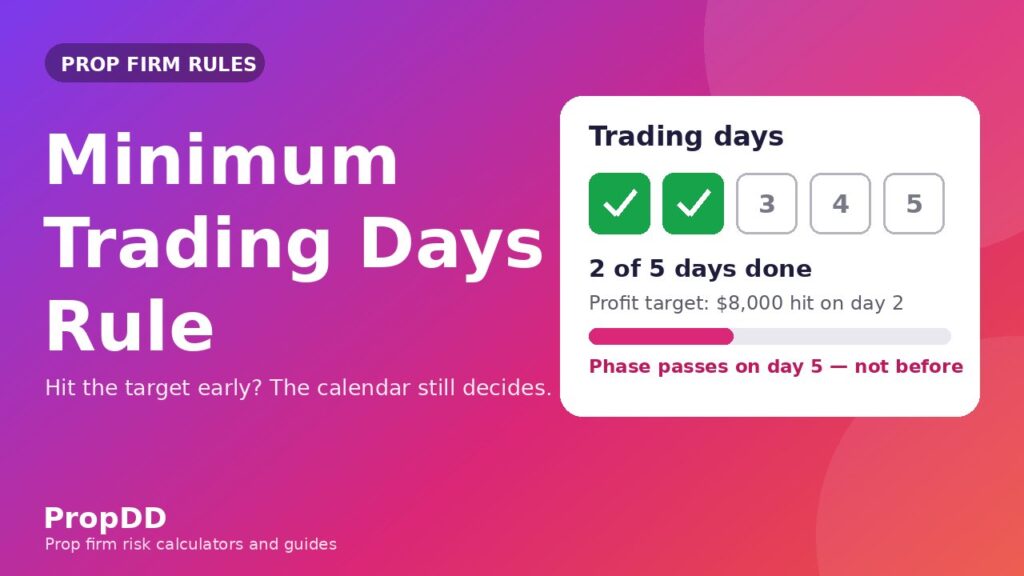
I still remember the screenshot I sent to my friend on a Tuesday night. My $100,000 challenge account was up $8,140. The profit target was 8%. I had done it in two days — one clean gold move, one EUR/USD continuation, nothing reckless by my standards. I wrote under the screenshot: “Phase 1 done.”
In this article
- What the Prop Firm Minimum Trading Days Rule Actually Counts
- Why Firms Will Not Let You Pass on One Lucky Day
- The Numbers: Minimum Days by Challenge Type
- I Tested It: Finishing a Target Early on a 0K Plan
- How to Survive the Remaining Days Without Blowing the Account
- Minimum Trading Days vs the Consistency Rule — They Are Not the Same
- My Exact Filler-Day Routine, Step by Step
- Frequently Asked Questions
It was not done.
The dashboard had a small grey line I had scrolled past at least twenty times: Trading days: 2 of 5. My firm had a prop firm minimum trading days rule, and until I traded on three more separate days, the phase simply would not close — no matter how green my balance was. I was not angry at the market that night. I was angry at myself for buying a challenge whose calendar I had never actually read.
What happened over the next three days taught me more about survival than the two winning days did. This is the full breakdown — what this rule counts, what it does not count, the maths for getting through the remaining days without giving the profit back, and the exact low-risk routine I now use whenever I finish a target early.
What the Prop Firm Minimum Trading Days Rule Actually Counts
The prop firm minimum trading days rule is simple on paper: you must place at least one qualifying trade on a set number of separate trading days before a phase can be marked as passed, or before a payout can be requested. Hit the profit target on day one, day two, whenever — the calendar still has to be satisfied.
Three words in that definition cause almost all the confusion: qualifying, separate and trading.
Separate means calendar days on the firm’s server clock, not your local clock and not 24-hour blocks. A trade opened at 23:40 server time and another at 00:20 server time can count as two different days even though you experienced them as one late night. The reverse is also true and it hurts more: a full evening of trading in Pakistan or India can sit inside a single server day. If you have not read how the reset works, read my guide on daily drawdown reset time and server time before you plan anything around days.
Qualifying is where firms differ. At the relaxed end, any opened and closed position counts, even a tiny one. In the middle, the firm wants a minimum hold time — often a few minutes — so a one-second open-and-close does not register. At the strict end, the day only counts if the trade was a minimum size, or if the day ended with a small minimum profit, sometimes called a profitable-day rule. That last version is a different beast and you need to know which one you bought.
| What traders assume | What most rulebooks actually say |
|---|---|
| Every day I log in counts | Only days with at least one qualifying trade count |
| A day means my local day | A day means the firm’s server day, usually resetting late evening GMT |
| Profit target reached = phase passed | Target + minimum days + no rule breach = phase passed |
| One tiny trade always counts | Some firms require a minimum hold time, size or a profitable day |
| The rule is only for Phase 1 | It can return at Phase 2, on funded accounts and before payouts |
Why Firms Will Not Let You Pass on One Lucky Day
I used to think this rule existed just to slow traders down and sell more patience. After failing and passing a few challenges, I see it differently. A firm selling evaluations has one core problem: it cannot tell a skilled trader from a lucky gambler using a single day of data. One CPI spike, one oversized gold position, one coin-flip that landed right — that trader looks identical to a professional on the results page.
Minimum days are the firm’s cheapest lie detector. Spread your results over five, seven or ten separate days and luck gets diluted. Your real habits show up: your sizing, your stop discipline, what you do after a loss. That is also why this rule almost always travels with two cousins — the consistency rule, which caps how much of your profit can come from your best day, and the daily drawdown limit, which caps how much damage one bad day can do.
There is a formula hiding inside this rule that changed how I plan every challenge:
Safe Daily Target = Profit Target ($) ÷ Minimum Trading Days
Example: $8,000 target ÷ 5 days = $1,600 per day
Read that slowly. If your firm wants five trading days anyway, you never needed the heroic $4,000 day. You needed five ordinary $1,600 days — or, the way I actually trade it, a few solid days and a few tiny ones. The rule you are cursing is quietly telling you the slowest, safest pace that still passes. The traders who plan around passing with small daily risk are not being timid. They are just doing this division before they trade instead of after.
And the second formula, the one for the morning after you hit target early:
Days Remaining = Minimum Trading Days − Qualifying Days Already Traded
Example: 5 − 2 = 3 days still to trade — at the smallest risk that still counts
The Numbers: Minimum Days by Challenge Type
There is no industry-wide number, which is exactly why copying a friend’s plan firm-to-firm goes wrong. These are the ranges I see most often when I compare rulebooks. Treat them as a map, then confirm your own firm’s page — rules change, and the version that applies to you is the one live on the day you bought the account.
| Challenge type | Typical minimum trading days | Common catch |
|---|---|---|
| 2-step evaluation (classic) | 0–5 per phase | Some firms removed the rule; older accounts may still carry it |
| 1-step evaluation | 0–5 | Often paired with a stricter consistency rule instead |
| Instant funding | 0 for access, 3–7 profitable days for payout | The day-count hides in the payout terms, not the sales page |
| Futures evaluations | 5–10 | Frequently combined with a consistency threshold |
| Funded / payout cycle | 3–7 active or profitable days per cycle | Resets after every payout request at some firms |
I Tested It: Finishing a Target Early on a $100K Plan
Let me walk you through my own numbers from that $100,000 challenge, because the abstract version of this rule never scared me straight — the arithmetic did. The account: $100,000 starting balance, 8% Phase 1 target ($8,000), 5% maximum daily loss ($5,000), 10% maximum overall loss, and a prop firm minimum trading days rule of 5 days.
Day 1: gold continuation, two trades, +$4,920. Day 2: EUR/USD trend day, one trade, +$3,220. Total: +$8,140 in 2 qualifying days. Target cleared with $140 to spare — and that tiny $140 cushion is the real story. I did not have a comfortable lead. I had a rounding error standing between me and falling back below target, with three mandatory trading days still in front of me and a market that owed me nothing.
Here is how I ran the test on the tools before risking another real position. I put my numbers into the Challenge Pass Time Calculator and the Max Daily Drawdown Calculator and asked one question: what is the most I can afford to lose per filler day and still finish above target?
| Input / output | Value |
|---|---|
| Account size | $100,000 |
| Profit after day 2 | +$8,140 |
| Profit target | $8,000 (8%) |
| Cushion above target | Only $140 |
| Qualifying days done / required | 2 / 5 |
| Max loss per filler day I allowed myself | $45 (0.25% risk on one small trade, hard stop) |
| Worst case after 3 filler days | +$8,005 — still above target |
| Actual result after 3 filler days | +$8,213 — phase passed on day 5 |
Look at the worst-case line. That is the insight I want you to steal: with a $140 cushion, my filler-day risk budget was not “small.” It was $45 per day, total, full stop. If I had traded my normal 0.5% risk ($500) on day 3 and lost, I would have dropped below target and needed to earn it back — turning a finished phase into a live one again, with all the drawdown risk that brings. Most traders who finish early and then fail do not fail on the winning days. They fail on the victory lap.
My one real-experience rule from that week: the day you cross the target, your risk should fall off a cliff — to roughly one-tenth of normal — until the calendar is satisfied. You are no longer being paid to make money. You are being paid to not lose it.
How to Survive the Remaining Days Without Blowing the Account
So you are in my position: target hit, days remaining, cushion maybe thin. Here is the survival framework, in order of importance.
1. Recalculate your real risk budget first. Your budget is not the firm’s $5,000 daily limit — it is your cushion above target, divided by days remaining, with something held back. If the cushion is $140 over 3 days, you saw the number: about $45 a day. If your cushion is $2,000, you have more room, but I would still cap filler-day risk at a quarter of the cushion per day. Before any filler trade, run your numbers through the drawdown calculator so the limit you respect is a number on a screen, not a feeling. My process for calculating max daily loss is the same one I use here, just with the cushion replacing the firm limit.
2. Trade your most boring setup, at minimum qualifying size. This is not the week for a new market, a news scalp or an experiment. Take the setup you have traded a hundred times, on your most liquid instrument, in your normal session, at the smallest size that still registers as a qualifying trade under your firm’s definition. If your firm requires a minimum hold time, set a timer. If it requires a profitable day, your target for the day is a few dollars green, not a home run — close, log it, walk away.
3. Set a personal daily stop far below the firm’s. I keep a hard personal stop on every challenge day, and on filler days it shrinks to my per-day risk budget. The method is exactly the one in my guide on setting a personal daily stop below the firm limit — the firm’s limit protects the firm; yours protects the pass you have already earned.
4. Respect the day-count traps. Do not place the filler trade in the last minutes before the server reset, when spreads widen and a slipped fill can cost more than your budget. Do not hold it over a high-impact news release to “let it breathe” — one spike can eat a thin cushion whole, the same way I describe in my piece on news trading and daily drawdown. And never, ever try to count a day with a hedge across two accounts or a copied trade from a friend — firms treat cross-account hedging and third-party copy trading as prohibited strategies, and getting flagged on a filler day, after doing the hard part honestly, is the most avoidable failure in this business. The official objectives on a major firm’s page, like the FTMO challenge structure, show how explicitly these conditions are spelled out when you actually read them.
Minimum Trading Days vs the Consistency Rule — They Are Not the Same
These two rules get mixed up constantly, and the mix-up matters because the fix for each is different.
| Minimum trading days rule | Consistency rule | |
|---|---|---|
| What it measures | How many separate days you traded | How your profit is spread across those days |
| Typical form | Trade on at least 3–10 separate days | Best day ≤ 30–50% of total profit |
| When it bites | At phase completion | Usually at payout request |
| You can fail it by | Finishing too fast | Winning too much on one day |
| The fix | Add small, safe trading days | Add more profitable days to dilute the best day |
Notice the ugly overlap: one huge winning day can leave you trapped by both rules at once — too few days for the minimum, and one day dominating your profit for consistency. The escape is the same in both cases, which is why I solve them together: add calm, modestly profitable days until both counters are satisfied. If consistency is your problem, the Consistency Rule Calculator will tell you exactly how much more profit you need to dilute your best day — run it before you trade, not after a payout is refused.
My Exact Filler-Day Routine, Step by Step
This is the routine I now keep taped to my monitor for any day where the target is already met. It is deliberately dull. Dull is the point.
| Step | Action | Tool / check |
|---|---|---|
| 1 | Check the dashboard counter: qualifying days done vs required | Firm dashboard, objectives page |
| 2 | Recalculate cushion above target and per-day risk budget | Max Daily Drawdown Calculator |
| 3 | Confirm today’s server-day window and any red-folder news times | Economic calendar + reset-time guide |
| 4 | Wait for my A-setup only; size at roughly one-tenth normal risk | Pre-written plan, fixed lot from budget |
| 5 | Close the trade, screenshot the dashboard day counter ticking up | Trading journal entry, same day |
| 6 | Stop trading for the day — platform closed, not just minimised | Personal daily stop rule |
Step 6 is the one everyone skips and the one that saves the account. A filler day that turns into a full session is how a $140 cushion becomes a failed phase. I log the day in my journal — the same simple format I outline in my trading journal guide — and I close the platform. The market will be there tomorrow. Your passed phase might not be, if you keep clicking.
Frequently Asked Questions
What is the prop firm minimum trading days rule?
It is a rule requiring you to place at least one qualifying trade on a minimum number of separate trading days — commonly 0 to 5 days on forex evaluations, and 5 to 10 on many futures evaluations — before a phase can be passed or a payout released, even if you reached the profit target earlier.
What happens if I hit my profit target before completing the minimum trading days?
Nothing bad — but the phase does not close yet. You keep trading on additional separate days, ideally at drastically reduced risk, until the day counter is satisfied. Your main danger in this window is losing enough to fall back below the target, so most experienced traders cut risk to around one-tenth of normal.
Does one small trade count as a trading day?
At many firms, yes — any opened and closed position counts. But some firms require a minimum hold time, a minimum lot size, or a day that ends slightly profitable. Check the trading-objectives section of your firm’s rules, because this single detail decides how you should trade your remaining days.
Do minimum trading days apply to funded accounts and payouts too?
They can. Some firms apply an active-days or profitable-days requirement to each payout cycle on funded accounts, separate from the evaluation rule. Always read the payout terms of the funded stage, not just the challenge sales page.
Is the minimum trading days rule the same as the consistency rule?
No. Minimum days count how many separate days you traded. The consistency rule limits how much of your total profit can come from a single day. One very large winning day can leave you short on both, and the cure for both is the same: more calm, modest trading days.
How can I check how many trading days I have completed?
Your firm dashboard normally shows it on the objectives or account-overview page, displayed as something like “Trading days: 2 of 5.” Check it after your first trade of each day to confirm the trade registered as qualifying, and screenshot it — that record protects you if the count is ever disputed.
Risk note: Prop firm challenges involve fees and strict loss rules, and most participants do not pass. This article is education based on my own trading experience, not financial advice or a guarantee of results. Always read your firm’s current rulebook before buying or trading a challenge.



9 comments
[…] as “earned properly”; the daily loss limit is the wall most refund attempts hit. My minimum trading days rule guide covers the gate most traders […]
[…] the same session, day after day. I wrote about that discipline problem at length in my guide to minimum trading days rules, and Ichimoku slots straight into it: one indicator means one decision framework, which means fewer […]
[…] far under any trade-count cap and naturally spreads activity across the calendar, which feeds the minimum trading days rule instead of fighting it. The fixed 0.5% risk means a full losing day is $1,500 — my personal stop, […]
[…] Minimum trading days rule […]
[…] sit in a small family of time-based rules that traders constantly confuse with each other. The minimum trading days rule is the mirror image: it forces a minimum number of active days before you can pass, while […]
[…] alike, they live in the same rulebook, and traders mix them up constantly. I wrote a full guide on the minimum trading days rule — read it after this one, because the two rules interact in an ugly way: some firms’ risk […]
[…] looks profitable before execution costs can be unprofitable after them. And it compounds with the minimum trading days rule, because a trader who burns days to slippage-driven losses still has to produce clean days […]
[…] is not timid trading; it is the price of a stop wide enough to survive a normal platinum day. My minimum trading days guide makes the same point from the other side: surviving the week matters more than winning the […]
[…] minimum trading days guide covers the days rule in full, and the challenge time limit guide covers the deadline. This article […]