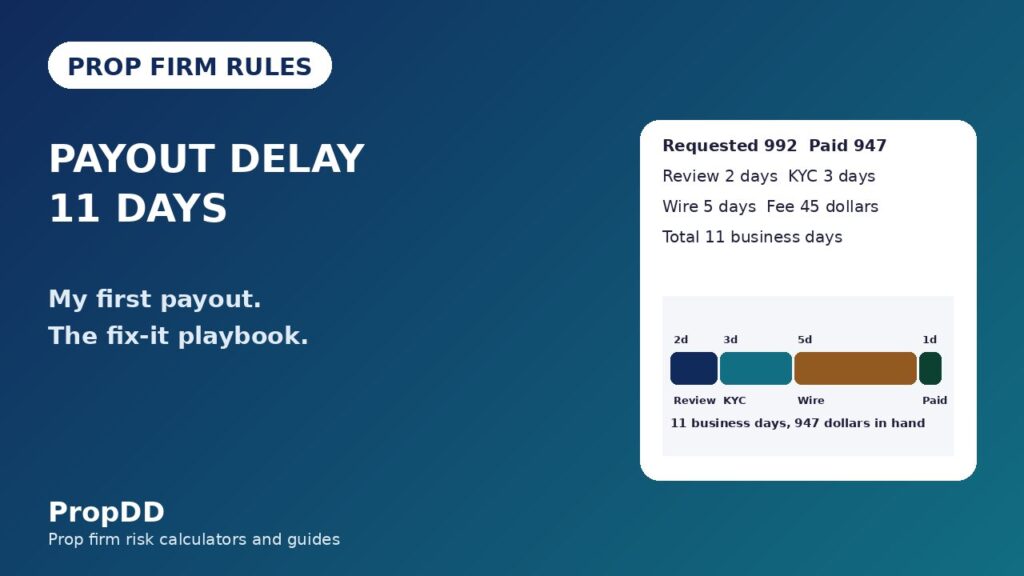
On a Monday morning in early November I clicked request on my first funded payout and watched one thousand two hundred and forty dollars of profit turn into a status line that read “under review”. By Friday it still read “under review”. By the following Friday it read “under review” again, and my profit was still sitting in the firm’s dashboard, not in my bank account. The money landed on the eleventh business day: nine hundred and ninety-two dollars was my eighty percent share, forty-five dollars went to wire fees, and nine hundred and forty-seven dollars reached my account. Nothing had gone wrong. Nobody had broken a rule. The delay was the system working exactly as designed — and nobody had told me how the system worked. I trade a one hundred thousand dollar funded account, so one payout delay does not hurt the way a blown daily limit does, but it taught me the same lesson: the rulebook you do not read is the one that costs you money.
In this article
- What a payout delay actually is
- The payout timeline, stage by stage
- The six reasons payouts stall
- My first payout: the 11-day diary
- I tested it: five payouts, five rails
- The pre-request checklist that stops delays before they start
- When a delay means something is wrong
- How payout delays fit prop firm rules
- Frequently asked questions
What a payout delay actually is
A payout delay is not one thing. It is three different clocks running one after another, and traders argue about the total because they are measuring different clocks. The first clock is eligibility: has the account cleared the gates — minimum trading days, a profit above the minimum withdrawal, the consistency rule, one-time identity verification? The second clock is the firm’s internal review: a human or a risk system checking the trades in the cycle for rule breaches. The third clock is the payment rail: the time the money itself needs to travel from the firm’s processor to your bank, wallet or card. Most payouts that feel slow are slow on only one of the three clocks, and each clock has a different fix.
The first distinction that matters is business days versus calendar days. Firms count business days, and a request made on a Friday evening loses two days before the first clock even starts. My eleven-day delay was eleven business days — fifteen calendar days from request to settlement. The second distinction is first payout versus repeat payout: the first request carries identity verification and the longest review, because the firm is paying a stranger for the first time.
The payout timeline, stage by stage
Every payout moves through the same four stages, and each stage has its own typical range. These are industry-wide observations, not promises from any one firm — your firm’s written terms override every number here, and terms change. The table below is the shape I now plan around before I ever click request.
| Stage | Brisk case | Typical case | Sluggish case | What stretches it |
|---|---|---|---|---|
| Eligibility check | Instant | Same day | 1 business day | Open positions, a breach on request day |
| Internal review | A few hours | 1 to 2 business days | 3 to 5 business days | Large profit, one oversized trade |
| Identity verification (first payout) | Already done | 1 business day | 3 to 7 business days | Blurry documents, name mismatch |
| Stablecoin or crypto transfer | Under 1 hour | Same day | 1 business day | Wrong network, batched sends |
| International bank wire | 1 to 2 business days | 3 to 5 business days | 7 to 10 business days | Intermediary banks, conversion |
| Local transfer or e-wallet | Same day | 1 to 3 business days | 5 business days | Provider holds, country limits |
Read the table as a chain, not a menu: the stages run one after another, so the total is the sum, not the worst single stage. A repeat payout by stablecoin can mean money in hand within a day; a first payout by international wire can mean two weeks, even when nothing goes wrong. The TradersYard payout schedule guide puts the same shape in firm terms: a fourteen-day cycle, a fifty dollar minimum withdrawal, four to six business hours of internal processing, and one to two business days for the transfer itself once identity verification clears.
The six reasons payouts stall
Most delays are not mysterious. They hinge on a short list of avoidable errors, and almost all of them sit on the trader’s side of the desk. I have now seen all six, four of them on my own account.
| Cause | Whose side | Typical cost | The fix |
|---|---|---|---|
| Identity verification left to request day | Trader | 3 to 7 business days | Verify the week you get funded, not the week you want paying |
| Consistency rule tripped by one big day | Trader | Held until profit rebalances | Keep the best day under 40 percent of the cycle profit |
| Minimum trading days not yet met | Trader | Days until the count clears | Count active days on the dashboard before requesting |
| Open positions at request time | Trader | 1 business day, or a rejected request | Close or flatten everything before you click request |
| Wrong wallet address or network | Trader | 1 to 5 business days, sometimes lost | Send a small test amount first, then the full payout |
| Firm review queue on a large profit | Firm | 3 to 5 business days | Nothing to fix — but a polite ticket with the rulebook clause helps |
The consistency trap is the one that catches the most people, because it looks like a delay when it is actually a hold. Many firms cap how much of your total profit any single day can represent, to filter out one-shot gamblers. At a forty percent cap, a best day of six hundred and forty dollars needs a cycle total of at least one thousand six hundred dollars before the payout releases — the required total is the best day divided by zero point four. If your best day is six hundred and forty and your total is one thousand two hundred and forty, the payout sits until you trade enough balanced days to dilute the big one. The firm is not stalling. It is applying the rule you agreed to when you bought the challenge.
My first payout: the 11-day diary
The account is one hundred thousand dollars, the daily loss limit is five thousand, and my risk per trade is five hundred dollars — half a percent of the account and ten percent of the daily limit. One loss is ten percent of my daily limit, so the profit that funded my first payout was built slowly, in three winning days of four hundred and eighty, four hundred and twenty and three hundred and forty dollars. The total was one thousand two hundred and forty dollars, and the best day was thirty-eight point seven percent of it — inside the forty percent consistency cap, but only just. Each winning trade ran two lots on EURUSD with a twenty-five pip stop, so the wins were twenty-four, twenty-one and seventeen pips: four hundred and eighty, four hundred and twenty and three hundred and forty dollars at ten dollars a pip per lot.
| Figure | Value | How it is calculated |
|---|---|---|
| Profit in the cycle | 1,240 dollars | 480 + 420 + 340 across three winning days |
| Best day share | 38.7 percent | 480 / 1,240 — inside the 40 percent cap |
| My share at 80 percent | 992 dollars | 1,240 x 0.80 |
| Wire fee | 30 dollars | Bank wire, charged by the firm’s processor |
| Intermediary bank fee | 15 dollars | One intermediary bank took its cut in transit |
| Money that reached me | 947 dollars | 992 – 30 – 15 |
| Fees as a share of my payout | 4.5 percent | 45 / 992 |
The diary itself is the lesson. Day zero, Monday: I requested the payout at nine in the morning, all positions flat. Day one to two: internal review, two business days, no message. Day three to five: identity verification, three business days, because the photo of my ID was slightly blurred and the firm asked for a retake on Friday afternoon — which sat unread until Monday. Day six to ten: the wire itself, five business days, with one intermediary bank adding its own day and its own fifteen dollar fee. Day eleven, Tuesday: nine hundred and forty-seven dollars in my account. Three of the eleven days were my fault, five were the rail I chose, and two were the firm’s review.
I tested it: five payouts, five rails
After the first payout I stopped guessing and started measuring. Five requests, five different rails, same account, same eighty percent split. I ran every size through the profit split calculator before requesting, so the requested amount was always the profit times the split, never a round number I had invented.
| Request | Profit x split | Rail | Business days | Fee | Net received |
|---|---|---|---|---|---|
| 1 | 1,240 x 80% = 992 | Bank wire | 11 | 45 | 947 |
| 2 | 2,000 x 80% = 1,600 | USDC stablecoin | 1 | 20 | 1,580 |
| 3 | 1,000 x 80% = 800 | Wise | 2 | 8 | 792 |
| 4 | 3,000 x 80% = 2,400 | Bank wire | 6 | 30 | 2,370 |
| 5 | 800 x 80% = 640 | Skrill | 2 | 12 | 628 |
Five requests totalling six thousand four hundred and thirty-two dollars, one hundred and fifteen dollars of fees, six thousand three hundred and seventeen dollars received, and an average of four point four business days. The pattern is blunt: the rail decides the speed more than the firm does. The stablecoin payout landed in one day; the second wire took six days, not eleven, because identity verification was already done — proof that the first payout’s delay was mostly first-payout overhead. The cheapest rail was Wise at eight dollars. On a small payout the fee percentage matters more than the speed: a forty-five dollar fee on a nine hundred and ninety-two dollar payout is a real haircut, while the same fee on two thousand four hundred dollars barely registers.
The pre-request checklist that stops delays before they start
I now run this checklist the week I get funded, and again the morning I request. It takes ten minutes and it has removed every delay I used to cause myself.
| Check | When | What it prevents |
|---|---|---|
| Identity verification submitted and approved | The week you get funded | The 3 to 7 day first-payout KYC stall |
| Minimum trading days counted on the dashboard | Before requesting | Requesting into a locked payout window |
| Best day under 40 percent of cycle profit | Before requesting | The consistency hold — check the payout after drawdown calculator |
| All positions flat, no pending orders | Request morning | Eligibility rejection or a 1-day bounce |
| Payout details verified with a test amount | First request per rail | Wrong wallet or network, money sent nowhere |
| Request sent Monday to Wednesday | Request morning | Losing the weekend before the review even starts |
| Profit above the minimum withdrawal | Before requesting | A rejected request that restarts the whole queue |
The Monday-to-Wednesday rule is the cheapest fix on the list. A request sent on Friday evening loses two days before the first clock starts, and a verification question asked on Friday afternoon sits unread until Monday. My first payout’s KYC retake was requested on a Friday and answered on a Monday — three calendar days that bought nothing. Request early in the week, answer every firm message the same day, and the chain never idles.
When a delay means something is wrong
Not every delay is routine, and the line between slow and wrong is a number: fourteen business days. Most reputable firms publish a processing window of one to five business days for the review stage, and several firms’ own terms allow processing to extend to fourteen business days where additional verification checks are required. Past fourteen business days with no explanation, the delay has stopped being a queue and started being a problem. My escalation ladder is short and documented: a support ticket quoting the exact rulebook clause and the request date, then a compliance email with the ticket number and screenshots, then a public review stating only dated facts. At every step I keep the language factual and keep every message.
Three red flags tell me to escalate immediately rather than wait: silence, with no reply to two tickets across five business days; a moving reason — KYC on Monday, a system upgrade on Wednesday, a compliance review on Friday; and a payout denied after a long review with no rule cited. A denial must name the clause, the trade and the date, or it is not a decision. One more thing worth knowing before you buy a challenge: some firms cannot serve traders in certain countries at all, and a payout to a restricted country will stall at the rail no matter how clean the trading was.
How payout delays fit prop firm rules
A payout is not just money leaving the account — it changes the account. On many firms the drawdown line locks or recalculates after a payout, so the balance you trade on the day after a payout is not the balance you had the day before it. My first payout left the account at one hundred thousand two hundred and forty-eight dollars: the one hundred thousand starting balance, plus one thousand two hundred and forty of profit, minus nine hundred and ninety-two paid out. I check the new floor before trading again, because a payout that drops the balance toward the trailing line is a payout that quietly tightens the room for the next trade. That is why the payout after drawdown calculator exists: profit first refills the drawdown hole, and only the surplus above the starting balance is split and payable.
The delay itself is also a risk-management event. Eleven business days between request and money is eleven days when the profit is still inside the firm’s system and still exposed to a breach: one bad session in that window, and the payout request dies with the account. That is why I never request a payout and then keep trading at full size on the same account — the personal daily stop stays on, and the size comes down until the money lands. The minimum profit to withdraw sets the gate and the consistency rule sets the shape of the profit; the delay is what happens between the gates and the bank.
Frequently asked questions
How long does a prop firm payout normally take?
Most funded payouts land in one to five business days once approved, and stablecoin payouts often arrive within twenty-four to forty-eight hours. A first payout takes longer — one to two weeks is normal when identity verification, the review and a bank wire stack up. Count business days, not calendar days, and judge the firm on its repeat payouts, not its first one.
Why is my first payout slower than later ones?
The first request carries one-time identity verification and the longest compliance review, because the firm is paying a stranger for the first time. Later requests skip verification and usually clear review in one to two business days. Verify your identity the week you get funded.
Can a payout be delayed by the consistency rule?
Yes. If your best trading day is more than forty percent of the cycle profit at a firm with a forty percent cap, the payout is held until the profit rebalances — more balanced trading days dilute the big one. The required total is your best day divided by zero point four, so a six hundred and forty dollar best day needs at least one thousand six hundred dollars of cycle profit.
Which payout method is fastest for prop firms?
Stablecoins are usually fastest — often same day once approved — followed by e-wallets like Wise or Skrill at one to three business days, and international bank wires at three to five business days in the typical case. The fastest rail is not always the cheapest: check the fee as a percentage of your payout, especially on small withdrawals.
What should I do if my payout is delayed more than two weeks?
Escalate in writing: a support ticket quoting the rulebook clause and the request date, then a compliance email with the ticket number and screenshots. If there is still no reply after five business days, or the reason keeps changing, treat it as a problem rather than a queue and raise it publicly with dated facts only. A denial must name the clause, the trade and the date.
Do payout fees really matter on a funded account?
Yes, especially on small payouts. My first wire cost forty-five dollars on a nine hundred and ninety-two dollar payout — four point five percent. The same fee on a two thousand four hundred dollar payout was one point two five percent. Pick the rail by fee percentage first and speed second when the payout is small, and always read the firm’s fee schedule before choosing a rail.
Risk disclaimer: trading funded accounts involves substantial risk of loss. The figures here come from my own trading log and are not a promise of future results. Never risk money you cannot afford to lose.