Everyone wants to pass a challenge in a week. The traders who pass reliably tend to take much longer than they expected, risk much less than the internet suggests, and spend a surprising amount of time doing nothing at all. That last part is the one nobody posts screenshots of.
In this article
- Why rushing fails
- The maths of small risk
- Check the time limit first
- Set your numbers before day one
- A daily routine that fits on a card
- Pacing against the target
- When you're ahead
- When you're behind
- Which sessions and instruments
- Handling a losing streak
- News and spreads
- Hitting the target
- A sample four-week plan
- Mistakes I'd watch for
- What a good week looks like
- The boring middle
- Money, expectations and the fee
- Using the first days to test, not to earn
- One more thing about patience
- Frequently asked questions
- The short version
This is a plan for passing a challenge by not failing it. It’s built around small daily risk, a pace you can sustain and a handful of rules written in advance. It won’t make you rich in a month. It might get you funded without a breach, which, given how most attempts end, is a perfectly good result. Keep the drawdown calculator open while you read, because a few of the numbers are easier to see than to describe.
Why rushing fails
A challenge has a profit target and a loss limit, and it’s tempting to look only at the first. But the target is a destination and the limit is the road. The faster you drive, the more likely you are to leave the road, and the arithmetic of risk is brutal about this. Doubling your risk per trade doesn’t double your chances of passing. It does roughly double the chance of hitting the daily limit on any given bad day.
There’s also a practical point. Most failed attempts, from what traders themselves report, don’t end because the strategy stopped working. They end because of a few oversized decisions in a hurry. Slow down the decisions and most of that disappears.
The maths of small risk
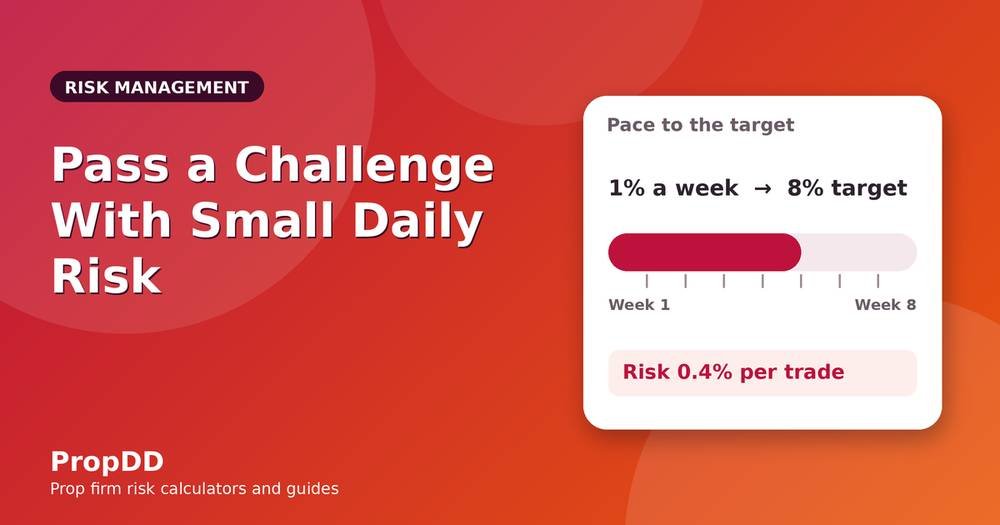
Suppose the target is 8% and you risk 0.4% per trade with an average reward of 1.5R. A winning trade makes 0.6%, a losing one costs 0.4%. With a 50% win rate, your expectancy is 0.5 × 0.6 − 0.5 × 0.4 = 0.1% per trade. To make 8%, that’s about 80 trades. At two trades a day that’s forty trading days, or eight weeks. It’s slower than the dream and perfectly achievable.
Now see what a bad streak costs. Five losses in a row is 2%. Ten in a row, which is rare but not impossible, is 4%. Both leave you well inside a typical 5% daily limit, and the account survives to trade again. Compare 2% risk per trade: three losses is 6%, and the account is gone by lunchtime. Small risk buys you time, and time is the thing that lets an edge show up.
Check the time limit first
Some challenges have a maximum duration, many have none, and some have a minimum number of trading days. If there’s a deadline, work backwards from it. If you have thirty days and need 8%, you can’t use a plan that needs sixty. The honest options are to risk a bit more, pick a longer challenge or skip that firm. Raising risk to fit a tight deadline is a common way to turn a good plan into a bad one. The checklist in daily drawdown rules: what to check before you buy covers this.
Set your numbers before day one
On a fresh account, write five numbers on a card. The daily floor. Your personal daily stop, which I’d put at 60% to 70% of the firm’s limit. Risk per trade, between 0.25% and 0.5% for most people. Maximum trades per day, three or four. And the overall floor. Everything in the plan comes from those five. The method for the first is in how to calculate max daily loss, for the second in setting a personal daily stop and for the third in how much to risk per trade.
A daily routine that fits on a card
Before the session: record start-of-day equity, write the floor and soft stop, check the economic calendar for the day, decide which events you’ll skip. During the session: take only setups that meet your written rules, add up open risk before each entry, stop at your personal stop or your trade limit. After the session: close the platform, record the percentage of the daily limit you used, write one line in your journal. Weekly: spend ten minutes reading the week back. That’s the whole thing.
Pacing against the target
Break the target into weekly slices. An 8% target over eight weeks is 1% a week, which is 2.5 winning trades at your average. Look at it that way and the target suddenly seems less frightening and your actions less urgent. If you’re ahead of the pace, don’t speed up. If you’re behind, don’t either. The pace is a rough guide, not a deadline, and the only thing a deadline should change is whether the firm was the right choice.
When you’re ahead
This is the dangerous one, oddly. After a good week, confidence rises, size creeps up and the plan loosens. A rule I like: after any day in which you’ve made more than about 1.5R, you may take at most one more trade, at normal size, and then you’re done. It protects the profit and removes the temptation to prove that the good day wasn’t luck.
When you’re behind
You lose three trades in a row, the day is down 1.2%, and the voice starts. The right action is boring: check the numbers, take a break, and if your rule says two or three losses means a stop, stop. The plan has no clause for “recover today”. It has a clause for “trade tomorrow”. For the emotional side, see revenge trading and the daily loss limit.
Which sessions and instruments
Pick one or two instruments and one or two sessions and learn them well. A trader who watches five pairs across three sessions is constantly deciding what to look at, and that is its own kind of fatigue. Many people find the overlap of the London and New York sessions has the most movement and the most traps. Others prefer the quieter hours. It matters less which you pick than that you pick, and keep records of how you do in each. Your trading journal will show the pattern in a month.
Handling a losing streak
Streaks happen. If you lose six in a row at 0.4%, you’re down 2.4%, which is a bad day and not a disaster. What matters is that you’ve kept risk constant and that the personal stop didn’t trigger a size increase. After a streak, reduce size by half for a day or two, and check whether the losses were rule-following losses (the market just didn’t cooperate) or rule-breaking ones. If it’s the second kind, the cure is discipline, not a new strategy.
News and spreads
A challenge is a bad time to test your reflexes against a major release. Mark the high-impact events, skip them or flatten before them, and trade after spreads settle. The reasons are in news trading and daily drawdown. If you can’t resist a trade during a release, keep size tiny, and expect to be wrong sometimes.
Hitting the target
When you reach it, resist the urge to trade harder. The challenge is passed or about to be, and the funded account has different dynamics. Close your open trades according to plan, read the next phase’s rules again (they might differ) and take a day or two to reset your notes. It’s a strangely common moment for a bad trade, because the pressure’s gone and the discipline slips.
A sample four-week plan
Week one: demo or tiny size on the real account, writing down every trade, checking that the rules in your head match the rules on the page. Week two: normal risk, three trades a day maximum, personal stop in place, daily journal. Week three: review week two, change one thing, continue. Week four: if you’re consistently under 40% of the daily limit and following the plan, keep going and don’t change anything because things feel good. The plan doesn’t have a trick in it. It has a shape: slow start, steady middle, no heroics.
Mistakes I’d watch for
Raising risk because you’re behind schedule. Taking trades outside your sessions out of boredom. Ignoring the overall floor while watching only the daily. Chasing a perfect entry and then widening the stop. Trading the day you’re ill or exhausted. Moving the personal stop. Each of these is small, and each has ended an attempt that was otherwise on track.
What a good week looks like
Not the one with the biggest profit. A good week is one in which you followed the plan on every trade, never touched the personal stop, used well under half of the daily limit on your worst day and finished with a journal you could read without wincing. Profit is the side effect. If you evaluate weeks by process first and money second, the money tends to take care of itself over a long enough stretch, and you spend far less time feeling like a gambler.
The boring middle
Every challenge has a middle stretch where nothing exciting happens. You’re a few percent up, the target seems far away, and every day looks like the last. That’s where traders get restless. They start adding setups, trading new instruments or increasing size, all for the sake of feeling like something is happening. Learn to love the boring middle. It’s what most successful attempts consist of, and it’s the time when keeping the routine does the most good.
Money, expectations and the fee
The fee you paid can quietly distort your decisions. It’s gone either way, so it shouldn’t change what you do today, and yet it makes some traders desperate to “get value” from it. Treat the fee as the price of a ticket. The ticket gives you the chance to trade the rules, and nothing more. If you pass, wonderful. If you don’t, you’ve bought information about your process for the cost of a fee, and you can use it.
It also helps to be realistic about how many attempts it might take. Plenty of traders need more than one go, and that’s normal. Setting aside a budget for two or three tries, and treating each one as a better-informed version of the last, takes a lot of pressure off the first.
Using the first days to test, not to earn
The first few days on a new account are best treated as a test of your routine, not of your strategy. Place small trades, confirm that the platform’s equity matches the dashboard, check how your stops behave, note the real spreads at the hours you trade and confirm the reset time with your own eyes. It’s the cheapest time to discover a surprise. By the end of the first week, you’ll know the account the way you know a car you’ve driven for a while, and the actual attempt can start from there.
One more thing about patience
Patience isn’t passive. It’s a decision you make repeatedly: to skip a marginal setup, to stop at the personal stop, to keep size where it was. Each of those is small, and none looks heroic from outside. Added together over weeks, they’re what a passed challenge actually is.
Frequently asked questions
How long should passing take?
With small risk and a modest target, a few weeks to a few months is realistic. Faster usually means more risk than the plan supports.
Is 0.25% risk per trade too small?
It’s slow, but not wrong. Some people use it for the first week or two as a trial, then raise it a little when they trust their routine.
Should I trade every day?
No. Days with no valid setup are fine, and writing them down as successes trains the right habit.
What if I’m consistently making small losses?
Review the journal for patterns in time of day, instrument and mood, and change one variable. If nothing helps, the strategy may need work and a demo is a cheaper place to do it.
The short version
Pass a challenge by staying alive: small risk, a daily stop under the firm’s limit, a few trades a day, a weekly review and no heroics when you’re ahead or behind. For the rule that decides it all, read the prop firm max daily drawdown explained, and for general learning, the free lessons at BabyPips and Investopedia’s overview of risk management are worth an hour.