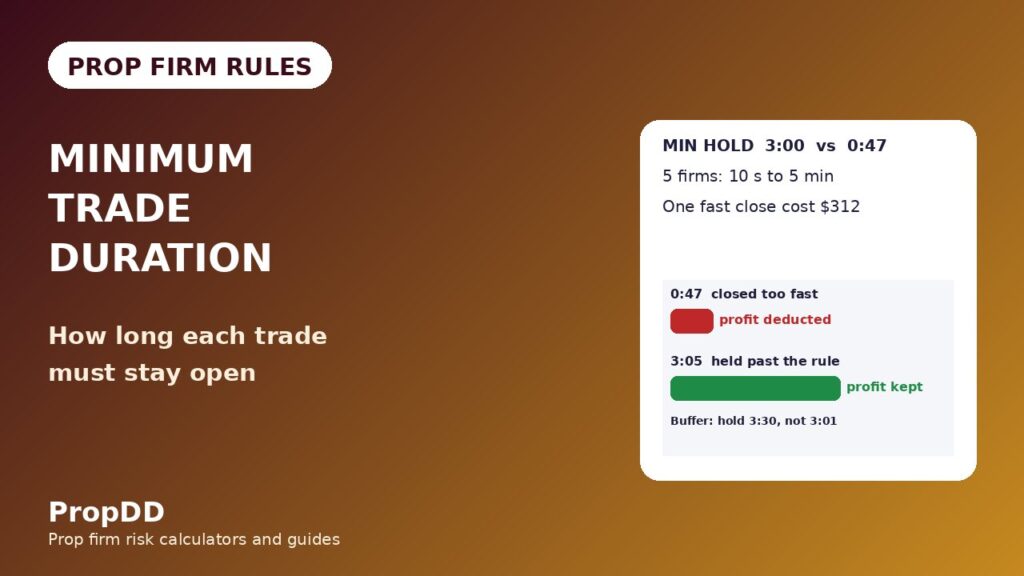
On a Tuesday morning in early November I scalped GBPUSD into the London open, took twelve pips in forty-seven seconds, and closed three hundred and twelve dollars richer. It was the cleanest trade of my week. Two weeks later, at my first payout review, the firm removed that three hundred and twelve dollars from my profit as if the trade had never happened. The reason was a rule I had never read: a minimum trade duration. My trade had lived for forty-seven seconds. The firm required five minutes. Nothing else about the trade was wrong — the entry, the stop, the size, the session — but the clock killed it.
In this article
- What minimum trade duration actually is
- The numbers: what five firms actually require
- Why firms impose it: the tick-scalping problem
- What happens when a trade closes too fast
- I tested it: ten trades, every one held past three minutes
- My routine: how I build trades that survive the rule
- The scalping add-on: is it worth paying for?
- Mistakes that still get traders caught
- Frequently asked questions
I trade a one hundred thousand dollar funded account with a five thousand dollar daily loss limit, risking five hundred dollars per trade. Every number here comes from that account, from the rulebooks I have since read properly, and from a ten-trade test I ran to prove the rule could be lived with. If you close trades quickly, this is the rule most likely to take money off you without ever breaching your account.
What minimum trade duration actually is
Minimum trade duration is the shortest time a trade is allowed to stay open. The clock starts at the fill and stops at the close, and if the gap is shorter than the firm’s minimum, the trade breaks the rule. The usual numbers are ten seconds, two minutes, three minutes or five minutes. A trade closed at two minutes fifty-nine seconds on a three-minute rule is a violation; at three minutes one second it is not. The boundary is that sharp, and it is measured on the firm’s server clock, not on yours.
It is easy to confuse with two other time rules. It is not the minimum trading days rule, which counts how many separate days you trade, and it is not the challenge time limit, which is the deadline for hitting your profit target. Three rules, three different clocks: days, a deadline, and the life of a single trade.
| Rule | What it counts | Typical value | Where it bites |
|---|---|---|---|
| Minimum trade duration | Seconds or minutes one trade stays open | 10 seconds to 5 minutes | Every single trade, evaluation and funded |
| Minimum trading days | Separate calendar days you place a trade | 3 to 10 days per phase | Passing the evaluation or requesting a payout |
| Challenge time limit | Days allowed to reach the profit target | 30 days, or unlimited | The whole evaluation phase |
The minimum trading days guide covers the days rule in full, and the challenge time limit guide covers the deadline. This article is about the third clock, the one that runs inside every trade you take. It matters more than the other two because of frequency: the duration rule is checked on every fill you ever take.
The numbers: what five firms actually require
There is no industry standard. The numbers below come from the firms’ own rulebooks and independent reviews of them, checked in November 2026 — but rules change, so read your own firm’s current terms before you buy a challenge. The shortest rule in the industry is fifty times shorter than the longest, and the same trading style can be legal at one firm and a violation at another.
| Firm | Minimum duration | What happens under the minimum | Note |
|---|---|---|---|
| Top One Trader | 5 minutes | Trade classed as tick scalping; gains may be deducted | Also charges a 2 percent fee on every payout |
| Funded Elite | 3 minutes | Minor violation; profit split reduced for that payout period | 30 seconds with the scalping add-on |
| Top One Futures | 10 seconds | 10.00 seconds is a violation; 10.01 is acceptable | If half your profits break the rule, those profits are removed |
| NEOM Funded | 2 minutes | Profitable trades under 2 minutes excluded from profit | Stop loss must also be placed within 2 minutes |
| Velotrade | No minimum | No mandatory position rules at all | Daily loss limit and static drawdown are the only hard limits |
Two things deserve a second look. The Top One Trader numbers come from an independent review of Top One Trader’s terms, which also confirms the five-minute rule and the mandatory stop-loss requirement. First, the ten-second futures rule is not generosity: ten seconds is the line between a trade and a burst of machine-gun fills. Second, the five-minute firm and the no-minimum firm sell the same product with completely different ideas of what counts as trading. The rule is a property of the firm, not of the market.
Why firms impose it: the tick-scalping problem
Firms do not impose a minimum duration because they dislike fast traders. They impose it because a trade that lasts seconds is hard to price as risk, and because their business depends on the difference between a trader and a machine. A human who opens and closes in forty-seven seconds is usually reacting to a one-minute candle or a news spike. A system that opens and closes hundreds of positions a day, each lasting seconds, is usually harvesting something else: a gap between the simulated feed and the real market, a latency edge, or a fill the firm cannot replicate.
The risk team has a second reason, and it is the one that affects honest traders. A stop loss is the firm’s only proof that a trade had a defined risk, and a trade opened and closed in under a minute often never had a stop attached at all. Several firms now pair the duration rule with a stop-placement rule: NEOM Funded requires the stop within two minutes of the fill, and Hola Prime Futures within three. One rule says your trade must live long enough to be a trade. The other says it must carry a stop while it lives.
What happens when a trade closes too fast
The punishment is a ladder, and where you land depends on the firm and on how much of your profit came from fast trades. At the bottom, the firm simply removes the profit of the offending trades. In the middle, it cuts your profit split for the payout period, so you keep a smaller share of everything, including the legal trades. At the top, repeated violations become a breach and the account ends. The worst version I found is the futures rule: if half or more of your total profit came from trades under the minimum, all of that profit is removed.
The maths of a deduction is simple, and worth doing before you decide the rule does not apply to you.
| Figure | Formula | My 10-trade test |
|---|---|---|
| Profit kept | Total profit minus profit from sub-minimum trades | 4,000 dollars minus 3,000 dollars = 1,000 dollars |
| Share of profit lost | Deducted profit divided by total profit | 3,000 / 4,000 = 75 percent |
| Kept win rate | Winners that survive the rule, divided by all trades | 3 kept winners / 10 trades = 30 percent |
| Raw win rate | All winners divided by all trades | 6 winners / 10 trades = 60 percent |
The test in the next section made four thousand dollars and won six trades out of ten — a good fortnight by any measure. Under a three-minute rule, with my old habit of closing winners early, three of those six winners would have been deducted, and the fortnight would have paid one thousand dollars instead of four thousand. The win rate on paper stays sixty percent. The win rate that gets paid drops to thirty percent. That gap is the whole cost of this rule, and it is invisible until payout day, because no firm I checked puts a live duration timer on the ticket. You have to run the clock yourself.
I tested it: ten trades, every one held past three minutes
After the three hundred and twelve dollars disappeared, I gave myself a rule stricter than any firm on my list: no trade closes before three minutes five seconds, measured from the fill, and no partial close before that mark either. I ran it for ten trading days, one trade a day, risking five hundred dollars per trade — half a percent of the account and ten percent of the daily limit. The table is the full log; the “old habit” column is where I would have closed each winner before, at the first sign of momentum fading.
| Day | Pair and direction | Held | Old-habit exit | Result | Under a 3-minute rule |
|---|---|---|---|---|---|
| 1 | EURUSD long | 3:05 | 0:47 | Plus 1,000 dollars | Deducted |
| 2 | GBPUSD short | 4:40 | 3:31 | Plus 1,000 dollars | Kept |
| 3 | XAUUSD long | 3:22 | 1:12 | Minus 500 dollars | Loss stands |
| 4 | EURUSD short | 6:12 | 4:05 | Plus 1,000 dollars | Kept |
| 5 | USDJPY long | 3:58 | 2:47 | Plus 1,000 dollars | Deducted |
| 6 | GBPUSD long | 5:03 | 5:20 | Minus 500 dollars | Loss stands |
| 7 | EURUSD long | 8:21 | 2:58 | Plus 1,000 dollars | Deducted |
| 8 | XAUUSD short | 4:15 | 2:31 | Minus 500 dollars | Loss stands |
| 9 | GBPUSD short | 11:40 | 6:02 | Plus 1,000 dollars | Kept |
| 10 | EURUSD short | 7:30 | 4:48 | Minus 500 dollars | Loss stands |
Six winners at one thousand dollars and four losers at five hundred is a net of four thousand dollars, or plus eight R. Three of the six winners — days one, five and seven — would have been closed inside three minutes by my old habit, and under a three-minute rule those three thousand dollars would have been deducted, leaving one thousand kept: twenty-five percent of the profit I actually made. I checked the worst day against the max daily drawdown calculator before the test: a single five hundred dollar loss is ten percent of the five thousand dollar daily limit, and the best day was a single one thousand dollar winner — twenty-five percent of the total, inside the forty percent best-day cap the consistency rule guide explains. The duration rule is not a separate game. It is one more limit inside the same daily maths.
My routine: how I build trades that survive the rule
A rule you have to remember in the moment is a rule you will break in the moment. So I built the duration into the plan before the trade exists, and I do not take trades that cannot survive it. Every step below answers a specific way the rule has actually caught traders.
| Step | My rule | Why it exists |
|---|---|---|
| Timeframe floor | No entries below the 5-minute chart | A 1-minute setup invites a 1-minute exit |
| Minimum hold | 3 minutes 30 seconds from the fill, never 3:01 | Server clock and platform clock can differ by seconds |
| Timer | Phone timer started at the fill, not at the entry click | The clock runs from the fill, and fills lag clicks |
| Partials | No partial close before the minimum hold | A partial is a close of that portion |
| Stop first | Stop attached within 60 seconds of the fill | Some firms pair the duration rule with a stop-placement rule |
| News check | No trade inside 5 minutes of red-folder news | News spikes are where the fastest closes happen |
| Daily stop | Personal daily stop set below the firm limit | One bad morning must never reach the firm limit |
The thirty-second buffer is the most important line in the table. The firm’s server time and the clock on my screen are not the same clock, and a trade I think lasted three minutes two seconds may have lasted two minutes fifty-eight on the server. Three minutes thirty costs me nothing, and it removes the argument entirely. If your firm’s minimum is five minutes, use five minutes thirty. The buffer is free; the dispute is not.
The scalping add-on: is it worth paying for?
Some firms sell their way out of the rule. Funded Elite offers a scalping add-on that cuts the minimum from three minutes to thirty seconds, and Top One Trader offers one that removes the mandatory stop-loss rule. Both are priced at checkout, and the question is whether the money buys back more than it costs. You can run the maths on your own numbers before you pay.
Run the add-on maths with the numbers from my test. If it lets you keep one extra one thousand dollar winner a month, it pays for itself in the first month at any price under one thousand dollars. But that hides the real question: would you actually have lost that winner without it? In my ten-trade test, holding past three minutes did not reduce a single winner — every trade that would have been closed early went on to hit its full target anyway. If your edge genuinely lives inside the first two minutes, the add-on — or a firm with no minimum — is the honest answer. If your edge is a normal intraday setup and you are simply closing early out of habit, the add-on is money spent on a habit you could fix for free. Fix the habit first, buy the add-on second, and only if the numbers still say so.
Mistakes that still get traders caught
The first mistake is assuming the rule does not apply during the evaluation. At several firms it applies from the first trade of phase one, and a payout review is not the first time it is checked — it is simply the first time you notice. The second mistake is trusting the platform clock: allow a buffer, and measure from the fill. The third mistake is the partial close. It feels safe, but it is not a way around the rule — it is the rule, applied to half your position.
The fourth mistake is subtler: building a strategy that only works inside the minimum. If your setup needs a forty-second hold to be profitable — a news spike, a one-minute wick, a spread play — then no add-on fixes the problem, because the firm’s risk team has already decided that shape of trading is not what they pay for. Either trade a slower setup or trade at a firm that wants your style. The fifth mistake is forgetting that the rule can change: a minimum that was two minutes when you bought the challenge can be three minutes when you request the payout, so I re-read the duration line of my firm’s terms every month. It takes ninety seconds, and it is the cheapest insurance in this business.
Frequently asked questions
Does minimum trade duration apply during the evaluation, or only on funded accounts?
It depends on the firm — check your own rulebook. At several firms it applies from the first trade of phase one; at others it is enforced mainly at the funded stage. Do not assume the evaluation is a free pass: the safest reading is that every trade you ever take is subject to it.
What counts as the start and end of a trade?
The start is the fill, not the click. The end is the close fill, not the moment you pressed the button. A partial close ends the clock for the portion you closed. If you scale in, each add is its own position with its own clock, though the original position’s clock does not reset.
Do losing trades count against the rule?
For profit deductions, no: there is nothing to deduct from a loser. For violations, sometimes yes — some firms log every sub-minimum trade regardless of outcome, and a run of them can escalate to a split cut or a breach. A fast loser is not free, even if no money is removed for it.
Is scalping banned on prop firms?
No. Scalping is a trading style, and many firms allow it. What is restricted is the holding time of each trade, and that varies from ten seconds to five minutes to nothing at all. A scalper at a five-minute firm is in the wrong shop; the same scalper at a no-minimum firm is a normal customer.
How is the duration measured — server time or my platform clock?
Server time — the firm’s clock. Your platform clock can differ by seconds, and the fill can lag your click by more on a fast market. Aim for a thirty-second buffer past the minimum and you remove the argument entirely.
Can a firm remove profits from trades that were legal when I placed them?
The rules that apply are the ones in force when the trade is reviewed, and firms do update their terms — that is why I re-read the duration line every month. Keep your own records with entry and exit times, so if a deduction ever looks wrong you can show the exact holds.
Risk disclaimer: This article is educational and describes my own experience on a simulated funded account. It is not financial advice. Prop firm rules change — the numbers here were checked in November 2026, so always confirm the current terms on your firm’s own pages before you trade. Trading involves risk of loss.