By last spring I was running two fifty-thousand-dollar funded accounts at the same firm, passed months apart, and the admin was quietly eating my trading. Two daily loss clocks to watch, two payout cycles to track, two consistency rules to satisfy, and every morning began with the same question: which account gets the good setup today? I was splitting my own edge across two dashboards for no reason except that I had never asked whether the two accounts could become one. So I asked support. The answer was yes, provided the combined balance stayed under four hundred thousand dollars, and the merge took a day. The maths took me an evening to check properly, and that evening is this article.
In this article
- What account merging actually means
- Which firms let you merge, and which do not
- The merge maths: what changes and what stays the same
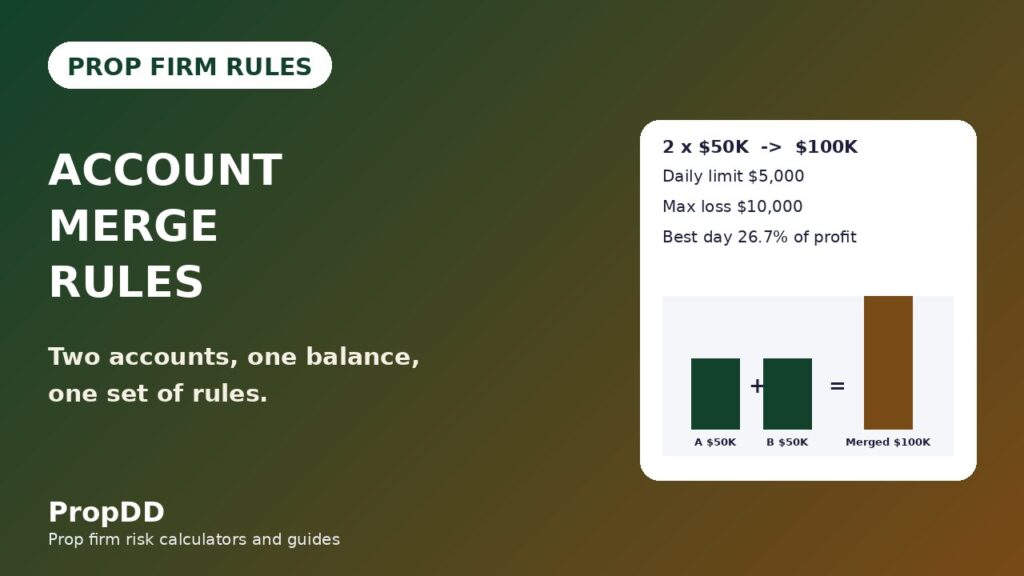
- My worked example: two 50K accounts into one 100K account
- Ten trades after the merge
- Merge vs scaling vs holding several accounts
- My merge-day checklist
- Frequently asked questions
Merging is not a trick and it is not a shortcut to more capital. It is a piece of account admin that turns two small funded accounts into one bigger one, with one set of rules instead of two. Done right, it simplifies everything. Done without reading the rules, it can strand your profits on an account that no longer exists. Here is how it works, which firms allow it, and the exact numbers from my own merge. These are the prop firm account merge rules as they actually work in practice, not as the marketing pages describe them.
What account merging actually means
Account merging means asking your prop firm to combine two or more of your funded accounts into a single account whose starting balance is the sum of the parts. Two fifty-thousand-dollar accounts become one hundred-thousand-dollar account. The trades you already closed stay in your history, the open positions are usually closed or carried over according to the firm’s process, and from the merge date you trade one balance, one daily loss limit and one payout cycle.
Three things merging is not. It is not buying a bigger account, because you already paid the challenge fees on both accounts and merging does not refund them. It is not scaling, because scaling grows one account by a percentage after you hit a profit milestone, while merging combines accounts you already hold. And it is not the same as holding several accounts, which is a different setup entirely: several accounts means several rulebooks running in parallel, while a merged account means one rulebook with bigger dollar limits. If you want the parallel version, read my guide to trading multiple prop firm accounts first, because the risks there are the mirror image of the ones here.
The practical appeal is simple. One daily loss limit of five thousand dollars is easier to manage than two limits of two thousand five hundred, because a single bad morning no longer forces you to choose which account absorbs it. One payout cycle means one minimum profit target and one withdrawal request instead of two. And one consistency rule means your best day is measured against your combined profit, not judged separately on two smaller totals. None of that makes you more profitable. It makes the operation cleaner, and cleaner operation is what keeps funded accounts alive.
Which firms let you merge, and which do not
Most prop firms never publish a merge policy at all. Their rulebooks cover drawdown, consistency, news trading and payouts in detail, and say nothing about combining accounts. Silence is not permission. If the rulebook does not mention merging, assume it is not offered until support confirms otherwise in writing, and keep the message, because a support chat is the only proof you will have if the merge goes wrong. The prop firm account merge rules that do exist in public are short, and the two firms below are the ones that actually print them.
A small number of firms do publish the rule, and their terms are worth reading closely because they show the shape of the whole topic. Goat Funded Trader states in its published rules that evaluation accounts or funded accounts above four hundred thousand dollars cannot be merged, while accounts below that threshold may be combined, with a maximum capital allocation of eight hundred thousand dollars per trader. FundingTraders states on its own blog that traders may merge multiple smaller accounts at all stages, with a maximum capital allocation of four hundred thousand dollars per customer. The same firm’s instant funding accounts, by contrast, cannot be merged at all, which is a reminder that the account type matters as much as the firm. I verified the Goat Funded Trader wording against their published rules page, which is the source I used for the figures in this section.
| Firm / account type | Merging allowed? | Cap | What the rule actually says |
|---|---|---|---|
| Goat Funded Trader, evaluation or funded | Yes, below the cap | $400,000 combined | Accounts above $400,000 cannot be merged; below it they may be combined. Maximum capital $800,000 per trader. |
| FundingTraders, all stages | Yes | $400,000 per customer | Merge multiple smaller accounts at any stage, up to $400,000 total allocation per customer. |
| Goat Funded Trader, instant funding | No | Not applicable | Instant accounts cannot be merged; each runs on its own rules and limits. |
| Most other firms | Not published | Unknown | No merge clause in the public rulebook. Ask support in writing before assuming anything. |
Two warnings belong here. First, a merge is usually one-way. Once two accounts become one, you cannot split them back into two fifty-thousand-dollar accounts if you change your mind, so treat the request as permanent. Second, some firms only merge accounts that have not started trading yet, or only merge evaluation accounts before they are funded, so the timing of your request matters as much as the size. Ask these three questions before you request anything: can funded accounts be merged or only evaluations, is there a combined-balance cap, and does the merge reset the minimum trading days or the payout clock? The answers decide whether merging helps you or costs you a payout cycle.
The merge maths: what changes and what stays the same
The percentages never change. A five percent daily loss limit is five percent whether the account is fifty thousand or one hundred thousand dollars, and a ten percent maximum loss is ten percent on either size. What changes is every dollar figure attached to those percentages, and the dollar figures are what your trading actually feels. My two accounts each allowed a two-thousand-five-hundred-dollar losing day. The merged account allows five thousand. That sounds like freedom, and it is, but it is also twice the room to hurt yourself before the rule stops you, so the personal daily stop I set for myself matters more after a merge, not less.
| Figure | Formula | Two $50K accounts | One $100K account |
|---|---|---|---|
| Daily loss limit (5%) | Balance x 0.05 | $2,500 each | $5,000 |
| Maximum loss (10%) | Balance x 0.10 | $5,000 each | $10,000 |
| Risk per trade at 1% | Balance x 0.01 | $500 each | $1,000 |
| Lots, 20-pip stop, $10 per pip | Risk / (20 x $10) | 2.5 lots each | 5.0 lots |
| Profit target at 10% | Balance x 0.10 | $5,000 each | $10,000 |
Two subtleties hide inside that table. The first is the trailing drawdown. If your firm’s maximum loss trails your peak equity, the merged account’s peak is the sum of both accounts’ peaks, so your floor moves up with it. My accounts peaked at a combined one hundred and four thousand dollars, three thousand on one and one thousand on the other, which put a trailing floor at ninety-four thousand. A static maximum loss, by contrast, holds the floor at ninety thousand regardless of the peak. That four-thousand-dollar gap is the difference between a rule you survive and a rule you breach, so confirm which type your firm uses before you merge. The second subtlety is the consistency rule. A best-day cap of thirty percent is measured against the merged account’s total profit, which usually helps, because two medium days combine into one total that neither day dominates. I show the exact numbers in the worked example below.
My worked example: two 50K accounts into one 100K account
Here is my merge, with the real numbers. Account A sat at fifty-three thousand dollars after a good month. Account B sat at fifty-one thousand. Combined starting balance for the merged account: one hundred and four thousand dollars, which is four thousand above the round one hundred thousand the percentages are calculated from. That four thousand is a buffer, not a bonus: it is profit I had already banked, and it sits above the static maximum-loss floor of ninety thousand, giving me fourteen thousand dollars of room instead of ten.
I checked the merged limits against the max daily drawdown calculator before I confirmed anything, because the calculator turns the percentages into the dollar figures I actually trade against. The table below is what I tested: the two accounts side by side, then the merged account, with the same one percent risk per trade and the same twenty-pip stop on EURUSD. The only number that looks generous is the lot size, five lots instead of two and a half, and that is exactly the number that demands discipline, because five lots at a twenty-pip stop is a one-thousand-dollar loss when the trade fails.
| Measure | Account A ($50K) | Account B ($50K) | Merged ($100K) |
|---|---|---|---|
| Balance at merge | $53,000 | $51,000 | $104,000 |
| Daily loss limit (5%) | $2,500 | $2,500 | $5,000 |
| Maximum loss (10%) | $5,000 | $5,000 | $10,000 |
| Static floor | $45,000 | $45,000 | $90,000 |
| Trailing floor at peak | $48,000 | $46,000 | $94,000 |
| Risk per trade (1%) | $500 | $500 | $1,000 |
| Lots at 20-pip stop | 2.5 | 2.5 | 5.0 |
| Best-day cap (30% of profit) | $1,200 on $4,000 profit | $600 on $2,000 profit | $1,800 on $6,000 profit |
The consistency line is the one that surprised me. Before the merge, my best day on account A was one thousand one hundred dollars against four thousand of total profit, which is twenty-seven and a half percent and uncomfortably close to the thirty percent cap. My best day on account B was five hundred against two thousand, twenty-five percent. After the merge, those two days combine to one thousand six hundred against six thousand of total profit, which is twenty-six point seven percent, inside the cap with room to spare. Merging did not change my trading. It changed the denominator, and the denominator is what the consistency rule judges. If your best day is already over the cap on one account, merging can rescue it, provided both accounts are at the same firm and both are eligible. That is the one genuine mathematical advantage of merging, and it is worth checking before you request anything.
Ten trades after the merge
I traded the merged account for ten sessions after the merge, one trade a day, same setup, same one percent risk, same twenty-pip stop. Six wins, four losses. Each win paid two thousand dollars, two times my risk, and each loss cost one thousand. The net is eight thousand dollars, eight times my risk, at a sixty percent win rate and an expectancy of nought point eight R per trade. The number that mattered most was not the profit. It was the best day: two thousand dollars, one single winning trade, which is twenty-five percent of the eight thousand total, inside the thirty percent consistency cap. On the old two-account setup the same ten trades would have been split across two dashboards and the same best day would have been judged against a smaller total. The merge did not improve the trades. It improved the accounting around them.
| Day | Pair | Result | P&L | Running total |
|---|---|---|---|---|
| 1 | EURUSD | Win, 2.0R | +$2,000 | +$2,000 |
| 2 | GBPUSD | Loss, 1.0R | -$1,000 | +$1,000 |
| 3 | EURUSD | Win, 2.0R | +$2,000 | +$3,000 |
| 4 | EURUSD | Win, 2.0R | +$2,000 | +$5,000 |
| 5 | GBPUSD | Loss, 1.0R | -$1,000 | +$4,000 |
| 6 | EURUSD | Win, 2.0R | +$2,000 | +$6,000 |
| 7 | GBPUSD | Loss, 1.0R | -$1,000 | +$5,000 |
| 8 | EURUSD | Win, 2.0R | +$2,000 | +$7,000 |
| 9 | GBPUSD | Loss, 1.0R | -$1,000 | +$6,000 |
| 10 | EURUSD | Win, 2.0R | +$2,000 | +$8,000 |
One warning from that table: the daily loss limit on the merged account is five thousand dollars, which is five losing trades at one percent risk. On the old setup, five losses in a day would have been split across two accounts and neither would have breached. On the merged account they all land in one place. I keep my personal daily stop at two thousand dollars, two losing trades, precisely because the merged limit is generous enough to let a bad day run away with me. The rule protects the firm. My own stop protects me.
Merge vs scaling vs holding several accounts
Traders confuse merging with two neighbouring ideas, and the confusion costs money, so here is the distinction in one place. Merging combines accounts you already hold into one bigger account right now, with no new challenge and no new fee. Scaling grows one account by a percentage after you hit a profit milestone and wait out the firm’s schedule: FundingTraders, for example, scales a three-hundred-thousand-dollar account by twenty-five percent every two months, up to one million dollars, which is slower than merging but requires no second account at all. Holding several accounts keeps each one separate, with its own rules and its own payout cycle, which spreads risk across dashboards but doubles the admin. My guide to scaling plans and drawdown covers the waiting game in detail, and the multiple-accounts guide covers the parallel version.
| Option | Capital | New fee? | Speed | Rulebooks | Best when |
|---|---|---|---|---|---|
| Merge two $50K accounts | $100K at once | No | Immediate | One | You already hold two accounts at one firm |
| Scale one $50K account | Grows by percentage | No | Months | One | You hold one account and can wait |
| Hold several accounts | Sum of all | Yes, per challenge | Immediate | One per account | You want separation between strategies |
| Buy a bigger challenge | Whatever you pay for | Yes, full fee | After passing | One | You hold nothing yet and want one account |
The fee point deserves a plain sentence. Merging does not refund the challenge fees you already paid on either account, and it does not make a future challenge cheaper. What it saves is the next fee you would otherwise pay: if you wanted one hundred thousand dollars of capital and did not merge, you would buy a new one-hundred-thousand-dollar challenge and pay its fee on top of the two you already paid. Merging reaches the same capital with the fees already spent. If a refund is what you are chasing, the relevant rules are the challenge fee refund rules, not the merge rules, because the two are separate policies at every firm I have seen.
My merge-day checklist
I run this checklist before I request any merge, and I would not request one without it. Every item is a question I have either answered wrongly before or watched another trader answer wrongly. The whole list takes twenty minutes, and it has saved me from one bad merge already, when I discovered at step three that the smaller account’s payout cycle would have restarted and cost me a withdrawal I had been counting on.
| Step | Check | Why it matters |
|---|---|---|
| 1 | Confirm both accounts are at the same firm and the same account type | Cross-firm merges do not exist; instant and evaluation accounts often cannot merge |
| 2 | Get the merge rule in writing from support | The public rulebook may not mention merging at all |
| 3 | Ask whether minimum trading days and the payout clock reset | A reset can delay your next withdrawal by weeks |
| 4 | Check the combined-balance cap | Over the cap, the merge is refused outright |
| 5 | Confirm static vs trailing maximum loss on the merged account | Four thousand dollars of floor difference on my own merge |
| 6 | Close or note every open position before the merge | Open trades may be closed by the firm during the merge |
| 7 | Recalculate daily loss, risk per trade and lot size for the new balance | Five lots feels very different from two and a half |
Step five is the one traders skip, and it is the one that breaches accounts. A static maximum loss is measured from the starting balance, so my merged floor was ninety thousand dollars. A trailing maximum loss is measured from the peak, so the same account’s floor was ninety-four thousand. If you assume static and the firm applies trailing, you will trade four thousand dollars deeper into danger than you planned. The consistency rule guide explains the other half of the same problem: the best-day cap is judged on the merged total, so check your best days on both accounts against the combined profit before you merge, not after.
Frequently asked questions
Can I merge two prop firm accounts into one?
Only if your firm allows it. A few firms publish the rule: Goat Funded Trader allows merging below a four-hundred-thousand-dollar combined balance, and FundingTraders allows it at all stages up to four hundred thousand dollars per customer. Most firms publish no merge rule at all, which means you must ask support in writing and keep the answer. Never assume a merge is possible.
Does merging accounts reset my minimum trading days?
It can, and that is the question to ask before you request the merge. Some firms carry your trading history across; others restart the payout clock on the new account. If a payout is close, wait until the money is out before you merge, because a reset can delay the withdrawal by a full cycle.
Do I get my challenge fees back when I merge?
No. The fees you paid for both challenges are spent, and merging does not refund them. The saving is that you do not pay a third fee to reach the bigger balance. Refunds follow the firm’s fee refund policy, which is separate from the merge policy.
What happens to my open trades during a merge?
It depends on the firm. Some close all open positions before combining the balances; others carry them over. Close your own positions before you request the merge, so the decision is yours and not the firm’s system closing a trade at a price you did not choose.
Can I merge accounts from different prop firms?
No. Merging only works between accounts at the same firm, because the firm is combining its own internal records. Accounts at two different firms stay separate, and trying to trade them as one combined balance breaks the drawdown maths on both.
Is merging better than scaling my account?
It depends on what you already hold. If you already have two accounts, merging is immediate and free, while scaling takes months of milestones. If you hold one account, scaling is the only route, because there is nothing to merge. Merging is faster; scaling needs no second account. Neither makes your trading more profitable on its own.
Risk disclaimer: This article is for education only and is not financial advice. Prop firm rules change without notice, and merging policies differ by firm and account type. Confirm the current rule with your firm in writing before requesting a merge, and never trade money you cannot afford to lose.