Lot size confuses people for a silly reason: every platform shows it slightly differently, and every tutorial assumes you already know the vocabulary. The idea itself is simple. A lot is a unit of trade size, and the bigger the lot, the more each pip is worth. Once that clicks, your risk becomes something you can calculate before the trade instead of discover after it.
In this article
- The three sizes you'll see
- What a pip is
- Pip value in a table
- When the dollar isn't the quote currency
- If your account isn't in dollars
- From risk to lots
- Three examples
- Lot steps and minimums
- Lots and the daily limit
- Margin and leverage are separate from risk
- Metals, indices and others
- Different platforms, different words
- Common mistakes
- A short routine for every trade
- Matching lot size to your style
- A one-page sizing worksheet
- Why smaller lots help your head
- Test your numbers on a demo
- Converting between units and lots
- One more sanity check
- Frequently asked questions
- The short version
This guide goes through the standard lot sizes, how pip value works on different kinds of pairs, how to pick a size that fits your daily drawdown, and where people trip up. If you want to see how your lot choice affects your limit on a real account, put your numbers into the drawdown calculator as you read.
The three sizes you’ll see
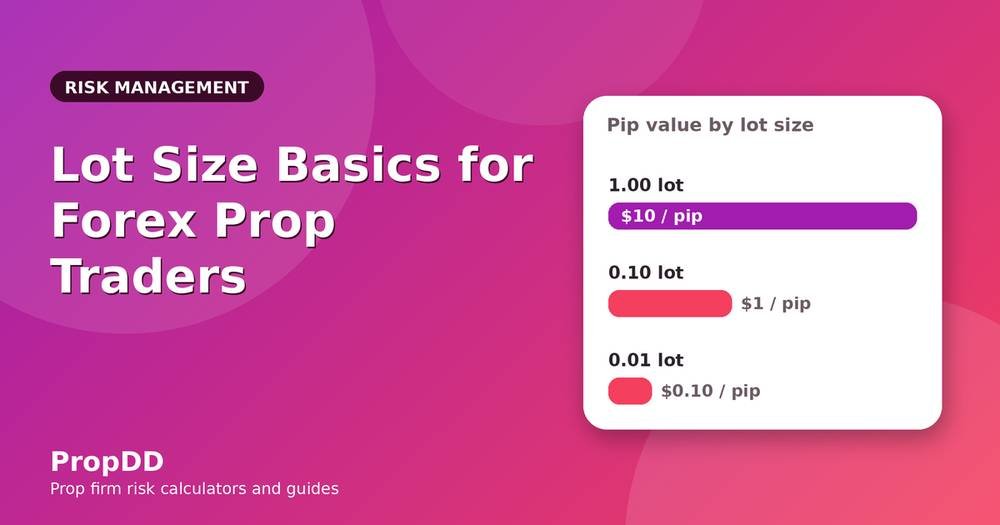
A standard lot is 100,000 units of the base currency. A mini lot is 10,000 units, shown as 0.10 on most platforms. A micro lot is 1,000 units, shown as 0.01. Many brokers also allow sizes between these, in steps of 0.01 lots, and some allow even smaller ones. On a platform that shows “1.00”, that means one standard lot.
The units are for the base currency, the first in the pair. One standard lot of EURUSD is 100,000 euros. One standard lot of USDJPY is 100,000 US dollars. That detail matters when you work out what a pip is worth.
What a pip is
A pip is the usual smallest quoted price move: the fourth decimal place for most pairs (0.0001) and the second for pairs involving the yen (0.01). Many brokers quote an extra decimal, a “pipette” or fractional pip, so a price like 1.08457 has the pip at the fourth decimal and the pipette at the fifth. The idea is explained neutrally on Investopedia’s page about the pip if you want a second source.
Pip value in a table
For pairs where the US dollar is the quote currency (EURUSD, GBPUSD, AUDUSD and so on) and an account in dollars, the maths is wonderfully easy.
| Lot size | Units | Pip value (USD-quoted pair) |
|---|---|---|
| 1.00 (standard) | 100,000 | about $10 |
| 0.10 (mini) | 10,000 | about $1 |
| 0.01 (micro) | 1,000 | about $0.10 |
So a 20-pip loss on one standard lot is $200, on a mini lot $20 and on a micro lot $2. Scale the lot, scale the loss.
When the dollar isn’t the quote currency
For USDJPY, the pip is 0.01 and a standard lot’s pip is worth 1,000 yen. To get the value in dollars you divide by the current USDJPY rate. At a rate of 150, that’s about $6.67. At 140, about $7.14. So the dollar value of a pip on yen pairs changes slowly as the rate changes. For crosses like EURGBP or GBPJPY, the pip value is expressed in the quote currency and converted to your account currency at the current rate.
You don’t have to do these conversions by hand. Your platform’s contract specification, or the order ticket’s risk panel, shows the pip value for each pair. Use that figure, not a number you remember from last year.
If your account isn’t in dollars
An account in euros or pounds converts every pip value into that currency. A standard lot of EURUSD is $10 a pip, which in a euro account is that amount converted at the current EURUSD rate. The practical advice is to keep everything in the account currency: express your risk in it, read the pip value in it and make sure your calculator inputs use it too. Mixing currencies is a classic source of “why was this loss bigger than I planned?”.
From risk to lots
The formula is short: lots equals dollar risk divided by stop distance in pips times pip value per lot. With a $500 risk, a 25-pip stop and $10 per pip per lot on EURUSD, you get 500 ÷ 250 = 2 lots. With a 50-pip stop, 1 lot. The stop decides the size.
The full walk-through, including gold, indices and a short practice drill, is in position sizing for prop firm challenges. And the dollar risk itself comes from the daily limit; see how much to risk per trade on a funded account.
Three examples
EURUSD, $100,000 account, 0.5% risk ($500), 20-pip stop. $500 ÷ (20 × $10) = 2.5 lots.
USDJPY, same account and risk, 35-pip stop, pip value about $6.70. $500 ÷ (35 × $6.70) = $500 ÷ $234.50 = 2.13, so 2.1 lots.
GBPJPY, risk $300 on a $60,000 account, 45-pip stop, pip value about $6.70. $300 ÷ (45 × $6.70) = $300 ÷ $301.50 = 0.995, so round down to 0.99, or 0.9 if your steps are 0.1. Notice that crosses can be volatile, and a 45-pip stop on GBPJPY is not a lot.
Lot steps and minimums
Brokers set a minimum lot, often 0.01, and a step, the smallest increment. If the formula says 1.87 lots and your step is 0.1, you can only trade 1.8 or 1.9. Always round down. Rounding up quietly adds risk, and across a hundred trades it adds up. If the minimum lot is already too big for your intended risk on a given stop, the trade is simply too large for your account at that stop. Skip it, or find a tighter, valid stop.
Lots and the daily limit
Here’s what a single trade means against a $5,000 limit on a $100,000 account, at $10 a pip per lot.
| Lots | Stop (pips) | Loss | Share of daily limit |
|---|---|---|---|
| 1 | 25 | $250 | 5% |
| 2 | 25 | $500 | 10% |
| 5 | 25 | $1,250 | 25% |
| 5 | 60 | $3,000 | 60% |
| 10 | 50 | $5,000 | 100% |
The last row is a full breach from a single stopped trade. It’s not hypothetical: it’s what happens when a trader picks “10 lots” because margin allows it, without thinking about the stop. Lots and stop together are your daily drawdown plan.
Margin and leverage are separate from risk
Leverage decides how much margin you need to open a position. It doesn’t change what you lose when the stop is hit. Ten lots with a 50-pip stop is a $5,000 loss whether your leverage is 1:30 or 1:500. Many breaches happen because traders size to what margin allows. For a general explanation of the idea, see Investopedia on leverage, and remember that on a prop account your real limit is the loss rule, not the margin.
Metals, indices and others
Gold, silver, indices and oil don’t follow the forex pattern. A lot may be 100 ounces of gold, or a certain number of index units per point, and brokers differ. The contract specification tells you the “tick value” or “value per point”. Read it every time you add a new instrument, and run a test on a demo account with a tiny size to confirm that the loss you see matches your calculation.
Different platforms, different words
MetaTrader shows lots. Some other platforms show units or contracts, with 100,000 units equalling one standard lot. A few show “volume” in millions or thousands. If you switch platforms, double check the first few trades against your calculation, because “1” can mean very different things on different screens.
Common mistakes
Picking a lot size first and placing the stop afterwards. Using the same lot size on every trade even though the stop distance changes. Using a pip value from memory. Forgetting to add the spread on tight stops. Sizing to margin, not to risk. Each of those turns a planned $300 loss into something else.
A short routine for every trade
Decide the dollar risk. Place the stop where the idea fails. Read the pip value from the platform. Divide, round down, enter the size. Then add the trade’s risk to anything already open and check it against the room you have left. It takes thirty seconds and it’s the habit that separates people who hit limits by accident from people who rarely get near them.
Matching lot size to your style
A scalper with 8-pip stops can trade a larger lot for the same dollar risk than a swing trader with a 90-pip stop. That sounds obvious, but it has a consequence people forget: the scalper’s costs per lot matter more, and slippage on a tight stop is a bigger share of the planned loss. The swing trader’s lots are small and the stops are wide, so a gap or a news spike moves the account by a lot more than the “planned” amount. Neither is safer by default. Each has a different way of going wrong, and the lot size should reflect that.
A one-page sizing worksheet
If you like paper, make a small card. Account equity. Risk per trade as a percentage and in dollars. Instrument and pip value from the platform. Stop distance. The lot size from the formula and the rounded-down figure you’ll actually use. Total open risk after this trade. Room left today. Seven lines. Fill it in for the first twenty trades of your challenge, and the process will be automatic by the end of the week. Afterwards you can use a calculator, but you’ll know when the answer looks wrong.
Why smaller lots help your head
There’s a purely psychological reason to prefer a modest size. When one trade is worth 0.4% of the account, a loss is just a number. When it’s worth 2%, every tick pulls at your attention, you start moving stops, and decisions get worse. Many traders find that cutting the lot size by a third doesn’t reduce their results, because it improves their discipline. If you ever feel your pulse during a trade, the size is too big for you, even if the maths says it’s fine.
Test your numbers on a demo
Before you trust a calculation on a new instrument, open a small trade on a demo account, set a stop a known number of pips away and let it be hit. Check the loss against your formula. If they match, you’ve understood the contract. If not, find out why: perhaps the pip is defined differently, or the lot unit is different from what you assumed. It costs nothing, and it’s the cheapest way to avoid an expensive misunderstanding on a funded account.
Converting between units and lots
Some platforms ask for units. Divide the units by 100,000 to get standard lots: 50,000 units is 0.5 lots, and 2,500 units is 0.025 lots, which many brokers will round or reject depending on their step. If you trade across platforms, write a tiny conversion note for yourself and stick it on your monitor. It prevents the embarrassing and expensive mistake of entering 10 when you meant 0.10.
One more sanity check
After you calculate a lot size, ask a very plain question: if this trade loses, can I look at the number without flinching? If the answer is no, cut the size, whatever the formula says. Maths gives you the maximum. Comfort gives you the actual figure, and the second is usually smaller.
Frequently asked questions
What lot size should a beginner use?
Whatever keeps risk per trade small, usually 0.25% to 0.5% of the account. On a small account that may be a micro or mini lot. Start small and demo first.
Is a bigger lot always more profitable?
No. It’s more volatile in both directions. Bigger lots simply mean each pip counts for more, which includes the losing ones.
How do I check the pip value on my platform?
Open the contract specification for the symbol, or use the risk panel on the order ticket. If in doubt, place a tiny trade on demo and watch the profit move by one pip.
Do all pairs have the same pip value?
No. USD-quoted pairs are about $10 per standard lot per pip. Yen pairs and crosses differ and change with the exchange rate.
The short version
A lot is a unit of size, a pip is a unit of movement, and your risk is the stop distance times the pip value times the lots. Fix the dollar risk first, let the stop decide the lots and always round down. For the daily limit that all this protects, read the prop firm max daily drawdown explained, and for free beginner lessons, the BabyPips school is a good place to keep learning.