I paid 60 dollars to open my first platinum trade, and price had not moved a single dollar. I had just passed my challenge on EURUSD, platinum looked quiet at 1,290 dollars an ounce, and I bought 1.00 lot the way I would buy one lot of gold. The spread on my firm’s feed was 0.60 dollars an ounce, and one lot is 100 ounces, so crossing the spread cost me 60 dollars before the trade even started. My stop sat 10 dollars below entry, which I thought was a tight stop. Ten dollars times 100 ounces is 1,000 dollars of risk on an account with a 5,000-dollar daily loss limit. One trade, one fifth of my day, gone on a stop I had sized like a forex pair. I closed the trade down 180 dollars and sat down to learn the metal properly before touching it again.
In this article
- What platinum actually is on a funded account
- The contract maths: one lot, one tick, one dollar
- The spread trap: why platinum costs more per trade than gold
- When platinum moves: sessions, news and the South Africa factor
- The sizing grid under a 5,000-dollar daily loss limit
- One worked trade, start to finish
- I tested it: ten platinum trades on the funded account
- Platinum vs gold vs palladium
- The mistakes that breach funded accounts on platinum
- My platinum routine
- Frequently asked questions
I trade a $100,000 funded account with a $5,000 daily loss limit and a 10% maximum drawdown. Platinum is now one of my regular instruments, but only because I treat it as its own market with its own contract, spread and leverage cap. This is the guide I wish I had read before that first click.
What platinum actually is on a funded account
Platinum, ticker XPT, trades against the dollar as XPTUSD on funded accounts. It is a precious metal, but it is not gold with a different name. Gold is a monetary metal that traders buy when they are scared. Platinum is an industrial metal that car makers buy: roughly two fifths of annual platinum demand goes into catalytic converters, most of them for diesel vehicles, and the rest splits between jewellery, chemicals, electronics and investment. That demand mix is why platinum does not always follow gold. On a risk-off day gold can rally while platinum falls, because the same fear that lifts gold cuts car sales forecasts.
Supply is the other half of the story. Around 70% of mined platinum comes from South Africa, and most of the rest from Russia and Zimbabwe. A power cut at a South African mine, a strike, or a sanctions headline can move platinum 20 dollars in a session while gold barely moves. That concentration is a feature, not a bug: it gives platinum its own news calendar, and a funded trader who knows the calendar is not surprised by the move.
On a funded account platinum trades like any other CFD: no delivery, no physical metal, just price exposure against the dollar. It trades almost 24 hours a day, five days a week, with a weekend close like forex, so there is no Sunday-night crypto session and no Saturday trade to rescue a bad week. Platinum is a weekday metal with a weekend gap, and every position you hold on Friday carries that gap into Monday. Check your own firm’s contract before you trade, because contract sizes and leverage differ between firms.
The contract maths: one lot, one tick, one dollar
Everything in platinum sizing flows from one fact: on my firm’s feed, one lot of XPTUSD is 100 troy ounces. That single number sets every pip value, every stop distance and every margin figure below. The futures market is different and worth knowing as a cross-check: the NYMEX platinum contract covers 50 troy ounces, with a minimum tick of 0.10 dollars an ounce worth 5 dollars per contract, as published in the CME platinum futures rulebook. My CFD feed doubles that contract size to 100 ounces, so my numbers are twice the futures numbers, and mixing the two up is exactly how traders double their risk by accident.
| Fact | My funded account | Why it matters |
|---|---|---|
| Symbol | XPTUSD | Quoted in dollars per troy ounce, two decimals |
| One lot | 100 troy ounces | Sets every pip-value number below |
| One dollar move | 100 dollars per lot | A 10-dollar stop is 1,000 dollars of risk |
| One 0.10 tick | 10 dollars per lot | The smallest price step still moves real money |
| Typical spread | 0.50 dollars an ounce | 50 dollars per lot just to enter and exit |
| Leverage | 1:10 funded | Caps how much notional you can hold |
| Trading hours | 24/5, closed weekends | Friday positions carry a weekend gap |
| Typical daily range | 15 to 25 dollars an ounce | 1,500 to 2,500 dollars per lot, per day |
The formula box is the whole article in three lines. If you remember nothing else, remember this: your risk in dollars is your stop distance in dollars an ounce, times 100 ounces, times your lots. A 5-dollar stop on 1.00 lot is 500 dollars. A 5-dollar stop on 0.50 lots is 250 dollars. There is no other maths, and there is no shortcut around it.
| What you want | Formula | Worked example |
|---|---|---|
| Risk per trade | Stop distance x 100 oz x lots | 5.00 x 100 x 1.00 = 500 dollars |
| Lot size from risk | Risk / (stop distance x 100) | 500 / (5.00 x 100) = 1.00 lot |
| Spread cost | Spread x 100 oz x lots | 0.50 x 100 x 1.00 = 50 dollars |
| Margin at 1:10 | Price x 100 oz x lots / 10 | 1,285 x 100 x 1.00 / 10 = 12,850 dollars |
| Daily range in dollars | Range x 100 oz x lots | 20 x 100 x 1.00 = 2,000 dollars |
Run the margin line twice: one lot at 1,285 dollars is 128,500 dollars of notional value, and at 1:10 leverage the margin is 12,850 dollars, nearly 13% of a 100,000-dollar account for a single lot. Forex traders, used to about 1,000 dollars of margin per lot at 1:100, do not expect it.
The spread trap: why platinum costs more per trade than gold
Platinum is a thinner market than gold, and thin markets charge you at the spread. On my firm’s feed gold typically quotes a 0.30-dollar spread, while platinum quotes 0.50 dollars, and in the Asian session I have seen platinum widen past 1.00 dollar an ounce. At 1.00 lot that is 50 dollars on a normal entry and 100 dollars on a wide one, every single trade, win or lose. My gold guide shows the same maths at a lower rate, which is why I trade gold more often and platinum only when the setup earns its spread.
The spread also changes what a good trade looks like. A 5-dollar stop with a 0.50-dollar spread means the spread alone is 10% of your risk before price moves. A 2-dollar scalp stop with the same spread means the spread is 25% of your risk, and you need price to move 2.50 dollars just to reach breakeven. That is why scalping platinum on a funded account is a slow bleed: not because the direction is wrong, but because the toll is too high for the distance. I do not take platinum trades with stops under 5 dollars an ounce, and I do not trade it in the Asian session, when the spread doubles and the range halves.
Slippage is the spread’s quieter cousin: platinum gaps over South African news and over the weekend close, and a stop can fill several dollars from its level. I size every stop as if it might slip 2 dollars, so I never call the paper risk the real risk. The spread is a cost you can see; slippage is the same cost wearing a disguise, and both come out of the same daily limit.
When platinum moves: sessions, news and the South Africa factor
Platinum is most liquid when London and New York overlap, roughly 13:00 to 16:00 GMT. That is when the spread is tightest, the range is widest, and a stop has the best chance of filling near its level. The Asian session is the opposite: thin, wide-spread, and prone to drifting 5 dollars on no news at all. I trade platinum only in the London-New York window, and I treat an Asian-session setup as a note for later, not a trade.
Four news types move platinum enough to matter: South African mining news, including power-grid failures and strikes, which hits supply directly; United States and European car-sales data, which moves catalytic-converter demand; gold moves, which drag platinum along through the precious-metals correlation; and dollar news, especially CPI and Federal Reserve decisions. I check all four before a trade, and I never hold a fresh position into a mining headline I have not read.
The sizing grid under a 5,000-dollar daily loss limit
My rule is simple: no single trade risks more than 500 dollars, which is 0.5% of the account and 10% of the daily limit. Two losing trades cost 1,000 dollars and the day is over by my own rule, long before the firm’s 5,000-dollar limit is anywhere near. The grid below is the only sizing table I use for platinum. Find your stop distance, read across, and trade that size. Do not round up.
| Stop distance | Lot size | Risk | Spread cost at 0.50 |
|---|---|---|---|
| 2.50 dollars | 2.00 lots | 500 dollars | 100 dollars |
| 5.00 dollars | 1.00 lot | 500 dollars | 50 dollars |
| 7.50 dollars | 0.66 lots | 495 dollars | 33 dollars |
| 10.00 dollars | 0.50 lots | 500 dollars | 25 dollars |
| 15.00 dollars | 0.33 lots | 495 dollars | 17 dollars |
| 20.00 dollars | 0.25 lots | 500 dollars | 13 dollars |
Notice what the grid does to wide stops. A 20-dollar stop, which is a normal daily-range stop on platinum, only allows 0.25 lots at my risk cap. Traders who refuse small size end up doing one of two things: they tighten the stop to 2.50 dollars so they can trade 2.00 lots, and then the spread and the noise stop them out, or they keep the 20-dollar stop at 1.00 lot and risk 2,000 dollars, which is 40% of the daily limit on a single trade. Both paths end at the same place. Small size is not timid trading; it is the price of a stop wide enough to survive a normal platinum day. My minimum trading days guide makes the same point from the other side: surviving the week matters more than winning the morning.
One worked trade, start to finish
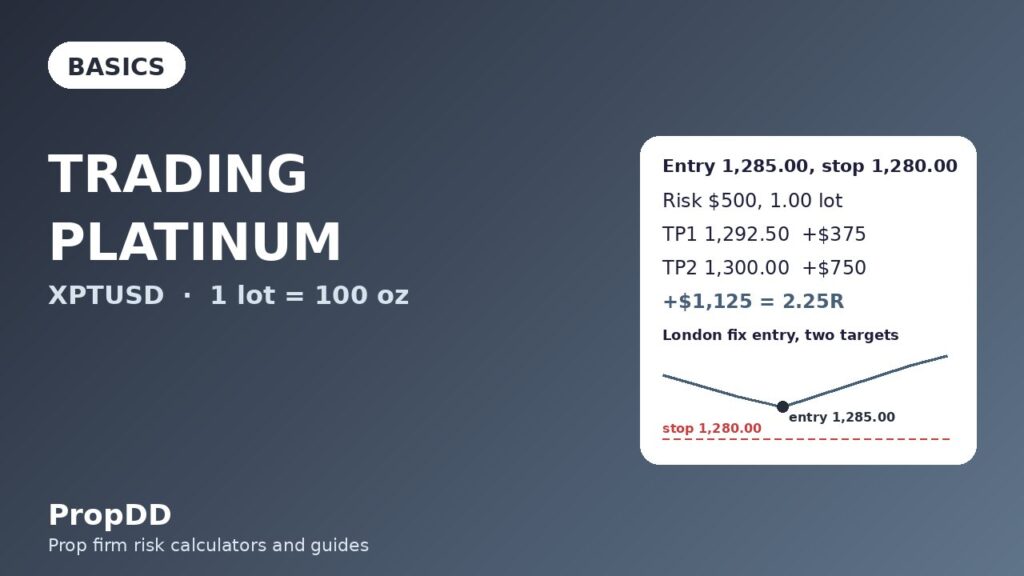
Here is a real trade from my journal, with the numbers exactly as they happened. Platinum had fallen for three days, gold was steady, and the platinum-gold discount had widened to a level I had flagged on Monday. On Thursday at 13:40 GMT, after the London fix, XPTUSD printed a bullish engulfing candle off 1,282, with the spread back to 0.50 after the morning widening. I bought 1.00 lot at 1,285.00, stop at 1,280.00, five dollars below entry, risking 500 dollars. My first target was 1,292.50, 7.50 dollars above entry, and my second target was 1,300.00, 15 dollars above entry.
| Leg | Price | Size | Result |
|---|---|---|---|
| Entry | 1,285.00 | 1.00 lot | Spread cost 50 dollars |
| Stop loss | 1,280.00 | 1.00 lot | Risk 500 dollars |
| Target 1 | 1,292.50 | 0.50 lots closed | +375 dollars |
| Target 2 | 1,300.00 | 0.50 lots closed | +750 dollars |
| Total | — | 1.00 lot | +1,125 dollars = 2.25R |
The trade took nine hours to play out. Price reached 1,292.50 in the New York afternoon, I closed half for 375 dollars and moved the stop on the rest to breakeven at 1,285.00. Price dipped to 1,286 overnight, never threatened breakeven, and reached 1,300.00 the next morning in London: 1,125 dollars on 500 dollars of risk, or 2.25R. The two-target split is what makes platinum workable: the first target pays for the spread and the risk, and the runner captures the slow metal’s habit of continuing once it moves. A single target at 1,292.50 would have made 750 dollars; the runner added 375 dollars for free, because its risk was zero after breakeven.
I tested it: ten platinum trades on the funded account
One good trade proves nothing, so here is the full ten-trade test I ran over five weeks, one trade per day at most, only in the London-New York window, every trade risking 500 dollars with the same two-target split. Six wins, four losses, and the numbers below are the journal entries, not a backtest.
| Trade | Setup | Result | R |
|---|---|---|---|
| 1 | Engulfing off 1,282 support | +$1,125 | +2.25R |
| 2 | Breakout above 1,310, no retest | -$500 | -1.00R |
| 3 | Pullback to 1,295, TP1 only | +$750 | +1.50R |
| 4 | Engulfing off 1,275 support | +$1,125 | +2.25R |
| 5 | News trade into CPI | -$500 | -1.00R |
| 6 | Range top fade at 1,320 | +$1,500 | +3.00R |
| 7 | Asian session chase | -$500 | -1.00R |
| 8 | Pullback to 1,300, TP1 only | +$750 | +1.50R |
| 9 | Engulfing off 1,290 support | +$1,125 | +2.25R |
| 10 | Breakout above 1,335, no retest | -$500 | -1.00R |
| Total | 6 wins, 4 losses | +$4,375 | +8.75R |
Check the maths: six wins total 6,375 dollars, four losses total 2,000 dollars, net 4,375 dollars, or 8.75R at 500 dollars of risk per trade. Win rate 60%, expectancy 0.875R per trade. Every single loss broke one of my own rules: both breakout trades without a retest lost, the CPI news trade lost, and the Asian session chase lost. The wins all followed the plan. I run the same grid through my minimum trading days tracker each week, because a metal this slow punishes impatience more than it rewards courage.
Platinum vs gold vs palladium
Platinum sits between gold and palladium, and knowing which neighbour it resembles on a given day keeps me out of trouble. Gold is the safe haven, palladium is the petrol-car metal, and platinum is the diesel-car metal with a jewellery habit. My palladium guide covers the petrol side in full; the table below is the comparison I keep taped to my monitor.
| Fact | Platinum (XPTUSD) | Gold (XAUUSD) | Palladium (XPDUSD) |
|---|---|---|---|
| One lot | 100 troy ounces | 100 troy ounces | 100 troy ounces |
| One dollar move | 100 dollars per lot | 100 dollars per lot | 100 dollars per lot |
| Typical spread | 0.50 dollars | 0.30 dollars | 0.80 dollars |
| Typical daily range | 15 to 25 dollars | 20 to 35 dollars | 30 to 60 dollars |
| Main demand | Diesel catalysts | Jewellery, central banks | Petrol catalysts |
| Main supply risk | South Africa power | None concentrated | Russia sanctions |
| Leverage, funded | 1:10 | 1:10 | 1:10 |
| My verdict | Slow, wide, patient | Liquid, always tradeable | Fast, expensive, rare |
The practical takeaway is simple. If I want a metal trade every day, I trade gold. If I want one once or twice a week with a wide stop and a runner, I trade platinum. Palladium I trade almost never, because its spread and range turn every mistake into a daily-limit event. The three metals share a contract size, but they do not share a personality, and sizing them identically is the mistake I made on day one.
The mistakes that breach funded accounts on platinum
The first mistake is sizing platinum like forex. A 10-dollar stop feels small on a chart and is 1,000 dollars on a 1.00-lot position. Every platinum stop must be multiplied by 100 before it means anything, and if that multiplication is not automatic yet, write it on a sticky note until it is.
The second mistake is trading the Asian session. The spread widens, the range shrinks, and the fills get worse, all at once. My trade 7 above was an Asian session chase, and it lost the full 500 dollars. There is no edge in paying double spread for half the movement.
The third mistake is holding through the weekend without a plan. Platinum gaps on Monday on South African weekend news, and a gap through a stop is a fill at the market, not at your level. I close platinum positions on Friday unless the trade is already at breakeven with the stop moved up, and I never open a fresh platinum position after 16:00 GMT on a Friday.
The fourth mistake is treating platinum like gold during a crisis. When markets panic, gold rallies and platinum often falls, because panic cuts car demand. If you want a haven, trade gold; if you trade platinum, trade it as an industrial metal with a slow trend.
The fifth mistake is overtrading a slow metal. Platinum gives two or three good setups a week, not two or three a day. Forcing a fourth setup means trading a worse level with the same spread, and the journal proves it: my forced trades are my losing trades. One pair, one metal, one plan is the discipline my one-pair guide teaches, and platinum rewards it more than most markets.
My platinum routine
- Monday: note the platinum-gold ratio, check South African power and mining headlines, mark the week’s support and resistance on the daily chart.
- Each morning: check the spread at 08:00 GMT; if it is above 0.80 dollars an ounce, no platinum trade that day.
- Entry window: 13:00 to 16:00 GMT only, London-New York overlap, never the Asian session.
- Before entry: confirm the setup, the stop distance, the lot size from the grid, and the spread cost; if any number is missing, no trade.
- After entry: close half at target 1, move the stop to breakeven, let the runner work; never move the stop further away.
- Daily stop: two losing trades, or 1,000 dollars down, and platinum is closed for the day.
- Friday: no fresh positions after 16:00 GMT; runners only with stops at breakeven.
- Journal: log every trade with entry, stop, targets, spread and R; review the ten-trade block before changing any rule.
If you take one number from this guide, take the spread: fifty dollars per lot, every trade, before price moves. A metal that charges that much to enter must be traded rarely, sized small and held patiently. Do that, and platinum becomes what it is for me now: the slowest, calmest trade on my funded account. And if you are splitting the profit at month end, run the numbers through my profit split calculator before you celebrate.
Frequently asked questions
Can I trade platinum on a funded account?
Yes, most prop firms list platinum as XPTUSD on their CFD feeds, usually with 1:10 leverage on funded accounts. Availability differs by firm and account type, so check your firm’s symbol list first; some firms restrict metals to certain challenge types, and a few exclude platinum entirely while offering gold.
How much is one lot of platinum worth?
On my firm’s feed one lot of XPTUSD is 100 troy ounces, so one dollar of price movement is worth 100 dollars per lot. At 1,285 dollars an ounce, one lot controls 128,500 dollars of notional value. Always confirm your own firm’s contract size, because a 50-ounce feed would halve every number in this guide.
What is the spread on platinum?
On my feed the typical spread is 0.50 dollars an ounce, or 50 dollars per lot, widening past 1.00 dollar in the Asian session. Gold is usually cheaper at around 0.30 dollars, and palladium dearer at around 0.80 dollars. The spread is a fixed cost on every trade, so it matters most on short stops and short holds.
How much should I risk per platinum trade?
I risk 500 dollars per trade, which is 0.5% of my 100,000-dollar account and 10% of my 5,000-dollar daily loss limit. With a 5-dollar stop that means 1.00 lot, and with a 20-dollar stop it means 0.25 lots. Never size from the account balance; size from the daily loss limit, because that is the number that ends your account.
When is the best time to trade platinum?
The London-New York overlap, roughly 13:00 to 16:00 GMT, when the spread is tightest and the range is widest. I avoid the Asian session entirely, when the spread doubles and the range halves, and I avoid holding fresh positions into the weekend close on Friday afternoon.
Is platinum better than gold for funded traders?
Neither is better in general; they are different trades. Gold is more liquid, cheaper to trade and available every day, while platinum is slower, wider and gives fewer setups, but its moves last longer once they start. I trade gold for frequency and platinum for patience, sizing both from the same 500-dollar risk rule.
Risk disclaimer: Trading on a funded account involves substantial risk of loss, and most traders do not pass their challenge. This article describes my own experience and is for education only, not financial advice. Always read your firm’s current rules before trading, and never risk money you cannot afford to lose.