I came back from a five-week break in early October, opened my funded-account dashboard expecting to see my $1,840 of accrued profit sitting there, and found the account closed. No warning email I had read, no breach notification, no drawdown violation. Just a greyed-out login and a support reply that took three days to arrive: the account had been terminated under the firm’s inactivity rule. Thirty-eight days without a closed trade, eight days past their limit, and the profit I had built over six weeks of careful trading was void along with the account. That was the moment I learned that prop firm inactivity rules are the quietest rule in the whole rulebook — and one of the most expensive to discover by accident. This is the guide I wish someone had handed me before I booked that break: what the rule actually says, the countdown maths, and the calendar system that now protects every account I hold.
In this article
- What prop firm inactivity rules actually say
- Why firms enforce it: the unglamorous operational reason
- The three traps that catch real traders
- The inactivity countdown: the only maths in this rule
- I tested it: my 30-day calendar system across three accounts
- My monthly inactivity-proof routine
- The five mistakes that trigger it
- How it fits the rest of the rulebook
- Frequently asked questions
What prop firm inactivity rules actually say
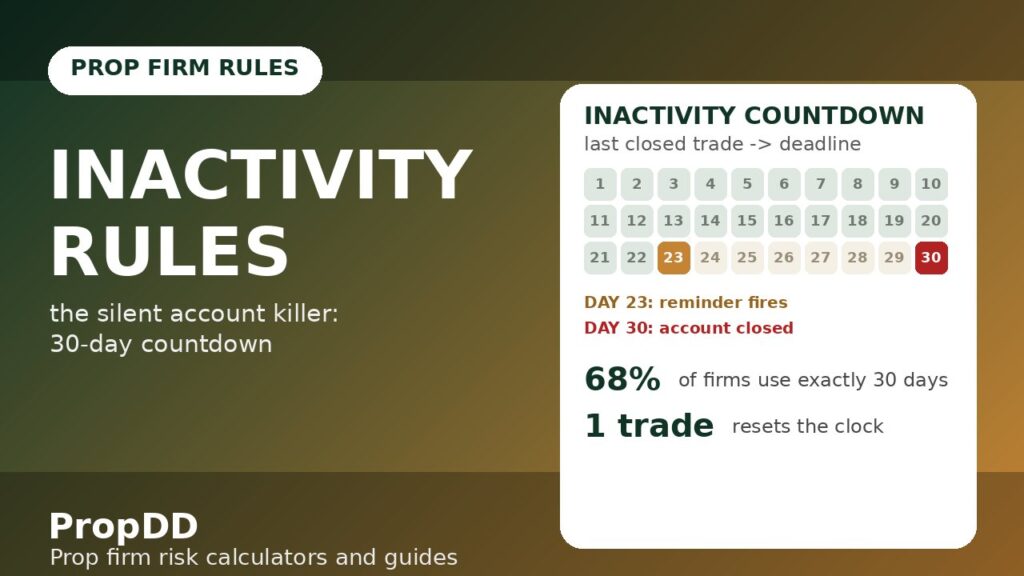
Strip away the legalese and almost every inactivity clause says the same thing: place at least one trade within N consecutive days, or the account is closed. The clock starts from your last closed trade and counts calendar days — weekends and holidays included, at most firms. The number N is where firms differ, but not by much. A 2026 data study of 237 firms found that 93 publish a numeric inactivity rule, and 68% of those — 63 firms — set the clock at exactly 30 days. Sixty days is the next most common at just 6 firms; 90 days shows up at 3. Thirty days is the de facto industry default, chosen independently by two out of every three firms that publish a number.
The rule applies at every stage — evaluation and funded — though the consequence differs. During an evaluation, inactivity usually just ends the attempt: you lose the challenge fee and the progress. On a funded account it is harsher: the account is terminated and, at most firms, any accrued but unpaid profit is void. That was my $1,840. The rule is not a drawdown breach and it is not a consistency violation, which is why it never appears in the dashboard warnings most traders watch. It lives in the terms page nobody re-reads after signup.
| Inactivity window | How common | What it means for you |
|---|---|---|
| 30 days | ~68% of firms with a numeric rule | One trade every calendar month, minimum — the default assumption |
| 60 days | A small minority | More breathing room, but the same void-on-closure consequence |
| 90 days | Rare | Usually paired with stricter terms elsewhere in the rulebook |
| No published number | The rest | The rule may still exist in discretionary form — ask support in writing |
Why firms enforce it: the unglamorous operational reason
When I got the closure email, my first reaction was that the rule was a trap designed to steal profits. Having thought about it for a few weeks, I no longer believe that — and understanding the real reason matters, because it tells you how strictly the rule is enforced. Maintaining a funded account costs the firm money even when you are not trading: data feeds, platform licences, risk-monitoring compute, support overhead. An account sitting dormant for two months is pure cost with no upside, and firms would rather reallocate that slot to an active trader.
There is a second reason that is more flattering to us: the clock starts from your last closed trade, and one closed trade resets the clock. The firm is not asking for volume or performance — a single 0.01-lot trade that you open and close in a minute satisfies the requirement at most firms. A rule that can be satisfied that cheaply is not a profit trap; it is a housekeeping filter. It exists to sweep dormant accounts, and it only catches traders who genuinely forgot the account existed. That framing changed how I handle it: this is not a rule to outsmart, it is a calendar event to never miss.
The three traps that catch real traders
The rule is simple, which is exactly why the traps are psychological rather than technical. The first trap is the profitable pause. You have a strong month, you are up nicely, and you decide to step back for a few weeks to “protect the gains” or wait for better conditions. This is the most common way funded traders die by inactivity — the account was doing well, so nobody was watching it. My own case was a version of this: I had banked profit and told myself I would return “when the market calms down.”
The second trap is the evaluation pause. You buy a challenge, trade it for two weeks, life gets busy, and you assume the account just waits for you. Some firms with no time limit on evaluations still enforce inactivity — the evaluation has no deadline, but the account still needs a heartbeat. The third trap is definitional: pending orders do not count, open positions do not count, and logging in does not count. Only a closed trade resets the clock at most firms. I have seen traders in forums insist their account should be safe because they “had a position open” for three weeks — an open position is not activity, it is the opposite of activity, and support will not accept it as such.
| Action | Resets the inactivity clock? | Why |
|---|---|---|
| Opening and closing a trade | Yes | A closed trade is the definition of activity at most firms |
| Holding an open position | No | No new trading decision was made; the clock keeps running |
| Placing a pending order | No | Unfilled orders are intent, not activity |
| Logging into the dashboard | No | Login activity is not trading activity |
| Closing a 0.01-lot trade in one minute | Yes | Size and hold time do not matter — a closed trade is a closed trade |
The inactivity countdown: the only maths in this rule
There is exactly one calculation in the whole topic, and getting it wrong by a day is what closes accounts. The deadline is your last closed trade’s date plus the firm’s window, and your personal reminder goes off a week before that. I do this in my head now, but when I was rebuilding the habit I wrote it out every time, because “about a month ago” is how you end up at day 38.
| Step | Formula | My October example (30-day rule) |
|---|---|---|
| Deadline | Last closed trade date + N days | 28 Aug + 30 days = 27 Sep |
| My reminder | Deadline − 7 days | 27 Sep − 7 days = 20 Sep |
Walk it through with my real numbers: my last closed trade was 28 August. Add the firm’s 30 days and the deadline was 27 September. Subtract my 7-day safety buffer and the reminder should have fired on 20 September — a full week to place one token trade. I returned on 5 October, which was day 38: eight days past the deadline, account gone, $1,840 void. Your firm’s number is the only one that matters — mine was 30, yours might be 60, but the method is identical. Note the subtlety that burned a friend of mine: his firm counted the window from the last closed trade’s server date, and his “28 August” trade closed at 23:40 server time on what was already the 29th in his timezone. When the margin is days, check the server date on your trade history, not your local calendar.
I tested it: my 30-day calendar system across three accounts
After the closure I built a system with one design goal: inactivity must become impossible to forget, not merely unlikely. I run three funded accounts at two firms — one on a 30-day rule, two on a 60-day rule — and I track all three on a single sheet with four columns: account, last closed trade (server date), deadline, reminder date. Every Sunday evening I spend ninety seconds updating it, and I log each trading day in the minimum trading days tracker, which doubles as my activity proof if a firm ever disputes the timeline. Here is what the sheet looked like through September and October:
| Account | Firm window | Last closed trade | Reminder fired | Action taken |
|---|---|---|---|---|
| Funded A ($50K) | 30 days | 12 Sep | 5 Oct | 0.02-lot EURUSD closed same day — clock reset |
| Funded B ($100K) | 60 days | 28 Aug | 20 Oct | Normal trading resumed 2 Oct before reminder |
| Funded C ($25K) | 60 days | 9 Sep | 1 Nov | Reminder pending — token trade scheduled |
The interesting row is Funded A. On 5 October the reminder fired while I was in a deliberate two-week trading pause — exactly the “profitable pause” trap from the previous section. Without the system I would have drifted past 12 October and lost a $50K account over nothing. Instead I opened a 0.02-lot EURUSD position, closed it eleven minutes later for a $4 loss, and the clock reset to zero. That $4 is the cheapest insurance I have ever bought. The system has now run for ten weeks without a single missed reminder, which is the entire point: the reminder goes off seven days early so that a busy week, a sick week, or a holiday never turns into a closed account.
My monthly inactivity-proof routine
The calendar is the core, but four supporting habits make it robust. First, I never let an account’s deadline fall inside a planned holiday without pre-placing the token trade before I leave — holiday planning is risk management, and a one-minute trade before a flight beats a support ticket after one. Second, I screenshot the closed token trade with the server timestamp visible and file it with the month’s journal; if a firm ever claims inactivity, the burden of proof is mine and a timestamped fill is the whole argument. Third, I re-check each firm’s current number once a quarter, because firms update terms without fanfare and the number I memorised in January may not be the number enforced in October. Fourth, I keep one “sacrificial” micro-lot strategy — a simple 0.01-lot limit order at a round number, closed manually — so the token trade never becomes an excuse to take a real position I do not believe in.
| When | Action | Time cost |
|---|---|---|
| Every Sunday | Update the four-column sheet; check reminder dates | ~90 seconds |
| 7 days before any deadline | Place and close one token trade; screenshot the server timestamp | ~5 minutes |
| Before any holiday | Pre-place the token trade; confirm the fill before travelling | ~5 minutes |
| Quarterly | Re-read each firm’s inactivity clause for number changes | ~15 minutes |
The five mistakes that trigger it
Every inactivity closure I have seen described — in forums, in Discords, in my own inbox — maps to one of five mistakes. The first is relying on memory: “I traded last month, I’m fine” is not a date, and memory rounds optimistically. The second is assuming the evaluation is exempt: some firms waive inactivity during evaluation, many do not, and the terms page is the only authority. The third is the open-position fallacy from the traps section — an open trade is not activity. The fourth is the timezone slip: server date versus local date, which matters when you are cutting it close. The fifth is the profit-void surprise: traders assume a closed account means the profit is still payable, but at most firms inactivity closure voids pending payouts, which is what turned my break from an inconvenience into a $1,840 lesson.
| Mistake | What happens | The fix |
|---|---|---|
| Relying on memory for the last trade date | You drift 5–10 days past the real deadline | Four-column sheet, updated weekly |
| Assuming evaluation accounts are exempt | Challenge attempt terminated mid-progress | Read the clause for each account type separately |
| Counting an open position as activity | Clock never reset; closure anyway | Only closed trades count — close something |
| Using local date instead of server date | Off-by-one at the deadline | Read the server timestamp on your trade history |
| Assuming profit survives closure | Accrued payout voided with the account | Treat the reminder as protecting money, not just the account |
How it fits the rest of the rulebook
Inactivity rules sit in a small family of time-based rules that traders constantly confuse with each other. The minimum trading days rule is the mirror image: it forces a minimum number of active days before you can pass, while inactivity punishes too few days across a window. The challenge time limit caps how long you can take; inactivity floors how little you can do within whatever time you take. And the payout rules are where the consequence lands — a voided payout is the real cost of a funded-account closure, not the lost account itself, since accounts can be rebought but voided profit cannot be recovered. If a closure does happen, the challenge reset rules guide covers when a reset beats a fresh purchase. Read the inactivity clause the day you buy the account, set the first reminder that same evening, and this rule becomes the easiest one in the book to never break.
Frequently asked questions
What are prop firm inactivity rules?
A clause requiring at least one closed trade within a set window — most commonly 30 consecutive calendar days — failing which the account is closed. It applies during evaluation and on funded accounts, and on funded accounts accrued unpaid profit is usually voided along with the account.
Do open positions count as activity?
No, at most firms. Activity means a closed trade: opening and closing a position. An open position, a pending order, or logging into the dashboard does not reset the clock.
Does a 0.01-lot trade really reset the inactivity clock?
Yes, at most firms. The rule measures activity, not size or profit. A single micro-lot trade opened and closed in a minute satisfies the requirement — which is why the rule is a calendar problem, not a trading problem.
Is the window calendar days or trading days?
Calendar days at most firms, including weekends and holidays. A 30-day window starting 1 October ends 31 October regardless of how many of those days the market was open. Check your firm’s terms — a minority count differently.
Can I get my account back after an inactivity closure?
Almost never. Unlike a drawdown breach, which some firms let you appeal, inactivity closure is administrative and final. Your realistic path is a reset or a fresh challenge, which is why the reminder system in this article exists.
Where can I find my firm’s exact inactivity number?
In the terms and conditions or FAQ under “inactivity,” “dormant account,” or “account closure.” If no number is published, ask support in writing before you buy — an unwritten rule is still enforced. A 2026 study of 237 firms found 68% of those publishing a number use exactly 30 days (propfirmmap.com/blog/prop-firm-inactivity-rule-data-study-2026).
Risk note: inactivity rules vary by firm and change without notice — always verify the current number in your firm’s live terms before relying on it. This article is educational, not financial advice. Never risk more than you can afford to lose.