I opened eight lots of EURUSD on a Wednesday morning because the setup looked clean, the trend was with me, and my stop was only 40 pips away. Then I glanced at the bottom of the platform and saw a number I had never paid attention to before: margin level 576%. I had traded funded accounts for months without knowing what that number meant, and that morning it finally bothered me enough to find out. The answer changed how I size every trade. A margin call on a funded account is not the thing that kills you. It is the thing that almost never gets the chance to kill you, because the firm’s daily loss limit fires first — and the real trap is not the margin call at all, but a margin usage rule that can deny your payout even when every trade wins.
In this article
- What a margin call actually is on a funded account
- The four limits on one account
- The margin level formula, worked by hand
- Which limit fires first
- Leverage changes everything about the margin level
- The 80 percent margin usage trap
- I tested it: one week, margin level logged on every trade
- The mistakes that cost funded accounts
- My daily margin routine
- Frequently asked questions
This guide is the full picture: what a margin call and a stop-out actually are on a funded account, the margin level formula worked by hand, which of the four limits on your account fires first at every position size, how leverage moves the numbers, the 80% margin usage rule that cost one trader a $410 payout, and a week of my own trades with the margin level logged on every entry.
What a margin call actually is on a funded account
A margin call is the platform telling you that your equity has fallen to the level of the margin locked up in your open positions. The platform measures it as a ratio called the margin level: your equity divided by the margin your open trades are using, multiplied by 100. When that ratio hits 100%, your equity equals your used margin, new orders are blocked, and a warning appears. If it keeps falling to the stop-out level — usually 50% — the platform starts closing your positions itself, largest loser first, until the ratio recovers. That is the textbook definition, and it is also the definition that misleads funded traders, because it was written for retail brokerage accounts, not for prop firm accounts.
On a funded account you carry four limits at once, enforced by two different parties. The platform enforces the margin call and the stop-out, both measured as ratios of equity to collateral. The firm enforces the daily loss limit and the maximum drawdown, both measured as percentages of your account. The firm’s limits are far tighter than the platform’s, and that is the whole story of this article: on any sane position size, the firm’s daily loss limit fires long before the platform’s margin call ever gets close. The margin call only wins the race when your position is so large that the collateral locked at entry is already bigger than your equity minus your daily loss limit. I will show you exactly how large that is, in lots, because “too big” is not a feeling — it is a number you can calculate before you click buy.
One more distinction matters before the maths. A margin call on a funded account does not mean you owe the firm money. You are trading the firm’s simulated capital, and your financial downside is the challenge fee you already paid. A margin call means the platform is about to close your trades for you, and on a funded account that almost always happens after the account has already failed on the daily loss limit. The damage is the failed account and the lost fee, not a debt. Keep that in mind when you read the numbers below: the margin call is a symptom, not the disease.
The four limits on one account
Here are the four limits side by side on a $100,000 challenge with a 5% daily loss limit and a 10% maximum drawdown, at 1:50 leverage. Read the “who enforces it” column first — it tells you which limit you can actually control, and which one is just the platform’s safety net.
| Limit | Enforced by | Fires when | On a $100,000 account | What happens |
|---|---|---|---|---|
| Daily loss limit | The firm | Equity falls 5% from the day’s starting balance | Down $5,000 | Account fails immediately |
| Maximum drawdown | The firm | Equity falls 10% from the starting balance | Down $10,000 | Account fails immediately |
| Margin call | The platform | Margin level hits 100% (equity = used margin) | Depends on position size | New orders blocked, warning shown |
| Stop-out | The platform | Margin level hits 50% (equity = half of used margin) | Depends on position size | Platform closes positions, largest loser first |
The first two rows are fixed dollar amounts. They never move with your trading, and you can plan around them to the dollar. The last two rows are ratios, and they move with every lot you add. That is why the same account can be perfectly safe at eight lots and one pip from a margin call at forty-four lots. The firm’s limits are the ones that decide your fate on every normal day. The platform’s limits only matter on the day you trade far too big, and the rest of this guide is about knowing where that line sits.
Note the asymmetry in the consequences, too. Breaching a firm limit ends the account on the spot — there is no warning, no partial close, no second chance. A margin call, by contrast, is a warning first: new orders are blocked, but your positions stay open until the stop-out level. Traders who fear the margin call and ignore the daily limit have their priorities backwards. The daily limit is the executioner. The margin call is the fire alarm in a building that has already burned down.
The margin level formula, worked by hand
The formula is one division, and working it once by hand removes all the mystery. Margin level equals equity divided by used margin, multiplied by 100. Used margin is the collateral the platform locks for your open positions: the notional value of the position divided by your leverage. On EURUSD at 1.0850, one lot is 100,000 units, so the notional value is $108,500, and at 1:50 leverage the platform locks $2,170 of your equity as margin for that lot.
| Step | Formula | EURUSD example (1.0850, 1:50 leverage) |
|---|---|---|
| Notional value of 1 lot | 100,000 units x price | 100,000 x 1.0850 = $108,500 |
| Used margin per lot | Notional value / leverage | $108,500 / 50 = $2,170 |
| Used margin, 8 lots | $2,170 x 8 | $17,360 |
| Margin level at entry | Equity / used margin x 100 | $100,000 / $17,360 x 100 = 576% |
| Margin level after a $5,000 loss | $95,000 / $17,360 x 100 | 547% |
| Loss needed for a margin call | Equity must fall to $17,360 | $82,640 — never reached, daily limit fires at $5,000 |
Two things jump out of that table. First, the margin level at entry on a normal trade is nowhere near the danger zone. At 576%, price would have to move against you by $82,640 before the platform called you — and the firm fails your account at $5,000. Second, the margin level barely moves as you lose money on a normal position: after the full daily loss, it has only slipped from 576% to 547%. The margin level is not a useful early warning on a funded account, because the firm’s limit is so much tighter. If you are watching the margin level to manage risk, you are watching the wrong number. Watch the dollars left under your daily loss limit instead, and check the margin level only when you are about to open a position far larger than usual.
The formula also explains why leverage changes the margin call without changing your risk. Higher leverage means less margin locked per lot, which means a higher margin level at the same position size — but the dollars you lose per pip do not change at all. A trader who raises leverage to “fix” a low margin level has fixed a number on the screen and changed nothing about the trade. The leverage rules guide on this site covers the firm’s side of leverage in detail; here, remember only this: leverage moves the margin level, position size moves the dollars, and only the dollars can fail your account.
Which limit fires first
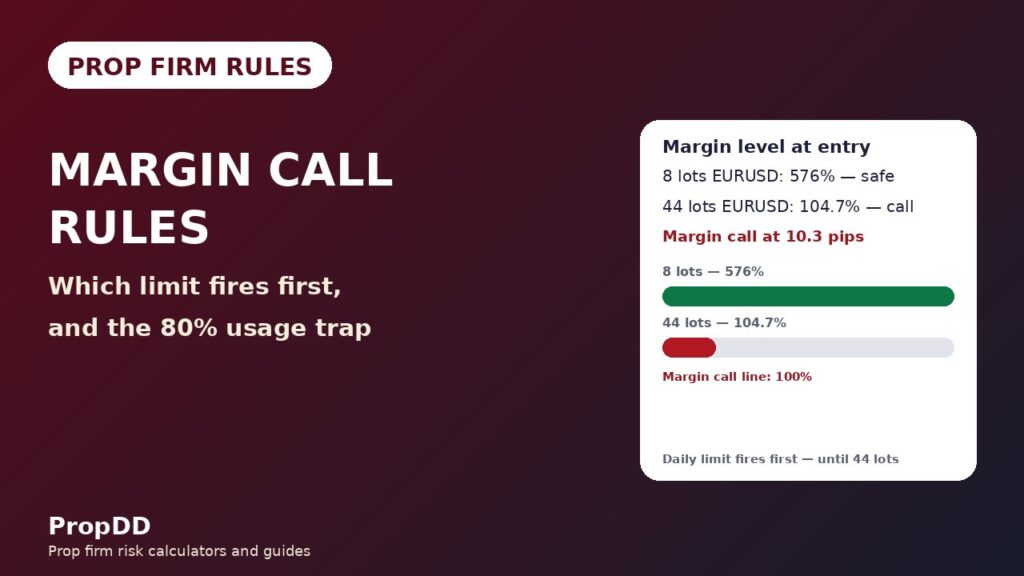
The question every funded trader should be able to answer is: at my position size, which limit fires first? The answer is a simple comparison. The margin call fires first only when the used margin at entry is larger than your equity minus your daily loss limit. On a $100,000 account with a $5,000 daily limit, that means used margin above $95,000. At $2,170 of margin per EURUSD lot at 1:50 leverage, that takes 44 lots. Here is the same account at two sizes, so you can see the line between safe and reckless.
The normal trade is the eight-lot position from my Wednesday morning. Used margin $17,360, margin level 576% at entry, and each pip against me costs $80. The daily loss limit sits 62.5 pips away. The margin call sits 1,033 pips away — a move of more than ten cents on EURUSD, which does not happen in a day. The margin call is irrelevant to this trade, and it would be irrelevant at any size up to about 40 lots. The daily limit is the only limit that matters.
The extreme trade is the one I ran on a demo account to prove the point, because I was not going to risk a real challenge on it. Forty-four lots of EURUSD at 1:50 locks $95,480 of margin — more than the $95,000 line — and the margin level at entry is 104.7%. Each pip now costs $440. Price needs to move only 10.3 pips against me for equity to fall to $95,480 and trigger the margin call, and 11.4 pips to hit the $5,000 daily loss limit. The margin call fires first, by about one pip, and the account fails either way a few seconds later. That is the only world in which the margin call matters on a funded account: a position so large that the entry itself puts you within a handful of pips of both limits at once. The Pivex margin call guide reaches the same conclusion from the other direction — the margin call can only win when the collateral locked at entry is larger than equity minus the daily loss limit — and its worked numbers match mine to the dollar.
The stop-out is even further out of reach. At 50% margin level on the 44-lot trade, equity would have to fall to $47,740 — a $52,260 loss — before the platform closed anything. The daily limit fails the account at $95,000 of equity, ten times sooner. On a funded account the stop-out is a theoretical number. You will never see it, because the firm’s limits end the account first. If your platform ever shows a stop-out warning on a funded account, something has already gone badly wrong with your sizing.
Leverage changes everything about the margin level
Leverage is the dial that moves the margin level without moving your risk, and the table below shows how far it moves it. Same account, same ten lots of EURUSD, three leverage settings. At 1:30 the margin level at entry is 276%. At 1:100 it is 922%. The dollars at risk per pip are $100 in all three cases — leverage does not change them by a cent. What changes is only the collateral the platform locks, and therefore the distance to the margin call.
| Leverage | Margin locked per lot | Used margin, 10 lots | Margin level at entry ($100k) | Lots to reach the $95,000 line |
|---|---|---|---|---|
| 1:30 | $3,617 | $36,167 | 276% | 26.3 lots |
| 1:50 | $2,170 | $21,700 | 461% | 43.8 lots |
| 1:100 | $1,085 | $10,850 | 922% | 87.6 lots |
Read the last column carefully, because it is the one that traps people. At 1:100 leverage you can open 87 lots before the margin call can beat the daily limit — but 87 lots costs $870 per pip, so the daily limit is only 5.7 pips away. High leverage does not make a big position safe. It makes the margin call quiet while the daily limit gets closer. The traders who blow funded accounts on leverage are not the ones who hit a margin call. They are the ones who opened a position the daily limit could not survive, while the margin level on their screen still read a reassuring 900%.
My rule is simple and it has survived three years of funded trading: I size every trade from the dollars at risk, never from the margin level, and I never open a position whose used margin exceeds 20% of my equity. On a $100,000 account that caps used margin at $20,000 — about nine lots of EURUSD at 1:50. That cap is not a firm rule. No firm I trade with enforces it. It is my own rule, and it exists because of the next section: the margin usage trap that can deny a payout on trades that all won.
The 80 percent margin usage trap
Here is the margin rule that actually costs funded traders money. Several firms now scan the highest margin usage across your whole trading cycle — peak used margin divided by equity, as a percentage — and flag anything over a threshold as gambling, even when the daily loss limit and the maximum drawdown were never touched. The most commonly published threshold is 80%. FundedNext caps it at 70%. Blue Guardian treats margin usage over 80% as a gambling violation. The check usually happens at payout review, not while you trade, which is what makes it dangerous: you can trade for weeks, pass every limit, request a payout, and only then discover that a single burst of large positions has disqualified you.
| Lots of EURUSD (1:50) | Peak used margin | Margin usage on $100,000 | Verdict |
|---|---|---|---|
| 9 lots | $19,530 | 19.5% | Safe — my own 20% cap |
| 20 lots | $43,400 | 43.4% | Safe, but half the account is locked as collateral |
| 32 lots | $69,440 | 69.4% | Passes an 80% cap, fails FundedNext’s 70% cap |
| 37 lots | $80,290 | 80.3% | FAILS the 80% rule — payout review flag |
| 44 lots | $95,480 | 95.5% | Fails every cap, and the margin call is 10 pips away |
The formula is the same division as the margin level, turned upside down: margin usage equals peak used margin divided by equity, multiplied by 100. The worked case that made this rule famous is documented by FundedTradingRules: a trader stacked gold and EURUSD positions totalling $85,000 of used margin on an account sitting at $102,000 of equity — 83.3% usage — and was denied a $410 payout. The same $85,000 of margin on an account at $110,000 of equity is 77.3% and passes. The difference between a paid payout and a denied one was $8,000 of equity, and the trader had no idea the check existed until the review.
Three details make this trap worse than it looks. First, the check uses your peak usage, not your average. One afternoon of stacking positions counts, even if you traded small for the other twenty-nine days. Second, winning does not excuse it — the review checks peak usage, not final profit and loss, so a burst of winners can still be flagged. Third, the rule is often buried in a FAQ or enforced only at payout review, not on the pricing page, so many traders first learn about it from a denied payout. Before you buy a challenge, search the firm’s terms for “margin usage” and “gambling” and write down the number. If the firm does not publish one, assume 80% and stay well under it. My 20% personal cap leaves a wide margin for error, and on the week below you will see it in practice.
I tested it: one week, margin level logged on every trade
Rules are cheap, so I tested them. Over one week I traded a $100,000 demo challenge with a 5% daily loss limit and a 10% maximum drawdown, risking a fixed $500 per trade — 0.5% of the account — with a 20-pip stop on EURUSD, which sizes to 2.50 lots from the position sizing rule. I logged the margin level at every entry, and I ran the 44-lot demo test on the same account after the week’s trading was done. Here is the worked example first, then the full log.
The 44-lot test took less than a minute. I opened 44 lots of EURUSD at 1.0850 on the demo account: used margin $95,480, margin level 104.7%, $440 per pip. Price ticked 11 pips against me and the account was done — the margin call warning appeared at 10.3 pips, when equity touched $95,480, and the daily loss limit breached at 11.4 pips, when the loss hit $5,000. Both limits fired inside the same minute, on a move smaller than a normal hourly candle. The test cost nothing on demo and proved the point exactly: the margin call only matters when the entry itself is reckless, and by then it hardly matters which limit fires first, because both fire at once. If you want to check the numbers yourself, the max daily drawdown calculator runs the same risk-per-trade maths against your own account size and daily limit.
| Day | Trade | Lots | Used margin | Margin level at entry | Result |
|---|---|---|---|---|---|
| Monday | EURUSD long 1.0842 | 2.50 | $5,425 | 1,843% | +$1,000 (+2R) |
| Tuesday | EURUSD short 1.0910 | 2.50 | $5,425 | 1,862% | -$500 (-1R) |
| Wednesday | EURUSD long 1.0865 | 2.50 | $5,425 | 1,853% | +$750 (+1.5R) |
| Thursday | EURUSD long 1.0890 | 2.50 | $5,425 | 1,866% | -$500 (-1R) |
| Friday | EURUSD short 1.0935 | 2.50 | $5,425 | 1,857% | +$1,000 (+2R) |
| Friday (demo) | EURUSD long 1.0850 | 44.00 | $95,480 | 104.7% | Margin call at 10.3 pips, daily limit at 11.4 pips |
The week totals 3 wins and 2 losses, net +$1,750, which is +3.5R at $500 of risk per trade. The best day made $1,000 and the worst day lost $500 — 10% of the $5,000 daily limit. The margin level never dropped below 1,843% on a real trade, and the used margin never exceeded 5.4% of equity — far under my 20% cap and nowhere near any firm’s 70% or 80% gambling threshold. That is the point of the log: on sensibly sized trades, the margin level is a boring number that stays above 1,800%, and the only numbers that need your attention are the dollars at risk and the dollars left under your daily limit. One honest caveat: five trades cannot prove anything about the consistency rule — the best day was 57% of the week’s net profit, which would fail a 30% best-day cap, and that is exactly why consistency is judged over a full payout cycle, not a single week. The week proves the margin maths. It does not prove consistency, and I am not going to pretend it does.
The mistakes that cost funded accounts
Every mistake in this table is one I have made or watched a trader make, and none of them involves a margin call arriving out of nowhere. The margin call is always the last thing to happen. The mistake is always earlier, in the sizing or the rulebook.
| Mistake | What happens | What it costs | The fix |
|---|---|---|---|
| Sizing from the margin level | Raising leverage to “fix” a low margin level, then opening a bigger position | Daily limit 5.7 pips away at 87 lots | Size from dollars at risk, never from the margin level |
| Stacking positions across pairs | Used margin adds up silently; peak usage trips the 80% gambling rule | A denied payout, like the $410 case | Cap total used margin at 20% of equity across all open trades |
| Ignoring the firm’s margin usage cap | Passing every trading limit, then failing the payout review | Weeks of profit, unpaid | Search the terms for “margin usage” before buying the challenge |
| Trading through the margin call warning | Adding to a losing position after new orders are blocked is impossible — so traders open a second account instead | Two failed accounts instead of one | A margin call warning means stop for the day, not switch accounts |
| Confusing stop-out with the daily limit | Assuming the platform will close trades before the firm fails the account | Account fails at $95,000 equity; stop-out needed $47,740 | Learn the firm’s limits first; the platform’s are a safety net, not a plan |
| Martingale after a margin scare | Doubling size to recover, which doubles used margin and halves the distance to every limit | The full daily limit in one trade | Fixed risk per trade, and a personal daily stop below the firm’s limit |
The stacking row is the one I want you to remember, because it is the only mistake in the table that punishes winners. Every other mistake ends in a loss, and losses teach. Stacking ends in a denied payout on a winning account, and the lesson arrives after the money is gone. Count your total used margin across all open positions before every new entry, not just the margin on the trade in front of you. The platform shows you the total on the same screen as the margin level. It takes five seconds.
My daily margin routine
I run this routine every morning before London opens, and it takes about ten minutes. It is boring by design — boring is what keeps a funded account alive while other traders are improvising. The margin checks are two rows in the middle, and they are the cheapest insurance on the list.
| Time (PKT) | Step | What I check |
|---|---|---|
| 11:30 | Read the limits | Daily loss limit remaining and maximum drawdown remaining, in dollars |
| 11:35 | Check the margin cap | Total used margin across open trades under 20% of equity |
| 11:40 | Size the trade | $500 risk, stop distance in pips, lots from the sizing rule — never from the margin level |
| 11:45 | News filter | No red-folder releases in the next 30 minutes before any entry |
| 12:00 | London open | Trade the plan; log margin level and used margin at every entry |
| 16:00 | Review | Peak margin usage for the day; two losses and the session ends |
The 16:00 review is the part most traders skip, and it is the part that protects the payout. I log the peak margin usage for the day, not just the closing usage, because the firm’s gambling check looks at the peak. If a day’s peak ever crosses 20%, I want to know about it the same evening, not at the payout review three weeks later. The soft breach guide on this site explains which breaches end the account and which only cost a payout — a margin usage flag is the second kind, and it is the cruellest, because the account survives and the money does not arrive. The max daily drawdown guide pairs with this routine for the same reason: the daily limit is the number that decides your day, and the margin level is only the number that decides your collateral.
Frequently asked questions
Can you get a margin call on a funded account?
Technically yes, but practically almost never on a sensibly sized trade. The platform still tracks margin level and will call you at 100% and stop you out at 50%. In practice the firm’s daily loss limit — usually 4% to 5% — fires first, because it takes a far smaller loss to breach. The margin call only fires first when the margin locked at entry is larger than your equity minus your daily loss limit, which on a $100,000 account at 1:50 leverage takes about 44 lots of EURUSD. At that size the account fails either way within a dozen pips.
What is a good margin level for prop firm trading?
There is no single good number, because the margin level depends on leverage and position size, but on a funded account you want it high and boring — above 500% at entry on every normal trade. My own trades log between 1,800% and 1,900% because I risk a fixed $500 per trade. If your margin level at entry is under 200%, your position is large enough that the platform’s limits are starting to matter, and you should check the dollars at risk before anything else. A margin level under 150% means you are one bad morning from a margin call and a failed account at the same time.
Does a margin call mean I owe the prop firm money?
No. On a funded account you trade the firm’s simulated capital, and your financial downside is limited to the challenge fee you already paid. A margin call means the platform blocks new orders and may start closing positions at the stop-out level. The real cost is the failed account and the lost fee, not a debt. That is also why firms can afford to be strict about margin usage at payout review — the money at stake is the payout, not a loan.
What is the 80% margin rule at prop firms?
Several firms flag any trading cycle where peak used margin exceeds 80% of equity as gambling, even if no drawdown limit was breached. FundedNext caps it at 70%. The check usually happens at payout review, uses the peak usage across the whole cycle, and winning does not excuse it — one documented case saw a $410 payout denied at 83.3% usage. Search the firm’s terms for “margin usage” before you buy a challenge, and keep your own total used margin well under the cap. I cap mine at 20% of equity.
How does leverage affect a margin call?
Higher leverage locks less margin per lot, so the margin level at entry is higher and the margin call is further away — at 1:100, ten lots of EURUSD shows a 922% margin level against 276% at 1:30. But leverage does not change the dollars you lose per pip, so it does not change the distance to the daily loss limit at all. Raising leverage to fix a low margin level is cosmetic. The risk is set by position size, and the margin call is set by leverage, and confusing the two is how traders open positions their daily limit cannot survive.
Will the platform close my trades before the firm fails my account?
No — on a funded account it is the other way round. The firm’s daily loss limit fails the account at $95,000 of equity on a $100,000 account, while the platform’s stop-out on a 44-lot position would need equity to fall to $47,740. The platform’s stop-out is a safety net for the broker’s collateral, not a rescue for your account. Never plan around it. Plan around the daily loss limit, keep total used margin under your own cap, and treat the margin level as a collateral readout, not a risk tool.
Risk disclaimer: This article is educational content about prop firm rules, not financial advice. Prop firm trading can result in the loss of your challenge fee and your funded account. Margin levels, stop-out levels and margin usage caps vary between firms and change without notice — always verify the current terms on your own firm’s website before trading. Past test results do not guarantee future results. Always size every trade from your account’s daily loss limit and never risk money you cannot afford to lose.