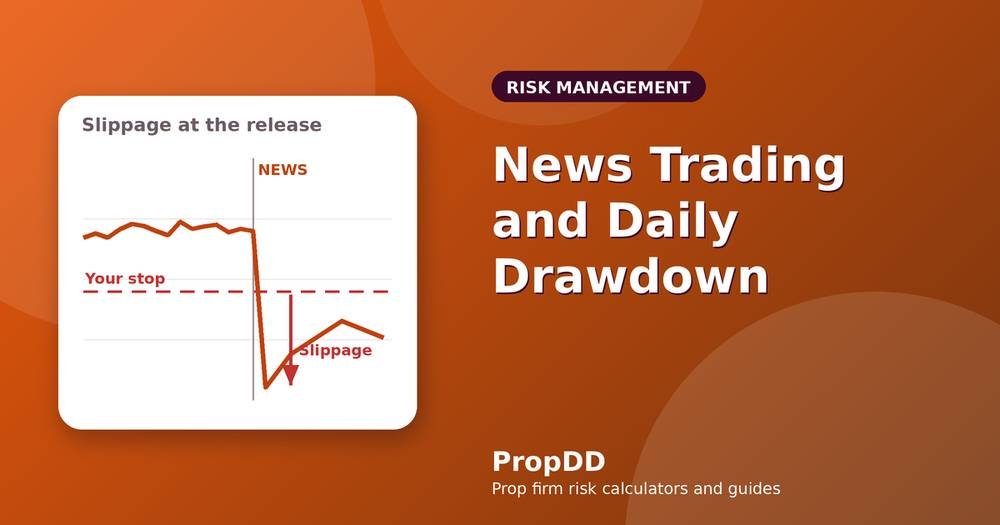
High-impact news is the one time the market stops behaving the way your stop loss assumes. A release comes out, liquidity thins for a few seconds, and a trade that was supposed to lose $500 loses $900. If you’re sitting near your daily loss limit, that gap between planned and actual loss is the difference between a bad day and a closed account.
In this article
- Why news is different
- Spread widening
- Slippage in numbers
- How news breaches daily drawdown
- Check your firm's news rules
- Know which releases matter
- Sizing for the worst case
- Four ways to handle a news day
- Order types and their traps
- Gaps and weekends
- Platform lag
- A sample plan for a heavy news day
- Common mistakes
- A tale of two traders
- Quiet sessions are not automatically safe
- Test your news plan on a demo first
- Keep a news log
- A note on mindset
- Frequently asked questions
- The short version
- Around major releases, spreads widen and stops can fill far from your price, so real loss can be two to three times the planned loss.
- Size for the worst case, not the planned stop, or skip the release entirely when the day’s room is small.
- Check your firm’s news rules separately from its drawdown rules, because breaking them can void profits.
This article covers how news affects daily drawdown, what slippage and spread widening actually do to your numbers, how to size or skip around events, and a sample plan for a heavy news day. Use the drawdown calculator before the release to see exactly how much room you can afford to lose.
Why news is different
On an ordinary day, price moves through many levels and your stop fills close to where you placed it. At a major release, large participants step back or rush in at the same moment. The order book can thin out, quotes can jump, and price may travel dozens of pips with very few trades in between. Your stop order becomes a market order the moment its level is touched, and it fills at whatever is available.
Spread widening
The spread is the gap between buy and sell prices. Normally on a major pair it’s a pip or less. Around news, it can widen several times over, briefly. This matters in two ways. First, your equity drops the instant the spread widens, because open trades are valued at the bid or ask. Second, a stop on a long position triggers at the bid, so a wide spread can trigger your stop even if the “chart price” hasn’t touched it. For a clear definition, see Investopedia’s explanation of slippage.
Slippage in numbers
Suppose you’re long EURUSD on a $100,000 account with a 10-pip stop and 5 lots. Planned risk: 10 pips × $10 × 5 = $500. A surprise number hits and the stop fills 18 pips beyond your level, so the total loss is 28 pips: 28 × $10 × 5 = $1,400. That’s 2.8 times your plan, and a full 28% of a 5% daily limit gone in a second.
| Stop (pips) | Slippage (pips) | Actual loss at 5 lots | Multiple of plan |
|---|---|---|---|
| 10 | 0 | $500 | 1.0× |
| 10 | 5 | $750 | 1.5× |
| 10 | 18 | $1,400 | 2.8× |
| 30 | 18 | $2,400 | 1.6× |
Notice that wider stops are less affected proportionally, but the dollar damage is bigger if you keep the same lots. The fix is to size from the stop plus a slippage allowance, which we’ll do below.
How news breaches daily drawdown
There are three common patterns:
- The stacked stop. You hold three correlated trades, all stopped by the same move, all slipping.
- The no-stop trade. A position with no stop floats a huge loss before you can react.
- The tired-day trade. You’ve already used half your limit, take a “quick” news trade for recovery and slip. This is how revenge trading and news combine.
Check your firm’s news rules
Separately from drawdown, many firms have news-trading restrictions, especially on funded accounts. Typical forms include no opening or closing trades within a few minutes of listed high-impact events, or profits made inside the window not being counted. The exact wording varies, so search for “news” in the rulebook and copy the section into your plan. Breaking this rule can cost profits or the account even if you never touch the drawdown.
Know which releases matter
Not every item on the calendar moves markets equally. The heavy ones for USD pairs tend to include employment reports, inflation data, central bank rate decisions and press conferences. Others matter for their own currencies. Use a live economic calendar or the Forex Factory calendar, filter to high impact, and note the times in your own zone and in server time. Our guide to the daily drawdown reset time explains why server time matters.
Sizing for the worst case
If you must hold through a release, size using a stress stop rather than the planned one.
- Take your planned stop in pips.
- Add a slippage allowance: at least 50% of the stop, more on major events.
- Divide your dollar risk by this stressed distance times pip value.
With $500 risk, a 10-pip stop and a 100% slippage allowance, the stressed distance is 20 pips. At $10 a pip, that’s 2.5 lots, not 5. If the stop fills cleanly, you lose half of plan. If it slips badly, you lose what you planned. The formula for sizing is in position sizing for prop firm challenges.
Four ways to handle a news day
1. Skip it
The simplest and, for most challenge traders, the best. A no-trade window of 15 minutes either side costs very little over a year and removes the worst tail risk.
2. Flatten before
Close or protect open positions a few minutes before the release, and re-enter after spreads normalise. You may miss a move. You’ll never miss your account.
3. Trade after the dust settles
Wait 15 to 30 minutes, let spreads normalise and price find structure, then trade as usual with a normal stop. Many traders find the “second move” cleaner than the first spike.
4. Reduce size sharply
If your strategy requires you to be involved, cut size to a quarter of normal and add the slippage allowance above. This is for experienced traders with clear rules.
Order types and their traps
A stop-loss order becomes a market order when triggered, so it fills at the next price available, not at the level. A stop-limit order can protect against bad fills but may not fill at all, leaving the position open and growing. Pending orders placed on both sides of the market ahead of a release (“straddles”) can both fill in a whipsaw and produce two losses. Know exactly how your platform and firm treat these before using them.
Gaps and weekends
News isn’t only scheduled. Weekend events can open the market on Sunday evening with a gap that jumps right over your stop. A trade held over the weekend risks a loss that no stop can limit. Some firms restrict weekend holding for this reason. If you do hold, size down. And remember the loss may land in “Monday’s” daily total.
Platform lag
During busy moments, platforms freeze, quotes update late and orders queue. If your connection or the firm’s server is slow, you may not be able to close a trade at the moment you want to. Don’t rely on being able to click your way out of a spike. Decide in advance what you’ll do if the platform stalls: usually, that means having a stop already in place and keeping size small enough that a slipped stop is survivable.
A sample plan for a heavy news day
- Morning: mark every high-impact event for the day, with times in server time.
- Enter your start-of-day equity in the calculator and note the floor and room.
- Decide: skip, flatten or trade after each event. Write it down.
- Thirty minutes before: close or protect open trades. Cancel pending orders.
- During the window: hands off.
- After: wait for spreads to normalise, then follow the usual plan with a normal stop.
- If the day is already down more than half the limit, skip the afternoon events entirely.
Common mistakes
- Trusting the planned stop as if it were a guarantee.
- Holding several USD pairs through a USD event.
- Adding size because “the move will be huge”.
- Forgetting the firm’s news rule while remembering the drawdown rule.
- Trading the release when the day’s room is already thin.
A tale of two traders
Two imaginary traders, Mina and Zayd, both hold a long EURUSD position into a major USD release. Both have $100,000 accounts and a 5% daily limit, so $5,000 of room, and both have already lost $1,500 earlier in the day.
Mina risks $500 with a 10-pip stop at 5 lots and no slippage allowance. The release surprises the market, spreads jump, and her stop fills 20 pips beyond the level. Loss: 30 pips × $10 × 5 = $1,500. Her day total is now −$3,000, which is 60% of the limit. Painful, but she’s alive.
Zayd had the same idea but sized with a stress stop. He assumed 100% slippage, so his stressed distance was 20 pips, and he traded 2.5 lots. The same move costs him 30 pips × $10 × 2.5 = $750. His day total is −$2,250, 45% of the limit. He lost less and, more importantly, he had room for a clear decision afterwards.
The only difference was sizing. Same view, same trade, very different outcome.
Quiet sessions are not automatically safe
Events scheduled during the Asian session or late in the New York evening often get less attention, yet liquidity can be thin and moves sharp. A surprise rate decision from a smaller economy can move its own currency pairs violently when few participants are around. Check the calendar for every currency you trade, not only the big ones, and remember that thin liquidity can make slippage worse even when the headline looks minor.
Test your news plan on a demo first
Before you rely on a news rule with real money, run it through a demo during two or three releases. Note the spread before and during the event, how far fills drifted from your stops and how long your platform took to respond. Demo conditions aren’t identical to live ones, but the exercise teaches you how fast things move and how your own habits behave under pressure. It’s free, and it often changes the allowance traders use.
Keep a news log
Add a small section to your trading journal for event days: which release, what you planned (skip, flatten, trade after), what you did, and the worst slippage you saw. After a few months you’ll know which events and which pairs hurt you most, and you can adjust your allowance with evidence instead of guesses.
A note on mindset
The urge to trade news usually comes from excitement, not from a plan. Ask yourself one honest question before every release: would I still take this trade if it were a quiet Tuesday? If the answer is no, you’re trading the adrenaline. Skipping a release never ends a challenge. Slipping through the floor on one does. Most traders who stick with prop firms for years end up with a simple rule: if the day’s room is small or the event is huge, they’re out of the market until the dust settles.
It’s also worth remembering that the same release will happen again next month, and the month after. There is no shortage of opportunities, and there is a very limited supply of accounts.
Frequently asked questions
Can I trade news safely on a prop account?
You can, if your firm allows it and you size for worst-case slippage. Many traders find it simpler and safer to avoid the window.
Does slippage count toward my daily loss?
Yes. Your equity reflects the actual fill, so a slipped stop is a bigger loss and it uses up more of the daily limit.
Is a guaranteed stop available?
Some retail brokers offer them, but prop firm accounts often don’t. Check what your account type provides rather than assuming.
How long should I wait after a release?
There’s no fixed rule. Fifteen to thirty minutes is common, or until spreads return to normal levels.
The short version
News turns a planned loss into an unknown one. Respect that by sizing for the stress case, reading your firm’s news rules, and skipping events when the day’s room is thin. The most useful number before any release is the one the calculator shows you: how much you can lose today. If you’re building a broader plan, pair this with a personal daily stop, and keep learning the basics through free forex lessons.