I lost 500 dollars on GBPUSD before I understood what Cable actually is. It was a London morning, the pair had already moved 90 pips before I sat down, and I bought the breakout at full size because the move looked strong. Within twenty minutes a Bank of England headline reversed it 70 pips, my stop was gone, and I spent the rest of the day telling myself the breakout had been real. It had been real for about forty minutes. That is the whole problem with Cable on a funded account: it is the most liquid sterling pair in the world, it moves further and faster than EURUSD on an ordinary day, and it punishes traders who size it like EURUSD and trade it at any hour. This article is the GBPUSD plan I trade now: the contract facts, the sessions that actually pay, the news that must be avoided, and the sizing maths that keep every trade inside a 5,000-dollar daily loss limit.
In this article
- What makes Cable different from EURUSD
- The contract facts every funded trader must know
- The sessions that pay, and the sessions that take
- The news calendar that decides Cable weeks
- The worked trade: a London pullback worth 750 dollars
- Sizing grid: the same 500-dollar risk at every stop distance
- Filtered versus unfiltered: what the session and news filters are worth
- Common mistakes that break funded accounts on Cable
- How Cable fits prop firm rules
- My daily Cable routine
- Frequently asked questions
GBPUSD is nicknamed Cable because the original sterling-dollar exchange rate was transmitted across a transatlantic telegraph cable, and the name has stuck because the pair still behaves like it carries news faster than anything else. It pairs the British pound against the US dollar, so every trade is really two stories at once: what the Bank of England might do next, and what the Federal Reserve might do next. When those two stories agree, Cable trends beautifully for days. When they conflict, it ranges violently, whipsaws through levels, and stops out traders who thought a level was a level. On a funded account that distinction matters more than on a personal account, because a funded account does not forgive a week of whipsaw losses — it breaches on the day the losses stack up.
What makes Cable different from EURUSD
The first difference is range. A normal EURUSD day moves roughly 70 to 90 pips. A normal GBPUSD day moves roughly 100 to 140 pips, and a news day can move 200 pips before lunch. That extra range is not free money. It is extra stop distance, extra spread widening, and extra room for a trade to go wrong before it goes right. Traders who copy a EURUSD stop of 25 pips onto GBPUSD get stopped out by ordinary Cable noise, then watch the pair go exactly where they predicted, without them. The second difference is timing. Cable wakes up in London, not in Asia, and its best moves usually happen between the London open and the first two hours of New York. The third difference is headline sensitivity: UK inflation, Bank of England votes, and US jobs data all hit this pair directly, and a single surprise can erase a week of careful gains in one candle.
The fourth difference is the one funded traders feel most. Because Cable moves further, the temptation to trade it bigger is constant. A 1.00-lot position that risks 400 dollars on EURUSD risks the same 400 dollars on GBPUSD only if the stop distance is the same — and on Cable it usually is not. The pair rewards patience and punishes size. My rule is simple: I trade Cable only when I can state the session, the level, and the stop distance before I look at the lot size. If any of those three is missing, I am gambling, not trading, and funded accounts do not pay gamblers.
The contract facts every funded trader must know
GBPUSD is quoted with the US dollar as the quote currency, which makes the pip maths refreshingly simple for a dollar-denominated funded account: one standard lot is 100,000 pounds, one pip is 0.0001, and one pip on one lot is worth 10 dollars. There is no conversion twist like the yen pairs or the CHF cross I covered in my EURCHF funded-account article. The simplicity is a trap, though, because it makes traders think the risk maths is done. It is only half done. The other half is volatility: how far Cable normally moves, how wide spreads get at the open, and how much room a stop genuinely needs.
| Contract fact | GBPUSD value | What it means for a funded trader |
|---|---|---|
| Pair | British pound / US dollar (Cable) | Two central banks drive it: the Bank of England and the Federal Reserve |
| One standard lot | 100,000 pounds | The base unit for every sizing calculation below |
| One pip | 0.0001 | Four decimal places, so 1.3420 to 1.3460 is 40 pips |
| Pip value, one lot | 10 dollars | No conversion needed on a dollar-denominated account |
| Typical daily range | 100 to 140 pips | Stops must be wider than EURUSD stops or noise stops you out |
| Typical spread, liquid hours | 0.8 to 1.5 pips | Cheap in London and New York, expensive at the Asian open |
| Spread at news and the open | 3 to 8 pips or wider | Never enter market orders in the first minute after a release |
Compare Cable with its sterling cousins before you decide it is your pair. My EURGBP funded-account article covers a slow, range-bound sterling cross, and my GBPJPY funded-account article covers a far wilder sterling pair where a 40-pip stop is barely a starting point. GBPUSD sits between them: volatile enough to pay, orderly enough to plan. That middle ground is exactly why it suits a funded account, provided the sizing respects the range.
The sessions that pay, and the sessions that take
Cable has a clear daily rhythm, and trading against it is the fastest way to donate to the market. The Asian session is usually quiet for GBPUSD, with thin ranges and frequent false breaks of the overnight high and low. The London session is where the pair finds its direction, driven by UK data at 07:00 and 09:30 London time and by the sheer weight of London order flow. The London-New York overlap, roughly 13:30 to 16:00 London time, is where the biggest clean moves happen, because both central-bank stories are live at once. After 17:00 London time the pair usually drifts, and late New York trading is chop more often than trend.
| Session (London time) | What Cable usually does | My funded-account rule |
|---|---|---|
| Asia, 22:00 to 07:00 | Quiet range, 20 to 40 pips, false breaks common | No new entries; use the range only to mark levels |
| London open, 07:00 to 09:30 | First direction, often a spike then a pullback | Wait for the pullback; never chase the first 15 minutes |
| London morning, 09:30 to 12:30 | Cleanest trend leg of the day | Best window for planned entries at marked levels |
| London-New York overlap, 13:30 to 16:00 | Largest moves, US data at 13:30 | Trade only with a plan written before 13:30; no fresh entries into US data |
| Late New York, after 17:00 | Drift, thin liquidity, random wicks | Manage open trades only; no new entries |
The session plan also explains the loss that opened this article. I bought a London breakout during the overlap window without waiting for a pullback, on a morning when UK data was still moving the pair. The breakout was real, the entry was early, and on Cable early entries pay the spread, the wick, and the reversal. My London breakout article gives the full breakout rules, including the pullback filter I now apply to every Cable breakout without exception.
The news calendar that decides Cable weeks
Five releases dominate GBPUSD, and a funded trader who ignores them is trading blind. UK inflation (CPI) moves sterling expectations in minutes. Bank of England rate decisions and minutes move the pair for days, because they reset the whole rate path. UK employment and GDP shift the growth story. US non-farm payrolls and CPI move the dollar leg, which is half the pair. US Federal Reserve decisions do the same. The rule that keeps me funded is a 30-minute blackout around every red-folder release on either currency: no new entries 30 minutes before, no new entries 30 minutes after, and no exceptions for a setup that looks too good to skip. A setup that only works if you trade through a Bank of England decision is not a setup. It is a coin flip with a funded account at stake.
| Release | Currency leg | Typical Cable reaction | My rule |
|---|---|---|---|
| UK CPI (inflation) | Pound | 60 to 120 pips in minutes on a surprise | Flat 30 minutes either side |
| Bank of England decision | Pound | 100-plus pips, often a reversal after the first spike | Flat 30 minutes either side; trade the second move, never the first |
| UK employment and GDP | Pound | 40 to 80 pips, direction often holds | Flat 30 minutes either side |
| US non-farm payrolls | Dollar | 80 to 150 pips, whipsaw first then trend | Flat 30 minutes either side |
| US CPI and Fed decision | Dollar | 100-plus pips, trend often lasts days | Flat 30 minutes either side; re-plan after the release |
The Babypips account of a trader losing 100 pips on Cable in a single day is a useful warning here: the pair popped 150 pips in three hours against a well-reasoned short, because a top-tier event rewrote the story mid-trade. For that first-hand lesson in why Cable stops must respect event risk, see Babypips on losing 100 pips on GBPUSD in one day. My version of the lesson is simpler: if I cannot name the next red-folder release on GBP or USD, I do not open a Cable trade that day.
The worked trade: a London pullback worth 750 dollars
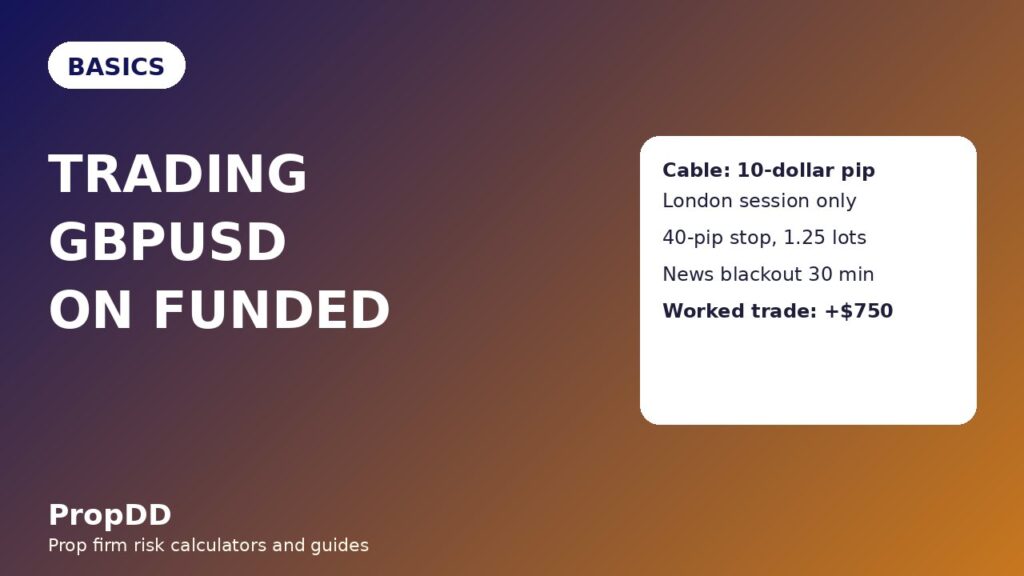
The trade that fixed my Cable trading came on a Thursday in the London morning session. GBPUSD had risen for two days, pulled back overnight to a clear support level at 1.3420, and the hourly chart showed higher lows into that level. I did not buy the touch. I waited for the hourly candle to close back above 1.3420, which is the difference between buying support and catching a falling knife that happens to be passing support. The close confirmed, I entered at 1.3420, and the stop went below the overnight low at 1.3380, forty pips below entry. That stop is not a guess: if price closes below the overnight low, the support story is broken, so the stop sits just beyond the level that proves me wrong.
| Formula | Worked number |
|---|---|
| Position size = Risk divided by (stop distance times pip value) | 500 dollars divided by (40 pips times 10 dollars) = 1.25 lots |
| Risk check | 1.25 lots times 40 pips times 10 dollars = 500 dollars |
| TP1 = entry plus stop distance, half position | 1.3460 — 0.625 lots times 40 pips = +250 dollars |
| Breakeven move | Stop to 1.3420 after TP1 — the runner can now lose 0 dollars |
| TP2 = entry plus twice the stop distance, remaining half | 1.3500 — 0.625 lots times 80 pips = +500 dollars |
| Total if both targets hit | 250 dollars + 500 dollars = +750 dollars = 1.5R |
Price reached 1.3460 before the New York open, I banked half for 250 dollars and moved the stop to breakeven, and the runner reached 1.3500 in the overlap session for the full 750 dollars. Compare that with the breakout loss that opened this article: same pair, same account, same daily limit — but the pullback trade risked 500 dollars only after the level, the session, and the close all agreed, while the breakout trade risked 500 dollars on momentum alone. The difference was never the market. It was the filter: level plus session plus confirmation, or nothing.
Sizing grid: the same 500-dollar risk at every stop distance
Cable stops vary with volatility — a quiet-week pullback might need a 25-pip stop, a Bank of England week 60 — and the lot size must shrink as the stop widens, or the risk explodes. This grid is pinned above my desk. If the stop distance makes the lot size smaller than 0.50, I skip the trade rather than rounding up, because rounding up on a funded account is how a 500-dollar plan becomes a 650-dollar loss.
| Stop distance | Position at 500-dollar risk | Actual risk after rounding | TP1 banks (half at one stop distance) |
|---|---|---|---|
| 25 pips | 2.00 lots | 500 dollars | 250 dollars |
| 30 pips | 1.66 lots | 498 dollars | 249 dollars |
| 40 pips (the worked trade) | 1.25 lots | 500 dollars | 250 dollars |
| 50 pips | 1.00 lots | 500 dollars | 250 dollars |
| 60 pips | 0.83 lots | 498 dollars | 249 dollars |
Every trade goes through the drawdown calculator first, with the worked trade’s exact inputs, and the outputs must match the table above before I click buy. My check uses the max daily drawdown calculator: a 100,000-dollar account, a 5,000-dollar daily limit, and 500 dollars of risk is 10 percent of the daily limit, which means ten consecutive full-stop losses would breach the day — a budget I never spend, because my personal stop sits at 60 percent of the firm’s limit. The calculator does not make the trade good. It makes the arithmetic honest, and honest arithmetic is the only edge a funded trader controls completely.
Filtered versus unfiltered: what the session and news filters are worth
I tested Cable two ways over twenty London sessions, keeping the same entry, stop and targets in both versions. The only difference was the filter: the filtered version took only London-morning pullbacks at marked levels, outside news blackouts, while the unfiltered version took every pullback at any hour, including Asia and news windows. The numbers below are from my own journal, not a vendor backtest, and they are the reason the session filter is non-negotiable in my trading now.
| Version | Trades | Wins / Losses | Net result |
|---|---|---|---|
| Filtered (London morning, levels, no news) | 14 | 9 wins, 5 losses | 6 wins at 750 dollars + 3 wins at 500 dollars = 6,000 dollars, minus 5 losses at 500 dollars = +3,500 dollars |
| Unfiltered (any hour, any pullback) | 19 | 8 wins, 11 losses | 8 wins at 750 dollars = 6,000 dollars, minus 11 losses at 500 dollars = +500 dollars |
| Value of the filter | 5 fewer trades | — | 3,000 dollars across the same twenty sessions |
The lesson is not that Cable is a winning system. It is that the filter does the work: five extra trades in Asia and news windows turned a 3,500-dollar profit into a 500-dollar near-breakeven, and every one of those five trades felt reasonable at the time. On a funded account, “felt reasonable” is not a filter. A London session, a marked level, and a clear news calendar are a filter. My trend pullback article makes the same point from the price-action side, and the two articles agree for a reason: pullbacks only pay inside a session that can carry them.
Common mistakes that break funded accounts on Cable
The first mistake is sizing Cable like EURUSD. A 25-pip stop that survives on EURUSD dies on Cable noise, and the trader who keeps re-entering after each noise stop-out burns the daily limit before lunch. Size the stop to Cable, then size the lots to the stop. The second mistake is trading the Asian range as if it were London. Asian Cable ranges break falsely more often than they break truly, and every false break costs a stop. The third mistake is holding through a Bank of England decision because the trade is “almost at target”. A decision can gap through a stop, and no target is worth a breach. The fourth mistake is trading Cable alongside GBPJPY and EURGBP at the same time and calling it diversification. Those three pairs share the pound, so one sterling shock hits all three at once — my cap is one sterling position at a time. The fifth mistake is chasing the London spike. The spike is the market repricing; the pullback is the trade. Traders who buy spikes on Cable buy the top of the repricing and fund the pullback traders’ profits.
There is one more mistake that deserves its own paragraph, because I made it for a month. I treated a winning Cable morning as permission to trade Cable all day. A morning trend does not license an afternoon chop trade, a late New York drift trade, or a second position “because the first one worked”. Each trade needs its own level, its own session, and its own sizing check. The day I stopped letting a winner license the next trade, my Cable equity curve stopped giving back its mornings.
How Cable fits prop firm rules
Cable fits funded rules when it is traded in its own window and nowhere else. The daily loss limit is protected by the trades it refuses: every Asian range trade skipped and every news-window trade skipped is a stop-out that cannot happen. The consistency rule is protected because London pullbacks produce similar-sized wins — the worked trade’s 1.5R, repeated, does not create a single best day that dwarfs the rest of the month. The minimum trading days rule is protected because London gives a steady trickle of valid setups across the week, not a feast-or-famine Monday. And the trailing drawdown is protected by the breakeven move: once TP1 banks, the runner cannot give back the day’s profit, which is exactly what a trailing floor punishes traders for forgetting.
There is one rule interaction to watch. Some firms restrict weekend holding or cap exposure, and Cable’s weekend gaps after a Friday Bank of England headline can be brutal. I close Cable positions before the weekend unless the firm explicitly allows weekend holding and the position is already at breakeven or better. My one-pair challenge article explains why focusing on a single pair — Cable, in this case — beats scattering across six pairs: depth on one pair’s sessions and news beats shallow knowledge of six.
My daily Cable routine
Routine is what turns a pair into a system. I run the same checks every session, in the same order, and I do not trade until all of them pass. The routine takes ten minutes and has saved me more money than any single trade in this article.
| Step | Check | If it fails |
|---|---|---|
| 1. News check | No red-folder GBP or USD release within 30 minutes | Wait until the window clears |
| 2. Session check | London morning or overlap window, not Asia or late New York | Flat for the session — no entries |
| 3. Level check | Marked support or resistance, with an overnight high or low as invalidation | No level, no trade |
| 4. Confirmation check | Hourly close back in the trend direction after touching the level | Do not buy the touch; wait for the close |
| 5. Sizing check | Risk divided by stop distance, run through the drawdown calculator | If size rounds below 0.50 lots, skip the trade |
| 6. Daily budget check | This trade’s 500 dollars plus today’s realised loss under 3,000 dollars | Personal daily stop hit — done for the day |
The routine also answers the question every Cable trader asks after a losing week: was the system wrong, or was I? If the journal shows Asian trades, news trades, or spike chases, the system was never tested. If it shows London-morning pullbacks that simply lost, the system had a normal losing week, and the sizing maths — not a pair change — is what carries you through it. That distinction is the difference between a trader who survives a challenge and a trader who pair-hops their way to a breach.
Frequently asked questions
Is GBPUSD harder to trade than EURUSD on a funded account?
Yes, but only because it moves further. The pip maths is identical — 10 dollars per pip per lot — so the difficulty is volatility management, not arithmetic. Wider stops, smaller lots, and a strict session window make Cable as tradable as EURUSD.
What stop distance should I use on GBPUSD?
Start from the level, not from a fixed number. A quiet-week pullback may need 25 to 30 pips, a normal London pullback 40 pips, and a Bank of England week 50 to 60 pips. Size the lots from the stop every time, using the grid in this article.
Can I trade GBPUSD during the Asian session?
You can, but the false-break rate is high and the ranges are thin, so the reward rarely justifies the stop-out risk. If your firm requires trading days, use Asia to mark levels and London to trade them.
Should I hold GBPUSD through a Bank of England decision?
Only if the position is already protected at breakeven or better and your firm allows it. Opening a new Cable trade into a decision, or holding an unprotected trade through one, risks a gap through your stop and a breach in one candle.
How does GBPUSD compare with GBPJPY for a funded account?
GBPUSD is the calmer sterling pair: dollar quote maths, 100 to 140 pip days, and London-driven structure. GBPJPY moves further, needs wider stops, and punishes oversizing faster. Learn Cable first, then earn the right to trade the dragon pair.
Can I trade GBPUSD and EURGBP at the same time?
Not under my rules. Both share the pound, so one sterling shock hits both positions at once. Trade one sterling position at a time, sized on its own, and let the other pair wait its turn.
Risk disclaimer: Trading on a funded account involves substantial risk, and most traders fail challenges. This article describes my own journaled approach for education only; it is not financial advice, and past results do not guarantee future results. Always check your firm’s current rules before trading.



2 comments
[…] Trading GBPUSD on a Funded Account: The 10-Dollar Pip, the London Spike and the Sizing Maths That Ke…Trading Bitcoin on a Funded Account: The 2,000-Point Stop, the Weekend Gap and the Sizing Maths That Keep You FundedTrading AUDUSD on a Funded Account: The 10-Dollar Pip, the Iron-Ore Aussie and the Sydney Plan That Keep You FundedTrading NZDUSD on a Funded Account: The 10-Dollar Pip, the Dairy Kiwi and the Wellington Plan That Keep You FundedTrading EURAUD on a Funded Account: The 6.50-Dollar Pip, the Two-Central-Bank Cross and the Sydney-London Plan That Keep You FundedTrading USDCAD on a Funded Account: The 7.19-Dollar Pip, the Oil Link and the New York Plan That Keep You FundedTrading EURGBP on a Funded Account: The 12.70-Dollar Pip, the Range Rules and the London Plan That Keep You FundedTrading EURCHF on a Funded Account: The 11.36-Dollar Pip, the SNB Surprise Risk and the Range Rules That Keep You Funded […]
[…] guide is the flagship-pair companion to the other instrument guides on this site, beside GBPUSD, EURGBP and USDJPY. GBPUSD moves further on the same news, EURGBP strips the dollar out, and USDJPY […]