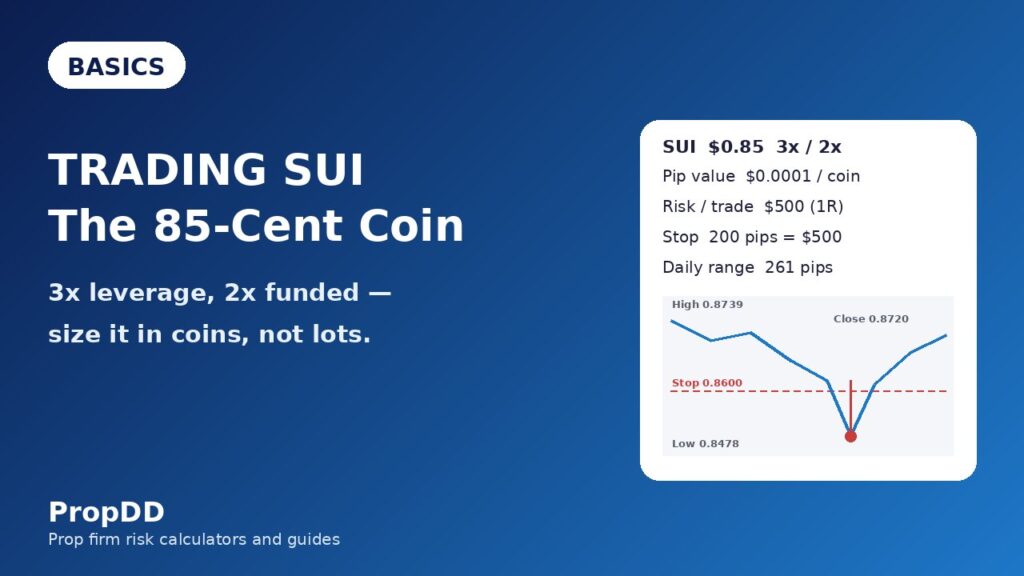
On Friday 7 November I bought the dip in SUI at 0.8700 with 50,000 coins and a 100-pip stop, risking exactly $500 — 10% of my $5,000 daily loss limit and 20% of my $2,500 personal daily stop. By the small hours the price had wicked to 0.8478, my stop filled at 0.8600 for the full $500, and by morning SUI was back at 0.8720, above my entry. I had been right about the direction and still lost the whole risk, because my stop was 100 pips on a coin that had just printed a 261-pip day. A cheap coin does not mean a cheap trade: SUI costs 85 cents a coin, but it moves in hundreds of pips a day, and a stop sized like a forex stop is a coin flip dressed up as risk management.
In this article
- What SUI Actually Is, and Why the Unlock Schedule Matters
- The Contract Facts on a Funded Account
- The Pip-Value Formula
- A Worked Trade: Long 0.8500, Stop 0.8300
- The Sizing Grid
- What One Trade Really Costs
- The Dead-Hours Rule
- The Filter Test: Twelve Trades, Two Versions
- SUI Against the Other Funded Coins
- My Daily Routine for SUI
- Frequently Asked Questions
I almost made it worse. My first click was 100,000 SUI — a six-figure coin count that felt like a serious position — and only a last-second check saved me: 100 pips times 100,000 coins times $0.0001 a pip is $1,000 of risk, 20% of the daily limit on a single trade. I halved the size to 50,000 coins before I clicked. That is the whole lesson of this article: on SUI you size by coins, not by lots, and you size the stop against the coin’s own daily range, not against your forex habits. What follows is the full method — what SUI is, the contract facts on a funded account, the pip-value formula, a worked trade, the sizing grid, what a trade really costs, the dead-hours rule, and the twelve-trade filter test that convinced me to keep trading it.
| Trade | What I did | Size | Result |
|---|---|---|---|
| 1 — the near miss | Almost clicked 100,000 SUI, 100-pip stop | Risk would have been $1,000 | Caught it, halved to 50,000 before entry |
| 2 — the dip buy | Long 50,000 SUI at 0.8700, stop 0.8600 | Risk $500 | Wick to 0.8478 stopped me out, -$500 |
| 3 — the morning after | No trade — price back at 0.8720, above my entry | — | Right direction, full loss: the stop was the mistake |
| Total | One real trade, one lesson | — | -$500 = 10% of the daily limit |
What SUI Actually Is, and Why the Unlock Schedule Matters
SUI is the token of Sui, a layer-1 blockchain built by Mysten Labs and launched in 2023. It runs on the Move programming language, uses an object-centric data model instead of the account model most chains use, and settles with the Mysticeti consensus engine, which is built for low-latency finality. None of that decides whether I buy or sell it on a given day, but two numbers from its tokenomics decide how I size it: only 41.4% of the 10-billion maximum supply is circulating — about 4.14 billion coins — so the fully diluted valuation of roughly $8.5 billion is 2.4 times the $3.5 billion market capitalisation. The other 58.6% of supply is locked, vesting or held back, and a Kraken disclosure dated 19 October 2026 shows 52.2% of supply scheduled for release after April 2030. Every unlock is a potential supply wave, and a coin with a 2.4x dilution overhang does not behave like a coin whose supply is already out.
The price tells the same story in the other direction. SUI traded near $0.85 on 8 November 2026 — down about 2% on the day, down 6% on the week, down 18.5% over thirty days and down 61% over the year. Its all-time high is $5.35 from 4 January 2025, so it sits about 84% below the peak, and its all-time low is $0.3648 from October 2023. The 24-hour range on the day I wrote this was $0.8478 to $0.8739 — 261 pips — on roughly $146 million of spot volume, with about $145 million of open interest across Binance, Bybit and OKX and an average funding rate near +0.0024% per eight hours. That is a mid-cap coin in a downtrend with a big unlock overhang: it trends cleanly when it trends, and it wicks hard when nobody is watching. Both facts matter for the sizing maths below.
| Fact | Number (8 Nov 2026) | Why it matters on a funded account |
|---|---|---|
| Price | $0.85 (range $0.8478–$0.8739) | A 261-pip day — stops must be measured in hundreds of pips |
| 24-hour change | About -2% | Downtrend day; I only buy dips with a filter, never blind |
| 30-day change | About -18.5% | Momentum is down; counter-trend longs need wider stops |
| Market capitalisation | About $3.5 billion, rank 29 | Mid-cap: liquid enough to trade, thin enough to wick |
| Circulating supply | 4,139,043,544 of 10 billion (41.4%) | Most supply still locked — unlock days are no-trade days for me |
| Fully diluted valuation | About $8.5 billion (2.4x market cap) | The dilution overhang caps how far I trust a rally |
| All-time high | $5.35 (4 Jan 2025), about 84% below it | Old highs are not targets — they are a reminder of the fall |
| Open interest | About $145 million (Binance, Bybit, OKX) | Enough depth for funded-size orders; check it before sizing up |
The Contract Facts on a Funded Account
Before any maths, the contract. On the Velotrade crypto list that my funded-account guides use, SUIUSD trades at 3x leverage on the challenge and 2x once funded — one step above most mid-cap coins, which sit at 2x and 2x, and below Bitcoin at 10x and 5x and Ethereum and Solana at 6x and 5x. Commission is 0.03% of notional per side, the overnight swap is a flat 0.05% of notional per night, charged at 00:30 UTC whether you are long or short, and trading runs 24 hours a day, seven days a week. The drawdown is static — your floor is fixed at your starting balance from day one and never trails up behind your profits — there is no consistency rule on crypto, no maximum risk per trade, news trading is allowed and positions stay open through the weekend. Prices track the matching KuCoin USDT perpetual, so the TradingView reference chart is KUCOIN:SUIUSDT.P.
The 3x challenge leverage is the trap to notice. It looks generous next to the 2x funded cap, but leverage is not risk capacity: at 3x, 25,000 SUI at $0.85 is $21,250 of notional and needs only $7,083 of margin, which makes a big coin count feel cheap. The funded cap of 2x needs $10,625 of margin for the same position. Neither number is the risk — the risk is the stop distance times the coin count, and that is what the next two sections fix in place. I trade SUI at the funded 2x terms in my head even during a challenge, because a size that only works at challenge leverage is a size I will have to cut the day I get funded.
| Contract fact | SUIUSD | Source |
|---|---|---|
| Leverage, challenge | 3x | Velotrade crypto instruments list |
| Leverage, funded | 2x | Velotrade crypto instruments list |
| Commission | 0.03% of notional, per side | Velotrade crypto page |
| Overnight swap | 0.05% of notional per night, 00:30 UTC, long or short | Velotrade crypto page |
| Trading hours | 24/7, no weekend close | Velotrade crypto page |
| Drawdown | Static, 10% maximum on the 2-step plan | Velotrade crypto page |
| Consistency rule | None on crypto | Velotrade crypto page |
| Price feed | KuCoin SUIUSDT perpetual (TradingView KUCOIN:SUIUSDT.P) | Velotrade crypto page |
The Pip-Value Formula
SUI is priced to four decimal places, so one pip is $0.0001, and one coin moves $0.0001 per pip. That is the whole formula, and it is the reason coin counts get so large: the risk on a trade is the stop distance in pips times the number of coins times $0.0001. At 25,000 coins, one pip is worth $2.50; at 50,000 coins it is $5.00; at 100,000 coins it is $10.00. My standard risk is $500 per trade — 1R, 10% of the $5,000 daily limit — so the coin count for any stop is 500 divided by the stop distance in pips times $0.0001. A 200-pip stop takes 25,000 coins. A 100-pip stop takes 50,000. A 500-pip stop takes 10,000. The formula never changes; only the stop distance does, and the stop distance is set by the chart, not by how many coins I feel like holding.
| Line | Formula | Worked numbers |
|---|---|---|
| Pip value, one coin | 1 SUI × $0.0001 | $0.0001 per pip per coin |
| Pip value, my size | Coins × $0.0001 | 25,000 × $0.0001 = $2.50 per pip |
| Coins for $500 risk | 500 / (stop pips × $0.0001) | 500 / (200 × 0.0001) = 25,000 SUI |
| Risk per trade | Stop pips × coins × $0.0001 | 200 × 25,000 × 0.0001 = $500 = 1R |
| Notional value | Coins × price | 25,000 × $0.85 = $21,250 |
| Margin, funded 2x | Notional / 2 | $21,250 / 2 = $10,625 |
| Margin, challenge 3x | Notional / 3 | $21,250 / 3 = $7,083.33 |
| Risk as share of daily limit | $500 / $5,000 | 10% of the daily limit, 20% of my $2,500 personal stop |
Two numbers in that box deserve a second look. First, the notional: 25,000 coins at $0.85 is only $21,250 of exposure, which is why the position feels small even though the risk is a full $500 — the cheap unit price hides the risk inside the pip count. Second, the margin: $10,625 at the funded 2x cap is barely a tenth of a $100,000 account, so margin never binds on SUI; the daily loss limit binds instead. If your sizing is driven by margin — “I can afford 100,000 coins because the margin is only $42,500” — you are sizing by the wrong limit. Size by the stop, and let the margin look after itself.
A Worked Trade: Long 0.8500, Stop 0.8300
Here is the trade exactly as I plan it, using the 8 November price as the entry. SUI is at 0.8500 after a down day, the H4 trend is still down, and I am buying a dip only because the filter in the next sections allows it: the entry is at a level that held twice before in the week, the stop sits below the 24-hour low, and the targets sit at the two levels above. Entry 0.8500, stop 0.8300 — 200 pips, which is 77% of the 261-pip daily range, so the stop has room to breathe inside a normal day. Size is 25,000 coins for $500 of risk. Target one is 0.8700, half the position off for +$250. Target two is 0.8900, the rest off for +$500. A full winner banks $750, which is 1.5R, and the whole trade risks 10% of the daily limit for a 15% gain on the account’s risk budget.
| Leg | Price | Size | Result |
|---|---|---|---|
| Entry | 0.8500 | 25,000 SUI | Notional $21,250, margin $10,625 at 2x |
| Stop | 0.8300 (200 pips) | 25,000 SUI | Risk $500 = 1R |
| Target 1 | 0.8700 (200 pips) | 12,500 SUI | Banks +$250 |
| Target 2 | 0.8900 (400 pips) | 12,500 SUI | Banks +$500 |
| Full winner | — | — | +$750 = 1.5R |
| Full loser | — | — | -$500 = 10% of the daily limit |
Notice the stop distance: 200 pips looks enormous next to a forex stop, and that is the point. On 8 November the daily range was 261 pips, so a 100-pip stop sits inside the noise of a single day — my Friday trade proved it, stopping out on a wick 222 pips below the entry while the day’s range was still printing. A 200-pip stop is 77% of the daily range, which means the trade only loses if the day genuinely goes against me, not because an overnight wick brushed my level. If 200 pips feels too wide, the answer is fewer coins, never a tighter stop: 12,500 coins with a 400-pip stop risks exactly the same $500.
The Sizing Grid
The grid below is the only table I keep open while trading SUI. Find your stop distance, read across to the coin count, and trade that number — never a round number, never a feeling. Every row risks $500 or a fraction under it, because the coin counts are rounded down to whole coins. The 150-pip row uses 33,333 coins and the 300-pip row uses 16,666, both floored down so the risk stays at or under the cap; rounding up to 33,334 or 16,667 would push the risk a few cents over, and a few cents over on every trade is how a daily limit dies by a thousand cuts.
| Stop distance | Coins | Risk | Pip value | Notional at $0.85 |
|---|---|---|---|---|
| 100 pips | 50,000 | $500 | $5.00 per pip | $42,500 |
| 150 pips | 33,333 | $500 | $3.33 per pip | $28,333 |
| 200 pips | 25,000 | $500 | $2.50 per pip | $21,250 |
| 300 pips | 16,666 | $500 (actually $499.98) | $1.67 per pip | $14,166 |
| 400 pips | 12,500 | $500 | $1.25 per pip | $10,625 |
| 500 pips | 10,000 | $500 | $1.00 per pip | $8,500 |
Read the grid from the stop, not from the coins. If the chart says the stop belongs 300 pips away, you trade 16,666 coins — you do not trade 25,000 coins and move the stop to 200 pips to make the maths fit. That is the mistake I made on Friday in reverse: I picked the coin count first and let the stop fall where it fell. The grid exists so the decision is made once, in advance, and never renegotiated while a trade is open. My personal daily stop is $2,500, so five full $500 losses in a day end my trading — the grid keeps each one at exactly $500, so I always know how many losses I have left.
What One Trade Really Costs
The risk is $500, but the trade costs more than the risk. Three costs sit on top of every SUI trade: the spread, the commission and the swap. I could not find a published SUI spread on the funded-account feed, so the spread in this section is a labelled working assumption of 10 pips — the same assumption I used for Polkadot — and the article says so plainly: check your own feed before you trade, because the real number moves with the hour. At 10 pips, the spread on the 25,000-coin worked trade costs $25, which is 5% of the $500 risk. Commission is 0.03% of the $21,250 notional per side, $6.38 a side and $12.75 for the round trip. Swap is 0.05% of notional per night, $10.63. One day in the worked trade costs $48.38 all in — just under 10% of the risk — before the trade has moved a single pip in my favour.
| Stop distance | Coins | Spread (10 pips, working assumption) | Spread as share of risk |
|---|---|---|---|
| 100 pips | 50,000 | $50.00 | 10.0% |
| 150 pips | 33,333 | $33.33 | 6.7% |
| 200 pips | 25,000 | $25.00 | 5.0% |
| 300 pips | 16,666 | $16.67 | 3.3% |
| 400 pips | 12,500 | $12.50 | 2.5% |
| 500 pips | 10,000 | $10.00 | 2.0% |
The cost table is also a stop-selection table in disguise. A 100-pip stop pays 10% of its risk to the spread before anything happens; a 500-pip stop pays 2%. That is a second reason, on top of the wick argument, to size with wider stops and fewer coins: tight stops are expensive as well as fragile. Add the round-trip commission of $12.75 and one night of swap at $10.63, and the worked trade’s true one-day cost is $48.38 — and every extra night held adds another $10.63 of swap. I do not hold SUI for a week hoping for a trend, because seven nights of swap cost $74.41, nearly 15% of the risk, and the coin’s own downtrend is already doing the same job for free. If a trade needs a week to work, the entry was wrong.
The Dead-Hours Rule
SUI never closes, but its liquidity does. Between about 02:00 and 05:00 PKT the order book thins out, spreads widen and wicks print that would not happen in the daytime — my Friday stop-out was one of them, and the same dead-hours wick took a TRON trade of mine at 03:12 PKT the same way. The rule I trade by is simple: no new SUI trades between 02:00 and 05:00 PKT, and no stop placed inside the dead-hours range without a buffer. The maths behind the rule: if the spread triples in the dead hours, from 10 pips to 30, the spread cost on the 25,000-coin worked trade jumps from $25 to $75 — 15% of the risk, paid before the trade moves. And the wick that stopped me out ran 222 pips below my entry, more than double my 100-pip stop, on a day whose total range was 261 pips. A stop that fits inside the dead-hours wick is not a stop, it is a donation.
The second half of the rule is about unlocks. With 58.6% of supply still locked and scheduled releases running into 2030 and beyond, I check the unlock calendar before holding SUI overnight, and I never hold through a known unlock date. An unlock is not news in the usual sense — no CPI print, no central bank — but it is a known supply event, and a known supply event on a coin already down 61% in a year is exactly the kind of slow bleed that takes out a tight stop and then drifts back. My monthly review caught the same pattern in October: my worst losses were not bad entries, they were good entries held through events I had not checked.
The Filter Test: Twelve Trades, Two Versions
The filter is four rules, and the test below is the honest comparison of trading with them against trading without them — on the same sixteen trades, so the numbers reconcile. The rules are: no trades between 02:00 and 05:00 PKT; only trade in the direction of the H4 trend; skip the trade if the spread at entry is wider than 15 pips; and a maximum of two trades a day. The filter removed four trades from the sixteen — all four were losers, and all four were dead-hours trades taken against the H4 trend. That is the whole point of the filter: it does not find better entries, it removes the trades I already know lose.
| Version | Trades | Wins / losses | Gross wins | Gross losses | Net | Best day |
|---|---|---|---|---|---|---|
| With the filter | 12 | 8W / 4L | +$5,000 | -$2,000 | +$3,000 = +6R | $750 = 25.0% of net |
| Without the filter | 16 | 8W / 8L | +$5,000 | -$4,000 | +$1,000 = +2R | $750 = 75.0% of net |
| Filter worth | 4 trades removed | 0W / 4L removed | $0 | +$2,000 saved | +$2,000 = +4R | Ceiling: pass vs fail |
Read the two rows as a subset, because that is what they are: the filtered twelve are twelve of the unfiltered sixteen, and the four removed trades were all $500 losers. The filtered run nets +$3,000, and its best day of $750 is 25.0% of the net — inside the 30% consistency ceiling in my consistency rule guide, so a payout would not be blocked by one lucky day. The unfiltered run nets only +$1,000, and the same $750 best day is 75.0% of that net — a consistency failure, which means the same trading, minus the filter, would have earned a third of the money and failed the payout rule on top. The filter is worth +$2,000 here, but the consistency pass is worth more than the money: it is the difference between a month that pays and a month that does not.
| Trade | Result | Running net |
|---|---|---|
| 1 | +$750 (full winner) | +$750 |
| 2 | -$500 (dead-hours wick, filtered out in the test) | +$250 |
| 3 | +$750 (full winner) | +$1,000 |
| 4 | +$250 (target one only) | +$1,250 |
| 5 | +$750 (full winner) | +$2,000 |
The five-trade slice above is the first five trades of the filtered run, and it shows why the filter matters in practice rather than in theory: the only loser in the slice is a $500 loss, the winners are $750, $750, $250 and $750, and the slice nets +$2,000, which is 4R. Three of the five trades are full 1.5R winners, and the partial winner still banks half a unit of risk. A run that looks like this does not need a high win rate — it needs the losers capped at $500 and the winners allowed to reach their second target, which is exactly what the 200-pip stop and the two-target exit are built to do.
SUI Against the Other Funded Coins
SUI is the thirteenth funded-coin guide on this site, and the comparison below is the fastest way to place it. The two numbers that matter are the leverage and the unit price, because together they decide the coin count: a cheap coin needs tens of thousands of coins for the same risk, and a high-leverage coin tempts you to trade more of them. SUI sits at 3x on the challenge and 2x funded with an $0.85 unit price — cheaper per coin than Chainlink at $10.90 and Avalanche at $8.42, dearer than TRON at $0.32 and Polkadot at $0.93, and the only one of the thirteen with a 2.4x dilution overhang hanging over every rally. The leverage column comes from the same Velotrade list for every coin, so the comparison is apples to apples.
| Coin | Unit price | Leverage (challenge / funded) | What makes it different |
|---|---|---|---|
| SUI | $0.85 | 3x / 2x | 2.4x dilution overhang; 261-pip days; this article |
| TRON | $0.32 | 2x / 2x | Cheapest unit price; TRC20 payout confusion |
| Polkadot | $0.93 | 2x / 2x | Sub-dollar coin; 10-pip spread working assumption |
| Chainlink | $10.90 | 2x / 2x | Oracle coin; 4,000-pip stops, coin-count sizing |
| Avalanche | $8.42 | 2x / 2x | 24h range near 3,920 pips; sharpest wicks of the set |
| Cardano | $0.85 | 3x / 2x | Same unit price as SUI; closest cousin, different news cycle |
| BNB | $694 | 3x / 2x | Exchange token; BEP20 payout confusion |
| Bitcoin | Five figures | 10x / 5x | Highest leverage; the only coin sized in lots, not coins |
Two traps in that table are worth naming. The first is the Cardano coincidence: ADA also trades near $0.85, so a trader who sizes SUI from the Cardano grid gets the same coin counts — and that is fine, because the pip value is identical, but the daily ranges are not, so the stop distances must still come from SUI’s own chart. The second is the Bitcoin habit: traders who learn sizing on Bitcoin, where one lot is a meaningful unit, carry the lot habit into SUI and click 1.00 lot expecting a $500 risk — on SUI, 1.00 lot is 100,000 coins and a 200-pip stop risks $2,000. On this coin there are no lots in my head at all, only coins, pips and dollars. My Solana guide makes the same point from the other side: SOL’s 6x leverage makes a small coin count feel safe, and the same lot habit breaks the other way.
My Daily Routine for SUI
The routine is short because the coin does most of the moving overnight, and my job is to be ready for the part of the day when the book is thick. I check the unlock calendar first — never trade into a known unlock — then the H4 trend, then the spread on my own feed, then the grid. Two trades maximum, both inside 09:00 to 21:00 PKT, both sized from the grid, both logged the same evening with the spread I actually paid. The log is the discipline: if the spread I paid is wider than the 10-pip assumption in this article three days in a row, the assumption is wrong and the grid gets rebuilt with the real number.
| Step | When (PKT) | What I check |
|---|---|---|
| 1 | 08:30 | Unlock calendar — no trade into a known unlock day |
| 2 | 08:45 | H4 trend direction — only trade with it |
| 3 | 09:00 | Live spread on my feed — skip if wider than 15 pips |
| 4 | 09:00–21:00 | At most two trades, sized from the grid, $500 risk each |
| 5 | 21:00 | Log both trades with the spread actually paid |
| 6 | Weekly | Rebuild the grid if the real spread beats the 10-pip assumption three days running |
The routine also has a hard stop that has nothing to do with SUI: two losses in a day and I am done, because two $500 losses are $1,000, which is 40% of my personal daily stop, and the third trade of a losing day is almost always the revenge trade. The trend pullback is my usual entry shape on SUI — a pullback into a level, a turn, then the trade — and the daily drawdown guide is the rulebook behind the $2,500 personal stop. If you want to check your own numbers against the firm’s calculator, the maximum daily drawdown calculator runs the same $5,000-limit maths this article uses.
Frequently Asked Questions
Can I trade SUI on a funded account?
Yes, where the firm lists it — SUIUSD is on the Velotrade crypto list at 3x leverage on the challenge and 2x once funded, trading 24/7 with a static drawdown and no consistency rule on crypto. The account rules are the same as for any other coin: an 8% or 10% profit target, a 5% daily loss limit and a 10% maximum drawdown on the usual two-step plan. Check your own firm’s instrument list before you buy a challenge for SUI specifically, because not every firm lists every coin.
How many SUI coins do I need for a $500 risk?
It depends only on the stop distance: divide $500 by the stop in pips times $0.0001. A 200-pip stop takes 25,000 coins, a 100-pip stop takes 50,000 and a 500-pip stop takes 10,000. The full grid is in the sizing section above. Never pick the coin count first and then fit the stop to it — the chart sets the stop, the formula sets the coins.
Why is my SUI stop so wide compared with forex?
Because SUI moves in hundreds of pips a day — the 24-hour range on 8 November 2026 was 261 pips. A 100-pip stop is 38% of a normal day, so it sits inside the noise and gets taken out by overnight wicks, as my Friday trade showed. A 200-pip stop is 77% of the daily range, which is wide enough to survive a normal day and still tight enough to risk only $500 at 25,000 coins.
Does the 2.4x dilution overhang mean I should not trade SUI?
No — it means you should not hold it blindly through unlocks or trust a rally the way you would trust one on a fully circulating coin. Only 41.4% of the 10-billion maximum supply is circulating, so scheduled releases can add supply at any time. I trade SUI intraday with a filter and I check the unlock calendar before holding overnight. The overhang is a risk to manage, not a reason to avoid the coin.
What does it cost to hold SUI overnight on a funded account?
Swap is a flat 0.05% of notional per night on the Velotrade crypto terms, charged at 00:30 UTC whether you are long or short — $10.63 a night on the 25,000-coin worked trade. Add the round-trip commission of $12.75 and a 10-pip spread of $25, and one day in the trade costs $48.38. Seven nights of swap cost $74.41, so I do not hold SUI for a week hoping for a trend.
Can I use the same sizing for Cardano?
The coin counts are the same, because ADA also trades near $0.85 and the pip value is identical — but the stop distances are not. Cardano’s daily range and wick behaviour are different from SUI’s, so the stop must come from ADA’s own chart, and the grid must be rebuilt from its own range. My Cardano guide has its own grid for exactly that reason. Never copy a grid across coins, even when the price looks the same.
Trading involves substantial risk of loss and is not suitable for every investor. The numbers in this article are my own worked examples on a simulated funded account, not financial advice, and past results do not guarantee future performance. Check your firm’s current rules, spreads and instrument list before trading SUI, and never risk money you cannot afford to lose.
For the contract terms cited in this article, see the Velotrade crypto instruments page, which lists SUIUSD at 3x challenge and 2x funded leverage with 0.03% commission per side and a 0.05% overnight swap.



1 comment
[…] Velotrade’s crypto page, GRAMUSD runs on the same house rules as my SUI guide and my TRON guide: a simulated evaluation, not an exchange account, with a static drawdown and no […]