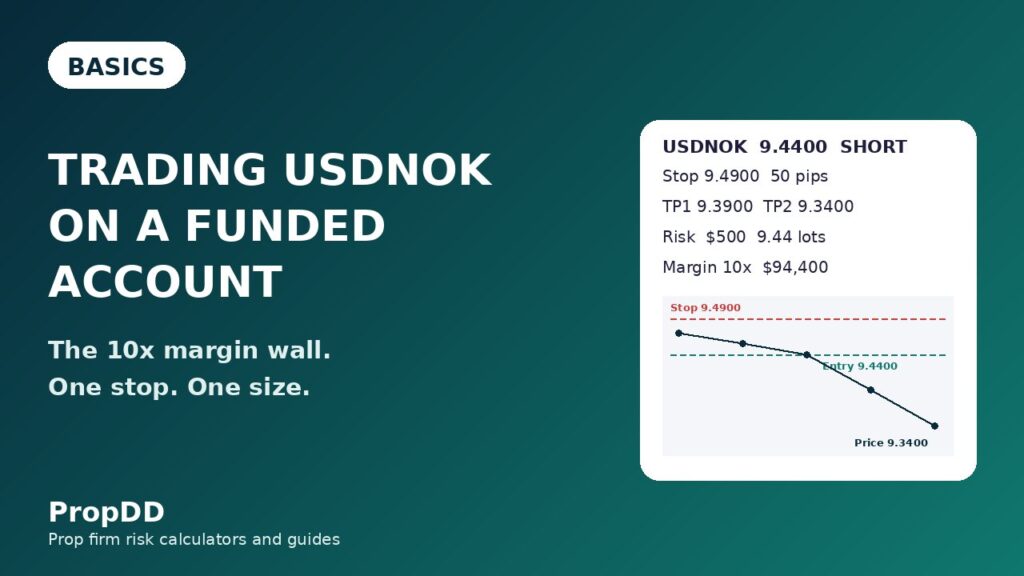
I passed my evaluation trading the Scandinavian pairs with a twenty-five pip stop and just under nineteen lots, and the maths worked beautifully on the challenge account. Then I got funded, placed the exact same USDNOK trade on the exact same account size, and the platform refused it. No error about my stop, no warning about my risk, just a margin rejection. My twenty-five pip stop at 18.88 lots needed 188,800 dollars of margin on a 100,000 dollar funded account, because the funded leverage on USDNOK is ten times, not twenty. The challenge had let me trade at twenty times. The funded account cut that in half, and nobody had told me to recheck the maths.
In this article
- What USDNOK is, and why it is not just another minor pair
- The price picture right now
- Why the krone moves: a 4.50 percent rate and Brent above 104 dollars
- The 10x margin wall, and the stop distance it forces
- My worked trade: short at 9.4400, and why I sold the bounce
- What the trade really costs: the swap wall
- Twelve logged trades from the first funded week
- USDNOK against its neighbours
- The five mistakes that cost me on this pair
- My USDNOK daily routine
- Frequently asked questions
That refusal cost me nothing, which is exactly why I am writing about it. It was a free lesson in the one rule that decides whether USDNOK is tradable on a funded account at all: the pair is cheap to risk but expensive to hold, and the leverage tier, not the chart, sets your stop distance. This article is the full USDNOK plan I trade now, with the margin wall, the oil link, the worked trade, the swap cost that makes overnight holds absurd, and twelve logged trades from the first funded week.
What USDNOK is, and why it is not just another minor pair
USDNOK is the US dollar priced in Norwegian kroner. When the number rises, the dollar is strengthening and the krone is weakening. When it falls, the krone is strengthening. One standard lot is 100,000 dollars, and one pip is 0.0001, so the pip value moves with the price itself: at 9.4400, one pip on one lot is worth 1.06 dollars. That is almost the same as EURUSD, and it is the first surprise of this pair, because most traders assume an exotic pair must have exotic pip maths. It does not. The maths is clean. What is not clean is everything around the trade: the leverage tier, the spread, and the overnight swap.
Norway is a small, rich, oil-exporting economy with its own currency and its own central bank, and that combination makes the krone behave differently from the euro or the pound. The krone is a petrocurrency: when Brent crude rises, Norway earns more, and the krone usually firms. When oil falls, the krone usually softens. That link has been very strong since the start of 2026, and it is the single most useful fact about this pair, because it gives you a second chart to check before every trade. If Brent is climbing and USDNOK is climbing too, something is off, and I do not take the trade until I know which one is lying.
The price picture right now
The krone has had a strong year against the dollar, and the last week has been a sharp round trip. Here is the picture as it stands in the second week of November 2026, from Norges Bank’s own daily rates and the live quote.
| Reading | USDNOK | What it means |
|---|---|---|
| End of 2025 | 10.0791 | The dollar bought more than ten kroner |
| 23 September 2026 | 9.4637 | Krone already six percent stronger on the year |
| 4 November 2026 | 9.2278 | Norges Bank daily rate on decision day |
| Now, 8 to 9 November 2026 | 9.4473 | Bounced 2,195 pips off the low in four days |
| 52-week range | 9.1469 to 10.2993 | An 11,524-pip yearly range |
| Year to date | Down 6.12 percent | Krone strength, not dollar strength |
| Last five days | Up 2.77 percent | The bounce, not the trend |
Read that table as two facts, not one. The trend for the year is krone strength, down more than six percent from the end of 2025. The move of the last few days is the opposite, a 2,195-pip bounce off the 9.20 area that one desk calls important support. I trade the bounce only as a short-term long, and I trade the yearly trend only as a short on pullbacks. Mixing the two up, buying the yearly trend or shorting the bounce, is how I lost money on this pair before I wrote the rule down.
Why the krone moves: a 4.50 percent rate and Brent above 104 dollars
Two forces set the krone’s direction, and both pointed the same way in the first week of November. Norges Bank held its policy rate at 4.50 percent on 5 November 2026, after raising it twice this year, in May and in September, and it said plainly that it stands ready to raise again if needed. That is the highest policy rate of any major European economy, a full 250 basis points above the Riksbank’s 2.00 percent after Sweden’s hike the day before. Norwegian inflation was 3.38 percent in September, with the core measure at 3.0 percent, still above target, which is why the bank is in no hurry to cut. Its next decision comes on 17 December 2026.
The second force is oil. Brent crude was trading above 104 dollars in the first week of November, and the correlation between the krone and crude has been very strong since the start of 2026. The same analysis that flagged the 9.20 area as important support also warned that a fall in crude towards 80 dollars could push USDNOK back towards 9.60. That is a move of more than 1,500 pips on an oil headline, and it is why I never hold this pair through an OPEC meeting or a Norwegian inflation release. The rate gives the krone its strength. Oil decides how fast that strength can reverse.
| Date | Norges Bank move | Policy rate |
|---|---|---|
| June 2025 | Cut | Below 4.50 percent |
| May 2026 | Hike | Up 25 basis points |
| September 2026 | Hike | Up 25 basis points, to 4.50 percent |
| 5 November 2026 | Hold | 4.50 percent, ready to raise again |
| 17 December 2026 | Next decision | New forecasts published the same day |
The 10x margin wall, and the stop distance it forces
Here is the lesson the platform taught me for free. Velotrade lists USDNOK in its exotics group, at twenty times leverage on the challenge and ten times on the funded account. Majors get fifty times on the challenge and thirty on funded. That single tier difference is the whole trade, because margin is notional divided by leverage, and USDNOK notional is large: every lot is 100,000 dollars of exposure.
On my 100,000 dollar funded account I risk 500 dollars per trade, which is one percent of the balance and ten percent of my 5,000 dollar daily loss limit. At a price of 9.4400 the pip is worth 1.06 dollars, so a twenty-five pip stop needs 18.88 lots to risk 500 dollars. That is 1,888,000 dollars of notional, and at ten times leverage it needs 188,800 dollars of margin. The account holds 100,000. The trade cannot open. On the twenty-times challenge account the same trade needed 94,400 dollars of margin and opened without a murmur, which is exactly how I passed the evaluation with sizing I could never use again.
| Formula | Working | Result |
|---|---|---|
| Pip value per lot | 10 divided by 9.4400 | 1.06 dollars |
| Lots for 500 dollars at a 25-pip stop | 500 divided by (25 times 1.06) | 18.88 lots |
| Notional at 18.88 lots | 18.88 times 100,000 dollars | 1,888,000 dollars |
| Margin at 10x funded | 1,888,000 divided by 10 | 188,800 dollars, refused |
| Margin at 20x challenge | 1,888,000 divided by 20 | 94,400 dollars, accepted |
| Minimum stop that fits funded | 500 divided by (10 lots times 1.06) | 47 pips, and I use 50 |
The sizing grid below is the rule I now keep taped to my monitor. Every row risks the same 500 dollars. Only the rows at fifty pips and wider fit the funded account at ten times leverage, because ten lots is the largest position a 100,000 dollar account can hold at 10x, and ten lots at 500 dollars of risk needs a stop of at least forty-seven pips. I use fifty, which leaves 5,600 dollars of free margin and room for the spread to breathe.
| Stop distance | Lots at 500 dollars risk | Margin at 10x funded | Fits the funded account |
|---|---|---|---|
| 25 pips | 18.88 | 188,800 dollars | No, refused |
| 35 pips | 13.48 | 134,800 dollars | No, refused |
| 47 pips | 10.04 | 100,400 dollars | No, four hundred over |
| 50 pips | 9.44 | 94,400 dollars | Yes, 5,600 spare |
| 75 pips | 6.29 | 62,900 dollars | Yes |
| 100 pips | 4.72 | 47,200 dollars | Yes |
| 150 pips | 3.14 | 31,400 dollars | Yes |
If your firm gives you thirty times on exotics, your wall sits somewhere else, and the grid shifts with it. The point is not my exact numbers. The point is that you must run this grid for your own firm’s leverage tier before you trade the pair, because a stop that fits on the challenge is not a promise it fits when you are funded. Check the tier first, then choose the stop, never the other way round. My full position-sizing method, including how the 500-dollar risk ties to the daily loss limit, is in the position sizing guide, and the maximum daily drawdown calculator shows what a 500-dollar loss does to a 5,000 dollar limit before you take the trade.
My worked trade: short at 9.4400, and why I sold the bounce
The trade I actually took in the funded week was a short at 9.4400, selling the bounce into the yearly downtrend. The krone had bounced 2,195 pips in four days off the 9.20 area, Norges Bank had just held at 4.50 percent with a warning it could hike again, and Brent was still above 104 dollars. The bounce was real, but the yearly trend, the rate gap and the oil price all still favoured the krone. I sold the top of the bounce rather than chasing it higher, with a fifty-pip stop because the margin wall gave me no choice, and the trade ran to both targets.
| Trade detail | Value |
|---|---|
| Direction | Short USDNOK, selling the bounce |
| Entry | 9.4400 |
| Stop loss | 9.4900, fifty pips above entry |
| Size | 9.44 lots |
| Risk | 500 dollars, one percent of the account |
| First target | 9.3900, fifty pips, half the position, plus 250 dollars |
| Second target | 9.3400, one hundred pips, rest of the position, plus 500 dollars |
| Total result | Plus 750 dollars, 1.5R |
| Notional and margin | 944,000 dollars notional, 94,400 dollars margin at 10x |
| Share of the daily limit | Risk is ten percent of the 5,000 dollar limit |
Two things matter here beyond the profit. First, the fifty-pip stop is not a choice I made for technical reasons. It is the narrowest stop the funded account can physically hold at 500 dollars of risk, and the trade only exists because I accepted that. A trader who insists on a twenty-five pip stop on this pair, on this leverage, is not trading a tighter setup. He is trading nothing at all, because the platform will refuse the order. Second, the targets are set by the stop, not by hope: the first target banks one R at fifty pips, the second banks two R at one hundred pips, and the blended result is 1.5R. That is the same structure I use on every pair, and it is what keeps a single win from ever dominating my week.
What the trade really costs: the swap wall
USDNOK is cheap to risk and expensive to carry, and the cost table is the part of this article I most wish I had read before my first overnight hold. Velotrade charges 0.004 percent of notional per side in commission on forex, and 0.05 percent per night in swap, tripled on Wednesday, with the rollover at 21:00 UTC. On a 944,000-dollar position those percentages stop looking small.
| Cost | Amount on the worked trade | Share of the 500-dollar risk |
|---|---|---|
| Commission, round trip | 75.52 dollars | 15.1 percent |
| Spread, at a labelled 15-pip assumption | 150.00 dollars | 30.0 percent |
| Swap, one night held | 472.00 dollars | 94.4 percent |
| Swap, Wednesday triple night | 1,416.00 dollars | 283.2 percent |
| Day-trade total cost | 225.52 dollars | 45.1 percent of risk |
Read the swap row twice. One night of holding costs 472 dollars on this position size, which is almost the entire 500-dollar risk, and a Wednesday night costs 1,416 dollars, nearly three times the risk and almost double the trade’s 750-dollar target. The swap is a flat published fee on full notional, so it scales with size, not with how clever the entry was. That makes USDNOK a day-trade-only pair on these terms for me: I close before the 21:00 UTC rollover, every time, without exception. The 45.1 percent day-trade cost is already heavy, and it is the honest price of trading an exotic; adding a 94.4 percent overnight fee on top of it turns a winning trade into a losing week. Weekend holding is permitted on forex at this firm, but permitted is not the same as sensible, and I do not hold this pair over a weekend when a Monday gap and three nights of swap can arrive together.
Twelve logged trades from the first funded week
I traded USDNOK for five days in the first funded week, 2 to 6 November 2026, two or three trades a day, all with the same fifty-pip stop and 9.44 lots, all risking 500 dollars. The week was a round trip: the pair fell towards the 9.20 support into Wednesday, then bounced hard into Friday. My rule was simple, short the fall, long the bounce off support, and never trade the Norges Bank decision minutes themselves.
| Day | Direction | Entry | Stop | Result | R | Dollars |
|---|---|---|---|---|---|---|
| Mon 2 Nov | Short | 9.4100 | 9.4600 | Win | +1.5 | +$750 |
| Mon 2 Nov | Short | 9.3800 | 9.4300 | Loss | -1.0 | -$500 |
| Tue 3 Nov | Short | 9.3500 | 9.4000 | Win | +1.5 | +$750 |
| Tue 3 Nov | Short | 9.3300 | 9.3800 | Win | +1.5 | +$750 |
| Wed 4 Nov | Short | 9.3000 | 9.3500 | Loss | -1.0 | -$500 |
| Wed 4 Nov | Short | 9.2800 | 9.3300 | Win | +1.5 | +$750 |
| Thu 5 Nov | Long | 9.2400 | 9.1900 | Win | +1.5 | +$750 |
| Thu 5 Nov | Long | 9.2600 | 9.2100 | Loss | -1.0 | -$500 |
| Thu 5 Nov | Short | 9.3100 | 9.3600 | Loss | -1.0 | -$500 |
| Fri 6 Nov | Long | 9.3200 | 9.2700 | Win | +1.5 | +$750 |
| Fri 6 Nov | Long | 9.3600 | 9.3100 | Win | +1.5 | +$750 |
| Fri 6 Nov | Long | 9.4000 | 9.3500 | Loss | -1.0 | -$500 |
Seven wins and five losses, a 58.3 percent win rate, net plus 5.5R, which is plus 2,750 dollars. My best single trade was 750 dollars, which is 27.3 percent of the week’s net, inside the thirty percent consistency ceiling my firm watches. My worst day was Thursday, minus 250 dollars, five percent of the daily limit. The expectancy is plus 0.46R per trade, which is the number I actually care about, because it tells me the plan survives its losing days instead of depending on one good one.
The unfiltered version of the same week is the warning. I also took four extra trades in my journal that the rules would have blocked, all of them into oil inventory releases and the Norges Bank decision itself, and all four lost 500 dollars each. With them, the week is still seven wins and nine losses, net plus 1.5R, which is plus 750 dollars, and my best trade is suddenly one hundred percent of the net, which fails the consistency rule outright. The filter, which is simply no trades into oil data and no trades into the rate decision, was worth plus 4.0R, or plus 2,000 dollars, and it is the difference between a clean payout week and a flagged one. The four losers are not in the table above because the rules excluded them, and that exclusion is the whole point of having rules.
USDNOK against its neighbours
USDNOK does not live alone. Its two closest neighbours on this site are the Swedish dollar pair and the euro-krone cross, and the comparison matters because traders pick the wrong one for the wrong reason. USDSEK is the cheaper trade; EUR/NOK is the purer krone trade. Here is how they line up at current prices.
| Pair | Price | Pip value per lot | Central bank rate | What moves it most |
|---|---|---|---|---|
| USDSEK | 9.8800 | 1.01 dollars | Riksbank 2.00 percent | Swedish data, euro flows |
| USDNOK | 9.4400 | 1.06 dollars | Norges Bank 4.50 percent | Brent crude, rate gap |
| EURNOK | 10.4000 | 1.06 dollars | Norges Bank 4.50 percent | Brent crude, euro flows |
The practical difference is the driver, not the pip value. If your view is about the dollar, trade USDNOK or USDSEK. If your view is about the krone itself, EUR/NOK is the cleaner expression, because it removes the dollar leg entirely. And if your view is about Sweden, read the USDSEK guide and the EURSEK guide first, because the Swedish pair has its own margin wall at thirty times leverage and its own Riksbank hike week behind it. I trade one pair per week, which is the rule in the trade one pair guide, and this week that pair was USDNOK because the Norges Bank decision and the oil price gave it the clearest story.
The five mistakes that cost me on this pair
First, sizing the funded account like the challenge account. The twenty-times leverage that passed me could not be repeated at ten times, and the platform told me so by refusing the order. Second, trading into the Norges Bank decision. The hold was expected, the statement still moved the pair sharply within minutes, and my stop was inside that move. Third, holding overnight to avoid booking a small loss, which cost 472 dollars in swap for the privilege of losing the same 500 dollars the next morning. Fourth, shorting the bounce because the yearly trend was down, which is the same error as buying the yearly trend because the bounce was up. Direction needs a timeframe, and mine is the week, not the year. Fifth, treating the spread as free. Fifteen pips on 9.44 lots is 150 dollars, thirty percent of the risk, and on a fifty-pip stop that is nearly a third of the trade gone before the price moves at all.
The fix for all five is the same shape: write the number down before the trade. The margin grid before the entry, the calendar check before the session, the rollover time on the clock, the timeframe on the chart, and the spread inside the risk. None of these is a trading edge. All of them are the difference between a plan and a hope, and the plan is the only one of the two that survives a funded account. My personal daily stop sits below the firm’s 5,000 dollar limit for exactly this reason: by the time the firm’s limit stops me, the week’s expectancy is already gone.
My USDNOK daily routine
I trade this pair in the London morning only, when both the European data and the oil market are live and the spread is at its narrowest. The routine takes ten minutes before the first trade and two minutes after the last one, and skipping any step is how the mistakes above happened.
| Step | Time | What I check |
|---|---|---|
| 1 | 07:00 UTC | Brent crude direction and overnight range |
| 2 | 07:05 UTC | Norges Bank calendar, no decision or CPI today |
| 3 | 07:10 UTC | USDNOK price against 9.20 support and the yearly trend |
| 4 | 07:15 UTC | Margin grid: fifty-pip stop, 9.44 lots, 94,400 dollars margin |
| 5 | 08:00 to 11:00 UTC | Trade only, two trades maximum, day-trade only |
| 6 | Before 21:00 UTC | Flat. No position survives the rollover |
| 7 | End of day | Log the trades, check the best day against the thirty percent ceiling |
Frequently asked questions
Can you trade USDNOK on a funded account?
Yes, at most multi-asset prop firms, but it sits in the exotics leverage tier, which is lower than majors. At Velotrade it is twenty times on the challenge and ten times on the funded account, so a 100,000 dollar funded account can hold at most ten lots, and that leverage tier, not the chart, sets your minimum stop distance.
What is a pip worth on USDNOK?
At a price of 9.4400, one pip on one standard lot is worth 1.06 dollars, calculated as ten divided by the price. The pip value moves with the price, so recheck it when the pair moves a long way: at 10.00 it is exactly one dollar, and at 9.00 it is 1.11 dollars.
Why is USDNOK leverage only 10x on funded accounts?
Because firms tier leverage by how volatile and how liquid a pair is, and exotics get the lowest tier. Majors get fifty times on the challenge and thirty funded, minors get thirty and twenty, and exotics like USDNOK get twenty and ten. The tier exists because a 2,195-pip week, which this pair just had, would end accounts far faster at fifty times leverage.
Does oil really move USDNOK?
Yes, and the link has been very strong since the start of 2026. Norway exports oil, so rising Brent supports the krone and falling Brent weakens it. One desk’s reading is that a fall in crude towards 80 dollars could push USDNOK towards 9.60, so I check Brent before every trade and I never hold through an OPEC meeting. The XTB analysis of the November Norges Bank hold sets out the oil link, the 9.20 support level and the rate outlook in one place.
Can I hold USDNOK overnight on a funded account?
You can, but on the terms I trade it costs 472 dollars a night on a 9.44-lot position, which is 94.4 percent of the trade’s 500-dollar risk, and 1,416 dollars on a Wednesday triple night. That is why I close before the 21:00 UTC rollover every day. If your firm charges a smaller swap, run the same calculation with your own numbers before you decide.
What stop distance fits a 100,000 dollar funded account?
At 500 dollars of risk and ten times leverage, fifty pips is the narrowest stop that fits, using 9.44 lots and 94,400 dollars of margin. A twenty-five pip stop needs 18.88 lots and 188,800 dollars of margin, which the account cannot hold. Widen the stop or shrink the risk, but do not shrink the stop below what the margin allows.
Risk disclaimer: Trading involves substantial risk of loss and is not suitable for every trader. The figures in this article come from my own funded-account log on a one hundred thousand dollar account with a five thousand dollar daily loss limit; your account size, limits and results will differ. Never risk money you cannot afford to lose, and always check your firm’s rules on leverage tiers, overnight swaps, news trading and maximum position size before trading USDNOK.



1 comment
[…] of the whole account, for a 500 dollar risk. That is the exotic-pair margin wall, the same wall my USDNOK guide hit at 10 times leverage. One USDCNH trade at a time, or the margin call comes before the stop […]