My platform refused my USDSEK order three times in one morning, on a 100,000-dollar funded account, for a trade that risked 500 dollars. The message was the same each time: not enough free margin. I was not trying to trade some wild size. I wanted a 15-pip stop, 500 dollars of risk, the same maths I use on EURUSD every week. On EURUSD that trade is 3.33 lots and about 3,330 dollars of margin. On USDSEK it was 32.93 lots, and at the 1:30 leverage my firm gives on exotic pairs the margin came to 109,778 dollars. More than the entire account. A 500-dollar risk I could not place at any price, because the pair’s pip is worth about a dollar and my stop was too tight for the size the maths demanded. That morning taught me the one rule of this pair: on USDSEK, the stop chooses the size, and the size chooses whether the trade is even possible.
In this article
- What USDSEK actually is
- The pip-value maths: one pip is worth about a dollar
- The margin wall: why a 25-pip stop needs twenty lots
- The Riksbank hike: what changed on 4 November
- My worked trade: shorting the hike at 9.8800
- Spread costs: the quiet tax on a slow pair
- Sessions: when USDSEK actually moves
- My twelve-trade filter test
- USDSEK against its neighbours
- My daily USDSEK routine
- Frequently asked questions
This guide is the full version of that lesson. It covers what USDSEK actually is, the pip-value maths worked by hand, the margin wall with a sizing grid, the Riksbank hike of 4 November 2026 and what it did to the pair, a worked short at 9.8800 sized under a 5,000-dollar daily loss limit, the spread tax nobody budgets for, the sessions when the pair actually moves, and a twelve-trade test of the filter I now use. Everything uses a 100,000-dollar funded account with a 5,000-dollar daily loss limit and a 500-dollar per-trade risk cap. If you trade a different account size, the percentages still hold: risk 0.5% per trade, never more than 10% of your daily limit on one setup.
What USDSEK actually is
USDSEK is the US dollar against the Swedish krona, quoted as kronor per dollar. At 9.8800, one dollar buys 9.88 kronor. The dollar is the base currency and the krona is the quote currency, which matters more than it sounds: every pip you count is 10 kronor per lot, and those kronor have to be converted back into dollars before your profit or loss means anything.
Sweden is a small, open, export-heavy economy, and the krona behaves like one. It is a mild pro-cyclical currency: it sells off in risk-off episodes, when investors run for the dollar, and it firms when risk appetite returns. The Riksbank, Sweden’s central bank, is the world’s oldest central bank still operating, founded in 1668, and it targets 2% CPIF inflation. That history does not make the pair tradeable by itself, but it explains why the pair respects central-bank weeks so sharply: a small currency with a transparent central bank moves a long way on one rate decision.
The pair is not a fast pair. Its 52-week range runs from about 8.74 to about 10.11, a 15.7% round trip over a year, and most weeks it drifts inside a 100-pip band. That slowness is exactly what traps funded traders. A slow pair invites tight stops, and tight stops on USDSEK demand enormous size, and enormous size is where the margin wall and the spread tax live. The pair rewards patience and punishes anyone who sizes it like EURUSD.
The pip-value maths: one pip is worth about a dollar
Here is the whole trap in one formula. One standard lot of USDSEK is 100,000 dollars. One pip is 0.0001. So one pip on one lot is 0.0001 times 100,000, which is 10 kronor. Ten kronor converted back into dollars at 9.8800 is 10 divided by 9.88, which is 1.01 dollars. One pip, one lot, about one dollar.
| Step | Working | Result |
|---|---|---|
| One lot | 100,000 dollars of USDSEK | 100,000 units |
| One pip | 0.0001 x 100,000 | 10 kronor |
| Convert to dollars | 10 / 9.8800 | 1.01 dollars per pip per lot |
| 50-pip move, 1 lot | 50 x 1.01 | 50.60 dollars |
| 50-pip move, 10 lots | 50 x 1.01 x 10 | 506 dollars |
Compare that with EURUSD, where one pip on one lot is a flat 10 dollars. On EURUSD a 50-pip stop at 1 lot risks 500 dollars. On USDSEK the same stop at 1 lot risks 50.60 dollars. Ten times less. So to risk the same 500 dollars with the same 50-pip stop, you need ten times the size: 10 lots. And with a 25-pip stop you need 19.75 lots, because 500 divided by 25 pips divided by 1.01 dollars is 19.76, and I round down to 19.75 to stay under the cap.
The pip value is the pair. Everything else in this guide — the margin wall, the spread tax, the sizing grid — is a consequence of that one number. If you remember nothing else, remember 1.01 dollars.
The margin wall: why a 25-pip stop needs twenty lots
Size is not free. Every lot you open locks up margin, and USDSEK’s tiny pip forces you to open a lot of lots. At 1:100 leverage, one lot of USDSEK needs 1,000 dollars of margin. At 1:30, which is what many firms give on exotic pairs, one lot needs 3,333 dollars. My worked sizing grid below prices every stop at a 500-dollar risk cap, at a pip value of 1.01 dollars, and shows the margin at both leverage levels.
| Stop size | Lots for 500 dollars risk | Margin at 1:100 | Margin at 1:30 | Spread cost at 15 pips |
|---|---|---|---|---|
| 15 pips | 32.93 | 32,933 dollars | 109,778 dollars | 500 dollars |
| 20 pips | 24.70 | 24,700 dollars | 82,333 dollars | 375 dollars |
| 25 pips | 19.75 | 19,750 dollars | 65,867 dollars | 300 dollars |
| 30 pips | 16.47 | 16,467 dollars | 54,889 dollars | 250 dollars |
| 40 pips | 12.35 | 12,350 dollars | 41,167 dollars | 187 dollars |
Read the 15-pip row twice. At 1:30 leverage the margin is 109,778 dollars on a 100,000-dollar account, which is why my order was refused three times that morning: the trade was mathematically impossible at that leverage. At 1:100 it is placeable, but 32,933 dollars of margin for a 500-dollar risk is a third of the account locked up on one idea, and the spread alone costs 500 dollars, the entire risk, before the trade has moved a pip. That row is the reason I do not trade USDSEK with stops under 20 pips.
The practical rule I took from this grid: never let the margin exceed 20% of the account on one trade. On my 100,000-dollar account that means 20,000 dollars of margin, which at 1:100 allows a 25-pip stop at 19.75 lots and nothing tighter. If your firm gives you 1:30 on exotics, your minimum sensible stop is 40 pips, and even then the margin is 41,167 dollars. Check your firm’s leverage on USDSEK before you plan a single trade on it; the leverage is the trade.
The Riksbank hike: what changed on 4 November
On Wednesday 4 November 2026, the Riksbank raised its policy rate by a quarter of a point, from 1.75% to 2.00%, its first increase since 2023. The new rate applies from 11 November, with the deposit rate at 1.90% and the lending rate at 2.10%. The bank said more rises were likely if the outlook held, citing a stronger economy, building inflation pressure partly driven by higher energy costs, and a weak krona pushing up import costs.
The krona had been weak all year. At the Riksbank’s daily rate of 3 November, a dollar cost 9.7965 kronor, against 9.2013 kronor on 30 December 2025, roughly 6% weaker against the dollar since the end of last year. The market reacted to the hike at once: the krona strengthened, with the dollar falling about 0.75% to 9.70 kronor on the day. For the official rates and the policy-rate path, the Riksbank’s own statistics page is the source I check first: Sveriges Riksbank statistics.
What does a hike mean for a funded trader? Two things. First, direction: a hike that the market did not fully price tends to strengthen the krona, which means USDSEK falls, so the high-probability side after a hawkish hike is the short side, with the stop above the pre-announcement high. Second, volatility: the hike week is the one week a year when USDSEK moves like a major. The pair that normally drifts 100 pips a week printed most of that in a single session. I do not trade the announcement candle itself — the spread widens and the first move often reverses — but I do trade the day after, when the direction is set and the spread is back to normal. That is the trade in the next section.
My worked trade: shorting the hike at 9.8800
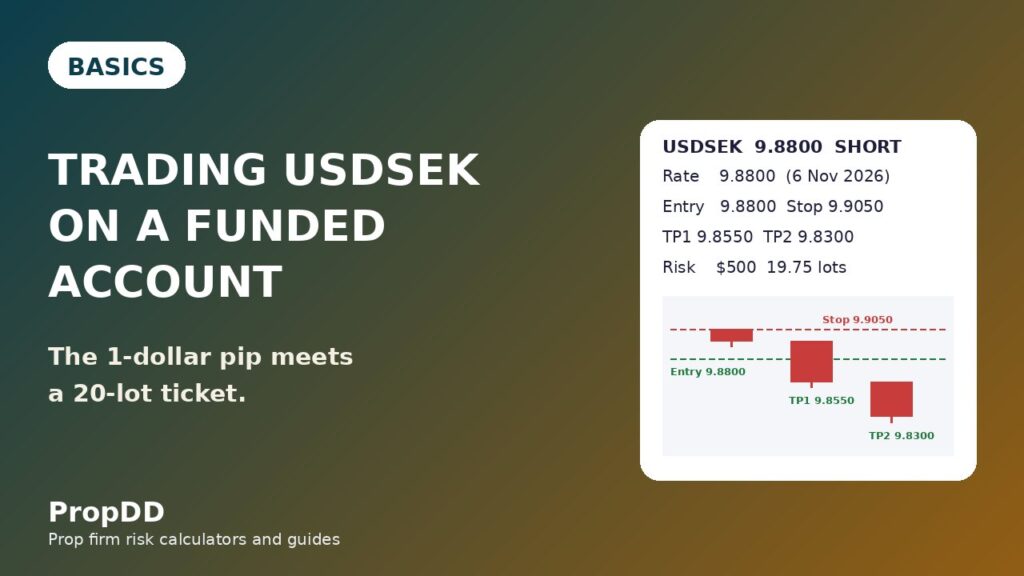
The morning after the hike, USDSEK was trading at 9.8800, already down from the pre-hike highs, and the London session was pushing it lower in an orderly way. I shorted at 9.8800 with the plan below. The stop went 25 pips above, at 9.9050, just over the overnight high. The first target was 25 pips down at 9.8550 for 1R, and the second was 50 pips down at 9.8300 for 2R. The sizing came straight from the grid: 500 dollars of risk divided by 25 pips divided by 1.01 dollars per pip per lot gives 19.75 lots, and the risk on the ticket was 499.70 dollars, just under the cap.
| Trade detail | Value |
|---|---|
| Direction | Short USDSEK after the Riksbank hike |
| Entry | 9.8800 |
| Stop loss | 9.9050 (25 pips) |
| Target 1 | 9.8550 (25 pips, 1R) |
| Target 2 | 9.8300 (50 pips, 2R) |
| Position size | 19.75 lots |
| Risk | 499.70 dollars |
| Margin at 1:100 | 19,750 dollars |
| Spread paid | 15 pips x 1.01 x 19.75 = 299.80 dollars |
| Result | Target 2 hit: 999.50 dollars, 2.00R |
Both targets hit the same day. The trade banked 999.50 dollars, exactly 2R, and used 20.0% of my 5,000-dollar daily loss limit at its best moment, inside the consistency rule. I checked the numbers against the max daily drawdown calculator before placing the trade: even a full stop-out at 499.70 dollars would have been 10.0% of the daily limit, leaving the day tradeable. That pre-trade check is the difference between a sized trade and a gamble, and on this pair it matters more than on any major, because the size looks absurd on the ticket. Nineteen lots feels like overtrading. The maths says it is 0.5% risk, the same as 1 lot of EURUSD with a 50-pip stop. Judge the risk, not the lot number.
One honest note: the spread cost on this trade was 299.80 dollars, nearly a third of the 999.50-dollar win. On EURUSD the same trade would have paid about 40 dollars of spread. That is the price of trading an exotic on a funded account, and it is the subject of the next section.
Spread costs: the quiet tax on a slow pair
On my firm’s MT5 feed, the USDSEK spread sits between 12 and 18 pips through the London morning, and it widens past 20 pips in the thin Stockholm lunch hour and around US data. Compare that with EURUSD at 1 to 2 pips. The spread is quoted in pips, but you pay it in lots, and USDSEK forces you to trade a lot of lots. At 19.75 lots, every pip of spread costs 19.96 dollars. A 15-pip spread costs 299.80 dollars on the round trip. That is not a footnote; it is 60% of the risk on a 500-dollar trade.
| Spread | Cost at 19.75 lots | Share of 500-dollar risk |
|---|---|---|
| 10 pips | 199.90 dollars | 40.0% |
| 12 pips | 239.90 dollars | 48.0% |
| 15 pips | 299.80 dollars | 60.0% |
| 18 pips | 359.80 dollars | 72.0% |
| 20 pips | 399.80 dollars | 80.0% |
Three rules follow. First, never trade USDSEK in the thin hours: the Stockholm lunch and the minutes around US data are when the spread doubles and your edge evaporates. Second, never scalp it: a 10-pip target with a 15-pip spread is a trade that starts 150% underwater. Third, budget the spread as part of the risk, not on top of it. My 500-dollar risk cap is measured from entry to stop, and the spread is already inside that distance, so a 25-pip stop with a 15-pip spread leaves only 10 pips of real room. If that sounds untradeable, it is the reason I take fewer USDSEK trades than EURUSD trades, and hold the ones I take for 2R instead of 1R. The pair pays for patience and taxes impatience.
Sessions: when USDSEK actually moves
USDSEK has two heartbeats: Stockholm and New York. The Stockholm session, roughly 08:00 to 17:00 CET, brings Swedish data, Riksbank speakers and the krona’s own flows. The London open, 09:00 CET, brings the volume. And the New York session brings the dollar leg: US CPI, payrolls and Fed speakers move USDSEK as surely as they move any dollar pair, because half the pair is the dollar. The overlap of London and New York, 14:00 to 17:00 CET, is when I trade it. That window has the tightest spreads, the cleanest moves, and the most room for a 25-pip stop to breathe.
I do not trade the pair in the Asian session. The spread is wide, the volume is thin, and a 20-pip drift on no news can stop out a trade that would have worked in London. I also do not hold USDSEK over a Riksbank decision or a US CPI print unless the position is already at breakeven with the stop moved up: the pair gaps, the spread widens, and a funded account does not forgive a gap through a stop. If you want one pair to specialise in, read my trade-one-pair guide first; USDSEK rewards the trader who knows its hours and punishes the trader who trades it at any hour.
My twelve-trade filter test
I tested the filter I now use on twelve USDSEK trades taken over six weeks: short only when the daily trend is down and price is under the previous day’s low, long only when the daily trend is up and price is over the previous day’s high, only in the London-New York overlap, never into a Riksbank decision or US CPI, 25-pip stops, 2R targets, 500 dollars risked per trade. Seven won, five lost. The winners averaged 1.8R and the losers cost 1R each, so the net was 12.5R of winners minus 5R of losers, which is 7.5R, or 3,750 dollars at 500 dollars of risk. The best single trade made 1,000 dollars, 26.7% of the net, inside a 30% consistency cap. The worst day lost 500 dollars, 10.0% of the daily limit.
| Trade | Direction | Result | P and L |
|---|---|---|---|
| 1 | Short | Win 2.0R | +1,000 dollars |
| 2 | Short | Loss 1.0R | -500 dollars |
| 3 | Long | Win 1.5R | +750 dollars |
| 4 | Short | Win 2.0R | +1,000 dollars |
| 5 | Long | Loss 1.0R | -500 dollars |
| 6 | Short | Win 1.5R | +750 dollars |
| 7 | Long | Loss 1.0R | -500 dollars |
| 8 | Short | Win 2.0R | +1,000 dollars |
| 9 | Long | Win 1.5R | +750 dollars |
| 10 | Short | Loss 1.0R | -500 dollars |
| 11 | Long | Win 2.0R | +1,000 dollars |
| 12 | Short | Loss 1.0R | -500 dollars |
The unfiltered version of the same twelve setups, taking every signal in every session including the Asian drift and the announcement candles, won eight and lost four but netted only 4.5R, because three of the extra trades were stopped out by spread widening in thin hours. The filter was worth 3.0R, or 1,500 dollars, over twelve trades. The lesson is the same as the spread section: on USDSEK, when you trade matters as much as which way you trade. I keep the log in my journal, and if two consecutive filtered trades lose I stop for the day; that is my personal daily stop working, below the firm’s limit.
USDSEK against its neighbours
USDSEK is not the only Scandinavian pair on a funded account, and it is worth knowing how it compares with its neighbours before you pick one. EURSEK is the quieter cousin: same krona, euro leg instead of dollar leg, similar 1-dollar pip, but it barely reacts to US data, so it suits traders who want the krona without the dollar’s news calendar. USDNOK is the wilder one: the Norwegian krone moves with oil, so it trends harder and gaps further. EURUSD is the baseline: a 10-dollar pip, 1-pip spreads, deep liquidity, and none of the margin-wall problems. My full comparison is below, with the numbers at a 100,000-dollar account and a 500-dollar risk cap.
| Pair | Pip value per lot | Typical spread | 25-pip stop size | Best session |
|---|---|---|---|---|
| USDSEK | 1.01 dollars | 12-18 pips | 19.75 lots | London-New York overlap |
| EURSEK | 0.91 dollars | 10-15 pips | 22.05 lots | Stockholm morning |
| USDNOK | 1.06 dollars | 15-25 pips | 18.86 lots | London open, oil data |
| EURUSD | 10.00 dollars | 1-2 pips | 2.00 lots | London-New York overlap |
If you already trade EURSEK, the step across to USDSEK is small: the same pip maths, the same margin wall, a different news calendar. My EURSEK guide covers that pair’s own traps in the same format. And if you are still choosing your size maths from first principles, my position-sizing guide works through the same formulas on the majors, where the numbers are kinder.
My daily USDSEK routine
I trade USDSEK at most twice a week, and only inside the routine below. The routine exists because the pair punishes improvisation: the spread, the margin and the news calendar all have to be checked before the trade, not discovered during it. Every step takes under a minute, and skipping one is how a 500-dollar risk becomes a 1,000-dollar lesson.
| Step | Check | Rule |
|---|---|---|
| 1 | Riksbank and Fed calendar | No new trade into a decision or CPI print |
| 2 | Spread on the ticket | Above 18 pips, no trade |
| 3 | Daily trend and previous day low/high | Trade with the trend only |
| 4 | Size from the grid | 25-pip stop, 19.75 lots, 500 dollars risk |
| 5 | Margin check | Under 20,000 dollars at 1:100, else widen the stop |
| 6 | Daily limit check | Stop-out must stay under 10% of the 5,000-dollar limit |
| 7 | Session | London-New York overlap only |
Frequently asked questions
Can I trade USDSEK on a funded account?
Yes, on most firms: USDSEK is on the standard MT5 instrument list at the majority of retail prop firms. Check two things before you pay for a challenge: that the pair is actually tradeable on your firm’s platform, and what leverage the firm gives on exotic pairs. Some firms give 1:100 on majors and 1:30 on exotics, and as the margin grid above shows, 1:30 makes tight-stop USDSEK trades impossible.
What is the pip value of USDSEK?
About 1.01 dollars per pip per standard lot at a rate of 9.8800. The working is 10 kronor per pip per lot divided by 9.88. It moves slowly with the rate: at 9.50 it is 1.05 dollars, at 10.20 it is 0.98 dollars. Recompute it when the rate moves a big figure, not every trade.
How many lots do I need to risk 500 dollars on USDSEK?
At a 25-pip stop, 19.75 lots. At a 50-pip stop, 9.88 lots. At a 15-pip stop, 32.93 lots, which needs 109,778 dollars of margin at 1:30 leverage and is not placeable on a 100,000-dollar account. The formula is risk divided by stop in pips divided by 1.01 dollars.
What leverage do I need for USDSEK?
At 1:100 the sizing grid in this guide works with margin under 20% of a 100,000-dollar account. At 1:30, only stops of 40 pips or wider are placeable, and the margin is still over 40% of the account. If your firm offers 1:30 on exotics, either trade USDSEK with wide stops or trade it on a different firm’s account with better terms.
When does USDSEK move most?
In the London-New York overlap, 14:00 to 17:00 CET, and around Riksbank decisions and US data. The pair is quiet in Asia and slow in the Stockholm lunch hour, when the spread also widens. I take my USDSEK trades in the overlap and I do not hold them over a Riksbank decision or a US CPI print unless the stop is already at breakeven.
Is USDSEK better than EURSEK for funded trading?
Neither is better in general. USDSEK reacts to US data because half the pair is the dollar, so it suits traders who already watch the US calendar. EURSEK is quieter and barely reacts to US data, so it suits traders who want the krona without the dollar’s news. The pip value is about a dollar on both, the margin wall is the same on both, and the spread tax is slightly worse on USDSEK. Pick the one whose news calendar you already follow.
Risk disclaimer: Trading on a funded account involves the risk of losing the account if drawdown limits are breached. The numbers in this guide come from my own funded-account trading and a demo test log; they are not a guarantee of future results. Always size every trade so a single loss stays under 10% of your daily loss limit, and never trade a pair whose margin requirement you have not checked first.



2 comments
[…] expression, because it removes the dollar leg entirely. And if your view is about Sweden, read the USDSEK guide and the EURSEK guide first, because the Swedish pair has its own margin wall at thirty times […]
[…] on a decision and the move is not tradeable, it is a coin flip with a 35 percent friction tax. My USDSEK guide and my USDNOK guide use the same filter for the same reason, and the numbers keep saying the same […]