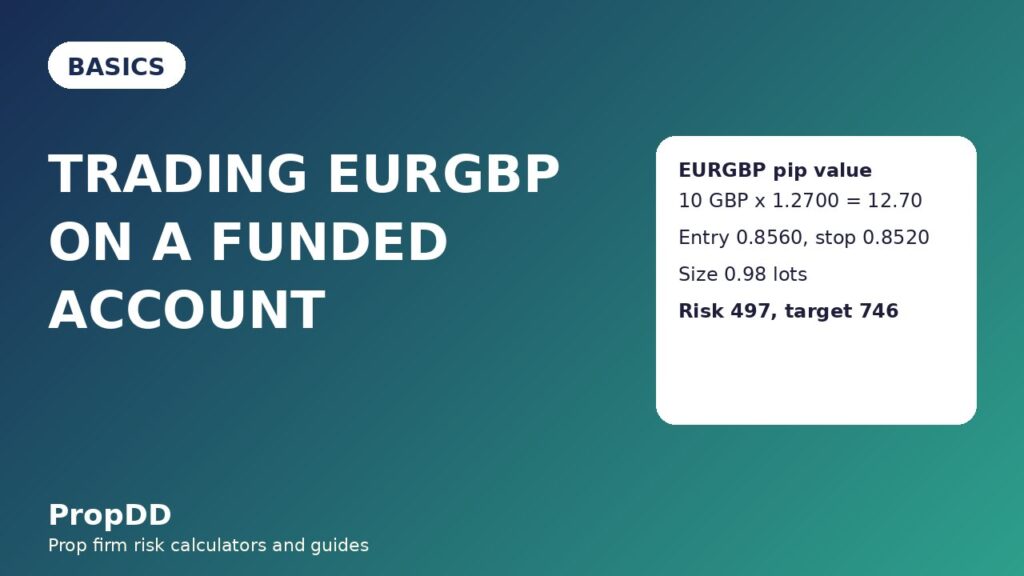
I lost 135 dollars to a pip I never calculated, and the trade itself was a winner on the chart. I was long EURGBP from 0.8560, the trade ran to my target, and I closed it in profit, so nothing in my journal looked wrong until I checked the money column at the end of the day. I had sized the position the way I sized EURUSD: one standard lot, a 50-pip stop, ten dollars a pip, five hundred dollars of risk. EURGBP does not work that way. Its pip is earned in pounds, not dollars, and at the GBPUSD rate that week each pip on one lot was worth 12.70 dollars, so my 50-pip stop was actually risking 635 dollars, not 500. That is the whole lesson of this pair: EURGBP is the cross with no dollar in it, so every sizing decision passes through a second exchange rate, and a trader who sizes it like a dollar pair is quietly trading bigger than they think. In this guide I set out the pair’s contract facts, the pip-value maths at different GBPUSD rates, a worked range trade sized under a 5,000-dollar daily loss limit, a sizing grid for every stop distance I use, the London session plan, the filter test that shows what happens when you trade this cross around the clock, and the daily routine that keeps it inside funded-account rules. Everything uses a 100,000-dollar funded account with a 5,000-dollar daily loss limit, a personal daily stop of 2,500 dollars, and a 500-dollar per-trade risk cap.
In this article
- What EURGBP actually is, and why it ranges
- The 12.70-dollar pip, worked from first principles
- The worked trade: buying the range floor
- The sizing grid for every stop I use
- The London session plan, and the news I skip
- What I tested: filtered vs unfiltered
- When EURGBP fails
- My daily EURGBP routine
- Frequently asked questions
EURGBP sits apart from the other crosses I have covered in this series, and the differences are worth stating before the maths. The EURCHF guide covers a cross between two safe havens, where the pip is earned in francs and converted to dollars by dividing by the USDCHF rate. The USDCHF guide covers a single safe haven against the dollar, with the same division step. EURGBP flips the conversion: its pip is earned in pounds and converted to dollars by multiplying by the GBPUSD rate, so a stronger pound makes every pip more expensive, not cheaper. The EURJPY guide covers a yen cross where the pip is worth a fixed number of yen and the conversion divides by USDJPY. EURGBP is the only cross in the series where the quote currency is a major that itself moves sharply against the dollar during the London session, which is exactly when this pair trades best. The general rule behind all of this, that a pip is first earned in the quote currency and only then converted into your account currency, is set out in EBC’s pip calculation guide.
What EURGBP actually is, and why it ranges
EURGBP is the euro against the pound, quoted as how many pounds one euro buys. There is no dollar in the pair, so it does not inherit the dollar’s trend the way EURUSD and GBPUSD do. Its drivers are the relative story of two neighbouring economies: Bank of England versus European Central Bank rate expectations, UK versus eurozone data, and risk sentiment that pushes money between London and Frankfurt. Because both currencies are large and liquid, and because their central banks often move in the same direction at different speeds, the pair spends long stretches inside a range rather than trending for weeks. That range-bound character is a gift and a trap. It is a gift because support and resistance levels hold repeatedly, giving a funded trader clean entries with stops just beyond a level. It is a trap because the ranges are narrow, often 100 to 200 pips wide over weeks, so a trader used to EURUSD’s daily ranges can feel starved of movement and start trading the middle of the range, where there is no edge at all.
| Contract fact | EURGBP detail |
|---|---|
| Pair structure | Euro base, pound quote; no US dollar leg |
| One pip | 0.0001, the fourth decimal place |
| One standard lot | 100,000 euros |
| Pip value per lot | 10 pounds, converted to dollars at the GBPUSD rate |
| Typical character | Range-bound over weeks, sharpest in the London session |
| Main drivers | Bank of England vs ECB expectations, UK and eurozone data, risk sentiment |
The 12.70-dollar pip, worked from first principles
The formula is short, and every mistake on this pair comes from skipping one of its steps. One pip on one standard lot is 0.0001 times 100,000 euros, which is 10 pounds. Ten pounds converted to dollars at a GBPUSD rate of 1.2700 is 12.70 dollars. That is the pip value I use for the whole guide, and the formula box below it is the version I keep taped to my monitor: size equals risk divided by stop distance times pip value. At a GBPUSD rate of 1.2000 the pip falls to 12.00 dollars, and at 1.3500 it rises to 13.50 dollars, so the same 50-pip stop on one lot costs 600 dollars, 635 dollars, or 675 dollars depending on the week. None of those is the 500 dollars a dollar-pair trader assumes, and the gap widens exactly when the pound is strong, which is often when EURGBP is moving fastest. I recalculate the pip value every morning from the live GBPUSD rate before I size anything, because a pip value carried over from last month is a position size built on stale maths.
| GBPUSD rate | Pip value per lot | One lot, 50-pip stop costs |
|---|---|---|
| 1.2000 | 10 x 1.2000 = 12.00 dollars | 50 x 12.00 = 600 dollars |
| 1.2700 | 10 x 1.2700 = 12.70 dollars | 50 x 12.70 = 635 dollars |
| 1.3500 | 10 x 1.3500 = 13.50 dollars | 50 x 13.50 = 675 dollars |
Formula box: pip value in dollars = 10 pounds x GBPUSD rate. Position size in lots = risk in dollars / (stop distance in pips x pip value in dollars). At GBPUSD 1.2700: size = 500 / (stop pips x 12.70).
The worked trade: buying the range floor
Here is a real-structure trade with the maths shown end to end. EURGBP has ranged between support at 0.8520 and resistance at 0.8600 for three weeks, and price pulls back to the floor and prints a bullish rejection on the hourly chart. I buy at 0.8560, once the rejection candle closes back above support, rather than catching the falling knife at the level itself. My stop goes below support at 0.8520, which is 40 pips. Size equals 500 divided by 40 times 12.70, which is 0.98 lots. Risk is 0.98 lots times 40 pips times 12.70 dollars, which is 497.84 dollars, inside the cap. First target is resistance at 0.8600, 40 pips above entry: I close half there for 248.92 dollars and move the stop to breakeven. Second target is the range extension at 0.8640, 80 pips above entry: the rest closes for 497.84 dollars. Total profit is 746.76 dollars, which is 1.5R on 497.84 dollars of risk. If the range floor breaks instead, the loss is 497.84 dollars and the day still has room, because my personal daily stop is 2,500 dollars, five such losses, and the firm’s daily limit is 5,000 dollars. The trade works because the stop sits where the range story is proven wrong, beyond support, and the targets sit where the range has already shown it likes to turn, not at round numbers I invented.
| Worked trade step | Number |
|---|---|
| Setup | Three-week range, support 0.8520, resistance 0.8600, bullish rejection at the floor |
| Entry | 0.8560 long (rejection close back above support) |
| Stop | 0.8520, 40 pips below entry |
| Pip value | 10 x 1.2700 = 12.70 dollars per lot |
| Size | 500 / (40 x 12.70) = 0.98 lots |
| Risk | 0.98 x 40 x 12.70 = 497.84 dollars |
| Target 1 (half) | 0.8600, +248.92 dollars, stop to breakeven |
| Target 2 (rest) | 0.8640, +497.84 dollars |
| Total | +746.76 dollars = 1.5R |
The sizing grid for every stop I use
Ranges give different stop distances depending on where the level sits, so I keep one grid and read the size off it instead of recalculating under pressure. Every row below uses the same 500-dollar cap and the same 12.70-dollar pip, and every size is rounded down, never up, because rounding up is how a 499-dollar risk becomes a 501-dollar risk. A tight 25-pip stop allows 1.57 lots, while a wide 80-pip stop allows only 0.49 lots, and both risk the same 500 dollars.
| Stop distance | Size at 12.70-dollar pip | Risk |
|---|---|---|
| 25 pips | 500 / (25 x 12.70) = 1.57 lots | 1.57 x 25 x 12.70 = 498.48 dollars |
| 30 pips | 500 / (30 x 12.70) = 1.31 lots | 1.31 x 30 x 12.70 = 499.11 dollars |
| 40 pips | 500 / (40 x 12.70) = 0.98 lots | 0.98 x 40 x 12.70 = 497.84 dollars |
| 50 pips | 500 / (50 x 12.70) = 0.78 lots | 0.78 x 50 x 12.70 = 495.30 dollars |
| 60 pips | 500 / (60 x 12.70) = 0.65 lots | 0.65 x 60 x 12.70 = 495.30 dollars |
| 80 pips | 500 / (80 x 12.70) = 0.49 lots | 0.49 x 80 x 12.70 = 497.84 dollars |
The London session plan, and the news I skip
EURGBP belongs to London. The pair moves when both its economies are awake, which means the London morning, roughly 08:00 to 12:00 London time, when UK and eurozone data land and Bank of England and ECB speakers are active. The London to New York overlap, roughly 13:30 to 16:00 London time, is tradable but second choice: US data moves GBPUSD, which changes the dollar value of an open EURGBP position and can whip the cross even when nothing European has happened. The Asian session is excluded entirely, because neither economy is awake, spreads widen, and the range drifts sideways in a way that fills neither targets nor stops cleanly.
| Session window | EURGBP plan |
|---|---|
| London morning, 08:00-12:00 | Primary window: range levels trade with follow-through |
| London-New York overlap, 13:30-16:00 | Second choice: tradable, but US data can reprice the pip mid-trade |
| Asian session | Excluded: neither economy awake, spreads wide, drift only |
| 30 minutes around high-impact news | Excluded: UK, eurozone, and US releases all count |
| Friday afternoon | Excluded for new positions: weekend gap risk over central-bank headlines |
What I tested: filtered vs unfiltered
I ran the same range idea two ways over 35 trades in my journal, and the gap is the whole argument for the session and level filters. The filtered version only traded marked range levels, only in the London morning or the overlap, skipped every news window, and stopped after two losses. The unfiltered version traded every bounce and break in any session, including the middle of the range and the Asian drift. The filtered version made 3,750 dollars across 15 trades, nine winners and six losers, with the best day at 750 dollars, which is 20 percent of the net profit and inside the 30 percent consistency ceiling. The unfiltered version lost 3,000 dollars across 20 trades, seven winners and thirteen losers, because most mid-range bounces reverse before either target and most Asian breakouts reverse before London. The filter was worth 6,750 dollars across the 35 trades. A range-bound cross rewards patience more than activity, and the fastest way to lose a funded account on it is to trade it like a trending pair.
| Test version | Trades | Win / loss | Winners minus losers | Net |
|---|---|---|---|---|
| Filtered (levels + London hours + news filter) | 15 | 9 / 6 | 9 x 1.5R – 6 x 1R | +3,750 dollars = +7.5R |
| Unfiltered (every bounce, any session) | 20 | 7 / 13 | 7 x 1R – 13 x 1R | -3,000 dollars = -6R |
When EURGBP fails
The pair fails in four recognisable ways, and naming them is what keeps the losses at one unit each. First, the range breaks for real: a Bank of England surprise or a eurozone shock turns a three-week range into a trend, and every fade of the old floor stops out in sequence. The stop beyond the level is sized for exactly this case, and the two-loss rule stops it becoming a day-ruining sequence. Second, the middle-of-range trade: buying halfway between support and resistance because the chart “looks bullish” gives a stop with no level behind it and a target with no level ahead of it, which is just noise at full size. Third, the stale pip value: sizing from last month’s GBPUSD rate after the pound has moved two figures, so every trade risks six percent more than planned and the fifth trade of the week quietly breaches the spirit of the cap. Fourth, the US-data whipsaw: a US release moves GBPUSD sharply, repricing an open EURGBP position and triggering stops on a cross that has not itself changed direction. Every failure mode here costs one unit when the rules hold, and several units when they do not. That asymmetry is the real edge on a quiet cross: the pair does not need to be exciting, it needs the trader to respect the stop and the pip maths.
My daily EURGBP routine
The routine is deliberately short, because a range-bound cross rewards the same few actions repeated cleanly. I check the live GBPUSD rate and rebuild the pip value before the London session, then mark the range floor and ceiling from the daily and four-hour charts and cross off every level that has held fewer than twice. I wait for price to reach a level and print a rejection, size from the grid, and place the stop beyond the level before I think about targets. I take at most two trades, I stop at two losses or at the personal daily stop, and I never move a stop further away because a range “looks like it will hold”. A range trade that needs its stop moved was a trade taken on hope, and hope is not a level. Kept inside these rules, EURGBP fits funded-account constraints cleanly: each trade risks about a tenth of the daily limit, the best day stays inside the consistency ceiling, and no single cross-rate surprise can end a challenge. If you trade only one pair while learning funded rules, the one-pair challenge guide explains why a quiet, well-understood cross like this one beats a basket of pairs you size from habit.
| Routine step | Action |
|---|---|
| 1. Reprice the pip | Live GBPUSD rate, pip value = 10 x GBPUSD, rebuild the sizing grid |
| 2. Mark the range | Floor and ceiling held at least twice, daily and four-hour charts, before London |
| 3. Wait for rejection | Trade only at a level, after a rejection close, never mid-range |
| 4. Size from the grid | Stop beyond the level, 500-dollar cap, size rounded down |
| 5. Manage by the rules | Half at 1R, stop to breakeven, rest at 2R, max two trades a day |
| 6. Stop rules | Two losses or 2,500-dollar personal daily stop, then done; no Friday-afternoon entries |
Frequently asked questions
What is one pip on EURGBP worth in dollars?
Ten pounds per standard lot, converted at the GBPUSD rate. At GBPUSD 1.2700 that is 12.70 dollars per pip per lot, at 1.2000 it is 12.00 dollars, and at 1.3500 it is 13.50 dollars. Always recalculate from the live GBPUSD rate before sizing.
Why is EURGBP different from EURUSD for position sizing?
EURUSD pays out in dollars, so one pip on one lot is always 10 dollars. EURGBP pays out in pounds, so the dollar value of a pip moves with GBPUSD. Sizing EURGBP like EURUSD means trading bigger than planned whenever the pound is above 1.0000 against the dollar, which is always.
What is the best session for trading EURGBP on a funded account?
The London morning, roughly 08:00 to 12:00 London time, when both economies are awake and range levels trade with follow-through. The London-New York overlap is second choice, and the Asian session should be skipped because neither economy is awake.
Can I hold a EURGBP range trade overnight?
You can, but check the swap costs first and keep the stop beyond the range level, because a weekend central-bank headline can gap price through it. I avoid new positions on Friday afternoons for exactly this reason.
How many EURGBP trades should I take per day?
At most two, with a stop after two losses or at the personal daily stop. A range-bound cross prints tempting mid-range setups all day, and without a hard cap it becomes an overtrading machine.
Does a US news release matter for a pair with no dollar in it?
Yes. US data moves GBPUSD, which reprices every open EURGBP position in dollars even if EURGBP itself does not move. I skip 30 minutes either side of high-impact US releases as well as UK and eurozone ones.
Risk disclaimer: This article is for education only and is not financial advice. Prop firm accounts carry strict loss limits, and a single oversized trade can end a challenge. Always size from your firm’s published rules and your own daily stop before trading.



4 comments
[…] it differs from the other cross guides on this site is worth stating plainly. EURGBP multiplies by a large rate and gives a 12.70-dollar pip; EURAUD multiplies by a small rate and […]
[…] Cable with its sterling cousins before you decide it is your pair. My EURGBP funded-account article covers a slow, range-bound sterling cross, and my GBPJPY funded-account article covers a far wilder […]
[…] on a Funded Account: The 7.19-Dollar Pip, the Oil Link and the New York Plan That Keep You FundedTrading EURGBP on a Funded Account: The 12.70-Dollar Pip, the Range Rules and the London Plan That K…Trading EURCHF on a Funded Account: The 11.36-Dollar Pip, the SNB Surprise Risk and the Range Rules […]
[…] guide is the flagship-pair companion to the other instrument guides on this site, beside GBPUSD, EURGBP and USDJPY. GBPUSD moves further on the same news, EURGBP strips the dollar out, and USDJPY adds […]