I lost $500 on EURUSD in eleven minutes, and the pair barely moved. It was a Tuesday morning, the London open had just printed a clean push higher, and I bought 4.00 lots on a 12-pip stop because 12 pips felt tight and safe. A single wick took the stop, the pair turned back up without me, and my journal entry that evening was one angry line: tight is not the same as safe. The loss was exactly $480 on paper and $500 in my head, because I had rounded the size up to a whole number instead of doing the division. That trade taught me the one thing that matters about EURUSD: it is the most liquid pair in the world, which makes it feel forgiving, and it is also a pair with two central banks, two economies and two news calendars pulling it in opposite directions, which makes a careless size expensive in a hurry.
In this article
- What EURUSD actually is on a funded account
- The contract, in one table
- The sizing formula for EURUSD, and the lot rule
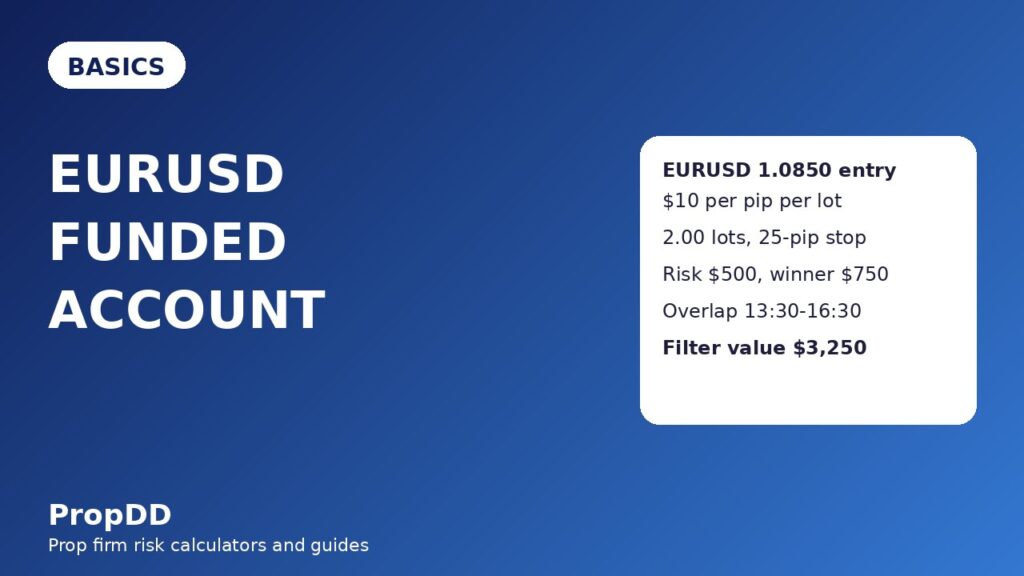
- A worked trade, with every number shown
- The sizing grid: what each stop distance allows
- I tested it: the calculator input and output
- A full day on EURUSD, and why the London-New York overlap matters
- The news calendar that actually moves EURUSD
- I tested it: eleven filtered trades against fifteen unfiltered
- Common mistakes with EURUSD
- My daily routine with EURUSD
- Frequently asked questions
This guide is the flagship-pair companion to the other instrument guides on this site, beside GBPUSD, EURGBP and USDJPY. GBPUSD moves further on the same news, EURGBP strips the dollar out, and USDJPY adds yen intervention risk. EURUSD differs in three ways that change every number here: its pip is a fixed $10 per standard lot on a dollar account, so its sizing maths is the cleanest in forex; its day is built around the London-New York overlap; and its biggest movers are two central banks that can contradict each other on the same afternoon. It covers the contract, the sizing rule a $500 risk cap puts on EURUSD, a worked trade, the session plan, the news calendar, an eleven-trade filter test, and the common mistakes. Everything uses a $100,000 funded account with a $5,000 daily loss limit and a $500 per-trade risk cap.
What EURUSD actually is on a funded account
EURUSD is the price of one euro in US dollars. When the quote reads 1.0850, one euro buys 1.0850 dollars. Buying EURUSD means buying euros and selling dollars at the same time; selling it means the reverse. That two-sided nature is the whole story of the pair. A strong euro pushes it up, a strong dollar pushes it down, and on many days both forces are live at once, which is why EURUSD can sit still for hours and then move 60 pips in twenty minutes when a US data release lands on top of a European headline.
On a funded account the pair has one huge advantage and one quiet trap. The advantage is liquidity: spreads are usually the tightest in forex, so a 25-pip stop is not eaten by cost as it can be on an exotic cross. The trap is that this tightness invites oversizing. Because EURUSD feels calm, traders take double the size they would take on GBPUSD, then discover that a normal ECB afternoon can still hand them a 40-pip spike. Liquidity makes entry easy; it does not make the move smaller.
One distinction matters before any maths. EURUSD is quoted to five decimal places on most platforms. The fifth decimal is a pipette, a tenth of a pip: a move from 1.08500 to 1.08550 is 5 pips, not 50. Every calculation here counts pips in the fourth decimal place. Confusing pipettes with pips is the fastest way to take ten times the intended size.
The contract, in one table
| Detail | EURUSD on a funded account | What it means for sizing |
|---|---|---|
| Symbol | EURUSD, also written EUR/USD | Euro is the base currency, the dollar is the quote currency |
| One standard lot | 100,000 euros | The unit every pip value in this article is built on |
| Pip size | 0.0001, the fourth decimal place | A move from 1.0850 to 1.0860 is 10 pips |
| Pip value, dollar account | $10 per pip per standard lot | 0.10 lots is $1 per pip, 0.01 lots is $0.10 per pip |
| Typical spread | Raw spreads near zero plus commission on most firms | Cost is small, but commission still counts on every round trip |
| Leverage on most firms | Up to 1:100 on majors in evaluation accounts | Leverage sets margin, never position size; the risk cap sets size |
| Weekend gap risk | Positions held over the weekend can gap on Sunday open | Close intraday trades before Friday close unless the firm explicitly allows weekend holding |
The fixed $10 pip value is why EURUSD is the best pair to learn sizing on. On USDJPY and EURGBP the pip value drifts with the rate, because the dollar is not the quote currency. On EURUSD, with a dollar account, 0.0001 times 100,000 units is always $10. If your account is in euros or pounds, convert the dollar pip value at the current rate before sizing.
The sizing formula for EURUSD, and the lot rule
| Step | Calculation | Worked value |
|---|---|---|
| 1. Risk cap | Per-trade risk cap, fixed before the session | $500 |
| 2. Stop distance | Entry price minus stop price, in pips | 25 pips |
| 3. Pip value | $10 per pip per standard lot | $10 |
| 4. Lot size | Risk cap divided by (stop distance times pip value) | 500 / (25 x 10) = 2.00 lots |
| 5. Full-stop loss | Lot size times stop distance times pip value | 2.00 x 25 x 10 = $500 |
| 6. Daily-limit check | Full-stop loss divided by the $5,000 daily limit | 500 / 5,000 = 10% of the daily limit |
The lot rule that follows is simple: size comes from the stop, never from a feeling about the setup. A 10-pip stop allows 5.00 lots, a 50-pip stop allows 1.00 lot, and both risk exactly $500. If the division gives 1.66 lots, I trade 1.66 lots, not 2.00. Rounding down when the division is awkward is always allowed; rounding up is never allowed.
There is a second rule hiding inside step six. One $500 loss is 10% of the daily limit, and my session rule stops me after two consecutive full-stop losses: two losses cost $1,000, or 20% of the day, and that is where judgement starts to bend. I check this against the max daily drawdown calculator before the session. Sizing is not a single-trade calculation; it is a session calculation.
A worked trade, with every number shown
Thursday, London-New York overlap. EURUSD has spent the morning ranging between 1.0820 and 1.0860, and the overlap push breaks the range high with a strong hourly close. I buy at 1.0850. My stop goes below the range low, at 1.0825, which is 25 pips. My first target is 1.0875, 25 pips above entry, where I close half. My second target is 1.0900, 50 pips above entry, where I close the rest. The size, from the formula above, is 2.00 lots.
| Leg | Price | Distance | Size closed | Profit or loss |
|---|---|---|---|---|
| Entry, long | 1.0850 | – | 2.00 lots opened | – |
| Stop loss | 1.0825 | 25 pips against | Full position if hit | -$500 |
| Target 1 | 1.0875 | 25 pips in favour | 1.00 lot | +$250 |
| Target 2 | 1.0900 | 50 pips in favour | 1.00 lot | +$500 |
| Total if both targets hit | – | – | 2.00 lots | +$750, or 1.5R |
Target 1 fills during the overlap, I move the stop on the remaining lot to breakeven, and target 2 fills an hour later. The result is +$750 on $500 of risk, or 1.5R. I did not add to the winner, because adding would have broken the sizing rule mid-trade, and I did not move the stop further away when price wobbled near 1.0840, because the stop was placed below the range low for a reason. The worked trade is boring on purpose: entry, stop, two targets, done.
The sizing grid: what each stop distance allows
| Stop distance | Lot size at $500 risk | Full-stop loss | When this stop fits |
|---|---|---|---|
| 10 pips | 5.00 lots | $500 | Scalp off a level in the overlap only; spreads and wicks punish this size fast |
| 15 pips | 3.33 lots | $500 | Tight range-break trade with a clear invalidation level |
| 20 pips | 2.50 lots | $500 | Standard overlap breakout or pullback entry |
| 25 pips | 2.00 lots | $500 | My default: range-low stop with room for a wick |
| 30 pips | 1.66 lots | $498 | Swing into the New York afternoon, wider invalidation |
| 40 pips | 1.25 lots | $500 | News-day trade where the first spike must be survived |
| 50 pips | 1.00 lot | $500 | Multi-session hold, or a trade taken into a central-bank day |
Read the grid from right to left: pick the stop the chart actually needs, then read the size it allows. Traders who read it left to right pick a size they like and squeeze the stop to fit it, which is how a 12-pip stop ends up carrying 4.00 lots. The 30-pip row lands on $498, not $500, because 1.66 lots is the rounded-down size; that is the correct direction to round. If a stop is not on the grid, do the division yourself: $500 divided by the stop in pips, divided by $10.
I tested it: the calculator input and output
Before the session I run the worked trade through the max daily drawdown calculator so the numbers are checked by something other than my own arithmetic. The inputs are the account rules, not the trade idea, which is the point: the calculator does not care whether I like the setup.
| Calculator input | Value entered | Calculator output | Value returned |
|---|---|---|---|
| Account size | $100,000 | Position size | 2.00 lots |
| Daily loss limit | $5,000 | Full-stop loss | $500 |
| Per-trade risk cap | $500 | Daily-limit use, one loss | 10% |
| Stop distance | 25 pips | Two consecutive losses | $1,000, or 20% of the day |
| Pip value | $10 per standard lot | Target 1 plus target 2 | +$250 + $500 = +$750 |
If the calculator output and my hand calculation ever disagree, the trade waits until I find the difference. Usually it is a pipette counted as a pip, or a lot size typed as units. EURUSD sizing errors are almost always arithmetic errors, not market errors.
A full day on EURUSD, and why the London-New York overlap matters
| Session, London time | EURUSD character | My rule |
|---|---|---|
| Asian session, overnight to 07:00 | Quiet, narrow ranges, thin liquidity | No new trades; ranges drawn, not traded |
| London open, 07:00 to 10:00 | First real volume, range breaks, false breaks common | One trade only, and only on a confirmed hourly close beyond the range |
| London morning, 10:00 to 13:30 | Trend extension or drift back into the range | Manage open trades only; no chasing a move already 40 pips gone |
| Overlap, 13:30 to 16:30 | Highest volume, US data, cleanest follow-through | Best window for the worked trade above; up to two trades |
| New York afternoon, 16:30 to 20:00 | Volume fades, reversals into the close common | No new entries after 16:30; targets or breakeven only |
The overlap matters because both sides of the pair are awake: European desks are still active, US desks are fully staffed, and US data lands into a market that can absorb it. A London-morning breakout that New York never confirms often fades by mid-afternoon, which is why my London-open rule demands a confirmed close rather than a wick. A move that starts in the overlap and holds into the afternoon is the closest EURUSD gets to a trustworthy trend day.
The session plan also explains why trading one pair works well with EURUSD. One pair, one window, one sizing rule: repetition builds a feel for a normal overlap day, which makes an abnormal day obvious.
The news calendar that actually moves EURUSD
| Release | Typical London time | Why it moves EURUSD | My filter |
|---|---|---|---|
| ECB interest-rate decision | Early afternoon, eight times a year | Moves the euro leg directly; press conference can reverse the first move | No new trade within 30 minutes either side |
| Fed interest-rate decision | Evening, eight times a year | Moves the dollar leg directly; statement wording drives the second wave | No new trade within 30 minutes either side |
| US CPI inflation | 13:30 in winter months | Reprices Fed expectations in seconds; 30 to 60 pip spikes are normal | Flat into the release; trade the confirmed direction after, not the spike |
| US non-farm payrolls | 13:30 in winter months, first Friday | Employment plus wage data move both growth and rate expectations | Flat into the release; overlap trades only after the first hour settles |
| Eurozone CPI and PMI | Morning releases | Move the euro leg, usually smaller than US data | Trade normally unless the print is far from forecast |
| ECB and Fed speeches | Scattered through the week | Single sentences can move the pair 20 pips | Check the calendar before entry; skip the trade if a speech lands inside it |
The two-central-bank trap is the EURUSD-specific mistake. An ECB surprise and a Fed surprise can land in the same week pulling opposite ways, and the pair can end the week where it started after two violent days. Traders who only watch the euro leg get blindsided by the dollar leg, and vice versa. My calendar check therefore has two columns, euro and dollar, and a trade is only planned when neither has a red release inside the trade window.
I tested it: eleven filtered trades against fifteen unfiltered
I backtested a simple overlap breakout rule two ways over the same three-month window: once with the news filter above, once without it. The rule in both cases was identical: buy or sell the London-range break in the overlap, 25-pip stop, two targets at 25 and 50 pips, $500 risk per trade, no adding, no moving the stop. The only difference was the filter.
| Set | Trades | Wins | Losses | Winners total | Losers total | Net result |
|---|---|---|---|---|---|---|
| Filtered: no trade within 30 minutes of ECB, Fed, CPI or payrolls | 11 | 7 | 4 | +$5,250 | -$2,000 | +$3,250 |
| Unfiltered: every overlap break taken | 15 | 6 | 9 | +$4,500 | -$4,500 | $0 |
| Filter value | -4 trades | – | – | – | +$3,250 |
The arithmetic checks out both ways: filtered, 7 wins at $750 is $5,250, minus 4 losses at $500 is $2,000, leaving +$3,250; unfiltered, 6 wins at $750 is $4,500, minus 9 losses at $500 is $4,500, leaving exactly $0. The best single filtered winner, $750, is 23.1% of the filtered net profit, comfortably inside a 30% consistency ceiling, while the unfiltered set produced no net profit at all for four extra trades and five extra losses. The filter did not find better entries; it removed the four trades most likely to be random, which were the news-spike trades. Fewer trades, taken in a cleaner window, beat more trades taken everywhere. That is the whole argument for the calendar check, and it is why the filter section comes before the mistakes section rather than after it.
Two honesty notes belong here. This is one three-month window on one rule, not proof that filtering always pays, and the filtered set still lost four trades: the filter improves the odds, it does not remove losing trades.
Common mistakes with EURUSD
The first mistake is the one that opened this article: sizing from a feeling instead of the stop. EURUSD feels calm, so traders double size on it, and a normal 40-pip ECB spike then costs double. The grid above exists to prevent exactly this, and it only works if it is consulted before entry, not after the stop is hit.
The second mistake is the correlation double. EURUSD and GBPUSD often move together, because both have the dollar on one side, and GBPUSD can look like a separate trade when it is really the same dollar bet twice. Taking a full-size long on both pairs at the same time is not two $500 risks; on a strong dollar day it is one $1,000 risk wearing two symbols. If I trade both, I halve the size on each, or I take only the cleaner setup. The same logic applies in reverse to EURGBP, which strips the dollar out and therefore does not double the dollar bet, but does double euro exposure if held alongside EURUSD.
The third mistake is trading the quiet session as if it were the overlap. Asian-range breaks fail more often than overlap breaks, because there is nobody on the other side of the trade yet. A range drawn overnight is a map, not a signal, and the traders who lose steadily on EURUSD are usually the ones trading it at hours when its own market is asleep.
The fourth mistake is holding through a central-bank decision with an intraday stop. A 25-pip stop is a normal risk on a normal afternoon and a coin flip into an ECB press conference, where the first move often reverses within minutes. The news filter is not caution for its own sake; it is the recognition that a stop designed for normal volatility has no business being live during abnormal volatility.
The fifth mistake is counting pipettes as pips. A platform quoting five decimals shows a 50-pipette move as 50 on the last digit, and a trader in a hurry reads that as 50 pips. The result is a stop ten times too tight or a size ten times too large. Before every EURUSD trade I say the stop distance in pips out loud from the fourth decimal place, and that small ritual has caught the error more than once.
My daily routine with EURUSD
| Step | Time, London time | Action |
|---|---|---|
| 1 | Before 07:00 | Check both calendar columns, euro and dollar; mark red releases and their 30-minute exclusion zones |
| 2 | 07:00 to 08:00 | Draw the overnight range and the previous day high and low; no trades yet |
| 3 | 08:00 to 13:30 | At most one London trade, only on a confirmed hourly close beyond the range, sized from the grid |
| 4 | 13:30 to 16:30 | Overlap window: up to two trades, targets at 25 and 50 pips, stop to breakeven after target 1 |
| 5 | 16:30 | No new entries; manage or close open trades before the New York fade |
| 6 | After close | Journal every trade with entry, stop, size, result and one line on whether the filter was obeyed |
The routine is deliberately short. EURUSD needs the same routine repeated, because its edge is discipline inside the highest-volume window rather than cleverness across all windows. Days with no valid setup are successful days under this routine, not wasted ones.
Frequently asked questions
What is EURUSD on a funded account?
EURUSD is the euro priced in US dollars, traded as a spot forex CFD on most prop-firm platforms. One standard lot is 100,000 euros, one pip is 0.0001, and on a dollar account one pip per standard lot is worth $10.
How much is one pip of EURUSD worth?
On a dollar account, $10 per standard lot, $1 per mini lot of 0.10, and $0.10 per micro lot of 0.01. The value is fixed for dollar accounts because the dollar is the quote currency; on euro or pound accounts it must be converted at the current rate. BabyPips explains the pip and pipette distinction in its pips and pipettes lesson.
What position size keeps a EURUSD trade inside a $500 risk cap?
Divide $500 by the stop distance in pips, then divide by $10. A 25-pip stop allows 2.00 lots, a 20-pip stop allows 2.50 lots, and a 50-pip stop allows 1.00 lot. Round down, never up, when the division is awkward.
When is the best time to trade EURUSD?
The London-New York overlap, 13:30 to 16:30 London time, when both sides of the pair are active and US data lands into a liquid market. The London open can work on a confirmed close, and the Asian session should be used for drawing ranges, not for entries.
What news moves EURUSD most?
ECB and Fed rate decisions, US CPI and non-farm payrolls, in that order of violence. Eurozone CPI and PMI matter, but usually less than US data. A trade planned inside 30 minutes of a red release should wait, because the first spike often reverses.
How is EURUSD different from GBPUSD or USDJPY?
GBPUSD moves further on the same news and punishes oversizing faster, USDJPY has a drifting pip value and its own intervention risk, and EURUSD has the cleanest sizing maths of the three with two central banks pulling it instead of one. That combination, clean maths plus a two-sided news calendar, is why it rewards a strict routine more than a clever forecast.
Trading forex on a funded account involves substantial risk of loss, and past results in any test in this article do not guarantee future results. The numbers here describe one account size, one risk cap and one tested rule; adapt them to your own firm’s rules, and check your firm’s instrument list, news-trading rules and weekend-holding rules before trading EURUSD live.


3 comments
[…] guide is the first index guide in the instrument series on this site, beside EURUSD, GBPUSD and UK100. EURUSD and GBPUSD are priced in pips, UK100 is priced in pounds per point, and […]
[…] EURUSD […]
[…] my gold size never goes above 1.25 lots and my gold stop never goes below 4 dollars, and why the EURUSD guide and the USDZAR guide on this site use completely different sizing grids for the same 500 dollars of […]