My first USDBRL trade cost me 854 dollars on a 500-dollar risk. Not because the idea was wrong. The pair went my way for an hour, then came back and stopped me out for the full 500. The extra 354 was friction I had never priced: a 10-pip spread and a 7-dollar-per-lot commission, multiplied across 11.02 lots I had no business trading. I had sized the trade the way I size EURUSD, with a tight 25-pip stop, and the maths punished me for it. USDBRL is not a major with a different name. It is an exotic with a small pip value, a wide spread, a per-lot commission and a central bank rate of 13.75 percent sitting behind every candle.
In this article
- The 11-lot click that taught me the commission maths
- What USDBRL actually is on a funded account
- The pip value: one lot, one pip, 1.81 dollars
- The sizing grid: every stop from 25 to 100 pips
- The commission trap: a third of your risk is gone before the trade moves
- The Selic carry: 13.75 against 3.88, and why I never hold longs overnight
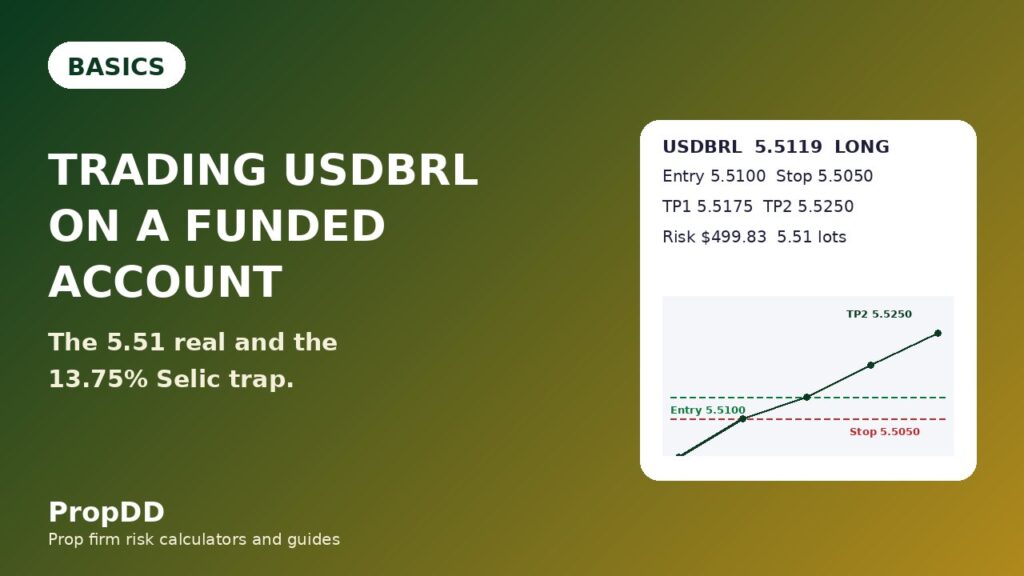
- My worked trade: long at 5.5100 into the six-month high
- The Copom filter: twelve trades, four skipped, 2,000 dollars saved
- USDBRL against its exotic neighbours
- My daily USDBRL routine
- Frequently asked questions
This guide covers it on a 100,000 dollar funded account: 5,000 dollar daily loss limit, 10,000 dollar maximum drawdown, 500 dollar risk per trade, and the Funded Trading Plus conditions I actually checked before writing — USDBRL listed, forex leverage 1:30 on the one-step account, 7 dollars commission per standard lot. One warning first: not every firm lists this pair. Velotrade’s published 39-pair forex list has no USDBRL on it at all. Check availability on your own firm before you size anything, because a sizing grid for a pair you cannot trade is a fantasy.
The 11-lot click that taught me the commission maths
It was a Tuesday morning in late October. USDBRL was drifting near 5.4620 and I wanted a long with a 25-pip stop, the same stop I use on EURUSD pullbacks. My EURUSD habit said 25 pips at 500 dollars risk means roughly 2 lots. On USDBRL the pip is worth 1.81 dollars per lot, not 10, so the same 500 dollars needed 11.02 lots. I clicked buy anyway. The platform filled me, and the position line showed a red number before price had moved at all: 10 pips of spread across 11.02 lots is 199.94 dollars, and the round-trip commission at 7 dollars a lot per side is 154.28 dollars. Together, 354.22 dollars — 70.8 percent of my risk — was gone in the first second of the trade.
The trade then did what trades do and stopped me out. The account lost 500 dollars of risk plus 354.22 of friction, 854.22 in total, on a setup I had rated as a normal half-percent risk. The lesson was not that USDBRL is untradeable. It was that tight stops are unaffordable here: the narrower the stop, the more lots you need, and the more lots you need, the more commission and spread you pay per dollar of risk. Everything in this guide follows from that one fact. Wider stops, fewer lots, and a hard rule that the friction on any trade must stay under a quarter of the risk.
What USDBRL actually is on a funded account
USDBRL is the US dollar against the Brazilian real. One standard lot is 100,000 dollars of base currency, one pip is 0.0001, and the quote on 9 November 2026 is 5.5119 — the highest print of the past six months, after a week that ran from 5.4316 on 5 November to 5.5119 on 6 November, an 803-pip swing in two days. The pair trades above its 8, 21, 50 and 100-day moving averages, so the trend I am trading into is up, not sideways. Brazil is Latin America’s largest prop-trading market, and the payout maths is part of the appeal: a 5,000 dollar payout converts to roughly 27,559 real at the current rate, which is why Brazilian traders put up with this pair’s costs — FXIFY’s guide to the top prop firms for Brazilian traders puts the same point in payout terms, with local-bank and PIX routes under 1 percent.
| Fact | USDBRL on a funded account |
|---|---|
| Pair | USD/BRL — US dollar vs Brazilian real |
| Quote, 9 Nov 2026 | 5.5119 (Finnhub/Wise); 6-month high, week range 5.4316–5.5119 |
| Standard lot | 100,000 units of USD |
| One pip | 0.0001; worth 1.81 dollars per lot at 5.5119 |
| Leverage (Funded Trading Plus) | 1:30 one-step, 1:50 two-step; commission 7 dollars per lot |
| Availability warning | Velotrade’s 39-pair list has no USDBRL — check your firm first |
| Session | London open for liquidity; New York morning for the Brazilian session overlap |
| Drivers | Copom/Selic decisions, Brazilian CPI, iron ore and soy exports, US dollar direction |
| Account frame | 100,000 dollars; 5,000 daily loss limit; 500 risk per trade |
The drivers matter more here than on a major. A Copom decision can move this pair 300 pips while you are asleep, and Brazilian CPI prints land in the New York morning when London liquidity is already thinning. I trade it only in the London open and the New York morning, never in the dead hours, and never into a Copom decision. The pair is available 24 hours a day, five days a week, on the firms that list it, but availability is not the same as tradeability, and the hours I skip are the hours that cost the most.
The pip value: one lot, one pip, 1.81 dollars
The whole sizing problem is one division. A 0.0001 move on 100,000 units is 10 real. Ten real divided by the quote 5.5119 is 1.81 dollars. That is the pip value, and it is small enough to change every decision downstream. On EURUSD the same lot and the same pip are worth 10 dollars, so a 50-pip stop at 500 dollars risk is 1 lot. On USDBRL it is 5.51 lots. On USDNOK, my last exotic guide, the pip was worth about 1.06 dollars and the same stop needed 9.44 lots against a 10x leverage wall that refused the trade. USDBRL has no leverage wall at 1:30 — 11.02 lots needs only 36,733 dollars of margin — but it has a commission wall instead, and the commission wall is worse because it charges you whether the trade wins or loses.
| Step | Formula | Number at 5.5119 |
|---|---|---|
| One pip in real | 100,000 x 0.0001 | 10.00 BRL |
| Pip value in dollars | 10 / 5.5119 | 1.81 dollars per lot |
| Lots for 500 dollars risk | 500 / (stop in pips x 1.8143) | 5.51 lots at a 50-pip stop |
| Margin per lot at 1:30 | 100,000 / 30 | 3,333.33 dollars |
| Commission, round trip | lots x 7 dollars x 2 sides | 77.14 dollars at 5.51 lots |
| Spread cost (10-pip budget) | 10 x 1.8143 x lots | 99.97 dollars at 5.51 lots |
Two things follow. First, the pip value moves with the quote: if USDBRL falls to 5.00, the pip is worth 2.00 dollars, and every size in this guide gets about 10 percent smaller. Recompute the pip value on the day you trade, never from memory. Second, the spread and commission are charged per lot, so they scale with size while the risk stays fixed at 500 dollars. That is why the 25-pip stop is the most expensive trade in the grid below and the 100-pip stop is the cheapest, even though both risk the same 500 dollars.
The sizing grid: every stop from 25 to 100 pips
This is the table I keep open whenever I trade the pair. Every row risks 500 dollars, every lot figure is rounded down, and the commission column is the round trip at 7 dollars a lot per side. Read the last column first: it is the reason my minimum stop on USDBRL is 50 pips.
| Stop (pips) | Lots | Risk | Margin at 1:30 | Commission round trip | Commission as % of risk |
|---|---|---|---|---|---|
| 25 | 11.02 | 499.83 | 36,733 | 154.28 | 30.9% |
| 30 | 9.18 | 499.65 | 30,600 | 128.52 | 25.7% |
| 40 | 6.88 | 499.28 | 22,933 | 96.32 | 19.3% |
| 50 | 5.51 | 499.83 | 18,367 | 77.14 | 15.4% |
| 60 | 4.59 | 499.65 | 15,300 | 64.26 | 12.9% |
| 75 | 3.67 | 499.37 | 12,233 | 51.38 | 10.3% |
| 100 | 2.75 | 498.92 | 9,167 | 38.50 | 7.7% |
All figures in dollars. Lots rounded down to two decimals; risk recomputed after rounding.
The pattern is the whole strategy. At a 25-pip stop the commission alone is 30.9 percent of the risk, before the spread has taken a cent. At 50 pips it is 15.4 percent. At 100 pips it is 7.7 percent. A trade that pays 31 percent of its risk in commission needs a 31 percent better win rate just to break even against the same setup on EURUSD. I do not take 25 or 30-pip stops on this pair at any size, and I treat 40 pips as the floor for a scalp and 50 pips as the floor for a normal trade. If the setup needs a tighter stop than the pair can afford, the setup is not a USDBRL setup.
The commission trap: a third of your risk is gone before the trade moves
Take the worked trade below and strip it to its costs. At 5.51 lots the round-trip commission is 77.14 dollars and the spread at my budgeted 10 pips is 99.97 dollars. Together that is 177.11 dollars, or 35.4 percent of the 500-dollar risk, paid before price has moved a single pip in my favour. The trade has to earn back more than a third of its risk just to reach breakeven. Compare that with the 25-pip stop from my first trade: 354.22 dollars of friction, 70.8 percent of risk, on a trade that then lost the full stop anyway.
| Cost | Worked trade (5.51 lots) | My first trade (11.02 lots) |
|---|---|---|
| Commission, round trip at 7 dollars a lot per side | 77.14 | 154.28 |
| Spread at budgeted 10 pips | 99.97 | 199.94 |
| Total friction | 177.11 | 354.22 |
| Friction as % of 500-dollar risk | 35.4% | 70.8% |
| Risk left for the market | 322.89 | 145.78 |
All figures in dollars. The 10-pip spread is my working budget for the London open, not a firm quote — check your own feed, because the spread widens hard around Copom and Brazilian CPI.
There are only three ways to beat this. Trade wider stops so the lot count falls. Trade fewer times so the commission is paid less often. Or do not trade the pair at all on days when the spread is running wide. I use all three: a 50-pip minimum stop, a maximum of two USDBRL trades a day, and no trade in the hour after a Brazilian data release. The max daily drawdown calculator is where I check the day before I trade: if the friction on the planned trade plus one full stop would take more than 15 percent of the 5,000-dollar daily limit, the trade is too expensive for the day and I wait.
The Selic carry: 13.75 against 3.88, and why I never hold longs overnight
The second trap is the carry, and it is bigger than the commission. Brazil’s central bank held the Selic rate at 13.75 percent on 4 November 2026, ending five straight quarter-point cuts from 15 percent, with inflation near 4.6 percent against a 3 percent target. The US federal funds rate sits at 3.75 to 4.00 percent, effective 3.88 percent. The gap is 9.87 percentage points, and it points the wrong way for a long: holding USDBRL long means holding dollars and shorting real, so you pay the high Brazilian rate and receive the low US rate. Every night you hold a long, the carry works against you. Shorts earn it, which is one more reason the pair trends up in spikes and bleeds down in quiet weeks — the carry pays traders to be short.
| Rate | Level | Date | What it means for USDBRL |
|---|---|---|---|
| Selic (Banco Central do Brasil) | 13.75% | Held 4 Nov 2026, after five cuts from 15% | One of the highest major-economy rates; longs pay it |
| Fed funds target | 3.75–4.00% | Held 27–28 Oct 2026; effective 3.88% | Longs receive the low US rate |
| Carry gap | 9.87 points | Selic minus effective fed funds | Shorts earn the gap; longs pay it every night |
| Brazil CPI | 4.58% year on year | September 2026 | Above the 3% target; cuts are paused, not finished |
| Next decisions | Copom 8–9 Dec; FOMC 8–9 Dec | Both in the same week | That week is a no-trade week for me |
My rule is simple and absolute: I never hold a USDBRL long overnight, and I never hold any USDBRL position through a Copom decision. Funded Trading Plus lists its current accounts as swap-free, which would blunt the carry on that firm, but I do not build a plan on a swap-free label — firms change swap terms, and the next firm on my list may charge triple swap on Wednesdays. The day-trade-only rule costs me nothing on this pair, because the moves I trade happen in the London open and the New York morning anyway. What it saves me is the slow bleed that turns a 2.25R winner into a 1.8R winner while I sleep.
My worked trade: long at 5.5100 into the six-month high
Friday 6 November. USDBRL had closed the week at its six-month high, 5.5119, above every moving average I watch, after bouncing from the 5.4316 low two days earlier. I do not chase highs blindly, but this one had a level behind it: the week low had held, the breakout candle had closed strong, and the London open was printing higher lows into the level. I bought 5.51 lots at 5.5100 with the stop at 5.5050, 50 pips, risk 499.83 dollars. The first target was 5.5175, 75 pips, where I banked half. The second was 5.5250, 150 pips, where I closed the rest. The trade returned 1,124.61 dollars, 2.25R, before costs — and the costs are the point of this guide, so they are in the table too.
| Leg | Price | Pips | Lots | Dollars | R |
|---|---|---|---|---|---|
| Entry (long) | 5.5100 | – | 5.51 | – | – |
| Stop loss | 5.5050 | 50 | 5.51 | -499.83 | -1.00R |
| TP1 (half out) | 5.5175 | +75 | 2.755 | +374.87 | +0.75R |
| TP2 (rest out) | 5.5250 | +150 | 2.755 | +749.74 | +1.50R |
| Total before costs | – | – | – | +1,124.61 | +2.25R |
| Less commission + spread | – | – | – | -177.11 | -0.35R |
| Net kept | – | – | – | +947.50 | +1.90R |
That last line is the honest one. The trade is a 2.25R winner on the chart and a 1.90R winner in the account, because 177.11 dollars of friction came off the top. It is still a good trade — 947.50 dollars is 19.0 percent of the daily loss limit earned, not risked — but it shows why I will not trade this pair on a 25-pip stop: the same winner at 11.02 lots would have kept only 770.39 dollars after 354.22 of friction, 1.54R instead of 1.90R. Same entry, same exit, worse trade, purely because of size. I checked the day against the max daily drawdown calculator before I clicked: one full stop plus friction is 676.94 dollars, 13.5 percent of the daily limit, inside my 15 percent ceiling for a single trade.
The Copom filter: twelve trades, four skipped, 2,000 dollars saved
The filter is the difference between the two columns of the log below. I trade USDBRL only when the trend, the level and the session all agree, and I never trade it on a Copom decision day or the day before one. The twelve trades in the log ran from 19 October to 6 November and returned 4,374.61 dollars, 8.75R, at a 66.7 percent win rate and 0.73R of expectancy per trade. The best single trade, the worked trade above at 1,124.61 dollars, is 25.7 percent of the net — inside the 30 percent consistency ceiling, so the run is a real run and not one lucky day dressed up as a system.
| Date | Setup | Result | Dollars |
|---|---|---|---|
| Mon 19 Oct | Pullback long 5.4620, TP1 only | +1.50R | +750.00 |
| Tue 20 Oct | Breakout long 5.4780, stopped | -1.00R | -500.00 |
| Wed 21 Oct | Range-top short 5.4900, TP1 only | +1.50R | +750.00 |
| Thu 22 Oct | Pullback long 5.4710, TP1 only | +1.50R | +750.00 |
| Fri 23 Oct | Friday fade short, stopped | -1.00R | -500.00 |
| Mon 26 Oct | London long 5.4520, TP1 only | +1.50R | +750.00 |
| Tue 27 Oct | Breakout long 5.4690, TP1 only | +1.50R | +750.00 |
| Wed 28 Oct | Post-Fed pullback long, stopped | -1.00R | -500.00 |
| Thu 29 Oct | Trend long 5.4810, TP1 only | +1.50R | +750.00 |
| Fri 30 Oct | Month-end short, stopped | -1.00R | -500.00 |
| Thu 5 Nov | Copom-eve pullback long 5.4480, TP1 only | +1.50R | +750.00 |
| Fri 6 Nov | Breakout long 5.5100, full run (worked trade) | +2.25R | +1,124.61 |
| Total (12 trades) | 8 wins, 4 losses | +8.75R | +4,374.61 |
Now the unfiltered version. Without the Copom filter I would also have taken four more trades: two on the Copom decision day itself, one pre-Copom chop trade and one gap fade the morning after. All four lost. The unfiltered log is 16 trades for 2,374.61 dollars, 4.75R, and the best trade becomes 47.4 percent of the net — over the 30 percent ceiling, which means the run fails a consistency check it otherwise passes. The filter is worth 2,000 dollars, 4R, across three weeks. That is the whole argument for skipping central bank days on an exotic: the pair moves 300 pips on a decision and the move is not tradeable, it is a coin flip with a 35 percent friction tax. My USDSEK guide and my USDNOK guide use the same filter for the same reason, and the numbers keep saying the same thing.
USDBRL against its exotic neighbours
USDBRL is the third exotic pair in this series, and the comparison is what stops me confusing one for another. USDSEK and USDNOK are quiet, low-volatility crosses with a margin wall: their pip is worth about a dollar, so the sizing problem is leverage, not commission. USDMXN and USDZAR are the closer cousins — big-pip, high-carry exotics where the costs dominate. USDBRL sits with the second group, but its Selic rate of 13.75 percent is the highest of the five, and its commission is the only one I could verify as a published per-lot figure.
| Pair | Pip value per lot | Funded leverage | Commission | Main driver | My rule |
|---|---|---|---|---|---|
| USDBRL | 1.81 dollars | 1:30 (FT+) | 7 dollars a lot | Selic 13.75%, Copom | 50-pip minimum stop; never hold longs overnight |
| USDSEK | About 1.00 dollar | 10x (Velotrade) | 0.004% of notional | Riksbank, EURSEK cross | Margin wall: 50-pip minimum stop |
| USDNOK | About 1.06 dollars | 10x (Velotrade) | 0.004% of notional | Oil link, Norges Bank | Margin wall: 50-pip minimum stop |
| USDMXN | About 0.50 dollars | 10x (Velotrade) | 0.004% of notional | Banxico, US data | Wide stops; small size |
| USDZAR | About 0.55 dollars | 10x (Velotrade) | 0.004% of notional | Gold link, SARB | Wide stops; small size |
The USDSEK and USDNOK figures are from my own earlier guides; the USDMXN and USDZAR figures are from the same series. The point of the table is not the decimals. It is that every exotic has a different trap, and the trap is never the chart pattern. On the Nordic pairs the trap is margin. On USDBRL it is commission and carry. Trade the pair you have actually priced, not the pair you wish you had.
My daily USDBRL routine
The routine is short because the pair punishes improvisation. I check the quote and recompute the pip value, I check the calendar for Copom and Brazilian CPI, I check the friction budget, and then I either take one trade or I take none. Two trades a day is the maximum, and most days it is one or zero. The personal daily stop is what ends the day: two losing trades and I am done, because two stops plus friction is already over 1,350 dollars, more than a quarter of the daily limit.
| Step | Time | What I do |
|---|---|---|
| 1 | 07:00 London | Quote check; recompute pip value (10 / quote); check Copom/CPI calendar |
| 2 | 07:15 London | Size the trade from the grid; check friction under 25% of risk |
| 3 | 08:00–11:00 London | Trade the open only; 50-pip minimum stop; TP1 at 1.5R, TP2 at 3R |
| 4 | 13:00–15:00 London | New York morning overlap only if the London trade is closed |
| 5 | 16:00 London | Close everything; no overnight holds on longs, ever |
| 6 | End of day | Log the trade; check the day against the max daily drawdown calculator |
If the spread is running above my 10-pip budget at the open, I skip the day. If Copom meets that week, I trade Monday and Tuesday only. If the pair gaps over the weekend — it can, because Brazilian politics does not keep London hours — I wait for the first hour of London to print a range before I touch it. The routine has no heroics in it. That is the point. On a pair that charges you a third of your risk to enter, the edge is not the entry. The edge is refusing the trades that cannot pay their own costs.
Frequently asked questions
Can I trade USDBRL on a funded account?
Yes, if your firm lists it. Funded Trading Plus lists USDBRL at 1:30 leverage on its one-step account with a 7-dollar-per-lot commission. Velotrade’s published 39-pair forex list does not include USDBRL, so check your own firm’s instrument list before you plan anything around the pair.
How much is one pip of USDBRL worth?
At the 5.5119 quote, one pip on one standard lot is worth 1.81 dollars: 10 real per pip divided by 5.5119. The value moves with the quote, so recompute it as 10 divided by the current price on the day you trade.
What stop size works on USDBRL?
Fifty pips is my minimum for a normal trade. At 25 pips you need 11.02 lots for 500 dollars of risk, and the commission alone is 30.9 percent of the risk. At 50 pips you need 5.51 lots and the commission is 15.4 percent. Wider stops cost less per dollar of risk on this pair.
Why not hold USDBRL longs overnight?
Because the carry works against you. The Selic rate is 13.75 percent and the US effective rate is 3.88 percent, a 9.87-point gap that a long position pays every night. Some firms list swap-free accounts, but I do not build a plan on a swap label. Day trades only, flat by the London close.
How big is the spread and commission really?
The commission is published: 7 dollars per standard lot per side at Funded Trading Plus, so 77.14 dollars round trip on the 5.51-lot worked trade. The spread is my 10-pip working budget for the London open, not a firm quote — it widens hard around Copom and Brazilian CPI, and on those days I do not trade.
Is USDBRL better than USDSEK or USDNOK for funded traders?
It is not better, it is different. The Nordic pairs have a margin wall at 10x leverage and a roughly 1-dollar pip. USDBRL has no margin wall at 1:30 but a commission wall and a 9.87-point carry gap. Pick the pair whose trap you have actually priced, and skip the rest.
Risk disclaimer: Trading on a funded account can lose the account. USDBRL is a volatile exotic pair with wide spreads, per-lot commissions and central-bank gap risk. The numbers in this guide are from 9 November 2026 and will move. Never risk more than your daily loss limit allows, and never trade a pair your firm does not list.


1 comment
[…] real is the most expensive to trade and the yuan is the most expensive to hold. My USDBRL guide paid 154.28 dollars of commission on its worked trade. USDCNH charges less commission, 53.36 […]