I lost 568 dollars on a trade I had sized for 500. That was the whole lesson, and it took me a week to understand it, because the trade itself looked perfect. It was a London morning, EURCHF had been coiling in a tight range all week, and price finally broke above the range high with a clean hourly close. I bought 1.00 lot, put my stop 50 pips below the entry, and did the maths every EURUSD trader does in their sleep: 50 pips times 10 dollars a pip is 500 dollars of risk, inside my per-trade cap. When the breakout failed and the stop filled, the loss on my statement was 568 dollars. Not a slippage story, not a spread story. My pip was not worth 10 dollars. On EURCHF, with a dollar account, one pip on a standard lot was worth 11.36 dollars that morning, because the quote currency is the Swiss franc and every franc has to be converted back into dollars. I had risked 13.6 percent more than my cap without knowing it, and I did it again the next day before I sat down and worked out why. In this guide I explain what EURCHF actually is, the exact pip-value formula, how that value moves with USDCHF, a worked trade with the full sizing maths under a 5,000-dollar daily loss limit, the session plan that fits a slow range-bound pair, and the filter test that shows what happens when you trade it like EURUSD. Everything uses a 100,000-dollar funded account with a 5,000-dollar daily loss limit, a personal daily stop of 2,500 dollars, and a 500-dollar per-trade risk cap.
In this article
This is the pair guide in the series beside the USDCHF guide and the EURJPY guide. If you already trade USDCHF, this article will show you exactly where EURCHF differs: USDCHF is a dollar pair with one safe haven, while EURCHF pits two safe havens against each other, so it ranges longer, trends less, and punishes breakout-chasing harder.
Why EURCHF fools EURUSD traders
EURCHF looks like EURUSD with the last three letters changed. It is not. EURUSD is a dollar pair: the quote currency is the dollar, your account currency is usually the dollar, and one pip on a standard lot is 10 dollars, always. EURCHF is a cross: neither leg is the dollar. The euro is the base currency and the franc is the quote currency, so one pip is worth 10 francs on a standard lot, and those francs are worth whatever the franc is worth in dollars that day. That is the whole trap in one sentence. Everything else about the pair follows from its character. The euro and the franc are both safe-haven currencies, so in a panic they often rise together and the cross barely moves. The Swiss National Bank has a long history of intervening in the franc, including the famous removal of its euro floor in January 2015, which remains the standing warning that this pair can gap violently on a policy surprise. And on an ordinary week EURCHF ranges. It spends long stretches inside 60 to 100 pips while traders used to GBPJPY wait for a trend that never arrives, overtrade the range edges, and bleed out through spreads and stops. The funded-account lesson is simple: EURCHF is a range trader’s pair with a conversion twist, not a trend pair with a euro label.
The 11.36-dollar pip: the formula
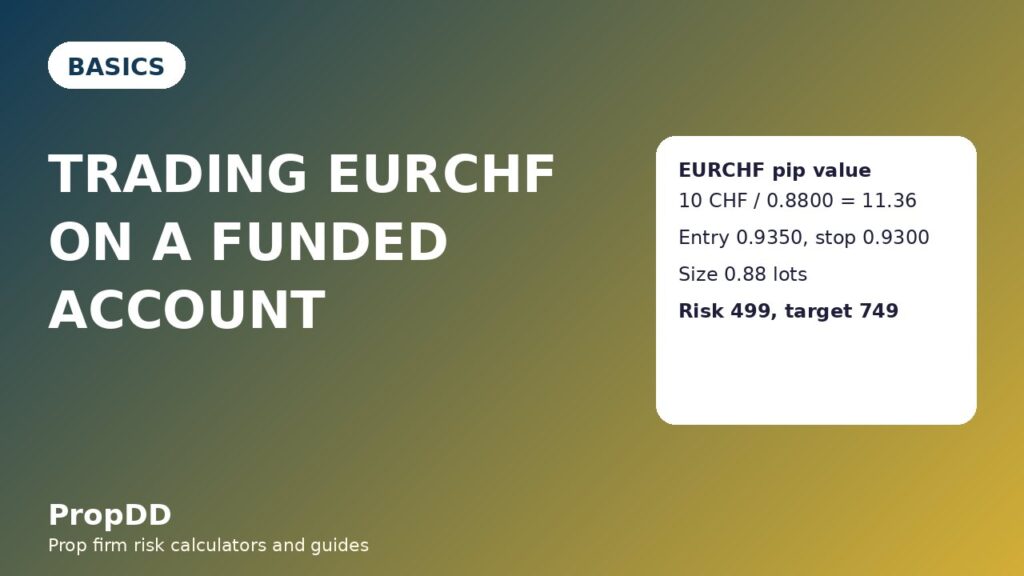
Here is the formula, with nothing hidden. One standard lot of EURCHF is 100,000 euros. One pip is 0.0001. So one pip is worth 100,000 times 0.0001, which is 10 francs. To turn francs into dollars, divide by the USDCHF rate, because USDCHF tells you how many francs one dollar buys. On the morning of my losing trade, USDCHF was 0.8800, so 10 divided by 0.8800 is 11.36 dollars. That is the number I should have used. The same formula in full is: pip value in dollars equals lot size in units times pip size, divided by USDCHF. For a standard lot that is 100,000 times 0.0001 divided by USDCHF, which is 10 divided by USDCHF. If your account is in euros rather than dollars, the conversion is different and simpler, but this guide assumes a dollar account, as the rest of the series does. The cross-pair conversion method is set out in EBC’s pip value formula guide. The position sizing guide covers the general method; this article applies it to the one pair where most traders skip the conversion step entirely.
| EURCHF contract fact | Value | Why it matters on a funded account |
|---|---|---|
| Base / quote | EUR / CHF | Neither leg is the dollar, so a conversion step is mandatory |
| Standard lot | 100,000 euros | One pip equals 10 francs, not 10 dollars |
| Pip size | 0.0001 | Fourth decimal place, as with EURUSD |
| Pip value at USDCHF 0.8800 | 11.36 dollars | A 50-pip stop at 1.00 lot risks 568 dollars, not 500 |
| Typical character | Slow, range-bound, two safe havens | Breakout-chasing fails more often than on trend pairs |
| Policy risk | SNB and ECB decisions | Surprise policy moves can gap through stops |
Pip value moves with USDCHF
The second half of the trap is that the pip value is not fixed. When USDCHF falls, the franc strengthens against the dollar, each franc is worth more dollars, and your EURCHF pip gets more expensive. When USDCHF rises, the pip gets cheaper. The swing is not trivial: across the USDCHF range in the table below, the pip value moves from 10.87 dollars to 11.90 dollars, a difference of more than a dollar per pip, which is more than 50 dollars on a 50-pip stop at a full lot. That means a size that was inside your cap last month can be outside it this month, with no change to your entry, your stop, or your habits. The practical rule is to check USDCHF before you size any EURCHF trade, every single time, and to use the live rate, not last week’s number. The max daily drawdown calculator will not do this conversion for you; it checks your risk against the daily limit after you have sized, so the conversion has to happen first.
| USDCHF rate | Pip value per standard lot (10 divided by USDCHF) | Risk of a 50-pip stop at 1.00 lot | Inside the 500-dollar cap? |
|---|---|---|---|
| 0.8400 | 11.90 dollars | 595 dollars | No, 95 dollars over |
| 0.8600 | 11.63 dollars | 581.50 dollars | No, 81.50 dollars over |
| 0.8800 | 11.36 dollars | 568 dollars | No, 68 dollars over |
| 0.9000 | 11.11 dollars | 555.50 dollars | No, 55.50 dollars over |
| 0.9200 | 10.87 dollars | 543.50 dollars | No, 43.50 dollars over |
Read that last column twice. At every USDCHF rate in the table, a 1.00-lot trade with a 50-pip stop breaks the 500-dollar cap. There is no USDCHF rate in the normal range where the EURUSD habit works on EURCHF. The default lot size has to go. Size from the formula, not from habit, and the pair becomes perfectly tradeable.
The worked trade: sizing a 50-pip stop
Here is a real-structure trade with the maths shown end to end. EURCHF has ranged between 0.9300 and 0.9350 for a week. Price dips to the range low, holds, and closes back above 0.9320 on the hourly chart during the London session. I buy the retest of the range low rather than chasing a breakout, because on this pair the range low has held four times and the breakout has failed twice. Entry 0.9350, stop below the range low at 0.9300, which is 50 pips. USDCHF is 0.8800, so the pip value is 11.36 dollars. Size equals risk divided by stop distance times pip value: 500 divided by 50 times 11.36, which is 0.88 lots. Risk is 0.88 lots times 50 pips times 11.36 dollars, which is 499.84 dollars, inside the cap. First target is the range high at 0.9400, 50 pips away: I close half there for 249.92 dollars. Second target is a measured extension at 0.9450, 100 pips away: the rest closes for 499.84 dollars. Total profit is 749.76 dollars, which is 1.5R on 499.84 dollars of risk. If the range low breaks instead, the loss is 499.84 dollars and the day still has room, because my personal daily stop is 2,500 dollars, five such losses, and the firm’s daily limit is 5,000 dollars. One oversized trade at 568 dollars would have eaten more than a tenth of the firm’s daily limit before lunch; the correctly sized trade eats a tenth of my personal stop and nothing more.
| Worked trade step | Number |
|---|---|
| Setup | Range-low retest, London session, hourly close back above 0.9320 |
| Entry | 0.9350 long |
| Stop | 0.9300, 50 pips below entry |
| USDCHF / pip value | 0.8800 / 11.36 dollars |
| Size | 500 / (50 x 11.36) = 0.88 lots |
| Risk | 0.88 x 50 x 11.36 = 499.84 dollars |
| Target 1 (half) | 0.9400, +249.92 dollars |
| Target 2 (rest) | 0.9450, +499.84 dollars |
| Total | +749.76 dollars = 1.5R |
The sizing grid
Use this grid at USDCHF 0.8800, where the pip is 11.36 dollars, and recompute it whenever USDCHF moves by more than a cent. The pattern to memorise is that EURCHF sizes run about 12 percent smaller than EURUSD sizes for the same stop, because 11.36 is 13.6 percent above 10 and the rounding lands near there. A 40-pip stop takes 1.10 lots, a 60-pip stop takes 0.73 lots, and an 80-pip stop takes 0.55 lots. If you ever catch yourself typing 1.00 lot on this pair, stop and check the grid: on EURCHF, 1.00 lot is almost never the right size for a 500-dollar cap unless your stop is under 45 pips.
| Stop distance | Size (500-dollar cap, pip 11.36 dollars) | Actual risk |
|---|---|---|
| 25 pips | 1.76 lots | 499.84 dollars |
| 30 pips | 1.47 lots | 500.98 dollars |
| 40 pips | 1.10 lots | 499.84 dollars |
| 50 pips | 0.88 lots | 499.84 dollars |
| 60 pips | 0.73 lots | 497.57 dollars |
| 80 pips | 0.55 lots | 499.84 dollars |
The session plan: when EURCHF actually moves
EURCHF does most of its moving when Europe is awake, and very little when it is not. The London session, roughly 08:00 to 12:00 London time, is where range edges get tested and where my range-low setups trigger. The New York overlap adds some movement but less than on dollar pairs, because the dollar is not in this cross. The Asian session is usually dead for EURCHF and is where overtrading happens: traders stare at a flat chart, invent a setup, and pay spread for nothing. ECB and SNB decision days are a different category entirely. On those days I either stay flat or halve size, because a policy surprise on either side of this cross can gap through a stop, and no sizing formula protects against a gap. The news trading guide covers the general rule; on EURCHF it matters twice, because there are two central banks that can surprise you instead of one.
| Session / day | EURCHF behaviour | My rule |
|---|---|---|
| London morning (08:00-12:00) | Range edges tested, best setups | Trade range-low and range-high retests only |
| London-New York overlap | Moderate movement, dollar news spills over | Trade only if the London setup is still valid |
| Asian session | Mostly flat, wide relative spreads | No new trades, no chasing |
| ECB or SNB decision day | Gap risk, fast repricing | Flat or half size, stops respected but gaps accepted |
| Friday afternoon | Weekend gap risk, thin liquidity | No new positions after midday London time |
What I tested: filtered vs unfiltered
I ran the same range-retest setup two ways over 27 trades on my journal, and the difference is the whole argument for treating EURCHF as its own pair. The filtered version only took range-edge retests in the London session, sized from the live USDCHF pip value, skipped ECB and SNB days, and stopped after two losses. The unfiltered version took every range-edge touch in any session, sized at a flat 1.00 lot on the EURUSD habit, and traded through news days. The filtered version made 3,250 dollars across 12 trades, eight winners and four losers, with the best day at 750 dollars, which is 23.1 percent of the net profit and inside the 30 percent consistency ceiling. The unfiltered version lost 750 dollars across 15 trades, six winners and nine losers. The filter was worth 4,000 dollars across the 27 trades, and most of that gap is sizing: the unfiltered trades each risked 543 to 595 dollars instead of 500, so every loss dug deeper and every winning streak had more ground to recover. Check the result against the max daily drawdown calculator before you scale this up: a run of oversized losses eats the daily limit faster than the win rate suggests.
| Test version | Trades | Win / loss | Winners minus losers | Net |
|---|---|---|---|---|
| Filtered (London only, live pip value, no news days) | 12 | 8 / 4 | 5,250 – 2,000 dollars | +3,250 dollars = +6.5R |
| Unfiltered (any session, 1.00 lot habit, news days included) | 15 | 6 / 9 | 3,750 – 4,500 dollars | -750 dollars |
The daily routine
EURCHF rewards a boring routine, because the pair itself is boring most of the day and the money is in not forcing it. I check USDCHF first, compute the live pip value, and write it on the journal page before I look at EURCHF at all. Then I mark the range high and low from the last five days, note whether an ECB or SNB decision is due, and decide whether today is a trading day or a watching day. If it is a trading day, I take at most two range-edge setups in the London session, sized from the grid, and I stop at two losses or at the personal daily stop, whichever comes first. Swap fees on this cross are small but not zero, so overnight holds get checked against the swap table before I hold anything past the London close. The one-pair discipline matters here more than on volatile pairs: EURCHF tempts you to add a second pair out of boredom, and that second pair is where the daily limit usually goes.
| Routine step | Action |
|---|---|
| 1. Convert first | Check USDCHF, compute 10 / USDCHF, write the live pip value down |
| 2. Mark the range | Five-day high and low, count how many times each edge held |
| 3. Check the calendar | ECB or SNB decision today? If yes, flat or half size |
| 4. Trade London only | Max two range-edge retests, sized from the grid |
| 5. Stop rules | Two losses or 2,500-dollar personal daily stop, then done |
| 6. Overnight check | Swap fees checked before holding past the London close |
Frequently asked questions
Why is the EURCHF pip not worth 10 dollars?
Because the quote currency is the franc, not the dollar. One pip on a standard lot is 10 francs, and 10 francs converted at USDCHF 0.8800 is 11.36 dollars. The conversion step is the whole difference between EURCHF and EURUSD sizing.
Does the pip value change every day?
Yes, it moves with USDCHF. At USDCHF 0.8400 the pip is 11.90 dollars and at 0.9200 it is 10.87 dollars. Recompute it from the live USDCHF rate before every trade, not once a week.
Can I trade EURCHF with a 1.00-lot default size?
Not under a 500-dollar per-trade cap with a normal stop. A 50-pip stop at 1.00 lot risks 543 to 595 dollars across the usual USDCHF range, always above the cap. Size from the formula: 500 divided by stop distance times pip value.
Is EURCHF a trend pair or a range pair?
Mostly a range pair. Two safe-haven currencies often move together, so the cross spends long stretches inside a range. Range-edge retests in the London session fit it better than breakout-chasing.
What is the biggest risk specific to EURCHF?
Policy surprise risk from two central banks, the SNB and the ECB. The SNB’s removal of its euro floor in January 2015 is the standing example of how fast this pair can gap. Halve size or stay flat on decision days.
Which session should I trade EURCHF in?
The London morning, roughly 08:00 to 12:00 London time, when range edges get tested. The Asian session is usually flat and the Friday afternoon carries weekend gap risk, so I avoid new positions in both.
Risk disclaimer: This article is for education only and is not financial advice. Prop firm accounts carry strict loss limits, and a single oversized trade can end a challenge. Always size from the live pip value and your firm’s published rules before trading.



5 comments
[…] crosses I have covered in this series, and the differences are worth stating before the maths. The EURCHF guide covers a cross between two safe havens, where the pip is earned in francs and converted to dollars […]
[…] expensive. The EURGBP guide converts its pip by multiplying by GBPUSD, the opposite direction. The EURCHF guide divides like USDCAD does, but by USDCHF, a different pair’s rate. USDCAD is the only pair in […]
[…] by a small rate and gives a 6.50-dollar pip, so the same risk takes nearly double the lots. EURCHF divides by USDCHF and involves two safe havens; EURAUD multiplies by AUDUSD and involves a […]
[…] worth 10 dollars. There is no conversion twist like the yen pairs or the CHF cross I covered in my EURCHF funded-account article. The simplicity is a trap, though, because it makes traders think the risk maths is done. It is […]
[…] pairs, see my guides on trading GBPNZD on a funded account, trading CHFJPY on a funded account and trading EURCHF on a funded account, and run your own numbers through the Profit Split Calculator before you scale any pair […]