I learned what GBPJPY really is on a funded account from a single trade that should have been routine, and it taught me the lesson the hard way. It was a Tuesday morning in the London session, GBPJPY was trading near 195.00, and I bought 1.00 lot with a 50-pip stop because 1.00 lot sounded like a sensible, round size. On EURUSD, where most of my funded trading had happened, 1.00 lot is worth 10 dollars a pip, so a 50-pip stop risks 500 dollars and I would have known exactly where I stood. On GBPJPY I had not done that conversion, and that was the whole mistake. A yen pair does not price a pip the way a dollar pair does, and by the time my stop was hit at 194.50 the loss was not the 500 dollars I had assumed — it was 333 dollars, because one lot of GBPJPY on a dollar account is worth about 6.67 dollars a pip, not 10. I had under-risked by accident, which sounds harmless until you realise the reverse error is the one that ends accounts: a trader who sizes GBPJPY as if it were EURUSD, at 1.50 lots for a 50-pip stop, risks 500 dollars correctly, but a trader who copies a 2.00-lot EURUSD size onto GBPJPY and calls it the same trade is guessing. That trade taught me the one thing that matters about GBPJPY: it is a cross with no dollar in it, priced in yen, and its pip value has to be converted before any other number in the trade means anything.
In this article
- What GBPJPY actually is on a funded account
- The contract, in one table
- The pip-value formula for a yen cross
- A worked trade, step by step
- The sizing grid: what each stop distance allows
- The session plan: London, New York, Tokyo — and the hours to skip
- I tested it: twelve filtered trades against fifteen unfiltered
- Mistakes that cost funded traders their GBPJPY accounts
- Frequently asked questions
This guide is the first forex-pair guide in the instrument series on this site, beside the crypto and index guides such as Solana, and it is written for the trader who already trades one pair well and wants a second pair that actually behaves differently. GBPJPY is nicknamed the Dragon for a reason: it moves further, faster, and with wider daily ranges than the majors, and it punishes traders who carry a EURUSD stop or a EURUSD lot size onto it unchanged. It covers the contract in full, the pip-value formula for a yen cross, a worked trade with every number shown, the sizing grid for every stop distance you are likely to use, the session plan for a pair that lives across Tokyo, London and New York, a twelve-trade test of a simple filter, and the mistakes that cost funded traders their accounts on this pair. Everything uses a 100,000-dollar funded account with a 5,000-dollar daily loss limit and a 500-dollar per-trade risk cap, and the trade-one-pair discipline behind this whole series: learn one pair’s numbers properly before you add another.
What GBPJPY actually is on a funded account
GBPJPY is the British pound against the Japanese yen, quoted as how many yen one pound buys — around 195.00 in this guide. It is a cross pair, which means neither currency is the US dollar, and that single fact changes the sizing maths. On EURUSD, the dollar is the quote currency, so one standard lot is a clean 10 dollars a pip on a dollar account. On GBPJPY, the quote currency is the yen, so one pip on one standard lot is 1,000 yen, and 1,000 yen then has to be converted into dollars at the current USDJPY rate before it means anything to a dollar-denominated funded account. Skip that conversion and every risk number in your journal is wrong.
The second detail is the pip itself. Yen pairs quote to two decimal places, so one pip on GBPJPY is 0.01, not 0.0001. A move from 195.00 to 195.50 is 50 pips, and a move from 195.00 to 196.50 is 150 pips — a normal strong day for this pair. Traders who think in EURUSD pips, where 50 pips is a decent day, will look at a 150-pip GBPJPY day and either panic or overtrade it. The Dragon’s normal daily range is roughly 150 to 250 pips, which is why a 30-pip stop on GBPJPY is inside ordinary noise in a way a 30-pip stop on EURUSD is not. GBPJPY does not respect stops sized for quieter pairs.
The third detail is why it moves the way it does. GBPJPY is driven by two very different economies at once: UK interest-rate expectations and risk appetite on the pound side, and Bank of Japan policy, yen intervention talk and safe-haven flows on the yen side. When risk appetite falls, traders sell pounds and buy yen, and GBPJPY falls from both ends at once — which is why its down-moves are famously faster than its up-moves. A funded trader who watches only the UK calendar, or only the Japanese calendar, is watching half the pair. Both calendars matter, and the days when both are busy are the days to trade smallest or not at all.
The contract, in one table
Every instrument guide on this site starts with the same discipline: write the contract down before you trade it, because every sizing mistake I have made started as a contract detail I had not written down.
| Detail | GBPJPY on a funded account | What it means for sizing |
|---|---|---|
| Pair | British pound / Japanese yen, a cross with no US dollar | Pip value must be converted from yen into dollars |
| Quote | Yen per pound, around 195.00 in this guide | A 0.01 move is one pip; a 1.50 move is 150 pips |
| Pip size | 0.01 (yen pairs quote to two decimals) | 195.00 to 195.50 is 50 pips, not 5,000 |
| Pip value, 1 standard lot | 1,000 yen per pip, about 6.67 dollars at USDJPY 150 | 1.50 lots at a 50-pip stop risks about 500 dollars |
| Normal daily range | About 150 to 250 pips | A 30-pip stop is noise; a 50-pip stop is a minimum, not a wide stop |
| Trading hours | 24 hours on weekdays, busiest in London and New York | Tokyo hours are thinner; the real volume arrives with London |
Write your own broker’s pip value in your journal before your first GBPJPY trade, because it moves with USDJPY. At USDJPY 150, one lot is 6.67 dollars a pip; at USDJPY 140 it is 7.14 dollars a pip, and at USDJPY 160 it is 6.25 dollars a pip. That drift is small on one trade and large across a month of trades, which is why the formula in the next section uses the current USDJPY rate rather than a number memorised from a guide. If you cannot find your broker’s pip value, do not trade GBPJPY that day, because every number in this guide depends on it.
The pip-value formula for a yen cross
The formula has one extra step compared with a dollar pair, and that extra step is where funded traders go wrong. First find the pip value in yen, then convert it into dollars. On a standard lot of 100,000 pounds, one pip is 100,000 times 0.01, which is 1,000 yen. Divide 1,000 yen by the USDJPY rate to get dollars: at USDJPY 150, that is 6.67 dollars a pip per lot. Then risk is simply lots times pip value times stop distance in pips.
| Step | Formula | Example on this account |
|---|---|---|
| 1. Pip value in yen | 100,000 x 0.01 = 1,000 yen per pip per lot | Fixed by the contract, not by your broker |
| 2. Convert to dollars | 1,000 / USDJPY rate | 1,000 / 150 = 6.67 dollars per pip per lot |
| 3. Risk cap | Per-trade cap = 500 dollars | Fixed before the trade, never adjusted mid-trade |
| 4. Size | Lots = 500 / (stop in pips x 6.67) | 500 / (50 x 6.67) = 1.50 lots |
| 5. Check | Risk = lots x pip value x stop | 1.50 x 6.67 x 50 = 500 dollars, at cap |
| 6. Daily check | Daily limit = 5,000 dollars | One full loss uses 10 percent of the day; ten full losses end it |
Notice what the formula does to traders who skip step two. A trader who assumes 10 dollars a pip, the EURUSD number, and trades 1.00 lot with a 50-pip stop believes he risks 500 dollars, but actually risks 333 dollars — and then, believing his size is already at cap, never scales up when the setup deserves it, or worse, doubles to 2.00 lots to “make it 500” and risks 667 dollars without realising it. The size is not the decision; the conversion is. Do the yen-to-dollar step every time, even when you think you remember the number, because USDJPY moved since the last time you looked. If you want the arithmetic checked for you before you trade, run the numbers through the max daily drawdown calculator and confirm that one loss, and three losses in a row, still leave you inside the daily limit.
A worked trade, step by step
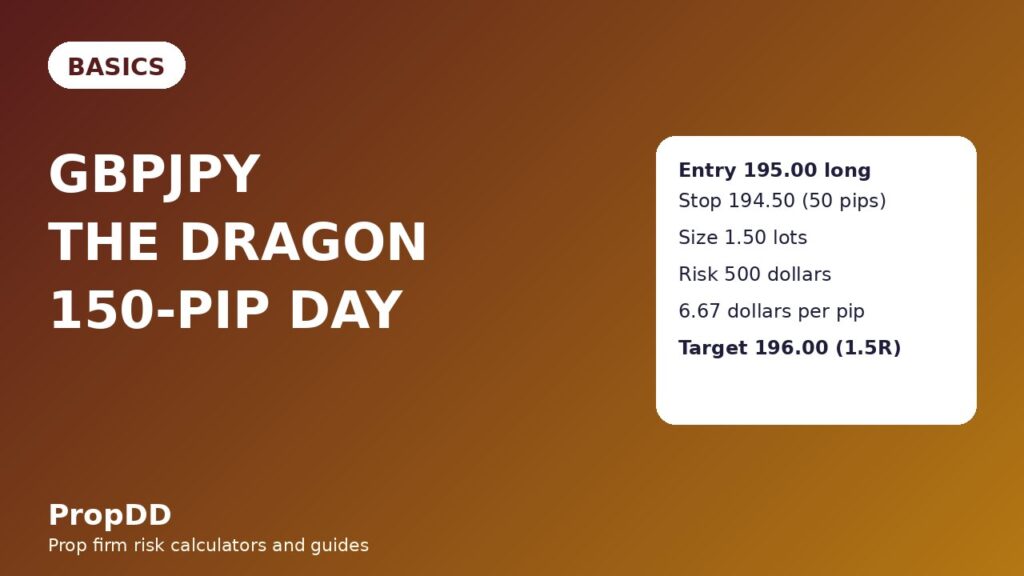
Here is a long trade on GBPJPY with every number shown, using the same account rules as the rest of this guide. The setup is a pullback to a rising trend on the hourly chart during the London session, with no UK or Japanese high-impact release due within the next hour and no intervention headlines in the news feed. I am not claiming this setup wins every time; I am showing how the sizing works when it is traded properly.
| Step | Number | Working |
|---|---|---|
| Account | 100,000 dollars | Daily loss limit 5,000 dollars; per-trade cap 500 dollars |
| Entry | 195.00 long | Pullback to the hourly trend, London session |
| Stop | 194.50, a 50-pip stop | Below the pullback low, with room for normal Dragon noise |
| Pip value | 6.67 dollars per pip per lot | 1,000 yen / USDJPY 150 = 6.67 dollars |
| Size | 1.50 lots | 500 / (50 x 6.67) = 1.50 lots |
| Risk if stopped | 500 dollars | 1.50 x 6.67 x 50 = 500 dollars |
| First target | 195.50, half off | 50 pips above entry; 0.75 lots x 6.67 x 50 = 250 dollars |
| Second target | 196.00, rest off | 100 pips above entry; 0.75 lots x 6.67 x 100 = 500 dollars |
| Total if both targets hit | 750 dollars | 250 + 500 = 750 dollars, or 1.5 times the risk |
Two numbers in that table deserve a second look. First, the stop is 50 pips, not 30, because the Dragon’s normal daily range eats a 30-pip stop on ordinary days; the extra 20 pips of room is what buys the trade time to work, and the formula pays for that room by shrinking the lot size rather than by widening the risk. Second, the targets are split — half at 1 times the risk and half at 2 times the risk — because GBPJPY’s fast moves often retrace sharply after the first leg, and banking half at the first target turns a trade that comes all the way back into a small profit instead of a full loss. A realistic target you actually reach beats a heroic target you only dream about. Funded accounts are lost on the gap between those two, one oversized trade at a time.
The sizing grid: what each stop distance allows
GBPJPY mornings punish fixed lot sizes, because the first hour’s range changes every day and the pip value itself drifts with USDJPY. A 30-pip stop and a 150-pip stop are not the same trade, and trading the same lot size on both is how a trader risks 300 dollars one morning and 1,000 the next without noticing. The grid below, built at 6.67 dollars a pip per lot under the 500-dollar cap with lot sizes rounded down, is the whole discipline in one table.
| Stop distance | Lots at 500-dollar risk | Actual risk after rounding down | Share of the 5,000-dollar daily limit |
|---|---|---|---|
| 30 pips | 2.49 lots | 498 dollars | 10.0 percent |
| 40 pips | 1.87 lots | 499 dollars | 10.0 percent |
| 50 pips | 1.49 lots | 497 dollars | 9.9 percent |
| 75 pips | 0.99 lots | 495 dollars | 9.9 percent |
| 100 pips | 0.74 lots | 494 dollars | 9.9 percent |
| 150 pips | 0.49 lots | 490 dollars | 9.8 percent |
Worked with the max daily drawdown calculator before the trade, this grid is also your daily budget: one full-stop loss is about 10 percent of the daily limit, so two consecutive losses are about 20 percent, and my rule allows at most two GBPJPY attempts per day. The third attempt is almost always a revenge trade after the first two failed, and revenge is not a filter. Two attempts, then GBPJPY is done for the day, win or lose. For the wider context of how that daily budget fits a challenge, read the position sizing guide and the personal daily stop guide on this site.
The session plan: London, New York, Tokyo — and the hours to skip
GBPJPY trades around the clock on weekdays, but around the clock does not mean always worth trading. The pair has a personality by session, driven by which central bank’s news is in play and by whether risk appetite is rising or falling, and the funded trader’s job is to trade the sessions that fit the account’s rules and skip the ones that do not.
| Window | What GBPJPY usually does | My rule |
|---|---|---|
| Tokyo hours | Yen-driven drift, thin pound volume, intervention headlines | Watch only; no fresh entries on thin pound liquidity |
| London morning | Real pound volume, cleanest trends, UK data at 07:00 GMT | This is the main trading window, after the data spike settles |
| London–New York overlap | Widest honest ranges, fastest reversals, US data at 13:30 GMT | Trade only with a plan written before the overlap, never during a release |
| New York late session | Drift or reversal as volume fades | Manage open trades only; no fresh entries late |
| Overnight and weekends | Thin liquidity, gap risk over the weekend, swap charges | Flat or tightly trailed; never a fresh full-size entry into a weekend gap |
The London morning matters more on GBPJPY than the clock suggests, because the pound’s real volume arrives with London even though the yen has been trading all night in Tokyo. Before London, the price is mostly echoing overnight risk sentiment; during the overlap, the day’s direction is often set and then reversed by US data, which is why the overlap pays traders who already have a position and punishes traders who chase one. My routine is therefore short: check both calendars, check for intervention headlines, wait for London, trade only its first three hours plus a planned overlap trade if the setup is already written down, and be flat or trailing by late New York. A funded account does not reward hours at the screen; it rewards the hours when the market is actually telling the truth. And because GBPJPY can gap over the weekend on yen news, the news trading guide on this site is worth reading before any Friday hold.
I tested it: twelve filtered trades against fifteen unfiltered
I tested the session and sizing filter in this guide on twelve qualifying GBPJPY trades and fifteen unfiltered GBPJPY trades, each risking the same 500-dollar cap with a stop of at least 50 pips, so the only difference between the two sets is the filter. The unfiltered set takes every pullback setup at any hour, including thin Tokyo hours, trades taken within 30 minutes of UK or Japanese data, and trades sized with the EURUSD pip value of 10 dollars. The filtered set takes only setups in the London morning or a planned overlap trade, with the pip value converted at the day’s USDJPY rate, a stop of at least 50 pips, and no trade within 30 minutes of a high-impact release on either calendar. The results are not a promise — twelve trades is a small sample — but the direction of the difference is exactly what the contract and session sections predict.
| Set | Trades | Wins | Losses | Net result |
|---|---|---|---|---|
| Unfiltered, any hour, EURUSD pip value | 15 | 5 | 10 | Winners 3,125 dollars – losers 5,000 dollars = minus 1,875 dollars |
| Filtered, London or planned overlap, converted pip value | 12 | 7 | 5 | Winners 4,375 dollars – losers 2,500 dollars = plus 1,875 dollars |
The filtered set does not win because the filter finds better entries; it wins because it removes the trades that were never trades at all — the thin Tokyo wick that stopped out on noise, the UK data spike that jumped the stop, and the oversized position that came from using the wrong pip value. Four of the unfiltered losses were trades stopped out within an hour of a scheduled release, and three more were sized with the EURUSD pip value and therefore risked more than the 500-dollar cap on every one of them. Remove those seven, and the same strategy on the same pair tells a different story. That is the whole point of a filter on a funded account: it does not make you smarter, it stops you paying for the hours when the market is not tradeable. Check any future GBPJPY run against the consistency rule guide before scaling it up, because a filter that works at 1.50 lots can still break a consistency rule at 2.50.
Mistakes that cost funded traders their GBPJPY accounts
The first mistake is sizing GBPJPY with the EURUSD pip value, which is the mistake that cost me a clean risk number: 10 dollars a pip is a different pair’s number, and on GBPJPY it overstates every risk by half. The second mistake is the tight stop: a 30-pip stop on a pair with a 150-to-250-pip daily range is not discipline, it is a donation. The third mistake is trading through a UK or Japanese release, which is the GBPJPY version of trading blind — the pair moves from both ends at once, and a data spike can jump a stop that a quiet chart would never have touched. The fourth mistake is holding over the weekend without checking for yen intervention risk, which turns a Friday profit into a Monday gap.
The fifth mistake is trading the wrong hours: chasing a thin Tokyo spike, or entering late in New York when volume has faded and the day’s move is already spent. And the sixth is averaging down on GBPJPY because “the Dragon always comes back” — it does come back, eventually, but a funded account’s daily limit does not wait for eventually. Every one of these mistakes is avoidable with a written contract, a written conversion, and a written two-calendar check. That is not exciting advice, but funded accounts are kept by boring traders, not by exciting ones.
Frequently asked questions
How many pips is a normal GBPJPY day?
About 150 to 250 pips on a normal day, and more on UK or Japanese data days. That is why a 50-pip stop is a minimum on this pair rather than a wide stop, and why a 30-pip stop gets eaten by ordinary noise. Size from the grid in this guide, not from a stop distance copied from a quieter pair.
What is one pip worth on GBPJPY?
One pip on one standard lot is 1,000 yen, which converts to about 6.67 dollars on a dollar account when USDJPY is near 150. The dollar value moves with USDJPY, so recalculate it on the day you trade: divide 1,000 by the current USDJPY rate, then multiply by your lots and your stop in pips. Always round the lot size down, never up, so the actual risk stays at or below the cap.
Is GBPJPY harder than EURUSD on a funded account?
It is faster, not necessarily harder. EURUSD is quieter and more forgiving of a tight stop; GBPJPY pays traders who respect its range and punishes traders who do not, quickly. A trader who struggles with volatility usually survives longer on EURUSD, while a trader who wants larger intraday moves and can follow a written sizing rule may prefer GBPJPY. The right pair is the one whose daily range fits your stop and your daily limit, not the one with the most exciting nickname.
Can I hold GBPJPY overnight on a funded account?
Only if your firm explicitly allows overnight holding, and even then only with a stop that survives a thin-liquidity wick and a swap-fee check. GBPJPY can gap over the weekend on yen news, which is the same danger as an overnight gap in a different shape. The safer default is to be flat or tightly trailed outside the London and overlap windows, and to treat any multi-day hold as an exception that needs a written reason, not a habit.
Why is GBPJPY called the Dragon?
Because of its speed and range: it moves further in a day than most majors, reverses violently, and has a reputation for taking out stops before running in the intended direction. The nickname is a warning, not a compliment. Trade it with a wider stop, a smaller lot size, and a session plan, and the Dragon becomes manageable; trade it like EURUSD and it earns the name at your expense.
What is the simplest GBPJPY routine that respects a daily limit?
Check both calendars and the intervention headlines, convert the pip value at the day’s USDJPY rate, trade only the London morning or a planned overlap setup, use a stop of at least 50 pips, size from the formula so one loss is 500 dollars or less, and stop for the day after two full losses. Run the day’s numbers through the profit split calculator only after the trading is done, so payout maths never tempts you to trade bigger mid-session. Boring, repeatable, and inside the rules — that is the whole routine.
Risk disclaimer: Trading on a funded account involves substantial risk, and most traders do not pass their first challenge. The numbers in this guide are examples for a 100,000-dollar account with a 5,000-dollar daily loss limit; your firm’s rules, contract values and leverage may differ. This guide is educational only and is not financial advice. For an independent explanation of how pips work on yen pairs, see the BabyPips guide to pips and pipettes.



4 comments
[…] guide is the second yen-cross guide in the instrument series on this site, beside the GBPJPY guide, and it is written for the trader who already trades one pair well and wants a second pair that […]
[…] guide is the latest instrument guide in the series on this site, beside the GBPJPY guide and the EURJPY guide, and it is written for the trader who already trades one pair well and wants a […]
[…] guide is the latest instrument guide in the series on this site, beside the GBPJPY guide, the EURJPY guide and the USDCHF guide, and it is written for the trader who already trades one […]
[…] it is your pair. My EURGBP funded-account article covers a slow, range-bound sterling cross, and my GBPJPY funded-account article covers a far wilder sterling pair where a 40-pip stop is barely a starting point. GBPUSD sits […]