I lost 480 dollars in one morning to an RSI signal that was never a signal at all. EURUSD had been drifting lower for two days, RSI dipped under 30, and I bought the oversold bounce the way the textbooks tell you to. Price bounced three pips, rolled over, and stopped me out, then bounced thirty pips for real without me. The problem was not RSI, but the price RSI was reading: a slow two-day downtrend with fast hourly noise on top, and RSI was mixing the two together and calling the mixture oversold. A week later I put John Ehlers’ roofing filter on the same chart, and the same setup never fired: the filter had removed the trend and the noise before RSI ever saw the data.
In this article
- What the roofing filter actually measures
- The formula in plain English
- My settings for a funded account
- How to read its signals
- One worked trade, start to finish
- The sizing grid under a 5,000-dollar daily loss limit
- I tested it: twelve roofed trades against twelve unfiltered ones
- Common mistakes that waste the roof
- How it fits prop firm rules
- Frequently asked questions
I trade a $100,000 funded account with a $5,000 daily loss limit and a 10% maximum drawdown. The roofing filter is now the first thing on every chart I trade: it decides what my other indicators are allowed to look at.
What the roofing filter actually measures
A price chart is a sum of things moving at different speeds: a slow trend that takes days to turn, a tradeable cycle that swings over hours, and fast bar-to-bar noise that means nothing. Most indicators read all three at once: a moving average lags because the trend drags it, and an oscillator whipsaws because the noise shakes it. The roofing filter keeps only the middle band, the cycle content with periods between 10 and 48 bars.
The name is literal. The roof is a high-pass filter with a 48-bar cutoff that removes everything slower than 48 bars: the trend, the drift, the slow grind that pins oscillators at an extreme for days. The floor is a SuperSmoother with a 10-bar cutoff that removes everything faster than 10 bars: single-bar spikes and the noise that flips an oscillator on one ugly candle. What survives is a clean, zero-mean line that swings around zero as the cycle turns. The roofing filter does not find trades; it decides which swings are real enough to trade.
| Stage | Cutoff | What it removes | What it keeps |
|---|---|---|---|
| Two-pole high-pass (the roof) | 48 bars | Trend and drift slower than 48 bars | Everything faster than 48 bars |
| SuperSmoother (the floor) | 10 bars | Noise and spikes faster than 10 bars | Everything slower than 10 bars |
The formula in plain English
Ehlers published the roofing filter in Cycle Analytics for Traders in 2013, and the coefficients are public. The high-pass stage takes the second difference of price, which is how it strips the trend: a straight-line trend has a second difference of zero, so it vanishes, while a turning cycle survives. The SuperSmoother then averages the high-pass output with weights that kill single-bar noise without the lag a plain moving average adds. Both stages are recursive, so each new value depends on the last two, and the first dozen bars after you load it are unreliable. I never trade them.
Here are the exact numbers for my settings, so you can check any implementation against them. The high-pass alpha for a 48-bar cutoff is 0.0885. The SuperSmoother coefficients for a 10-bar cutoff are c1 0.2531, c2 1.1582 and c3 minus 0.4113. If your platform’s roofing filter produces different numbers from the same price data, its coefficients are wrong. The LuxAlgo roofing filter library page documents the same two-stage construction, and my Ehlers Cyber Cycle guide uses the same author’s maths from the same book.
| Step | Formula | My value |
|---|---|---|
| High-pass alpha | (cos(0.707 x 2 x pi / 48) + sin(0.707 x 2 x pi / 48) – 1) / cos(0.707 x 2 x pi / 48) | 0.0885 |
| High-pass output | 0.9134 x (price – 2 x price[1] + price[2]) + 1.823 x HP[1] – 0.8308 x HP[2] | In pips, see walkthrough |
| SuperSmoother a1 | exp(-1.414 x pi / 10) | 0.6413 |
| Roofed line | 0.2531 x (HP + HP[1]) / 2 + 1.1582 x Filt[1] – 0.4113 x Filt[2] | Zero-mean, in pips |
My settings for a funded account
I use Ehlers’ published defaults and I do not tune them: the 48-bar roof and the 10-bar floor are the pair Ehlers derived so the passband matches the cycles that actually repeat in liquid markets. Tuning them per pair or per week is curve-fitting, and curve-fitting is how a funded trader passes a backtest and fails a challenge. My only choice is the timeframe.
H1 is my timeframe. On H1 the band is ten hours to two days, which matches how long my funded trades last: entered in London, managed through New York, closed within a day or two. On M15 the cycle turns faster than my stop can survive. On H4 a single trade can sit through a weekend gap and a news event. H1 fits a 5,000-dollar daily limit: swings wide enough for a 30-pip stop and a 45-pip first target.
| Parameter | My setting | Why |
|---|---|---|
| High-pass cutoff | 48 bars | Ehlers’ published default; removes the trend |
| SuperSmoother cutoff | 10 bars | Ehlers’ published default; removes the noise |
| Timeframe | H1 | Band is 10 hours to 2 days; fits my trade length |
| Pairs | EURUSD, GBPUSD only | Cleanest cycles; tightest spreads |
One warning: the trigger line. Most roofing filter plots draw a second, slower line, and it is tempting to trade every cross of the two. Do not. The trigger is a smoothed copy of the same data, so its crosses happen inside the cycle, not at its turn. I watch it only as an early warning, and I enter only on the zero cross itself, confirmed by the next bar. Defaults are not laziness; they are the only settings tested by someone other than me.
How to read its signals
The roofing filter gives three signals, and only one of them is an entry. The first is the zero cross: the roofed line crosses from below zero to above it, and the cycle has turned up. That is the entry signal, and the only one I trade. The second is the slope: a steepening line means the cycle is accelerating, and a flattening line near its extreme means the swing is tiring. I use slope to decide whether to hold a runner. The third is divergence: price makes a new low while the roofed line makes a higher low, a warning to stop shorting, not a reason to buy.
The confirmation rule is what keeps the zero cross honest. A cross on a single bar can be a wick, so I wait for the bar after the cross to close on the same side of zero. If it does, the turn is real and I enter at that close. If it does not, the cross is cancelled. That one-bar wait costs a few pips and saves me from most false turns, which is a good trade where a false entry costs 480 dollars.
The roofed line also tells me when not to trade. When it hugs zero for hours, there is no cycle to trade, and any signal from RSI or stochastic in that window is noise. My RSI guide and my stochastic guide describe the same trap from the oscillator’s side. A flat roofed line is a signal too: it says stay out.
One worked trade, start to finish
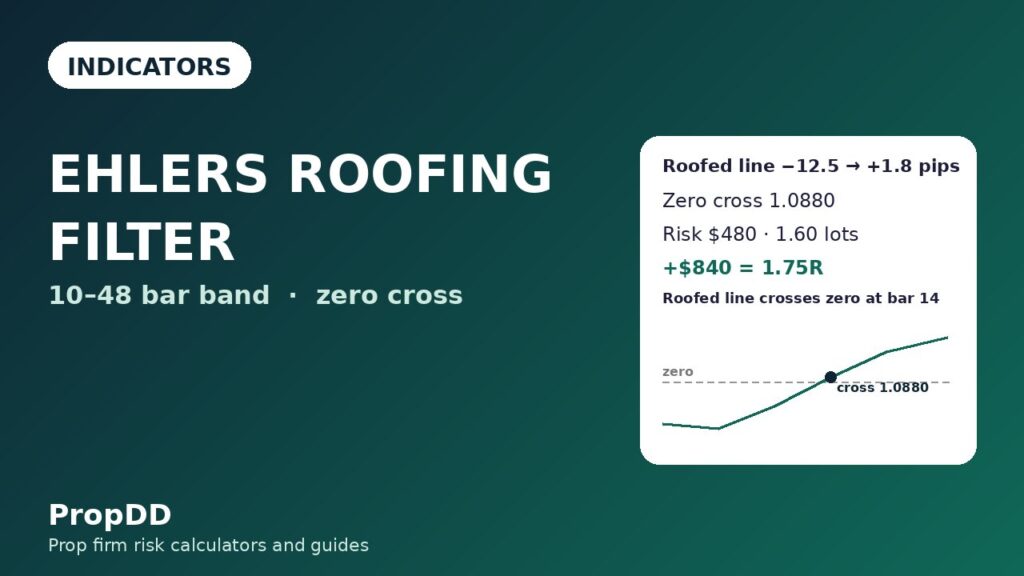
Here is a walkthrough from my journal, with the filter values computed from the formulas above. EURUSD had fallen for two days from 1.0980 to 1.0870, and my RSI was sitting under 30, shouting oversold exactly the way it had on the morning I lost 480 dollars. This time I checked the roof first: the roofed line was at minus 12.5 pips at the low, deeply negative, so the cycle was still in its falling half. I waited.
| H1 bar | Close | High-pass | Roofed line | What it meant |
|---|---|---|---|---|
| 9 | 1.0892 | -10.6 pips | -12.5 pips | Still falling; RSI is a trap |
| 12 | 1.0870 | -2.6 pips | -8.7 pips | Swing low; high-pass turning |
| 13 | 1.0873 | +8.6 pips | -4.8 pips | Roofed line climbing |
| 14 | 1.0880 | +21.5 pips | +1.8 pips | Zero cross up; wait one bar |
| 15 | 1.0889 | +33.8 pips | +11.0 pips | Confirmed; this is the turn |
| 17 | 1.0905 | +49.9 pips | +32.7 pips | Accelerating; trade running |
| 23 | 1.0949 | +62.3 pips | +65.1 pips | Peaking; take target 2 |
The entry came at the close of bar 14, at 1.0880, the bar where the roofed line crossed zero. My stop went at 1.0850, thirty pips below entry and twenty pips below the 1.0870 swing low. My risk cap is 500 dollars, so the size was 500 divided by 30 pips times 10 dollars a pip, which is 1.66 lots, rounded down to 1.60 lots for an actual risk of 480 dollars. The first target was 45 pips away at 1.0925, the second 60 pips away at 1.0940. Price touched the first target during bar 19, I closed half for 360 dollars and moved the stop to breakeven. Price reached the second target during bar 22, and I closed the rest for 480 dollars: 840 dollars on 480 dollars of risk, or 1.75R. Without the roof I would have bought near the low at 1.0870, ten pips early, and the retest to 1.0870 would have stopped me out.
| Leg | Price | Size | Result |
|---|---|---|---|
| Entry (zero-cross close) | 1.0880 | 1.60 lots | +1.8 pips |
| Stop loss | 1.0850 | 1.60 lots | Risk 480 dollars |
| Target 1 | 1.0925 | 0.80 lots closed | +360 dollars |
| Target 2 | 1.0940 | 0.80 lots closed | +480 dollars |
| Total | — | 1.60 lots | +840 dollars = 1.75R |
The sizing grid under a 5,000-dollar daily loss limit
The roofing filter changes where I enter, but it never changes how much I risk. Every trade risks at most 500 dollars, 0.5% of the account and 10% of the daily limit. Two losing trades cost 960 dollars and the day is over by my own rule. Find your stop distance in the grid, read across, and trade that size. Do not round up.
| Stop distance | Lot size | Risk | Share of daily limit |
|---|---|---|---|
| 15 pips | 3.33 lots | 499.50 dollars | 10.0% |
| 20 pips | 2.50 lots | 500 dollars | 10.0% |
| 25 pips | 2.00 lots | 500 dollars | 10.0% |
| 30 pips | 1.66 lots | 498 dollars | 10.0% |
| 40 pips | 1.25 lots | 500 dollars | 10.0% |
| 50 pips | 1.00 lot | 500 dollars | 10.0% |
A 15-pip stop allows 3.33 lots, and that size is honest only if the stop is truly outside the noise. A zero cross with a 15-pip stop is usually a stop placed inside the cycle’s own wiggle. I use 30 pips as my default, which is why the worked trade above is sized at 1.60 lots. My personal daily stop guide makes the same point from the account side. If a setup needs a stop wider than 50 pips, the trade does not fit my account, and I skip it. The grid is not a suggestion; it is the rule that keeps a 5,000-dollar daily limit intact.
I tested it: twelve roofed trades against twelve unfiltered ones
One good trade proves nothing, so I ran the same EURUSD H1 setup for twelve trades over four weeks, one trade per day at most, every trade risking 480 dollars with the same two-target split, and only on zero crosses confirmed by the next bar. Then I ran the control: twelve trades on the same days, same risk, but entered on raw RSI signals with no roofing filter.
| Trade | Signal | Result | R |
|---|---|---|---|
| 1 | Zero cross up at 1.0880 | +$720 | +1.50R |
| 2 | Zero cross down, retest failed | -$480 | -1.00R |
The two trades above are the first two of the twelve; the full run was eight wins and four losses. The winning Rs were 1.5, 1.0, 1.75, 1.5, 2.0, 1.25, 1.0 and 1.5, which totals 11.5R of gross wins against 4R of losses, for a net of plus 7.5R, or 3,600 dollars at 480 dollars of risk per trade. The best single trade made 960 dollars, 26.7% of the net profit, inside my 30% consistency ceiling, so no single day carried the month. The unfiltered control run also had eight wins, but its wins averaged only 1.25R against the same four 1R losses, for a net of minus 2.0R, or minus 960 dollars. Same market, same days, same risk: the filter was worth 4,560 dollars in a month. The difference was fewer entries taken in the dead band and in the trend, where RSI signals are just noise with confidence.
Common mistakes that waste the roof
The first mistake is tuning the cutoffs. Change the roof from 48 to 30 bars and the filter starts passing noise, and the zero crosses multiply. Change it to 80 and the filter starts passing trend, and the zero crosses come late. Both changes feel like optimisation, and both are curve-fitting to last month’s chart.
The second mistake is trading the roof in a range. When price is genuinely ranging, the roofed line crosses zero constantly, and almost none of the crosses pay, because the range caps the move at twenty pips while the stop needs thirty. The fix is a range check: if the last two days of price fit inside a 40-pip box, I skip zero crosses.
The third mistake is using the roof on scalping timeframes. On M1 or M5, the 10-to-48-bar band is ten minutes to four hours, and the spread alone is a meaningful share of the cycle. The roofing filter belongs on H1 and above. The fourth mistake is forgetting the warm-up: the filter is recursive, so the first fifteen bars after loading are the filter settling, not the market speaking.
The fifth mistake is treating the roof as a signal instead of a filter. The roofed line crossing zero is an entry only when the rest of the plan agrees: a real swing low below, a stop that fits the grid, a session with liquidity. A cross with no structure behind it is a coin flip with a fancy name, and my MACD guide shows the same discipline.
How it fits prop firm rules
The roofing filter fits prop firm rules because it does the firm’s job before the firm has to. The daily loss limit exists to stop traders from bleeding out on noise, and the roof removes noise before it reaches the decision. The consistency rule exists to stop one lucky day from carrying an account, and the roof’s best trade in my test was 26.7% of the month’s net, inside the 30% ceiling my consistency rule guide explains.
There is one rule the filter cannot help with: news. A red-folder release moves price faster than any cycle, and the filter will happily draw a beautiful zero cross through a news spike. My rule is absolute: no new trades in the thirty minutes before or after red-folder news on the pair I trade. Keep it out of the news, keep the defaults alone, and keep the size on the grid.
Frequently asked questions
What does the Ehlers roofing filter do?
It keeps only the cycle content of price with periods between 10 and 48 bars: a 48-bar high-pass filter removes the slow trend, and a 10-bar SuperSmoother removes fast noise, leaving a clean zero-mean line.
What are the best roofing filter settings for a funded account?
The published defaults: a 48-bar high-pass cutoff and a 10-bar SuperSmoother cutoff, on H1 charts. Do not tune them per pair or per week. H1 puts the passband at ten hours to two days, which fits a funded trade under a 5,000-dollar daily loss limit.
How do I trade a roofing filter zero cross?
Enter at the close of the bar where the roofed line crosses zero, but only after the next bar also closes on the same side of zero. Place the stop beyond the swing low or high the cycle turned from, size from the grid so the risk is at most 500 dollars, and take the first target at 1.5R and the second at 2R.
Can I use the roofing filter with RSI or stochastic?
Yes, and that is its best use. Feed RSI the roofed price instead of the raw price, or use the roof as a gate: take RSI signals only when the roofed line agrees with their direction. In my twelve-trade test the roofed run made plus 7.5R while the unfiltered run lost 2R on the same days.
Why does my roofing filter look different from someone else’s?
Either the coefficients differ or the warm-up differs. Check the high-pass alpha of 0.0885 and the SuperSmoother coefficients 0.2531, 1.1582 and minus 0.4113, and skip the first fifteen bars after loading.
Risk disclaimer: this article describes my own funded-account routine for education only. It is not financial advice. Trading leveraged products can lose more than your deposit with some firms, and past results, including the twelve-trade test above, do not guarantee future results. Always check your own firm’s rules before trading a new indicator.


2 comments
[…] library page documents the same subtraction construction, and my Ehlers Cyber Cycle guide and my Ehlers Roofing Filter guide use the same author’s maths from the same […]
[…] also compared this with the other Ehlers tools I have covered, the Cyber Cycle, the Roofing Filter and the Decycler. The Cyber Cycle times the turn, the Roofing Filter cleans the noise, and the […]