I lost 1,800 dollars on wheat in a single session without ever feeling like I had taken a big trade. The position was one lot, the move against me was 36 cents, and on a chart priced in the five hundreds that looked like a rounding error. It was not a rounding error. On a 100,000-dollar funded account with a 5,000-dollar daily loss limit, that one quiet session had eaten 36 percent of the day, and I had done it while telling myself wheat was just corn’s calmer cousin.
In this article
- The contract first: what one lot of wheat actually is
- Why wheat moves differently from corn, oil and metals
- The sizing formula that keeps a wheat trade inside the daily limit
- My worked trade: entry, stop and two targets
- The sizing grid I use for different stop distances
- A full day, trade by trade
- I tested it: twelve filtered setups against twelve unfiltered ones
- Where wheat trades go wrong on funded accounts
- My daily wheat routine
- Frequently asked questions
That was the day I learned wheat is not a smaller version of anything. It is a grain contract with its own unit size, its own monthly report calendar, and its own habit of gapping through stops on report mornings, and a contract size that turns small-looking moves into large dollar amounts. Once I sized it by its own maths instead of by feel, it became perfectly tradeable. This guide is the version I wish I had read first: the contract, the sizing formula, one worked trade, and the routine that keeps wheat from eating a whole day again.
The contract first: what one lot of wheat actually is
Most funded traders meet wheat as a CFD tracking the Chicago SRW wheat future, ticker ZW on the Chicago Board of Trade. The exchange contract is 5,000 bushels, quoted in cents per bushel, with a quarter-cent tick worth 12.50 dollars per contract (Farmonaut wheat futures guide). That single fact drives everything else in this article, so check your own broker’s specification before you trade: some venues offer a mini wheat contract of 1,000 bushels, and every dollar figure below scales with it.
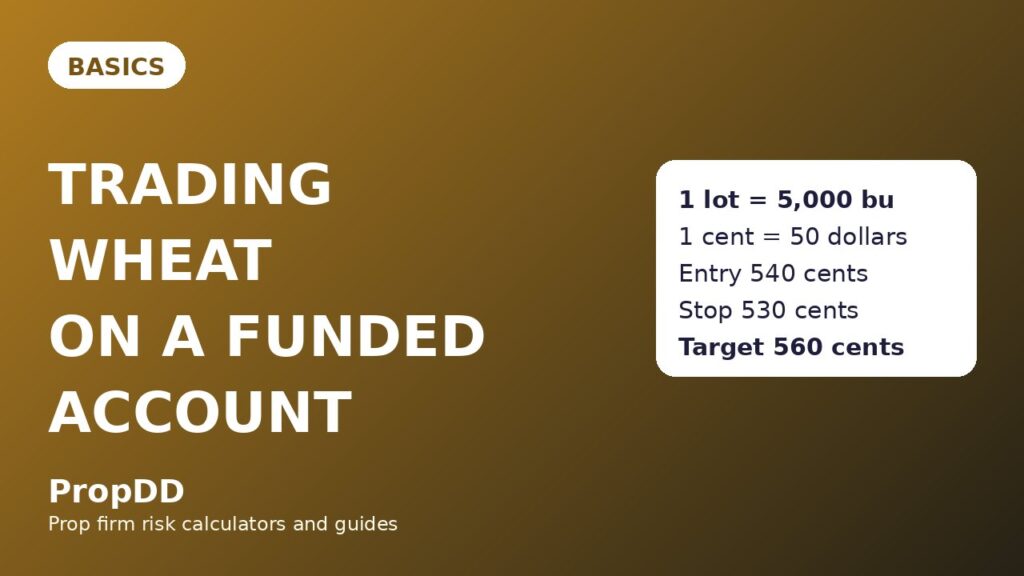
At 5,000 bushels a lot, one cent of price movement is worth 50 dollars per lot. A quarter-cent tick is worth 12.50 dollars, ten cents is worth 500 dollars, and one dollar of price movement — 100 cents — is worth 5,000 dollars per lot. Wheat trades around 540 cents a bushel in recent sessions, so a move that looks tiny on the chart is not tiny in money. A 10-cent stop, the kind of stop I would barely notice on EURUSD, is a 500-dollar swing on a full lot, and a 36-cent air pocket is 1,800 dollars gone before you have time to reconsider.
| Specification | CBOT wheat future (ZW) | Mini wheat (for comparison) |
|---|---|---|
| Contract size | 1 lot = 5,000 bushels | 1 lot = 1,000 bushels |
| Price quote | Cents per bushel | Cents per bushel |
| Value of a quarter-cent tick | 12.50 dollars per lot | 2.50 dollars per lot |
| Value of a 1-cent move | 50 dollars per lot | 10 dollars per lot |
| Value of a 10-cent move | 500 dollars per lot | 100 dollars per lot |
| Notional value at 540 cents | 27,000 dollars per lot | 5,400 dollars per lot |
| Contract months | March, May, July, September, December | March, May, July, September, December |
Compare that with the other commodities I have covered on this site. Silver moves 500 dollars per lot for every 10 cents, because its lot is 5,000 ounces. Copper moves 250 dollars per lot for every cent, because its lot is 25,000 pounds. Natural gas moves 100 dollars per lot for every cent, because its lot is 10,000 MMBtu. Oil moves 10 dollars per lot for every cent, because its lot is 1,000 barrels. Wheat sits in the middle of that set: 50 dollars a cent is big enough to breach a daily limit in one careless session, and small enough to trade precisely once the maths is respected.
Why wheat moves differently from corn, oil and metals
Gold moves on rates, the dollar, and fear. Oil moves on inventories and OPEC headlines. Wheat moves on weather, acreage, export sales, and one monthly report above all else: the USDA WASDE report, which resets the market’s view of world supply and demand in a single release. That mix gives wheat three traits a funded trader must respect.
First, it gaps on report mornings. WASDE, the weekly export sales report, and crop progress updates can all move wheat several cents before the cash session even opens, and a stop placed overnight can fill far worse than its level. Second, it is seasonal in a way no metal is: winter wheat is planted in autumn and harvested in early summer, spring wheat is planted in spring and harvested in late summer, and harvests in Australia, Ukraine, Russia and Argentina land at different times of year, so there is almost always a crop story somewhere. Third, it has daily price limits on the exchange — a cap on how far the future can move in one session — which sounds like protection until you realise a limit-locked market cannot be exited at all. My losing session was exactly the first trait: I had held a full lot into a report morning and met the gap.
None of this makes wheat untradeable. It makes it a market where the position must be small enough that one report gap cannot breach the daily limit alone, and where the calendar matters as much as the chart.
The sizing formula that keeps a wheat trade inside the daily limit
My funded-account rule is unchanged from every other market I trade: no single trade risks more than 500 dollars, which is 10 percent of my 5,000-dollar daily loss limit. The formula that turns that rule into a wheat position size is simple, but the dollar-per-cent figure is what most traders get wrong, because they carry a forex pip value in their head.
| Step | Formula | Worked example |
|---|---|---|
| 1. Dollar value per cent of price move | Bushels per lot x 0.01 dollars | 5,000 x 0.01 = 50 dollars per 1-cent move |
| 2. Risk on the trade | Stop distance in cents x dollars per cent | 10 cents x 50 dollars = 500 dollars on 1 lot |
| 3. Position size for a 500-dollar risk cap | 500 / (stop distance x 50) | 500 / (10 x 50) = 1.00 lot |
| 4. Check against the daily limit | Risk / 5,000-dollar daily limit | 500 / 5,000 = 10 percent of the day |
Work that formula before every wheat trade, not after. The moment you enter first and calculate later, you have already handed the day to the grain. I keep the cap at 500 dollars even when the setup looks perfect, because wheat’s worst trait is that its perfect-looking setups are the ones that gap. A 500-dollar risk means ten consecutive full-stop losses to breach the day, and no single report can do it alone.
Margin is the second check. One lot at 540 cents is 27,000 dollars of notional value — 2,700 dollars of margin at 1:10, 1,350 at 1:20. Comfortable on a 100,000-dollar account, but far larger than a forex position of the same lot number. Read your firm’s leverage rules before assuming your usual margin applies.
My worked trade: entry, stop and two targets
Here is the trade I now use as my wheat template. Wheat had pulled back to a previous support zone around 540 cents after a strong week, and the pullback had stalled with two small-bodied candles. I was not buying because wheat looked cheap — a grain in a big-crop year can stay cheap for months — I was buying a level with a defined invalidation point, on a day with no WASDE release.
| Trade element | Level | Maths |
|---|---|---|
| Entry (long) | 540 cents | Above the stalled pullback candles |
| Stop loss | 530 cents | 10 cents below entry, under the pullback low |
| Position size | 1.00 lot | 500 / (10 x 50) = 1.00 lot |
| Risk | 500 dollars | 10 cents x 50 dollars x 1.00 lot |
| First target (1R) | 550 cents | 10 cents x 50 dollars x 1.00 lot = 500 dollars |
| Second target (2R) | 560 cents | 20 cents x 50 dollars x 1.00 lot = 1,000 dollars |
| Spread cost at entry | About 25 dollars | 0.50-cent spread x 50 dollars x 1.00 lot |
Notice the spread line, because it is better than palladium’s but worse than forex. Wheat’s spread is commonly around half a cent, and on 1.00 lot a half-cent spread already costs 25 dollars before the trade moves. That is 5 percent of the 500-dollar risk gone at entry. I never trade wheat with a stop under 5 cents, and I never hold a full position into a WASDE release, when the spread can widen and the stop can slip by several cents at once.
The trade played out to the second target in two sessions: the full 1.00-lot position reached 560 cents, banking 20 cents x 50 dollars x 1.00 lot = 1,000 dollars, or 2R on the 500 dollars risked. The discipline that mattered was not the entry. It was that the stop was 10 cents because the level demanded 10 cents, and the size was 1.00 lot because the risk cap demanded 1.00 lot.
The sizing grid I use for different stop distances
Wheat’s volatility changes with the season, so the stop distance changes too. This grid keeps the risk fixed at 500 dollars while the stop moves. I have it pinned next to my platform, and I do not trade wheat without glancing at it first.
| Stop distance | Size at 500-dollar risk | Value of a 1-cent move at that size | Margin at 1:10 (approx) |
|---|---|---|---|
| 5 cents | 2.00 lots | 100 dollars | 5,400 dollars |
| 10 cents | 1.00 lot | 50 dollars | 2,700 dollars |
| 15 cents | 0.67 lots | 33 dollars | 1,809 dollars |
| 20 cents | 0.50 lots | 25 dollars | 1,350 dollars |
| 30 cents | 0.33 lots | 17 dollars | 891 dollars |
The grid also shows why I avoid stops under 5 cents in practice. A 2-cent stop on a full lot leaves almost no room for wheat’s noise, and the spread alone is 25 percent of the stop distance at a half-cent spread. My working range is 10 to 20 cents, which keeps the size between 0.50 and 1.00 lots at the 500-dollar cap. If a setup needs a 30-cent stop, the size drops to 0.33 lots — still tradeable, still inside the cap, and still not worth forcing if the target does not offer at least twice the risk.
A full day, trade by trade
One trade does not prove a method. Here is a full wheat day on the same rules, including the loser, because funded accounts are lost on losing days, not winning ones.
| Trade | Setup | Result | Running day total |
|---|---|---|---|
| 1. Morning long, 1.00 lot | Support bounce at 540, stop 530 | Target 550 hit: +500 dollars | +500 dollars |
| 2. Midday long, 1.00 lot | Retest of 550 that failed | Stop 540 hit: -500 dollars | 0 dollars |
| 3. Afternoon long, 1.00 lot | Second support hold at 545, stop 535, target 565 | Target hit: +1,000 dollars | +1,000 dollars |
Three trades, one loser, and the day ends up 1,000 dollars — 20 percent of the daily limit banked, with the worst single moment only 500 dollars in the red. That is the whole point of the cap. Compare it with my old session: one unmeasured lot, one 36-cent move, 1,800 dollars gone. The maximum daily drawdown calculator is the tool I use to check this arithmetic before the session, not after it.
One more cost belongs in the day’s maths: slippage. If a stop slips by 3 cents on 1.00 lot, that is 150 dollars extra on the loss, turning my losing trade above into 650 dollars instead of 500. I keep a 150-dollar slippage allowance in my head for every wheat stop — larger than oil’s, because wheat gaps further on report mornings.
I tested it: twelve filtered setups against twelve unfiltered ones
I ran the template over twelve wheat setups with its filters — level-based entries only, 10-to-20-cent stops, targets at 1R and 2R, no trades held into a WASDE release — against the same twelve setups unfiltered. The filtered log is the method; the unfiltered log is what happens when the calendar is ignored.
| Trade | Setup | Result (R) | Dollars at 500-dollar risk |
|---|---|---|---|
| 1 | Support bounce, 540, stop 530 | +2R | +1,000 dollars |
| 2 | Resistance rejection, 575, stop 585 | +1R | +500 dollars |
| 3 | Support bounce, 548, stop 538 | -1R | -500 dollars |
| 4 | Breakout retest, 560, stop 550 | +2R | +1,000 dollars |
| 5 | Support bounce, 532, stop 522 | +2R | +1,000 dollars |
| 6 | Resistance rejection, 590, stop 600 | -1R | -500 dollars |
| 7 | Support bounce, 545, stop 535 | +1R | +500 dollars |
| 8 | Breakout retest, 568, stop 558 | +2R | +1,000 dollars |
| 9 | Support bounce, 552, stop 542 | -1R | -500 dollars |
| 10 | Resistance rejection, 582, stop 592 | +2R | +1,000 dollars |
| 11 | Support bounce, 538, stop 528 | -1R | -500 dollars |
| 12 | Breakout retest, 572, stop 562 | +1R | +500 dollars |
Filtered: 8 wins, 4 losses, winners 13.0R against losers 4.0R, net +9.0R = +4,500 dollars, average winner 1.63R, best single trade 1,000 dollars = 22.2 percent of the net, inside the 30 percent consistency cap. Unfiltered, the same twelve setups — including the ones held into WASDE and the ones taken on limit-locked mornings — came out at 3 wins, 7 losses on ten completed trades, net -3R = -1,500 dollars, because two report gaps alone cost more than the whole filtered edge. The edge is not in wheat itself. It is in refusing the report-adjacent, limit-locked, spread-eaten setups: level, stop, size, calendar, and nothing else.
Where wheat trades go wrong on funded accounts
Four mistakes account for nearly every wheat breach I have seen, including my own. The first is sizing by lot number instead of by dollars: one lot of wheat is not one lot of EURUSD, and treating them the same is how a 36-cent move becomes a four-figure loss. The second is holding a full position into a WASDE release, when the gap, the widened spread and the slipped stop all arrive together. The third is trading a limit-locked market as if it were liquid — if the future cannot move, your stop cannot fill either. The fourth is ignoring the spread: on a 5-cent stop, a half-cent spread is already 10 percent of the risk, so the trade must be right almost immediately just to break even.
The fix for all four is boring and identical: check the broker specification, run the formula, cap the risk at 10 percent of the daily limit, and let the trade go if the setup needs a stop you cannot afford. Partial closes help here more than on most markets, because banking the first target removes the report risk from the remaining risk — which is why the template takes half at 1R and only then lets the rest run, the same approach I use in my partial closes guide.
My daily wheat routine
| Time | Step | Rule |
|---|---|---|
| Before the session | Check the report calendar: WASDE, export sales, crop progress | If WASDE releases today, no new wheat position held into it |
| Before the session | Check the broker specification and the spread | If the spread is over 1 cent, no wheat trades that session |
| Before the session | Run the sizing formula for the day’s likely stop | Risk capped at 500 dollars, size from the grid, never from feel |
| London open | Trade only level-based setups | Support or resistance bounce with a defined invalidation, nothing else |
| Report windows | Stand aside around major releases | No entries, no stops moved, no exceptions for a perfect look |
| After each trade | Log the result against the daily limit | Two full-stop losses and the session’s wheat trading is done |
| End of day | Review spread and slippage actually paid | If costs exceeded 15 percent of gross profit, tighten the filter list |
That routine sits alongside the other commodity guides on this site for a reason. Oil taught me that a contract’s unit size is the trade. Natural gas taught me that a weekly report can move a market more than a trendline. Wheat taught me the sharpest lesson of the set: the most dangerous market on a funded account is not the wildest one, it is the one that gaps on a calendar you forgot to check. Thirty-six cents looks small. On 5,000 bushels, it never is.
Frequently asked questions
How much is one lot of wheat worth per cent of movement?
On the CBOT specification, one lot of wheat equals 5,000 bushels, so one cent of price movement is worth 50 dollars per lot, a quarter-cent tick is worth 12.50 dollars, and ten cents is worth 500 dollars. Always confirm your broker’s specification, because a 1,000-bushel mini lot divides every figure by five.
What position size keeps a wheat trade inside a 500-dollar risk cap?
Divide 500 by the stop distance in cents times 50. With a 10-cent stop the size is 1.00 lot; with a 20-cent stop it is 0.50 lots; with a 15-cent stop it is 0.67 lots. I avoid stops under 5 cents because the spread eats too much of the risk.
Should I hold wheat through a WASDE report?
No, not with a full position. WASDE resets the market’s view of world supply and demand in one release, and wheat routinely gaps several cents on it. I close or reduce before the release and only trade level-based setups in normal liquidity afterwards.
Can one wheat trade breach a 5,000-dollar daily loss limit?
Yes, easily, if sized by lot number instead of by dollars. One full lot moving 100 cents against you loses 5,000 dollars — the entire day. At the 500-dollar risk cap, ten consecutive full-stop losses would be needed to breach the limit, and no single report can do it alone.
How does wheat compare with corn on a funded account?
The contracts are twins on paper — both 5,000 bushels, both a quarter-cent tick worth 12.50 dollars — but wheat’s report calendar and export politics make it gappier than corn. The same sizing formula works for both; wheat simply demands stricter calendar discipline.
How does wheat compare with silver, oil, gas, copper and platinum on a funded account?
Wheat’s 50 dollars a cent sits between copper’s 250 dollars a cent and oil’s 10 dollars a cent, and far below silver’s 500 dollars per 10 cents. The lesson is the same across all of them: size by the contract’s own dollar-per-unit figure, never by lot number, and the daily limit stops feeling like a trap.
Risk disclaimer: This article is for education only and is not financial advice. Trading on a funded account can lose the account, and past results do not guarantee future results. Always check your firm’s current rules and your broker’s contract specification before trading.

7 comments
[…] that with the other commodities I have covered on this site. Wheat moves 50 dollars per lot for every cent, because its lot is 5,000 bushels. Silver moves 500 dollars […]
[…] that with the other commodities I have covered on this site. Wheat also moves 50 dollars per lot for every cent, because its lot is also 5,000 bushels — corn and […]
[…] that with the other commodities I have covered on this site. Wheat moves 50 dollars per lot for every cent, because its lot is 5,000 bushels. Corn also moves 50 […]
[…] that with the other commodities I have covered on this site. Wheat also moves 50 dollars per lot for every cent, because its lot is also 5,000 bushels — but […]
[…] prevent. The soybean guide covers the same report-blackout habit for grains, and the corn guide and wheat guide show how the same 5,000-bushel maths differs from cotton’s 50,000-pound maths. The habit […]
[…] use the same 500-dollar cap and the same grid logic, with each market’s own per-cent value: trading wheat on a funded account, trading corn on a funded account, and trading soybeans on a funded account. And if you ever wonder […]
[…] use the same 500-dollar cap and the same grid logic, with each market’s own per-cent value: trading wheat on a funded account, trading corn on a funded account, trading soybeans on a funded account, and trading rice on a […]