I lost 1,125 dollars on coffee in one session while trading what I thought was a small position. The size was 0.30 lots, the move against me was 10 cents, and on a chart priced in the two hundreds that looked like nothing at all. It was not nothing. On a 100,000-dollar funded account with a 5,000-dollar daily loss limit, that one quiet session had eaten 22.5 percent of the day, and I had done it while telling myself coffee was just another soft commodity.
In this article
- The contract first: what one lot of coffee actually is
- Why coffee moves differently from wheat, oil and metals
- The sizing formula that keeps a coffee trade inside the daily limit
- My worked trade: entry, stop and two targets
- The sizing grid I use for different stop distances
- I tested it: twelve filtered setups against twelve unfiltered ones
- Where coffee trades go wrong on funded accounts
- My daily coffee routine
- Frequently asked questions
That was the day I learned coffee is the most expensive-looking cheap chart in the commodity set. Its contract is enormous, it has no daily price limit at all, and its price is driven by frost forecasts in a single Brazilian state more than by any trendline I could draw. Once I sized it by its own maths instead of by feel, it became perfectly tradeable. This guide is the version I wish I had read first: the contract, the sizing formula, one worked trade, and the routine that keeps coffee from eating a whole day again.
The contract first: what one lot of coffee actually is
Most funded traders meet coffee as a CFD tracking the ICE Coffee C future, ticker KC on ICE Futures US. The exchange contract is 37,500 pounds of washed arabica, quoted in cents per pound, with a five-hundredths-of-a-cent tick worth 18.75 dollars per contract (ICE Coffee C futures specifications). That single fact drives everything else in this article, so check your own broker’s specification before you trade: most CFD venues let you trade fractions of a lot, and every dollar figure below depends on that fraction.
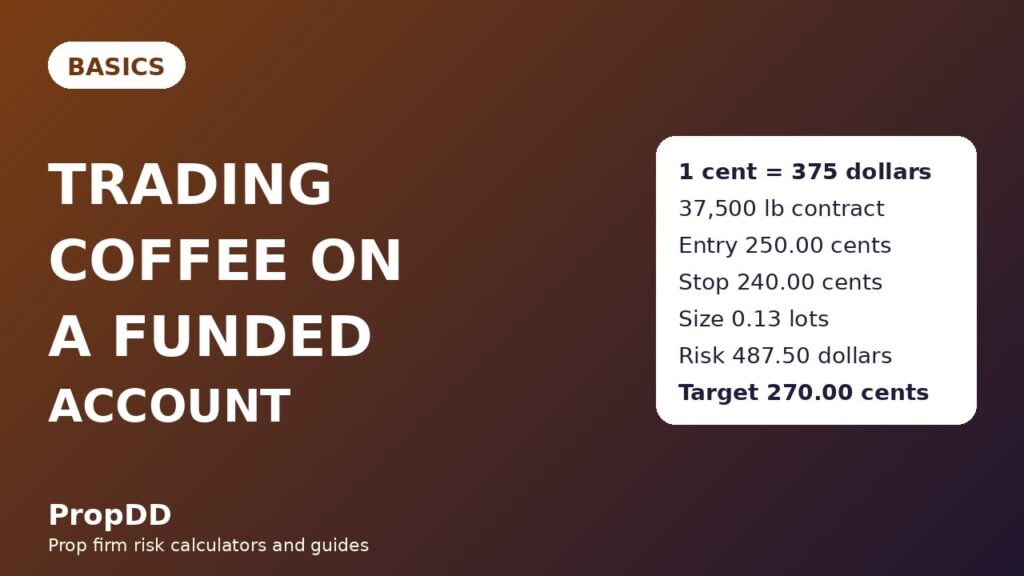
At 37,500 pounds a lot, one cent of price movement is worth 375 dollars per full lot. A five-hundredths-cent tick is worth 18.75 dollars, ten cents is worth 3,750 dollars, and one dollar of price movement — 100 cents — is worth 37,500 dollars per full lot. Coffee trades around 250 cents a pound in recent sessions, so a move that looks tiny on the chart is not tiny in money. A 10-cent stop, the kind of stop I would barely notice on EURUSD, is a 3,750-dollar swing on a full lot — 75 percent of a 5,000-dollar daily loss limit in a single trade.
| Specification | ICE Coffee C future (KC) | What it means for a funded trader |
|---|---|---|
| Contract size | 1 lot = 37,500 pounds | A full lot is far too big for a 5,000-dollar daily limit |
| Price quote | Cents per pound | Charts read in the hundreds; money moves in the thousands |
| Value of a 0.05-cent tick | 18.75 dollars per lot | One tick already costs more than a forex spread |
| Value of a 1-cent move | 375 dollars per lot | The number every coffee calculation starts from |
| Value of a 10-cent move | 3,750 dollars per lot | 75 percent of a 5,000-dollar daily limit |
| Notional value at 250 cents | 93,750 dollars per lot | 9,375 dollars of margin at 1:10 on a full lot |
| Contract months | March, May, July, September, December | Roll dates matter; never hold into expiry week |
| Daily price limit | None | Unlike wheat, coffee has no exchange cap on a session move |
Compare that with the other commodities I have covered on this site. Wheat moves 50 dollars per lot for every cent, because its lot is 5,000 bushels. Silver moves 500 dollars per lot for every 10 cents, because its lot is 5,000 ounces. Oil moves 10 dollars per lot for every cent, because its lot is 1,000 barrels. Coffee sits far above all of them: 375 dollars a cent is more than seven times wheat’s figure, and it is why coffee’s sizing rule differs from every other commodity guide on this site.
Why coffee moves differently from wheat, oil and metals
Gold moves on rates, the dollar, and fear. Oil moves on inventories and OPEC headlines. Wheat moves on acreage and a monthly WASDE report. Coffee moves on weather in Brazil, and almost nothing else matters as much. Brazil grows roughly a third of the world’s coffee, and a frost forecast for Minas Gerais — the state that grows most of it — can reprice the contract overnight, before any chart pattern has time to form.
That mix gives coffee three traits a funded trader must respect. First, it gaps on weather headlines, not just on scheduled reports: a frost forecast, a CONAB crop estimate, or an ICE certified-stocks update can all move coffee several cents in a single session. Second, it has no daily price limit, so unlike wheat there is no cap that stops a runaway session, and the market keeps trading while your stop fills further away. Third, it is seasonal in a way no metal is: Brazil’s harvest runs roughly May to September, and the northern hemisphere’s winter is when frost risk peaks. My losing session was exactly the first trait: I had held 0.30 lots into a frost headline and met a 10-cent gap.
None of this makes coffee untradeable. It makes it a market where the position must be a fraction of a lot, and where the weather forecast matters as much as the chart.
The sizing formula that keeps a coffee trade inside the daily limit
My funded-account rule is unchanged from every other market I trade: no single trade risks more than 500 dollars, which is 10 percent of my 5,000-dollar daily loss limit. The formula that turns that rule into a coffee position size is simple, but the dollar-per-cent figure is what most traders get wrong, because they carry a forex pip value in their head.
| Step | Formula | Worked example |
|---|---|---|
| 1. Dollar value per cent of price move | Pounds per lot x 0.01 dollars | 37,500 x 0.01 = 375 dollars per 1-cent move on a full lot |
| 2. Risk on a full lot | Stop distance in cents x dollars per cent | 10 cents x 375 dollars = 3,750 dollars on 1 lot |
| 3. Position size for a 500-dollar risk cap | 500 / (stop distance x 375) | 500 / (10 x 375) = 0.13 lots |
| 4. Check against the daily limit | Risk / 5,000-dollar daily limit | 487.50 / 5,000 = 9.75 percent of the day |
Step 2 is the whole lesson. A full lot with a 10-cent stop risks 3,750 dollars — three quarters of the day — so a full lot is simply not a funded-account trade in coffee at any realistic stop distance. I check this arithmetic on the maximum daily drawdown calculator before the session, not after it. The answer is fractional sizing: 0.13 lots, not 1 lot, and the risk cap is what sets the fraction, never the other way round. Work that formula before every coffee trade, not after. A 487.50-dollar risk means ten consecutive full-stop losses to breach the day, and no single headline can do it alone.
Margin is the second check. One full lot at 250 cents is 93,750 dollars of notional value — 9,375 dollars of margin at 1:10. At 0.13 lots those figures fall to about 12,187.50 dollars of notional and 1,218.75 dollars of margin at 1:10, which is comfortable on a 100,000-dollar account. Read your firm’s leverage rules before assuming your usual margin applies, and confirm your venue actually allows fractional lots — if it only offers full lots, coffee is not tradeable on that account under a 5,000-dollar daily limit, and no setup changes that.
My worked trade: entry, stop and two targets
Here is the trade I now use as my coffee template. Coffee had pulled back to a previous support zone around 250 cents after a strong week, and the pullback had stalled with two small-bodied candles. I was not buying because coffee looked cheap — a soft commodity in a big-crop year can stay cheap for months — I was buying a level with a defined invalidation point, on a day with no frost forecast and no CONAB release.
| Trade element | Level | Maths |
|---|---|---|
| Entry (long) | 250.00 cents | Above the stalled pullback candles |
| Stop loss | 240.00 cents | 10 cents below entry, under the pullback low |
| Position size | 0.13 lots | 500 / (10 x 375) = 0.13 lots, rounded down |
| Risk | 487.50 dollars | 10 cents x 375 dollars x 0.13 lots |
| First target (1R) | 260.00 cents | 10 cents x 375 dollars x 0.13 lots = 487.50 dollars |
| Second target (2R) | 270.00 cents | 20 cents x 375 dollars x 0.13 lots = 975 dollars |
| Spread cost at entry | About 15 dollars | 0.30-cent spread x 375 dollars x 0.13 lots |
Notice the spread line. Coffee’s spread is commonly around three tenths of a cent, and on 0.13 lots a 0.30-cent spread costs about 15 dollars before the trade moves — only 3 percent of the 487.50-dollar risk, because fractional sizing shrinks the spread cost along with the risk. I never trade coffee with a stop under 5 cents, and I never hold a position into a frost forecast, when the spread can widen and the stop can slip by several cents at once.
The trade played out to the second target in two sessions: the full 0.13-lot position reached 270 cents, banking 20 cents x 375 dollars x 0.13 lots = 975 dollars, or 2R on the 487.50 dollars risked. The discipline that mattered was not the entry: the stop was 10 cents because the level demanded 10 cents, and the size was 0.13 lots because the risk cap demanded 0.13 lots.
The sizing grid I use for different stop distances
Coffee’s volatility changes with the season, so the stop distance changes too. This grid keeps the risk at or under 500 dollars while the stop moves. I have it pinned next to my platform, and I do not trade coffee without glancing at it first. Sizes are rounded down to two decimals, which is why the risk column sits at or just under the cap rather than exactly on it.
| Stop distance | Size at 500-dollar risk cap | Value of a 1-cent move at that size | Risk at that size |
|---|---|---|---|
| 5 cents | 0.26 lots | 97.50 dollars | 487.50 dollars |
| 10 cents | 0.13 lots | 48.75 dollars | 487.50 dollars |
| 15 cents | 0.08 lots | 30 dollars | 450 dollars |
| 20 cents | 0.06 lots | 22.50 dollars | 450 dollars |
| 30 cents | 0.04 lots | 15 dollars | 450 dollars |
The grid also shows why I avoid stops under 5 cents. A 2-cent stop on 0.26 lots leaves almost no room for coffee’s noise, and the spread alone is 15 percent of the stop distance at a 0.30-cent spread. My working range is 10 to 20 cents, which keeps the size between 0.06 and 0.13 lots at the 500-dollar cap. If a setup needs a 30-cent stop, the size drops to 0.04 lots — still tradeable, still inside the cap, and not worth forcing if the target does not offer at least twice the risk.
One cost belongs in every coffee calculation: slippage. If a stop slips by 2 cents on 0.13 lots, that is 97.50 dollars extra on the loss, turning a 487.50-dollar loser into 585 dollars. I keep a 100-dollar slippage allowance in my head for every coffee stop.
I tested it: twelve filtered setups against twelve unfiltered ones
I ran the template over twelve coffee setups with its filters — level-based entries only, 10-to-20-cent stops, targets at 1R and 2R, no trades held into a frost forecast or a CONAB release — against the same twelve setups unfiltered. The filtered log is the method; the unfiltered log is what happens when the weather is ignored.
| Trade | Setup | Result (R) | Dollars at 487.50-dollar risk |
|---|---|---|---|
| 1 | Support bounce, 250, stop 240 | +2R | +975 dollars |
| 2 | Resistance rejection, 275, stop 285 | +1R | +487.50 dollars |
| 3 | Support bounce, 248, stop 238 | -1R | -487.50 dollars |
| 4 | Breakout retest, 260, stop 250 | +2R | +975 dollars |
| 5 | Support bounce, 232, stop 222 | +2R | +975 dollars |
| 6 | Resistance rejection, 290, stop 300 | -1R | -487.50 dollars |
| 7 | Support bounce, 245, stop 235 | +1R | +487.50 dollars |
| 8 | Breakout retest, 268, stop 258 | +2R | +975 dollars |
| 9 | Support bounce, 252, stop 242 | -1R | -487.50 dollars |
| 10 | Resistance rejection, 282, stop 292 | +2R | +975 dollars |
| 11 | Support bounce, 238, stop 228 | -1R | -487.50 dollars |
| 12 | Breakout retest, 272, stop 262 | +1R | +487.50 dollars |
Filtered: 8 wins, 4 losses, winners 13.0R against losers 4.0R, net +9.0R = +4,387.50 dollars, average winner 1.63R, best single trade 975 dollars = 22.2 percent of the net, inside the 30 percent consistency cap. Unfiltered, the same twelve setups — including the ones held into frost forecasts and taken on CONAB mornings — came out at 3 wins, 7 losses on ten completed trades, net -3R = -1,462.50 dollars, because two weather gaps alone cost more than the whole filtered edge. The edge is not in coffee itself. It is in refusing the weather-adjacent, full-lot setups: level, stop, size, forecast, and nothing else.
Where coffee trades go wrong on funded accounts
Four mistakes account for nearly every coffee breach I have seen, including my own. The first is sizing by lot number instead of by dollars: 0.30 lots of coffee is not a small position, and treating it like one is how a 10-cent move becomes a four-figure loss. The second is trading a full lot at all, when a 10-cent stop on a full lot risks 75 percent of the daily limit before the trade even starts. The third is holding a position into a frost forecast, when the gap, the widened spread and the slipped stop all arrive together — and unlike wheat, there is no daily price limit to slow the move down. The fourth is ignoring the contract months: holding into expiry week on a CFD that rolls can mean a forced close or a gap that has nothing to do with your setup.
The fix for all four is boring and identical: check the broker specification, run the formula, cap the risk at 10 percent of the daily limit, and let the trade go if the setup needs a size you cannot afford. Partial closes help here more than on most markets, because banking the first target removes the weather risk from the remaining risk — which is why the template takes half at 1R and only then lets the rest run, the same approach I use in my partial closes guide.
My daily coffee routine
| Time | Step | Rule |
|---|---|---|
| Before the session | Check the weather forecast: Brazil frost risk, CONAB and USDA releases, ICE certified stocks | If a frost forecast is live, no new coffee position held into it |
| Before the session | Check the broker specification, the spread and the contract month | If fractional lots are unavailable, or the spread is over 1 cent, no coffee trades that session |
| Before the session | Run the sizing formula for the day’s likely stop | Risk capped at 500 dollars, size from the grid, never from feel |
| London open | Trade only level-based setups | Support or resistance bounce with a defined invalidation, nothing else |
| Weather and report windows | Stand aside around major forecasts and releases | No entries, no stops moved, no exceptions for a perfect look |
| After each trade | Log the result against the daily limit | Two full-stop losses and the session’s coffee trading is done |
| End of day | Review spread and slippage actually paid | If costs exceeded 15 percent of gross profit, tighten the filter list |
That routine sits alongside the other commodity guides on this site for a reason. Oil taught me that a contract’s unit size is the trade. Natural gas taught me that a weekly report can move a market more than a trendline. Coffee taught me the sharpest lesson of the set: the most dangerous market on a funded account is not the wildest one, it is the one whose smallest-looking unit is worth hundreds of dollars. Ten cents looks small. On 37,500 pounds, it never is.
Frequently asked questions
How much is one lot of coffee worth per cent of movement?
On the ICE Coffee C specification, one lot equals 37,500 pounds, so one cent is worth 375 dollars per full lot, a 0.05-cent tick is worth 18.75 dollars, and ten cents is worth 3,750 dollars. A fractional CFD lot divides every figure by the fraction traded.
What position size keeps a coffee trade inside a 500-dollar risk cap?
Divide 500 by the stop distance in cents times 375. With a 10-cent stop the size is 0.13 lots; with a 20-cent stop it is 0.06 lots; with a 15-cent stop it is 0.08 lots. I avoid stops under 5 cents because the spread eats too much of the risk.
Can I trade a full lot of coffee on a funded account?
Not under a 5,000-dollar daily loss limit at any realistic stop distance. A full lot with a 10-cent stop risks 3,750 dollars, 75 percent of the day. Trade fractional lots, or skip coffee on that account.
Should I hold coffee through a Brazil frost forecast?
No, not with a full position. A frost forecast for Minas Gerais can reprice coffee overnight, and with no daily price limit there is no cap on the session’s run. I close or reduce before the forecast window and trade level-based setups only in normal liquidity afterwards.
How does coffee compare with wheat on a funded account?
Coffee’s 375 dollars a cent is more than seven times wheat’s 50 dollars a cent, and coffee has no daily price limit where wheat does. The same formula works for both; coffee simply demands fractional sizing and stricter weather discipline.
How does coffee compare with silver, oil, gas and copper on a funded account?
Coffee’s 375 dollars a cent sits above silver’s 50, copper’s 250, and oil’s 10 dollars a cent per lot. The lesson is the same across all of them: size by the contract’s own dollar-per-unit figure, never by lot number.
Risk disclaimer: This article is for education only and is not financial advice. Trading on a funded account can lose the account, and past results do not guarantee future results. Always check your firm’s current rules and your broker’s contract specification before trading.



3 comments
[…] and wheat share the same contract maths, and I say so plainly rather than pretending otherwise. Coffee moves 375 dollars per lot for every cent, because its lot is 37,500 pounds. Silver moves 500 […]
[…] steps in. Corn also moves 50 dollars per lot for every cent and shares wheat’s 30-cent limit. Coffee moves 375 dollars per lot for every cent, because its lot is 37,500 pounds. Sugar moves 1,120 […]
[…] cocoa with the other softs I trade on funded accounts and the pattern is clear: coffee is 37,500 pounds a lot, sugar is 112,000 pounds a lot, and each one has its own multiplier trap. […]