I did not breach my funded account with a bad strategy. I breached its daily limit with a position size that my leverage had quietly made possible, and I had not even noticed I was taking it. It was a Tuesday morning on EURUSD, and the setup was one I trade every week: a pullback to a level I had marked the night before, a clean entry, a stop 50 pips away. On my old retail account I would have traded 1 lot, because that was what my deposit allowed. On the funded account, with 1:100 leverage, the platform let me open 10 lots without blinking. The margin required was barely eleven thousand dollars on a hundred-thousand-dollar account, so it felt small. Then price pulled back 25 pips before it went my way, and 25 pips on 10 lots is two thousand five hundred dollars, which was my entire personal daily stop, gone in a single wick, on a trade that eventually would have won. I closed it in a panic at the bottom of the wick, and the account sat untouched for the rest of the day while I stared at a chart that did exactly what I had predicted. Leverage had not made me wrong. It had made me too big to survive being temporarily wrong, and that is the whole story of prop firm leverage in one trade.
In this article
- What leverage actually buys you on a funded account
- The margin formula, worked by hand
- The leverage firms actually publish, instrument by instrument
- Same risk, different leverage: the table that ends the argument
- How I size every trade now: risk first, margin second
- When firms quietly cut your leverage
- I tested it: two weeks, one change, and the breach that stopped happening
- Frequently asked questions
That morning taught me the distinction that this article is built on. Leverage is not risk, and it is not an edge. It is a borrowing limit, and borrowing limits decide how many mistakes you can afford to make at once, not whether your trades are good. A funded account does not care how clever your analysis is if a normal pullback can eat your whole daily budget, because the daily loss limit is a hard breach, not a warning. This article explains prop firm leverage rules the way I wish someone had explained them to me before that Tuesday: what the ratio actually means in margin dollars, the leverage firms publish for each instrument, why your risk stays identical at any leverage, and the margin-usage cap I now trade under. Every number below is worked on a hundred-thousand-dollar account with a 5 percent daily loss limit, because that is the account most funded traders start with.
What leverage actually buys you on a funded account
Leverage is a ratio between the size of the position you control and the margin the firm holds against it. At 1:100 leverage, one dollar of margin controls one hundred dollars of position. At 1:30, one dollar of margin controls thirty dollars of position. Nothing else changes. The price of EURUSD does not move differently, your stop loss does not get wider or tighter, and a pip is still worth the same amount of money per lot. All leverage changes is how much of your account must be set aside as a deposit before the trade is allowed to open, and therefore how many lots the platform will let you open at once.
That is why the sentence traders repeat, that high leverage is dangerous, is only half true. High leverage is dangerous in exactly one way: it removes the friction that would otherwise stop you from opening a position far larger than your risk plan allows. On a retail account with a small deposit, margin is a natural brake, because you simply cannot open 10 lots. On a funded account, the brake is gone, and the only brake left is the one you build yourself. Leverage does not increase your risk, it increases your permission to take risk you never planned, and on a funded account, unplanned risk is what breaches daily limits.
The margin formula, worked by hand
There are three numbers in every leverage calculation, and if you can work all three before you click buy, you will never again be surprised by a position. Notional value is the full size of the position in dollars. Margin is the deposit the firm holds, which is notional value divided by the leverage ratio. Margin usage is margin divided by your account size, expressed as a percentage, and it is the number that actually matters, because it tells you how much of your account is tied up in open trades at any moment.
| Number | Formula | Worked example: 1 lot EURUSD at 1.0900 |
|---|---|---|
| Notional value | Lots times contract size times price | 1 times 100,000 times 1.0900 = 109,000 dollars |
| Margin required | Notional value divided by leverage | 109,000 divided by 100 = 1,090 dollars at 1:100 |
| Margin usage | Margin divided by account size | 1,090 divided by 100,000 = 1.09 percent of the account |
| Maximum lots by margin | Account size times leverage, divided by notional per lot | 100,000 times 100 divided by 109,000 = 91.7 lots |
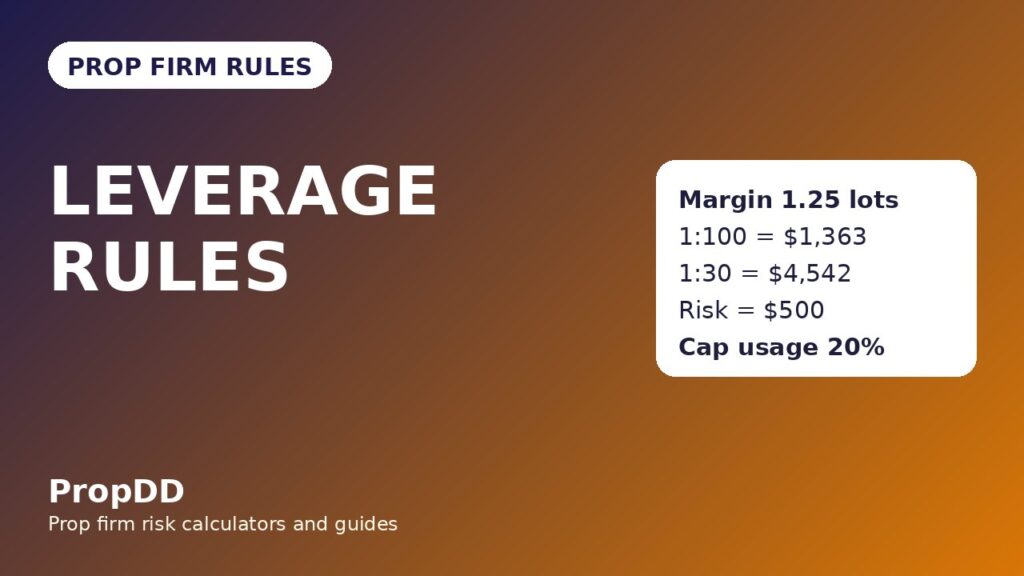
| Maximum lots by risk | Risk dollars divided by stop distance times pip value | 500 divided by 40 times 10 = 1.25 lots |
Read the last two rows together, because their gap is the entire lesson. Margin alone would let me open 91 lots of EURUSD on this account. My risk plan allows 1.25 lots. The platform enforces the first number and knows nothing about the second, which means the gap between 91 lots and 1.25 lots is policed by nobody except me. Every funded trader who has ever been stopped out by a normal wick has lived inside that gap. If you want a tool that measures the other side of the same problem, the max daily drawdown calculator on this site tells you exactly how much room your daily limit leaves before you place the trade, and I check it on the same mornings I check my margin usage.
The leverage firms actually publish, instrument by instrument
Prop firms do not offer one leverage number. They publish a table, and the ratio changes by instrument, because a calm currency pair and a volatile cryptocurrency do not carry the same gap risk overnight. The figures below are the typical published ranges I have seen across firm rule pages, and they match the pattern most firms follow. Your own firm will differ in the details, and its rule page is the only version that counts for your account, so check it before you trade an instrument for the first time.
| Instrument group | Typical published leverage | Margin on 1 lot | Why it is set there |
|---|---|---|---|
| Forex majors | 1:50 to 1:100 | About 1,090 to 2,180 dollars | Deep liquidity, tight spreads, small overnight gaps |
| Forex minors and exotics | 1:20 to 1:30 | About 3,633 to 5,450 dollars | Wider spreads and sharper moves on thin liquidity |
| Major indices | 1:20 to 1:30 | Varies by index contract | Large overnight gaps around earnings and data |
| Gold and silver | 1:20 to 1:30 | About 3,633 to 5,450 dollars per lot equivalent | Fast intraday swings, especially around US data |
| Oil | 1:10 to 1:20 | About 5,450 to 10,900 dollars per lot equivalent | Inventory-report spikes and weekend gap risk |
| Cryptocurrencies | 1:2 to 1:5 | About 21,800 to 54,500 dollars per lot equivalent | Extreme volatility and 24-hour weekend trading |
As a concrete example of how a firm publishes this, FundingTraders lists leverage by instrument class in its instant funding help article, from 1:50 on forex majors down to 1:5 on smaller crypto pairs. Two things in that table surprise most new funded traders. The first is that gold and oil are leveraged far lower than forex, which means a trader who sizes gold the way he sizes EURUSD is taking far more margin, and usually far more risk, than he realises. The second is that crypto leverage is almost no leverage at all, which is the firm’s way of saying that a 10 percent weekend move on Bitcoin is a normal event, not a disaster, and the margin must be big enough to survive it. The prop firm rule comparison calculator on this site is useful here, because it puts different firms’ limits side by side, and leverage is one of the limits where firms genuinely differ rather than just rewording the same rule.
Same risk, different leverage: the table that ends the argument
Here is the experiment that settled leverage for me, and you can repeat it on a demo account in ten minutes. Take the same trade, the same stop distance, and the same risk dollars, and run it at three different leverage levels. The margin changes every time. The risk never changes at all, because risk is stop distance multiplied by pip value multiplied by lots, and leverage appears nowhere in that formula. If your risk changes when leverage changes, you changed your size, not your leverage, and blaming the ratio is how traders keep repeating the same breach.
| Leverage | Margin for 1.25 lots EURUSD | Margin usage | Loss if the 40-pip stop is hit |
|---|---|---|---|
| 1:100 | 1,363 dollars | 1.36 percent | 500 dollars |
| 1:50 | 2,725 dollars | 2.73 percent | 500 dollars |
| 1:30 | 4,542 dollars | 4.54 percent | 500 dollars |
| 1:10 | 13,625 dollars | 13.63 percent | 500 dollars |
That table is also why low leverage is not automatically safer. At 1:10, the same sensible trade ties up nearly 14 percent of the account in margin, which leaves less room for a second position and tempts traders to remove their stop to free margin, which is a far worse decision than any leverage setting. Leverage is a constraint to manage, not a villain to avoid, and the traders who survive funded accounts are the ones who size from risk first and treat margin as a check afterwards, never the other way round.
How I size every trade now: risk first, margin second
My pre-trade routine has exactly two steps, in this order, and I do not reverse them. First I size from risk: risk dollars divided by stop distance in pips divided by pip value per lot. On my account that is 500 dollars of risk, a 40-pip stop, and 10 dollars per pip per lot, which gives 1.25 lots, at any leverage, on any day. Then I check margin: 1.25 lots at 1:100 needs about 1,363 dollars of margin, which is 1.36 percent of the account, and my personal rule is that total margin usage across all open trades never passes 20 percent. If a second trade would push usage past 20 percent, I do not take it, even if the setup is perfect, because two perfect setups open at once are how a normal losing day becomes a breach day.
| Stop distance | Lots at 500 dollars risk | Margin at 1:100 | Margin usage |
|---|---|---|---|
| 20 pips | 2.50 lots | 2,725 dollars | 2.73 percent |
| 30 pips | 1.67 lots | 1,820 dollars | 1.82 percent |
| 40 pips | 1.25 lots | 1,363 dollars | 1.36 percent |
| 50 pips | 1.00 lot | 1,090 dollars | 1.09 percent |
| 60 pips | 0.83 lots | 905 dollars | 0.91 percent |
The sizing grid above is the same maths the site’s drawdown tools use, and it is worth pinning next to your platform, because it removes the one decision tired traders get wrong: how big to go when the stop is wider than usual. A wider stop does not mean a bigger trade, it means a smaller one, and the grid makes that automatic. My other hard rule is about instruments: I check the leverage for any instrument I have not traded that week before I open it, because gold at 1:20 and EURUSD at 1:100 are not the same trade at the same lot size, and the maximum lot size rules on this site explain the second cap firms place on top of leverage, which is the per-trade and total lot ceiling that margin alone does not show you.
When firms quietly cut your leverage
Leverage is not fixed for the life of your account, and the cuts are where traders get caught. The most common cut happens between phases: a firm that offers 1:100 during evaluation may drop you to 1:50 once funded, which doubles the margin on every position you hold, and a trader who was running 30 percent margin usage wakes up at 60 percent without placing a single new trade. The second cut happens around news and weekends: some firms reduce leverage on instruments ahead of major events or Friday close, which has the same effect on margin, and a position that was comfortable on Thursday can become a margin problem on Friday afternoon. The third cut is equity-based: firms that scale leverage down as your account grows, or that restrict leverage after a drawdown, do so to protect the account, but they do it without asking, and the trader who does not read the rule page discovers it through a rejected order.
My rule for all three cuts is simple. I never run margin usage above 20 percent, precisely so that a leverage cut can double my margin without doubling my danger. Twenty percent at 1:100 becomes 40 percent at 1:50, which is uncomfortable but survivable. Sixty percent at 1:100 becomes 120 percent at 1:50, which is a forced closure. The 20 percent cap is not a magic number from a book, it is the number that leaves room for the firm’s next decision, and on a funded account, room for the firm’s next decision is the same thing as room to keep trading. It also protects against the weekend gap problem covered in the weekend holding gap risk guide on this site, because a gap hurts in dollars per lot, not in leverage, and the only defence against a gap is fewer lots open when it happens.
I tested it: two weeks, one change, and the breach that stopped happening
I ran this as a deliberate test over two trading weeks on the same strategy, the same session, and the same 500-dollar risk per trade, changing only how I treated margin. In the first week I sized by feel and let margin usage run wherever it landed, which is how most traders actually trade when they are honest about it. In the second week I applied the two-step routine above: risk-first sizing, a 20 percent total margin cap, and a leverage check on every instrument before entry. The strategy did not improve between the weeks. My exposure did, and the results show why that matters more than a better entry.
| Measure | Week one: margin by feel | Week two: 20 percent margin cap |
|---|---|---|
| Trades taken | 14 trades | 10 trades |
| Highest margin usage | 64 percent across 4 open trades | 18 percent across 2 open trades |
| Largest single-trade loss | 2,500 dollars (the Tuesday wick trade) | 500 dollars (one planned stop) |
| Days hitting personal daily stop | 2 days out of 5 | 0 days out of 5 |
| Week result | Minus 1,500 dollars, 5 wins and 9 losses | Plus 1,000 dollars, 6 wins and 4 losses |
| Rule breaks | 3 (oversize, second position, no leverage check) | 0 |
The honest reading of that table is that week two did not win because the strategy got better, it won because the account stopped taking losses it never planned. Week one’s 2,500-dollar loss was not a strategy loss at all, it was a margin-permission loss: a 25-pip wick on 10 lots, exactly the trade from the opening story, and it counted for more than the entire week’s strategy edge. Week two’s worst loss was 500 dollars because every loss was a planned stop at planned size, and planned losses are survivable in a way that surprise losses never are. The margin cap did not make me profitable, it stopped me from being unprofitable for a stupid reason, and on a funded account, that is usually the difference between keeping the account and buying another challenge.
Frequently asked questions
Does higher leverage mean higher profit on a funded account?
No. Profit is decided by lots, pip movement, and pip value, not by the leverage ratio. Higher leverage only lets you open more lots with less margin, and more lots mean more profit when you win and more loss when you lose, in exactly the same proportion. A trader who doubles his lots doubles both sides of every trade, and the daily loss limit does not care which side you were hoping for.
What leverage do most prop firms offer on forex?
Most firms publish 1:50 to 1:100 on major forex pairs, 1:20 to 1:30 on minors, indices, and metals, 1:10 to 1:20 on oil, and 1:2 to 1:5 on cryptocurrencies. These are typical ranges, not promises: your firm’s rule page for your exact account type is the only figure that applies to you, and funded-phase leverage is often lower than evaluation-phase leverage.
Can leverage alone breach my daily loss limit?
Leverage alone cannot breach anything, because a loss is measured in dollars, and dollars come from lots and price movement. What leverage does is allow a lot size whose normal price movement is larger than your daily limit, and that lot size breaches the limit the first time price moves against it. The breach belongs to the size decision, even though leverage made the size possible.
Should I choose a firm with the highest leverage?
Usually not. The highest leverage is only useful if your strategy needs many simultaneous positions, and most funded strategies need one or two. What matters more is whether the firm’s leverage is stable across phases, whether it cuts leverage around news or weekends, and whether its margin rules leave you room to trade normally. A firm at 1:50 with stable rules beats a firm at 1:100 that halves your leverage the week you get funded.
How much margin usage is safe on a funded account?
I cap total margin usage at 20 percent of the account across all open trades, which leaves room for a leverage cut to double my margin without forcing closures. There is no industry-standard safe number, and firms rarely publish one, so the right cap is the one that keeps a normal losing day inside your personal daily stop even if leverage is cut in half overnight.
Does leverage change after I get funded?
Often, yes. Many firms reduce leverage from evaluation to funded phase, for example from 1:100 to 1:50 on forex and from 1:20 to 1:10 on indices and commodities, and some reduce it further around major news or weekends. Read the funded-phase rules before your first funded trade, not after your first rejected order, and size your evaluation trading so the funded-phase margin still fits your plan.
Risk disclaimer: This article describes my own experience on a simulated funded account and is for education only, not financial advice. Prop firm rules change, leverage varies by firm and instrument, and trading leveraged products can lose money quickly. Always read your firm’s current rule page and never risk money you cannot afford to lose.


10 comments
[…] the max daily drawdown calculator to confirm the day’s remaining room, and I check the leverage rules guide whenever I change pairs, because a 2.50-lot EURUSD position and a 2.50-lot gold position are not […]
[…] times less forgiving per lot. If you trade both metals, read that gold article next, and check the leverage rules guide before you assume a lot size that worked on one instrument works on […]
[…] sizes. The method is identical, but check the contract maths for the instrument first, as the leverage rules guide explains, because a stop that looks small in pips can be large in […]
[…] is the second trap, and it works in the opposite direction from forex. My leverage rules article showed that on forex, risk caps size long before margin does. On oil, margin can bite first if your […]
[…] on copper entirely and size only from the cent formula and the daily limit, the same rule I use for leverage rules on every other […]
[…] rule. The first is the times-ten misread from my opening story. The second is leverage confusion: leverage rules differ by firm, and a firm that offers 1:50 on cocoa is not offering safety, it is offering a […]
[…] cap minus the expected swap bill by the stop distance instead. Lot size also interacts with the prop firm leverage rules, which decide how much margin each lot ties up, but leverage never changes the swap bill itself: […]
[…] an earnings day on NAS100: either be flat, or be sized so small that the gap cannot hurt you. The leverage rules guide on this site explains why the 1 to 2 cap makes that sizing discipline non-negotiable rather than […]
[…] it should never be the reason to hold a position. Check your firm’s crypto rules, including leverage rules, before assuming any crypto feature applies to a funded […]
[…] a low margin level has fixed a number on the screen and changed nothing about the trade. The leverage rules guide on this site covers the firm’s side of leverage in detail; here, remember only this: leverage […]