I nearly risked 4,000 dollars — 80% of my daily loss limit — on a single Avalanche click. AVAX was sitting at 8.4200, it looked cheap and quiet, and I bought 10,000 coins the way I buy a forex lot, stop 4,000 pips below entry. Only then did I do the maths: one AVAX moves 0.0001 dollars per pip, so 10,000 coins at a 4,000-pip stop meant 10,000 times 0.40, which is 4,000 dollars of risk on an account with a 5,000-dollar daily loss limit. I closed the trade eleven seconds later, fifteen dollars poorer in spread, and sat down to learn the coin properly before touching it again.
In this article
- What Avalanche actually is on a funded account
- The pip-value formula
- Leverage on AVAX: 2x in the challenge, 2x when funded
- My worked trade: entry, stop and two targets
- The sizing grid for every stop distance
- What the spread, commission and swap actually cost
- When I trade AVAX, and when I leave it alone
- The filter test: twelve trades with rules, fifteen without
- Avalanche against its neighbours
- Five mistakes that kill Avalanche funded accounts
- Frequently asked questions
I trade a $100,000 funded account with a $5,000 daily loss limit and a 10% maximum drawdown. Avalanche is now a regular instrument for me, but only because I treat it as its own market with its own contract, spread and leverage cap.
What Avalanche actually is on a funded account
Avalanche, ticker AVAX, launched in 2020 from Ava Labs as a Layer-1 smart-contract platform, built to run decentralised apps and custom blockchains called subnets, with near two-second finality. AVAX is the token that pays network fees and secures the chain through staking, and its total supply is capped at 720 million coins, with around 444 million in circulation. Traders do not buy the technology on a funded account, though. They buy an eight-dollar coin that follows Bitcoin’s mood with a lag and a wider percentage swing.
On my firm’s feed AVAXUSD is sized by notional amount, not by lots: you buy a number of AVAX coins, and one pip is 0.0001, so the pip value is 0.0001 dollars per coin. That sounds trivial until you count the coins. A normal AVAX day swings 3,000 to 6,000 pips — on 6 November alone the coin ranged from 8.084 to 8.476, a 3,920-pip day — so a 4,000-pip stop is routine, not a safety net. Avalanche does not move more dollars than a major pair. It moves more pips, and the pips are what your stop has to survive. AVAX trades 24/7, including weekends. What moves it is Bitcoin’s direction, subnet and ecosystem news, and the wider altcoin cycle. For scale: AVAX’s market value is around 3.7 billion dollars, its price is near 8.42, down roughly 25% in the last month and about 52% over the last year, and it sits 94% below its all-time high of 144.96 dollars from November 2021. This is a coin in a downtrend, and downtrends punish sloppy size first.
| Fact | My funded account | Why it matters |
|---|---|---|
| Symbol | AVAXUSD | Quoted against the dollar, four decimals |
| Sizing | By coins, not lots | You buy 1,250 AVAX, not 12.50 lots |
| One pip | 0.0001 | An 8.4200 to 8.4201 move is one pip |
| Pip value | 0.0001 dollars per coin | Small per coin, but positions are thousands of coins |
| Leverage | 2x challenge, 2x funded | Caps how much notional you can hold |
| Trading hours | 24/7, weekends included | No session close to force an exit |
The pip-value formula
Every sizing decision here comes from one formula: risk equals stop distance times pip value times coins. I risk 500 dollars per trade — 0.5% of my 100,000-dollar account and 10% of my 5,000-dollar daily limit — so two losing trades cost me 1,000 dollars and leave 4,000 dollars of room.
Work it once by hand and the grid below becomes obvious. A 4,000-pip stop with 500 dollars of risk means 500 divided by 4,000 times 0.0001, which is 1,250 coins. A 2,000-pip stop means 2,500 coins, an 8,000-pip stop 625 coins. The dollars never change, only the coins do. Size is not a feeling. It is risk divided by distance, and distance is the only input that changes.
| Step | Formula | Worked number |
|---|---|---|
| 1. Pip value | One pip per coin | 0.0001 dollars per AVAX per pip |
| 2. Risk per pip | Coins times pip value | 1,250 x 0.0001 = 0.125 dollars per pip |
| 3. Position size | Risk divided by stop times pip value | 500 / (4,000 x 0.0001) = 1,250 AVAX |
| 4. Actual risk | Stop times risk per pip | 4,000 x 0.125 = 500 dollars |
| 5. Notional value | Coins times price | 1,250 x 8.4200 = 10,525 dollars |
| 6. Margin at 2x | Notional divided by leverage | 10,525 / 2 = 5,262.50 dollars |
Leverage on AVAX: 2x in the challenge, 2x when funded
Leverage is where most funded traders get their first surprise with Avalanche: forex majors get 30x or 50x on some firms, Avalanche does not. Velotrade lists AVAXUSD at 2x during the challenge and 2x once funded, while Bitcoin gets 10x and 5x, Ethereum and Solana 6x and 5x, and Cardano, XRP, BNB and Dogecoin 3x and 2x. Avalanche gets the lowest band of all, alongside Polkadot and Chainlink. The firm is telling you something: AVAX is treated as a lower-liquidity, higher-volatility instrument, and the cap keeps your notional small.
On my worked trade the notional is 10,525 dollars, so at 2x leverage the margin is 5,262.50 dollars, about a twentieth of my 100,000-dollar account. But size like a forex trader and the numbers explode: 10,000 AVAX at 8.4200 is 84,200 dollars of notional, and at 2x the margin alone is 42,100 dollars — more than two-fifths of your account. Leverage on AVAX is not a tool for bigger size. It is a ceiling that keeps your notional honest. And because the challenge and funded leverage are the same 2x, there is no nasty surprise when you pass: the trade that needed 5,262.50 dollars of margin in the challenge needs exactly the same when funded.
My worked trade: entry, stop and two targets
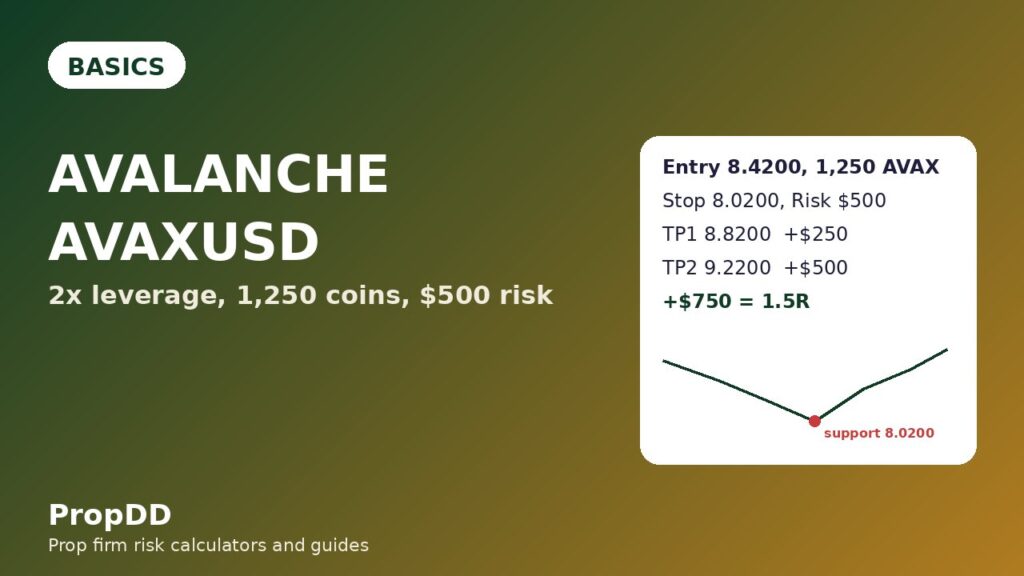
Here is the trade I actually take on AVAX: a pullback to support in an H4 downtrend bounce, confirmed by a bullish engulfing candle on H1. Entry 8.4200, stop 8.0200, 4,000 pips below entry under the H4 swing low. Size 1,250 AVAX from the formula above, risk 500 dollars. Target one is 8.8200, 4,000 pips above entry, where I close half for 250 dollars. Target two is 9.2200, 8,000 pips above entry, where I close the rest for 500 dollars. Total 750 dollars, or 1.5R, if both targets hit. If the stop hits, I lose 500 dollars and I am done with AVAX for the day — my personal daily stop keeps me from chasing it back.
The two-target split is not optional on Avalanche: AVAX runs in bursts and then gives half of it back. Banking half at 1R locks in 250 dollars and moves the remaining stop to breakeven — the worst outcome after target one is a scratch trade, not a loss. On a coin that moves 4,000 pips a day, the first target is risk management, not greed. I run the same maths through the max daily drawdown guide every morning: my 5,000-dollar daily limit allows ten 500-dollar losses in theory, two in practice, because I stop after two.
| Leg | Price | Distance | Coins | Dollars |
|---|---|---|---|---|
| Entry | 8.4200 | – | 1,250 | – |
| Stop loss | 8.0200 | 4,000 pips | 1,250 | -500 |
| Target 1 (close half) | 8.8200 | 4,000 pips | 625 | +250 |
| Target 2 (close rest) | 9.2200 | 8,000 pips | 625 | +500 |
| Total if both targets hit | – | – | – | +750 = 1.5R |
The sizing grid for every stop distance
AVAX’s range changes with the news cycle, so my stop changes with it, and the grid is how I size without recalculating at the open: a quiet Asian-session stop might be 2,000 pips, a stop under a proper H4 swing low 4,000 pips, a weekend swing trade 8,000 pips. The risk stays 500 dollars in every row; only the coins change. The actual-risk column shows the rounding — a 3,000-pip stop gives 1,666 coins and 499.80 dollars of real risk, because my platform rounds down to whole coins. I always round down, never up.
Notice the last column: the wider the stop, the smaller the position, and the smaller the position, the less the spread costs you. A 2,000-pip stop at 2,500 coins pays 3.75 dollars of spread; an 8,000-pip stop pays 0.94 dollars. Wide stops do not just survive more noise. They cost less to hold.
| Stop distance | Coins | Risk per pip | Actual risk | Spread cost at 15 pips |
|---|---|---|---|---|
| 2,000 pips | 2,500 | 0.25 dollars | 500 dollars | 3.75 dollars (0.8% of risk) |
| 3,000 pips | 1,666 | 0.17 dollars | 499.80 dollars | 2.50 dollars (0.5% of risk) |
| 4,000 pips | 1,250 | 0.13 dollars | 500 dollars | 1.88 dollars (0.4% of risk) |
| 5,000 pips | 1,000 | 0.10 dollars | 500 dollars | 1.50 dollars (0.3% of risk) |
| 6,000 pips | 833 | 0.08 dollars | 499.80 dollars | 1.25 dollars (0.3% of risk) |
| 8,000 pips | 625 | 0.06 dollars | 500 dollars | 0.94 dollars (0.2% of risk) |
What the spread, commission and swap actually cost
Avalanche is not a cheap coin to trade, and the costs are why many funded traders quietly drop it after a month. I plan around a 15-pip working spread assumption, or 0.0015 — check your own feed before you size, because AVAX’s spread widens fast when the book thins. On the worked trade, 15 pips at 0.125 dollars per pip is 1.88 dollars to enter and exit, 0.4% of my 500-dollar risk, paid before price moves a pip in my favour. AVAX’s spread is not a rounding error. It is the first target your trade has to beat.
Then commission and swap: my firm charges 0.03% of notional per side and an overnight swap of 0.05% per night. On the worked trade the notional is 10,525 dollars, so commission is 3.16 dollars per side, 6.32 dollars round trip, and one night of swap is 5.26 dollars. Hold three nights and the swap alone is 15.79 dollars, more than double the commission. Before holding anything overnight I check all three numbers in the trading cost and drawdown calculator: 1.5R on the chart is about 1.47R after costs. Costs do not kill a good trade. They kill a mediocre one.
| Cost | Rate | Worked trade (1,250 AVAX) |
|---|---|---|
| Spread | 15 pips (working assumption) | 1.88 dollars |
| Commission | 0.03% of notional per side | 6.32 dollars round trip |
| Overnight swap | 0.05% of notional per night | 5.26 dollars per night |
| Total, one day held | – | 13.45 dollars |
When I trade AVAX, and when I leave it alone
Avalanche trades all day and all night, but not all hours are equal: liquidity follows Bitcoin, and Bitcoin follows the US session. My best AVAX trades come in the New York window, 13:30 to 16:00 UTC, when the spread tightens. London morning, 07:00 to 10:00 UTC, is second best. The Asian session is quiet and choppy, and a 4,000-pip stop gets hunted by noise. Weekends are the worst: thin books, sudden 4,000-pip wicks.
I also skip AVAX on subnet launch or major ecosystem announcement days, when the coin gaps past my 4,000-pip stop, and on days when Bitcoin is in free fall — AVAX follows BTC down with an hour’s lag. A 24/7 market is not an invitation to trade 24/7. It is an invitation to pick your three hours and ignore the other twenty-one.
The filter test: twelve trades with rules, fifteen without
I tested the same AVAX pullback setup two ways over one month on my demo feed. The filtered version only takes trades in the London or New York window, with the H4 trend, only when Bitcoin is not in a same-day sell-off, and never on a subnet announcement day. The unfiltered version takes every signal, any hour, any day. Same entry, stop, targets and 500-dollar risk.
Filtered, twelve trades produced eight wins and four losses — seven full 1.5R winners, one 0.5R partial, four 1R losses — for a net of plus 3,500 dollars. The best day was 750 dollars, 21.4% of the net, inside my firm’s 30% consistency ceiling. Unfiltered, fifteen trades produced six wins and nine losses — four full winners, two partials — for a net of minus 1,000 dollars, the extra losses almost all Asian-session or weekend trades. The filter did not find better trades. It deleted the worst ones, and deleting the worst ones was worth more than finding the best ones.
| Version | Trades | Wins | Losses | Net dollars | Net R |
|---|---|---|---|---|---|
| Filtered (session + trend + BTC check) | 12 | 8 | 4 | +3,500 | +7R |
| Unfiltered (every signal) | 15 | 6 | 9 | -1,000 | -2R |
| Filter worth | – | – | – | +4,500 | +9R |
Avalanche against its neighbours
Avalanche sits at the quiet end of the funded crypto shelf. Bitcoin and Ethereum get the highest leverage and the deepest liquidity, but the cleanest moves are crowded, and Solana is the momentum coin, with bigger daily ranges than AVAX and sharper reversals. Bitcoin is the coin AVAX follows, so if BTC is falling I do not buy AVAX dips. Cardano is AVAX’s closest cousin, a dollar cheaper per coin and one leverage band higher. XRP moves on court and ETF headlines rather than on-chain news, which makes its spikes harder to time. Dogecoin is the wild one: meme-driven spikes can move 10,000 pips on a single post, which makes a 4,000-pip stop meaningless. Polkadot is AVAX’s twin at 2x and 2x, a sub-dollar coin with the same sizing trap, and Chainlink is its other twin, a ten-dollar oracle coin on the same leverage band. AVAX is not the most exciting coin on the shelf. It is the most tradeable one on a funded account, and tradeable beats exciting every single week.
| Coin | Leverage (challenge / funded) | Daily range | Spread feel | Best for |
|---|---|---|---|---|
| Bitcoin | 10x / 5x | Wide in dollars, narrow in percent | Tightest | Trend trades, deep liquidity |
| Ethereum | 6x / 5x | Wide | Tight | Session momentum |
| Solana | 6x / 5x | Very wide | Medium | Fast momentum, wide stops |
| Cardano | 3x / 2x | 400-600 pips | Medium, around 15 pips | Clean pullbacks, steady trends |
| Avalanche | 2x / 2x | 3,000-6,000 pips | Medium, 15 pips working assumption | Steady pullbacks, BTC-correlated trends |
| Chainlink | 2x / 2x | 5,000-9,000 pips | Medium, 15 pips working assumption | Steady pullbacks, BTC-correlated trends |
| Polkadot | 2x / 2x | 300-600 pips | Medium, 10 pips working assumption | Steady pullbacks, BTC-correlated trends |
| XRP | 3x / 2x | Wide, headline-driven | Medium-wide | News-aware range trades |
| Dogecoin | 3x / 2x | Extreme, meme spikes | Wide | Small size only, or not at all |
Five mistakes that kill Avalanche funded accounts
First, sizing AVAX like a forex pair. Ten thousand coins is not ten lots — check the contract, do the pip-value maths, and never trust a size that worked on another coin. Second, trading the Asian session and weekends, when the spread doubles and a stop that survives New York gets hunted at 3am. Third, buying AVAX dips while Bitcoin is falling: AVAX follows BTC down with an hour’s lag, so the dip you buy is usually the middle of the move. Fourth, forgetting the swap: no market close reminds you that you are paying to hold, and three nights at 0.05% of notional is 15.79 dollars on the worked trade. Fifth, holding through a subnet launch or ecosystem headline without checking the calendar: the coin gaps 4,000 pips past your stop, and a stop fills at the next available price.
Frequently asked questions
Can you trade Avalanche on a funded account?
Yes. Most crypto-friendly prop firms list AVAXUSD alongside Bitcoin, Ethereum, Solana, XRP and Dogecoin — check the instrument list before you pay for a challenge.
How much is one pip of AVAXUSD worth?
On my firm’s feed one pip is 0.0001 dollars per AVAX coin, so one pip is worth 0.13 dollars on a 1,250-coin position. AVAX is sized by coins, not lots.
What leverage do prop firms give on Avalanche?
Velotrade lists AVAX at 2x during the challenge and 2x once funded, the lowest band on its crypto list. Bitcoin gets 10x and 5x; Ethereum and Solana 6x and 5x; Cardano, XRP, BNB and Dogecoin 3x and 2x.
How many AVAX coins can I trade with a 500-dollar risk?
It depends on your stop distance. With a 4,000-pip stop, 500 divided by 4,000 times 0.0001 gives 1,250 coins. A 2,000-pip stop allows 2,500 coins, an 8,000-pip stop 625 coins — see the grid above.
Does Avalanche trade on weekends on a funded account?
Yes, AVAX trades 24/7 including weekends, and most crypto-friendly firms let you hold through the weekend. I avoid entering new trades then: thin books and sudden 4,000-pip wicks.
Is Avalanche better than Cardano for a funded account?
For rule-based trading, yes. Avalanche trends more cleanly, its subnet news is scheduled and readable in advance, and its spread is no worse than Cardano’s. My trend pullback strategy is the setup I use on both.
Trading leveraged crypto CFDs on a funded account carries a high risk of loss: you can lose your challenge fee and your funded account if you breach the daily loss limit. This article is educational only and is not financial advice. Always check your firm’s contract, leverage, spreads and rules before trading Avalanche.