I lost 498 dollars on my first BNB trade because I traded it at the wrong hour, not because I picked the wrong direction. I bought 20 BNB at 693.90 dollars with a stop at 669.00 and a target at 744.00, the same shape I had traded a dozen times on other coins. The entry was at 02:00 Pakistan time, in the dead hours when BNB’s spread triples and one Binance headline can wick the price 25 dollars on almost no volume. At 02:47 the price wicked to 668.90, one thin candle tagged my stop, and by the time I woke up BNB was trading back at 719, my first target, as if nothing had happened. The loss was 498 dollars, which is 24.90 dollars times 20 BNB, and it was 10 percent of my 5,000-dollar daily loss limit spent on a trade that was right about direction and wrong about the clock.
In this article
- What BNB actually is
- The two BNBs: the coin and the payout network
- When BNB actually moves in Pakistan time
- The contract facts before you size anything
- The sizing formula under a 5,000-dollar daily limit
- The worked trade: 694 to 744 for 1.5R
- The sizing grid: stop distance decides the coins
- What a BNB day actually costs
- The twelve-trade filter test
- BNB against its neighbours
- My BNB daily routine
- Frequently asked questions
I trade a 100,000-dollar funded account with a 5,000-dollar daily loss limit. Trading BNB on a funded account is now one of my regular crypto trades, but only since I fixed that one mistake: BNB trades 24 hours a day, 7 days a week, and that does not mean every hour is tradeable. This is the full guide: what BNB is, the confusion between the coin and the payout network that shares its name, when BNB actually moves in Pakistan time, the contract facts, the sizing maths, one worked trade, twelve real trades, and the filter test.
What BNB actually is
BNB is the native token of BNB Chain, the blockchain run by the Binance ecosystem, and it started life in 2017 as Binance’s exchange token. Holders use it to pay gas fees on BNB Chain, and traders use it as a large, liquid crypto that moves with the whole market and with Binance’s own news. When I write this, on 7 November 2026, BNB trades near 694.63 dollars, with a market capitalisation near 91.5 billion dollars and the number-four rank among all cryptocurrencies, behind only Bitcoin, Ethereum and the stablecoins. Its all-time high is 1,369.99 dollars from 13 October 2025, so the current price sits about 49.3 percent below the high, and the last thirty days have been a slow bleed of about 10 percent. The circulating supply is about 131.5 million BNB, and the daily volume runs near 1.15 billion dollars.
Those numbers matter because they set the character of the coin. BNB is not a small, wild altcoin: it is a top-four asset with deep order books in liquid hours, which is why the spread is about 1.50 dollars per BNB when the market is awake. But it is still an exchange token, which means Binance headlines move it faster than any chart pattern. On 6 November 2026 BNB Chain released a BSC-Reth hotfix and Binance restored withdrawals in phases after a security incident earlier in the month, and the price spent the week stabilising between roughly 690 and 700 dollars after touching 722.78 the day before. BNB is a top-four coin with a single company’s news cycle attached to it. That is the first thing to understand before you size a trade: the coin follows Bitcoin most days, and follows Binance on the days that matter.
The two BNBs: the coin and the payout network
The most common confusion I see from funded traders is between BNB the coin and BNB Smart Chain the payout network. They share a name and nothing else. When a prop firm says it pays out in USDT on the BNB Smart Chain, it means your profit arrives as Tether on the BEP20 network, which is cheap and fast to move. It does not mean you traded BNB, and it does not mean the firm offers BNB/USD at all. The two things live in different parts of the firm’s business: payouts are a finance-department choice, and the trading list is a risk-department choice.
| Thing | What it is | What it means for you |
|---|---|---|
| BNB the coin | Native token of BNB Chain, trades as BNB/USD | The instrument in this guide; check the symbol list first |
| BNB Smart Chain (BSC) | The blockchain network, also called BEP20 | A payout rail for USDT, not a trade by itself |
| USDT on BEP20 | Tether sent over the BSC network | How some firms pay you; low fees, fast arrival |
| BNB/USD on MT5 | The CFD pair on your funded account | The only one of the four that risks your daily limit |
The reason this matters is that the new crypto-native firms blur the two in their marketing. Coinhub Funded launched on 2 November 2026 with 28-plus crypto pairs and payouts in USDT on Ethereum, Tron or BNB Smart Chain, and Axora Funded lists 11 crypto pairs with payouts in USDT on TRC20, ERC20 or BEP20. Both facts are true at the same time, and neither one guarantees the other: a firm can pay on BEP20 and still not list BNB/USD, and a firm can list BNB/USD and pay only by bank transfer. For the launch details and the payout rails, see the HTX report on the Coinhub Funded launch, which lists the 28-plus pairs and the three payout networks side by side. Before you buy a challenge to trade BNB, open the firm’s instrument list and search for BNBUSD. If it is not there, no payout-network mention will put it there.
When BNB actually moves in Pakistan time
Crypto never closes, so the question is not when the market opens but when the liquidity shows up. BNB’s best hours are the same as the rest of crypto: the London afternoon and the New York morning, which is 17:00 to 21:00 Pakistan time, when both the European and American desks are awake and the spread sits near 1.50 dollars. The second window is 13:00 to 15:00 Pakistan time, the London afternoon, when European crypto desks are active and Bitcoin’s moves drag BNB along. The dead hours are 02:00 to 05:00 Pakistan time, when Asia is quiet, Europe is asleep and America has gone home: the spread widens past 4.50 dollars, the order book thins, and a single headline can wick the price 25 dollars, which is exactly how my 498-dollar loss happened.
| Pakistan-time window | What is happening | How I trade it |
|---|---|---|
| 02:00 – 05:00 | Dead hours, thin book, spread past 4.50 dollars | No new trades; this is where my stop got wicked |
| 05:00 – 13:00 | Asia session, slow drift, Bitcoin leads | Watch only; no entries before London |
| 13:00 – 15:00 | London afternoon, European desks active | Second window: pullbacks only, never chases |
| 17:00 – 21:00 | London and New York overlap, best liquidity | Main window: my entries live here |
| 21:00 – 02:00 | US evening, liquidity fades, weekend risk builds | Manage open trades only; flat before midnight |
Binance headlines do not respect the clock. The hotfix and the withdrawal restoration in early November both landed outside my main window, and the price reacted in minutes. That is why the routine below has a news check at 17:00 Pakistan time and a hard rule against trading the first fifteen minutes after a Binance announcement. A 25-dollar stop is 3.6 percent of a 694-dollar coin, and a headline can cover that distance in one candle. On BNB, the calendar is a risk input, not a decoration. I check the Binance announcements page the same way I check the economic calendar before a forex trade, and I skip the trade if the two collide.
The contract facts before you size anything
On MetaTrader the pair usually appears as BNBUSD or BNB/USD, depending on the broker. The contract I trade is the common crypto CFD version: one lot equals one BNB, the minimum is 0.01 lots, which is 0.01 BNB, and the tick size is 0.01 dollars. That is the first number that separates BNB from forex: there are no pips here, only dollars per coin, so the stop distance is a dollar number and the size is a coin number. Leverage on crypto at most prop firms is capped at 1:2, which means 50 percent margin, and the spread target is about 1.50 dollars per BNB in liquid hours. There is a nightly swap charge on leveraged crypto CFDs, which is one more reason I am usually flat before midnight Pakistan time.
| Contract fact | Value | Source or note |
|---|---|---|
| MT5 symbol | BNBUSD or BNB/USD | Symbol name varies by broker; check the symbol list first |
| Underlying | BNB, native token of BNB Chain | Top-four crypto, about 91.5 billion dollars market cap |
| One lot | 1 BNB | Minimum 0.01 lots, which is 0.01 BNB |
| Tick size | 0.01 dollars | Price quoted to two decimals, near 694.63 dollars |
| Leverage on crypto | 1:2 | Typical prop-firm crypto cap; 50 percent margin |
| Target spread | About 1.50 dollars per BNB | Liquid hours only; past 4.50 dollars in dead hours |
| Trading hours | 24 hours, 7 days | Some firms pause crypto briefly on Sunday maintenance |
| Overnight holding | Swap charged nightly | I close before midnight Pakistan time instead |
Read the leverage row twice. At 1:2 the margin on my standard 20-BNB trade is 6,940 dollars, which is more than my whole daily loss limit, and that surprises every forex trader who tries crypto for the first time. The margin is not the risk, the stop is the risk, but a trader who confuses the two either refuses a perfectly good trade or, worse, sizes up because the margin number looks small next to a 100,000-dollar account. Margin is the deposit, the stop is the risk, and only one of them can breach your daily limit. If your firm quotes BNB in 0.01-lot steps, the grid below still works: 20 BNB is 20.00 lots, and 0.33 BNB is 0.33 lots, so keep two decimals and never round up.
The sizing formula under a 5,000-dollar daily limit
My account is 100,000 dollars, my daily loss limit is 5,000 dollars, and my risk per BNB trade is 0.5 percent, which is 500 dollars. The size comes from that number alone, and the formula is simpler than forex because there is no pip value and no currency conversion: size in BNB equals risk divided by stop distance in dollars. At a 25-dollar stop the size is 500 divided by 25, which is 20 BNB. The notional value is 20 times 694, which is 13,880 dollars, and the margin at 1:2 leverage is half of that, 6,940 dollars.
| Item | Value | How it is calculated |
|---|---|---|
| Account size | 100,000 dollars | Funded account balance |
| Daily loss limit | 5,000 dollars | 5 percent of the account |
| Risk per trade | 500 dollars | 0.5 percent of the account |
| BNB price | 694.00 dollars | Near the 7 November 2026 price of 694.63 dollars |
| Size in BNB | Risk / stop distance in dollars | 500 / 25 = 20 BNB |
| Notional value | 13,880 dollars | 20 BNB x 694.00 dollars |
| Margin required | 6,940 dollars | 50 percent of notional at 1:2 leverage |
| Target 1 | 1R, close half | Entry + stop distance |
| Target 2 | 2R, close rest | Entry + 2 x stop distance |
Notice what is missing from the formula: there is no pip value, no lot conversion and no exchange rate, which is why crypto sizing feels easier than forex until the first dead-hours trade. The danger is the opposite one: because the maths is simple, traders skip it. They buy 20 BNB because 20 is a round number, not because 500 divided by 25 is 20, and then they discover their stop was 40 dollars away and their risk was 800 dollars, which is 16 percent of the daily limit. Run the numbers through the max daily drawdown calculator before you place the trade: it shows exactly how much of your daily limit one bad BNB trade consumes, and it is the fastest way to catch a sizing mistake before the market does.
The worked trade: 694 to 744 for 1.5R
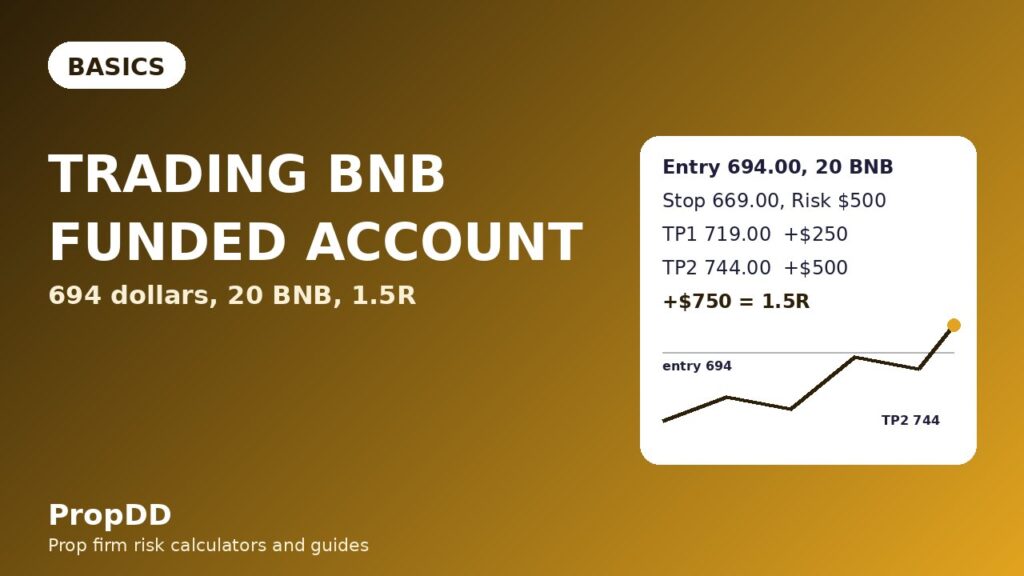
The trade that replaced the losing one came the following week, same setup, correct hour. BNB had based near 690 dollars, the support cluster between 681 and 723 dollars held for a third day, and the 17:00 Pakistan-time candle broke the intraday high at 694.00 and pulled back to hold it. I bought 20 BNB at 694.00 with the stop at 669.00, twenty-five dollars below, and two targets fixed before entry: close half at 1R, which is 719.00, and close the rest at 2R, which is 744.00.
| Leg | Price | Distance | BNB | Dollars |
|---|---|---|---|---|
| Entry, buy | 694.00 | – | 20 | – |
| Stop loss | 669.00 | 25 dollars | 20 | Risk 500 dollars |
| Target 1, close half | 719.00 | +25 dollars | 10 | +250 dollars |
| Target 2, close rest | 744.00 | +50 dollars | 10 | +500 dollars |
| Total result | – | – | – | +750 dollars = 1.5R |
The trade did what the plan said. It reached 719.00 in the evening session, I banked half for 250 dollars and moved the stop to breakeven, and the New York morning carried it to 744.00 for the remaining 500 dollars. The total was 750 dollars on 500 dollars of risk, exactly 1.5R, and the best part was not the profit: the risk was 500 dollars, inside my budget, because the size came from the dollar formula instead of a round number. The same 20 BNB with a 40-dollar stop would have risked 800 dollars, and the same 25-dollar stop on 50 BNB would have risked 1,250 dollars, which is a quarter of the daily limit on one trade. That is the whole guide in one comparison: 20 BNB with a 25-dollar stop is a plan, and any other combination of the same two numbers is a hope.
The sizing grid: stop distance decides the coins
I do not recalculate from scratch every evening. I keep a grid on my desk, built at a BNB price near 694 dollars, and I read the size off it for whatever stop the chart demands. Every row risks just under 500 dollars, and every row rounds the size down, never up, because rounding up is how a 495-dollar risk quietly becomes a 505-dollar risk.
| Stop distance | BNB | Risk in dollars | When I use it |
|---|---|---|---|
| 10 dollars | 50 | 500 | Tight break of the intraday high, stop just under it |
| 15 dollars | 33 | 495 | Pullback to the overnight low on the hourly chart |
| 20 dollars | 25 | 500 | Standard overlap trade, stop under the last swing |
| 25 dollars | 20 | 500 | The worked example, my most common stop |
| 30 dollars | 16 | 480 | Wide stop under a daily swing low |
| 40 dollars | 12 | 480 | Only around Binance headlines, rarely used |
If BNB moves, the grid does not need rebuilding, because the grid is built on dollar distance, not on percentage distance: a 25-dollar stop is a 25-dollar stop whether BNB trades at 694 or at 750. What changes is the notional value and the margin. At 750 dollars the same 20 BNB is 15,000 dollars of notional and 7,500 dollars of margin, which is why I check the margin number every time the price has moved 50 dollars since my last session. The Solana guide uses the same dollar-distance method, because every crypto CFD on this account is sized the same way: risk divided by stop distance, in dollars, with no pip conversion anywhere in the chain.
What a BNB day actually costs
The spread is the visible cost and the swap is the hidden one. At a 1.50-dollar target spread, the cost of entering and exiting is the spread times the size, which is 30 dollars on my standard 20-BNB trade. That is 6 percent of the 500-dollar risk, which is more than the Ethereum spread on the same account, because BNB’s book is thinner than Ethereum’s, and it is the price of trading the fourth-ranked coin instead of the second. The table below shows the spread cost at the sizes in my grid, and the point is that the cost scales with size, not with courage: doubling the coins doubles the spread bill.
| Position size | Spread cost at 1.50 dollars | Share of 500-dollar risk |
|---|---|---|
| 12 BNB | 18.00 dollars | 3.6 percent |
| 16 BNB | 24.00 dollars | 4.8 percent |
| 20 BNB | 30.00 dollars | 6.0 percent |
| 25 BNB | 37.50 dollars | 7.5 percent |
| 33 BNB | 49.50 dollars | 9.9 percent |
| 50 BNB | 75.00 dollars | 15.0 percent |
In the dead hours the spread is past 4.50 dollars, which triples every number in the table: the same 20-BNB trade costs 90 dollars to open and close, which is 18 percent of the risk, before the trade has moved a single dollar in my favour. That is the second reason the 02:00 trade failed. The wick that tagged my stop was bad luck; the 90-dollar spread bill was a certainty I had chosen by trading at that hour. The overnight swap is the other cost: it is charged nightly, it varies by firm, and on a multi-day hold it can eat a quarter of a 1R win. That is a cost problem with a simple solution: I do not hold BNB overnight. If you want the full cost picture including swap, the trading cost drawdown calculator shows how spread and fees stack against the daily limit.
The twelve-trade filter test
I tested the rules over twelve BNB trades: enter only in the 17:00 to 21:00 Pakistan-time window, only on a break of the intraday high with a pullback that holds, stop 25 dollars, targets at 1R and 2R, 0.5 percent risk, maximum two trades a day, flat before midnight. Eight won and four lost, and the winners averaged 1.5R because half the position ran to 2R. The net was 4,000 dollars, which is 8R, and the best single trade was 750 dollars, which is 18.75 percent of the net, comfortably inside the 30 percent consistency ceiling most firms enforce.
| Version | Trades | Wins | Losses | Net result |
|---|---|---|---|---|
| With all filters | 12 | 8 | 4 | +4,000 dollars = +8R |
| No filters, any hour | 15 | 6 | 9 | -1,500 dollars = -3R |
| Filters are worth | – | – | – | +5,500 dollars = +11R |
The unfiltered version is the interesting one. Fifteen trades, six wins, nine losses, net minus 1,500 dollars. The difference is not the entries: the entries were the same shapes. The difference is that the unfiltered version took dead-hours trades between 02:00 and 05:00 Pakistan time, traded the first fifteen minutes after Binance headlines, and let winners run without the 1R partial, so the average win fell to 1R while the losses stayed at 1R. Six wins at 1R minus nine losses at 1R is minus 3R. The filters did not find better trades; they removed the hours when BNB does not trade cleanly. A five-trade slice from the filtered run shows the rhythm: plus 750, minus 500, plus 750, minus 500, plus 750, a net of plus 1,250 dollars. Two losers in five trades and the account still grew, because the winners were bigger than the losers.
BNB against its neighbours
BNB is one of eight crypto articles I have written for this account, and the comparison matters because traders pick a coin by habit instead of by fit. The Solana guide covers the fastest mover of the group, with the tightest spreads after Ethereum and the sharpest reversals. The Ethereum guide covers the liquid benchmark, the coin with the deepest book and the smallest spread on the account. The XRP guide covers the news-driven coin, where a court headline can move the price more in an hour than a week of chart structure. The Litecoin guide covers the 12-dollar spread trap, and the Cardano guide covers the 15-dollar spread trap, while the Dogecoin guide covers the meme coin, where the moves are the widest in percentage terms and the stops must be the widest too.
| Coin | What moves it | Funded-account note |
|---|---|---|
| BNB | Bitcoin plus Binance headlines | Exchange-token risk; 1.50-dollar spread in liquid hours |
| Solana | Network upgrades, memecoin flows | Fastest mover; tightest spreads after Ethereum |
| Ethereum | The whole crypto market | Liquid benchmark; smallest spread on the account |
| XRP | Court and regulatory headlines | News-driven spikes; stops must clear the headline wick |
| Litecoin | Bitcoin, halving cycles | Wide spread trap; size from the dollar grid, not habit |
| Cardano | Development news, Bitcoin drift | Wide spread trap; slow mover, patience required |
| Dogecoin | Social media, Elon Musk posts | Widest percentage moves; widest stops of the group |
If you can only trade one altcoin on a funded account, BNB is the middle choice: more liquid than Cardano and Dogecoin, less liquid than Ethereum, and with a news cycle you can actually read in advance, because Binance publishes its announcements. If you already trade Solana, BNB adds almost nothing except a slower version of the same Bitcoin-driven move: trade one or the other, not both at full size on the same evening. I use the Ethereum guide rules for the liquid benchmark and this guide for the exchange token, and I never take the same direction on both at the same time, because two correlated positions are one position with double the risk. For the consistency angle, the consistency rule calculator shows how a 750-dollar best day sits against a 4,000-dollar month.
My BNB daily routine
The routine is boring on purpose. I check the Binance announcements, mark the support cluster, wait for the 17:00 overlap, and take at most two trades. The trend pullback strategy is the entry I use most often inside this routine: a break of the intraday high, a pullback that holds above it, and an entry on the reclaim, with the same 25-dollar stop and the same 20 BNB.
| Step | Pakistan time | Action |
|---|---|---|
| 1 | 16:30 | Check Binance announcements and the Bitcoin direction |
| 2 | 16:45 | Mark the 681 to 723 dollar support and resistance cluster |
| 3 | 17:00 | Overlap opens: watch the first 15 minutes, no trade before 17:15 |
| 4 | 17:15 – 21:00 | Take the setup if it comes: break, pullback, reclaim, 20 BNB, 25-dollar stop |
| 5 | At 1R | Bank half at 719.00, move the stop to breakeven |
| 6 | 21:00 | No new trades after the overlap ends; manage the open one only |
| 7 | 23:00 | Flat before midnight, log the trade, stop for the day |
| 8 | Next morning | Review the log: entry, stop, targets, spread paid, rule followed or not |
Step 7 is the one that protects the funded account. Midnight is a hard stop, not a suggestion, and the log is what makes the next evening faster: entry, stop, targets, the spread paid, and whether the trade followed the rules. Two trades a day is the maximum, and most days I take one. A funded account rewards the trader who trades the overlap and then stops, not the trader who trades every hour the market is awake.
Frequently asked questions
Can you trade BNB on a funded account?
Yes. Most crypto-friendly CFD prop firms list it as BNBUSD or BNB/USD on MT5, alongside Bitcoin, Ethereum and Solana. Check the symbol list before you buy a challenge, because a small number of firms offer only forex majors and gold, and some cap crypto leverage at 1:2, which changes the margin on every trade. If the symbol is there, the rules are the same as any crypto: daily loss limit, maximum loss limit, and usually a 1:2 leverage cap.
What is the BNB symbol on MT5?
Usually BNBUSD or BNB/USD, depending on the broker. Both track the same BNB token. Search the symbol list for BNBUSD first, then BNB/USD, and confirm the contract specification: the standard version is 1 lot equals 1 BNB with a minimum of 0.01 lots, while some brokers quote BNB in 0.1-lot steps, which changes every size number in this guide by a factor of ten.
How much BNB is a 500-dollar risk?
It depends on your stop. At a 25-dollar stop, 500 dollars of risk is 20 BNB, and at a 10-dollar stop the same risk is 50 BNB. The formula is size in BNB equals risk divided by stop distance in dollars. Never size from the coin price alone: 20 BNB at 694 dollars is 13,880 dollars of notional, and the same 20 BNB at a 40-dollar stop risks 800 dollars.
Is BNB the same as the BNB Smart Chain payout network?
No. BNB is the coin, BNB Smart Chain is the blockchain, and USDT on BEP20 is Tether sent over that chain. A firm can pay you in USDT on BEP20 and still not offer BNB/USD, and a firm can offer BNB/USD and pay only by bank transfer. Check the instrument list for BNBUSD and the payout page for the network separately, because they are two different decisions.
What time is best to trade BNB in Pakistan?
The London and New York overlap, 17:00 to 21:00 Pakistan time, has the best liquidity and the tightest spread, near 1.50 dollars per BNB. The London afternoon, 13:00 to 15:00, is the second window. The dead hours are 02:00 to 05:00, when the spread widens past 4.50 dollars and a single headline can wick the price 25 dollars, so I take no new trades then.
Does BNB trade on weekends on a funded account?
Yes, crypto trades 24 hours a day, 7 days a week, including weekends, on most firms. That is a trap as much as a feature: weekend liquidity is thinner, the spread is wider, and a Saturday headline moves further on less volume. I trade BNB on weekdays in the overlap window and treat the weekend as a no-trade period, because a funded account rewards the trader who trades the liquid hours and then stops.
Risk disclaimer: Trading leveraged crypto CFDs on a funded account can lose more than your challenge fee if you breach the firm’s loss limits, and past results from a twelve-trade test do not predict your results. The numbers in this guide come from my own 100,000-dollar funded account at a BNB price near 694.63 dollars on 7 November 2026; check your firm’s symbol specification and your own spread before you trade. This is education, not financial advice.