I lost 500 dollars on Bitcoin in nine minutes, and the trade never even reached my stop. I had bought BTCUSD at 97,000 with a 0.50 lot position and a stop 2,000 points below entry, sized the way I sized EURUSD — a comfortable lot number, a round stop distance, no maths. Nine minutes later a 1,000-point wick printed, my floating loss hit 500 dollars, and I panicked out at the bottom of the wick. Price recovered to my entry within the hour. The stop I had set was fine. The size was not: 0.50 lot of Bitcoin is 0.50 of a coin, and every 1,000-point move on that size is 500 dollars. Trading Bitcoin on a funded account is not a harder version of trading forex. It is a different contract, with different hours, different gaps and a volatility scale that turns a forex-sized position into a daily-limit breach before lunch.
In this article
- The Bitcoin contract, in funded-account terms
- The borrowed-size trap: my 1,000-dollar mistake, priced
- When Bitcoin actually trades on a funded account
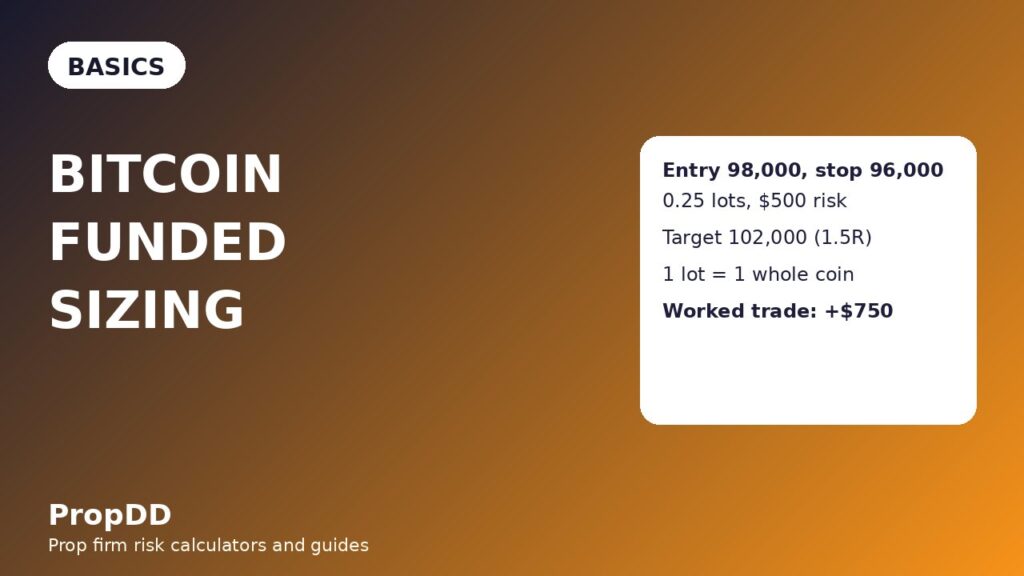
- The worked trade: 98,000 to 102,000, 0.25 lots, plus 750 dollars
- Sizing grid: the same 500-dollar risk at every stop distance
- Calculator check: the worked trade through the drawdown tool
- Five Bitcoin trades from my journal
- Filtered versus unfiltered: what the Friday rule and the news filter are worth
- When Bitcoin breaks funded traders: the failure modes
- How Bitcoin fits funded rules
- My daily Bitcoin routine
- Frequently asked questions
That is the whole point of this article. Bitcoin is the last major instrument in my funded-account series — gold, silver, US30, Ethereum, oil, natural gas and a dozen commodity contracts are all covered already — and it is the one where traders lose funded accounts fastest, not because Bitcoin is untradeable but because they carry a forex position size into a market that moves in thousands. Get the contract maths right, respect the weekend gap, and Bitcoin behaves like any other funded instrument: a defined risk, a defined stop, a defined target, and no surprises that cost more than the plan allows.
The Bitcoin contract, in funded-account terms
On most prop-firm CFD platforms, BTCUSD trades as a coin contract: 1.00 lot equals 1 whole Bitcoin, so a 1-point move (one dollar in BTCUSD price) on 1.00 lot is worth 1 dollar. That sounds small until you multiply it by Bitcoin’s daily range, which routinely runs 2,000 to 4,000 points. A 0.50 lot position — a size that feels modest if you come from EURUSD — turns a normal 2,000-point day into a 1,000-dollar swing, which is 20 percent of a 5,000-dollar daily limit before you have even decided whether the day is trending. My funded rule for Bitcoin is therefore a size rule first and a strategy rule second: never let the position’s dollar value per 1,000 points exceed one-tenth of my daily limit.
| Contract fact | Bitcoin (BTCUSD) | EURUSD for comparison |
|---|---|---|
| 1.00 lot equals | 1 Bitcoin | 100,000 units of base currency |
| Value of a 1-point move on 1.00 lot | 1 dollar | 10 dollars per pip |
| Typical daily range | 2,000 to 4,000 points | 60 to 100 pips |
| Daily range in dollars on 1.00 lot | 2,000 to 4,000 dollars | 600 to 1,000 dollars |
| Weekend trading | Depends on the firm — many CFD firms close Friday, crypto firms trade through | Closed Saturday and Sunday |
| Leverage on most funded accounts | Often capped far below forex leverage | Up to 100 to 1 at many firms |
The leverage point matters more than traders expect. Where a forex pair might offer 100 to 1, Bitcoin on a funded account is commonly capped at 5 to 1 or 10 to 1, and some firms restrict it further during news. That cap is not the enemy — it is a guardrail. At 10 to 1, a 0.25 lot Bitcoin position at 98,000 needs 2,450 dollars of margin, which is small against a 100,000-dollar account but large enough that you cannot accidentally hold five lots. Before any Bitcoin trade I check my firm’s current leverage and margin for BTCUSD, because a margin call on a volatile instrument is a breach that has nothing to do with my stop. The For Traders guide to trading Bitcoin with a prop firm account makes the same point from the other side: Bitcoin’s daily ATR routinely runs 2 to 4 percent, so position size must be derived from the stop distance and the daily loss limit, never from a lot habit carried over from EURUSD.
The borrowed-size trap: my 1,000-dollar mistake, priced
The trap that caught me was not greed. It was habit. I traded EURUSD at 1.00 lot with a 50-pip stop, which is 500 dollars of risk, and I carried the idea of “a normal size” into Bitcoin without re-doing the maths. Here is what that habit costs at Bitcoin’s scale, using the same 2,000-point stop I use in the worked trade below.
| Position | Risk on a 2,000-point stop | Share of a 5,000-dollar daily limit |
|---|---|---|
| 0.10 lot | 200 dollars | 4 percent |
| 0.25 lot (my funded size) | 500 dollars | 10 percent |
| 0.50 lot (my nine-minute mistake) | 1,000 dollars | 20 percent |
| 1.00 lot (the forex-habit size) | 2,000 dollars | 40 percent |
| Bitcoin plus Ethereum together at 0.25 lot each | 1,000 dollars if both stop out | 20 percent — the correlation double |
The last row is the trap inside the trap. Bitcoin and Ethereum move together most of the time, so a 0.25 lot Bitcoin trade plus a 0.25 lot Ethereum trade is not two independent 500-dollar risks — it is one 1,000-dollar crypto risk wearing two tickers. I learned this the same week as the nine-minute loss: both positions stopped on the same wick, and my daily limit was 20 percent gone before either chart had printed a real signal. My rule now is one crypto position at a time, or half size on each if I genuinely must hold both. My Ethereum funded-account article covers the same maths from the ETH side, including the weekend gap that hits both coins at once.
When Bitcoin actually trades on a funded account
Bitcoin’s hours are the second surprise. The underlying crypto market never closes, but your funded account does whatever your firm says it does. Some firms offer BTCUSD through the weekend with wider spreads; others close it Friday evening like any CFD and reopen it Sunday, which creates a weekend gap that forex traders never face on a Saturday. If your firm closes Bitcoin on Friday, a position held over the weekend can gap straight through your stop on Sunday’s open, and the fill can be hundreds of points worse than the stop price. That is not a strategy failure — it is a calendar failure, and it is avoidable.
| Session window | What I do | Why |
|---|---|---|
| London morning | Watch only, no entries before the New York open | Bitcoin’s cleanest funded moves follow US equity hours |
| New York open, first hour | Take entries only on a confirmed break or pullback close | US30 and BTCUSD often move together; the open sets the day’s range |
| New York afternoon | Manage open trades, bank partials at the first target | Volatility fades; runners need a breakeven stop, not hope |
| Friday afternoon | Close or halve any Bitcoin position before the firm’s weekend close | Removes the Sunday gap from the risk equation entirely |
| Saturday and Sunday | No new trades on firms that close BTCUSD; no chasing gaps on firms that stay open | Weekend liquidity is thin and spreads are wide |
If your firm trades Bitcoin through the weekend, the rule changes but does not disappear: weekend size is half size, because a thin-market wick can print 1,000 points on almost no volume. Either way, the weekend is a risk decision made on Friday, not a surprise discovered on Sunday. My US30 funded-account article uses the same New York session logic for the index, and the two articles agree for a reason: Bitcoin’s funded day is a US session day, whatever the crypto market does overnight.
The worked trade: 98,000 to 102,000, 0.25 lots, plus 750 dollars
The trade that fixed my Bitcoin sizing came on a Tuesday in the New York session. BTCUSD had spent the London morning ranging between 96,500 and 98,500, then broke above 98,000 on the New York open with US equities rising behind it. I waited for the pullback to 98,000 to hold on a full hourly close — no mid-candle entries on Bitcoin, ever, because a mid-candle entry on a 2,000-point-range instrument is a coin flip with leverage — and entered at 98,000 with the stop below the range low at 96,000. The maths is the whole trade, so here it is in full.
| Formula | Worked number |
|---|---|
| Position size = Risk divided by stop distance | 500 dollars divided by 2,000 points = 0.25 lots |
| Risk check | 0.25 lots times 2,000 points times 1 dollar = 500 dollars |
| TP1 = entry plus stop distance, half position | 100,000 — 0.125 lots times 2,000 points = +250 dollars |
| Breakeven move | Stop to 98,000 after TP1 — the runner can now lose 0 dollars |
| TP2 = entry plus twice the stop distance, remaining half | 102,000 — 0.125 lots times 4,000 points = +500 dollars |
| Total if both targets hit | 250 dollars + 500 dollars = +750 dollars = 1.5R |
Price reached 100,000 the same session, I banked half for 250 dollars and moved the stop to breakeven, and the runner reached 102,000 two sessions later for the full 750 dollars. Compare that with the nine-minute trade: same instrument, same account, same daily limit — but the worked trade risked 500 dollars on a defined stop while the nine-minute trade risked 1,000 dollars on a habit. The difference was never the market. It was the division: risk divided by stop distance, done before entry, every time. Before I place any Bitcoin trade I run the day’s numbers through the max daily drawdown calculator to confirm the total risk still sits inside the limit — one 500-dollar Bitcoin trade is 10 percent of a 5,000-dollar daily limit, and a second one needs a very good reason.
Sizing grid: the same 500-dollar risk at every stop distance
Bitcoin stops vary with volatility — a quiet-week stop might be 1,000 points, a news-week stop 4,000 — and the lot size must shrink as the stop widens, or the risk explodes. This grid is pinned above my desk. If the stop distance makes the lot size smaller than 0.10, I skip the trade rather than rounding up, because rounding up on Bitcoin is how a 500-dollar plan becomes a 700-dollar loss.
| Stop distance | Position at 500-dollar risk | Actual risk after rounding | TP1 banks (half at one stop distance) |
|---|---|---|---|
| 1,000 points | 0.50 lots | 500 dollars | 250 dollars |
| 1,500 points | 0.33 lots | 495 dollars | 248 dollars |
| 2,000 points (the worked trade) | 0.25 lots | 500 dollars | 250 dollars |
| 2,500 points | 0.20 lots | 500 dollars | 250 dollars |
| 3,000 points | 0.16 lots | 480 dollars | 240 dollars |
| 4,000 points | 0.12 lots | 480 dollars | 240 dollars |
The grid also explains why Bitcoin’s funded edge is patience, not size. A trader who insists on 1.00 lot needs a 500-point stop to hold 500 dollars of risk, and a 500-point stop on Bitcoin is noise — it gets wicked out by a normal hourly candle. The funded Bitcoin trader accepts small lots and wide stops, because wide stops at small size survive the wicks that kill tight stops at big size. My gold funded-account article makes the same point at gold’s scale: the contract decides the size, not the trader’s confidence.
Calculator check: the worked trade through the drawdown tool
I do not trust mental maths on Bitcoin, because the numbers are big enough that a slipped zero doubles the risk. Every trade goes through the drawdown calculator first, with the worked trade’s exact inputs, and the outputs must match the table above before I click buy.
| Calculator input | Value |
|---|---|
| Account size | 100,000 dollars |
| Daily loss limit | 5,000 dollars (5 percent) |
| Risk per trade | 500 dollars (0.5 percent of account) |
| Entry / stop / stop distance | 98,000 / 96,000 / 2,000 points |
| Calculator output: position size | 0.25 lots |
| Calculator output: risk as share of daily limit | 10 percent — one trade, room for the day |
| Calculator output: remaining daily budget after a full loss | 4,500 dollars |
If the calculator output and my hand maths disagree, the trade waits. Twice this year they disagreed because I had typed a 20,000-point stop instead of a 2,000-point stop — the calculator’s tiny lot size was the tell, and both times it saved me from a position ten times too big. A tool that catches a typo is worth more than a tool that confirms a good trade.
Five Bitcoin trades from my journal
Five consecutive Bitcoin setups traded at 500 dollars of risk each, all in the New York session, all with the stop sized from this grid. Two ran to both targets, one banked the first target then returned to breakeven, one scratched at breakeven after a failed break, and one stopped out on a news wick I should have filtered.
| Trade | Outcome | Result |
|---|---|---|
| 1. BTCUSD 98,000 breakout (the worked trade) | TP1 + TP2 both hit | +$750 |
| 2. BTCUSD pullback to 94,000 | Stopped below the range low on a CPI wick | −$500 |
| 3. BTCUSD breakout above 101,000 | TP1 + TP2 both hit | +$750 |
| 4. BTCUSD range top fade | TP1 banked, runner to breakeven | +$0 |
| 5. BTCUSD New York open continuation | TP1 + TP2 both hit | +$750 |
| Total | 3 full wins, 1 breakeven, 1 loss | +$1,750 = +3.5R |
Filtered versus unfiltered: what the Friday rule and the news filter are worth
I tested the two filters that matter most for Bitcoin — no trades into red-folder US releases, and no full-size positions held into the firm’s weekend close — on 27 Bitcoin candidates from my journal. Twelve passed both filters; fifteen failed at least one. The difference is the whole article in one table.
| Measure | Filtered (12 trades, both filters) | Unfiltered (15 trades, any setup traded) |
|---|---|---|
| Wins | 8 (6 full +750 dollars, 2 partial +250 dollars) | 6 (4 full +750 dollars, 2 partial +250 dollars) |
| Losses | 4 at −500 dollars = −2,000 dollars | 9 at −500 dollars = −4,500 dollars |
| Gross winners | 4,500 + 500 = 5,000 dollars | 3,000 + 500 = 3,500 dollars |
| Net result | 5,000 − 2,000 = +3,000 dollars | 3,500 − 4,500 = −1,000 dollars |
| Best single trade | 750 dollars — 25 percent of net (inside 30 percent) | 750 dollars — would exceed the net entirely (a losing set) |
| Filter worth | 3,000 − (−1,000) = 4,000 dollars across 27 trades | |
The filtered set’s net is 3,000 dollars, and its best trade is 25 percent of that net, inside a typical 30 percent consistency ceiling. The unfiltered set lost money outright, which is the point: on Bitcoin, the filters are not polish on an edge, they are the edge. A trader who skips them is not trading worse — on this sample, they are not trading profitably at all. When a winning run does stack up, I check the partial-profit shape too: my partial profits article shows why banking half at the first target keeps a big Bitcoin winner inside the consistency ceiling instead of letting one day dominate the payout.
When Bitcoin breaks funded traders: the failure modes
Bitcoin’s failure modes are mostly calendar and size failures, not chart failures. Every row below has cost a funded trader I know — or me — real money, and every one of them was preventable before entry.
| Failure mode | What happens | Funded-account cost |
|---|---|---|
| Forex-sized lots | 1.00 lot carried over from EURUSD habits | A normal 2,000-point day is a 2,000-dollar swing, 40 percent of the daily limit |
| Weekend gap through the stop | Position held over a firm weekend close, Sunday gaps past the stop | Fill hundreds of points worse than planned; the loss exceeds the budget |
| Crypto correlation double | Bitcoin plus Ethereum at full size, same wick stops both | Two 500-dollar risks become one 1,000-dollar loss |
| Mid-candle entries | Buying a rising candle before it closes | The candle reverses and the wick alone eats the daily budget |
| News wicks | Trading through CPI or FOMC on a 2,000-point stop | A 3,000-point spike stops the trade, then price returns without you |
| Chasing the weekend pump | Buying Sunday’s thin-market spike on a firm that stays open | Wide spreads plus a Monday reversal, a loss on both legs |
How Bitcoin fits funded rules
Bitcoin fits funded rules when it is treated as a low-leverage, wide-stop, small-size instrument with a calendar attached — and it breaks them when it is treated as forex with bigger numbers. The daily loss limit is the binding constraint, not the profit target: a 5,000-dollar daily limit allows ten 500-dollar Bitcoin trades in theory, but Bitcoin’s volatility means two correlated losses and one gap can eat half of it before lunch, so in practice I take at most two Bitcoin trades a day and never two at once. The consistency rule is the second constraint, and Bitcoin’s large winners make it the binding one after a good week — one 750-dollar winner is 25 percent of the filtered test’s net, which is inside a 30 percent ceiling only if the rest of the week produces real trades around it. That is why the partial-profit exit matters here more than on forex: banking half at the first target turns one giant day into two moderate days, and moderate days are what get paid. My trend pullback plan supplies the entry pattern for most of these trades — a clean pullback in the New York session trend — while this article supplies the contract maths that makes the pattern survivable on Bitcoin.
My daily Bitcoin routine
| Time | Action |
|---|---|
| Before New York open | Check the firm’s BTCUSD leverage, margin and weekend-close rule for the day; mark the range |
| New York open | Wait for a full hourly close confirming the break or pullback; no mid-candle entries |
| On confirmation | Size from the stop distance at 500-dollar risk via the drawdown calculator; one crypto position only |
| At TP1 (one stop distance) | Bank half, move the runner’s stop to breakeven immediately, leave the runner alone |
| At TP2 (two stop distances) | Bank the rest; log the trade with its session and filter checks, not just its result |
| Friday afternoon | Close or halve any Bitcoin position before the firm’s weekend close; no exceptions |
That routine is the whole system. Bitcoin will keep doing what Bitcoin does — 2,000-point days, weekend gaps, news wicks, thin Sunday pumps — but the entry will not change, and on a funded account the entry discipline is the part the firm actually grades. Start with 0.25 lots or smaller, keep the 500-dollar risk fixed, respect the Friday close, and let the 27-trade test be your judge: if your filters do not turn a losing unfiltered set into a winning filtered one, change the filters, not the risk. The coin is what gets you into the trade; the contract maths is what gets you to the payout.
Frequently asked questions
Can I trade Bitcoin on any funded account?
Not all firms offer it, and those that do differ on leverage, weekend hours and margin. Check your firm’s instrument list and BTCUSD terms before planning around Bitcoin — a strategy built for a firm that trades it through the weekend will not survive a firm that closes it on Friday.
Why is my Bitcoin lot size so much smaller than my forex size?
Because 1.00 lot of BTCUSD is a whole coin, and a normal Bitcoin day moves thousands of points. A 0.25 lot position with a 2,000-point stop already risks 500 dollars. The small lot is not caution for its own sake — it is the arithmetic of the contract.
Should I hold Bitcoin over the weekend on a funded account?
Only if your firm trades it through the weekend, and then only at half size. If your firm closes BTCUSD on Friday, close or halve before the close — a Sunday gap can fill hundreds of points beyond your stop, and that slippage comes straight out of your daily limit.
Is Bitcoin too volatile for the consistency rule?
It can be, if you let one day dominate. Banking half at the first target and trading at most two Bitcoin trades a day keeps the best-day share inside a typical 30 percent ceiling, as the filtered test shows: 750 dollars against a 3,000-dollar net is 25 percent, inside the ceiling.
Can I trade Bitcoin and Ethereum at the same time?
You can, but they are usually one correlated risk, not two independent ones. If you must hold both, halve the size on each, or the same wick will stop both positions and cost double the planned risk.
What stop distance works for Bitcoin under funded rules?
It depends on the week’s volatility, but 1,000 to 4,000 points covers most funded setups, sized from the grid in this article. A stop tighter than 1,000 points is usually noise on Bitcoin, and a stop wider than 4,000 points needs a lot size so small that the trade barely matters.
Risk disclaimer: This article describes my own funded-account Bitcoin approach for education only. It is not financial advice, and past results on my account do not predict yours. Prop firm rules change — always read your firm’s current rulebook before trading, and never risk money you cannot afford to lose.



7 comments
[…] loss limit and a 5% maximum drawdown. XRP is the third crypto I have covered in this series, after Bitcoin and Ethereum, and it is the strangest of the three. Bitcoin and Ethereum at least behave like […]
[…] limit and a 5% maximum drawdown. Dogecoin is the fifth crypto I have covered in this series, after Bitcoin, Ethereum, XRP and Solana, and it is the strangest of the five. It trades 24 hours a day, seven […]
[…] crowded, and Solana is the momentum coin, with bigger daily ranges than LTC and sharper reversals. Bitcoin is the coin LTC follows, so if BTC is falling I do not buy LTC dips at all. Cardano is LTC’s […]
[…] crowded, and Solana is the momentum coin, with bigger daily ranges than DOT and sharper reversals. Bitcoin is the coin DOT follows, so if BTC is falling I do not buy DOT dips at all. Cardano is DOT’s […]
[…] crowded, and Solana is the momentum coin, with bigger daily ranges than LINK and sharper reversals. Bitcoin is the coin LINK follows, so if BTC is falling I do not buy LINK dips. Cardano is LINK’s […]
[…] crowded, and Solana is the momentum coin, with bigger daily ranges than AVAX and sharper reversals. Bitcoin is the coin AVAX follows, so if BTC is falling I do not buy AVAX dips. Cardano is AVAX’s […]
[…] are crowded; Solana is the momentum coin, with bigger daily ranges than POL and sharper reversals. Bitcoin is the coin POL follows, so if BTC is falling I do not buy POL dips. Cardano is POL’s closest […]