You take a loss. A fair one, the setup simply didn’t work. But your chest tightens, you start staring at the chart a little too hard, and a small voice says: get it back, one good trade and you’re even. That voice has ended more prop firm accounts than any market crash ever will.
In this article
- What revenge trading actually is
- Why it feels like logic while you're doing it
- Anatomy of a revenge day
- The maths of escalating size
- Why it's worse on a prop account
- Warning signs you can catch in real time
- Common triggers
- The ten-minute reset
- Rules that make revenge trading hard
- Write an if-then plan
- Using the calculator as a brake
- If you already did it: damage control
- Routines that lower the odds
- Journal the urge, not just the trade
- When to take a few days off
- Myths worth dropping
- A word on being kind to yourself
- Further reading
- Frequently asked questions
- The short version
- Revenge trading is size and frequency creeping up after a loss, and it burns the daily limit far faster than normal losing trades.
- The warning signs show up before the damage: bigger lots, skipped rules, trades without a clear setup.
- A fixed stop rule, a short reset break and a written if-then plan beat willpower every time.
This guide explains what revenge trading really is, why it feels so logical while it’s happening, and how it interacts with the hard wall of a daily loss limit. You’ll get a worked example with numbers, a list of triggers, a ten-minute reset routine and the rules that make the whole thing harder to do. If you want to check how much room you actually have left after a loss, keep the drawdown calculator open while you read.
What revenge trading actually is
Revenge trading means placing trades mainly to recover a loss, rather than because your plan says there’s a setup. The motive is emotional: you want the loss to “not have happened”. The market doesn’t know or care, of course, and that mismatch is where the trouble starts.
It rarely looks dramatic. Usually it’s a slightly larger lot size, a slightly looser entry, a trade taken five minutes earlier than the plan allows. Researchers who study this kind of decision-making call it a bias that comes from how people feel about losses, and the field is covered in this overview of behavioural finance. You don’t need the theory to feel it. You just need to have had a bad morning.
Why it feels like logic while you’re doing it
This is the part nobody warns you about. In the moment, revenge trading doesn’t feel emotional. It feels like reasoning. “The setup is still valid.” “I only need 1% to be flat.” “The market owes me a bounce.” Each thought sounds sensible, and together they walk you off a cliff.
Notice the pattern: the target is your loss, not the market. A normal trade asks, “what does the chart say?” A revenge trade asks, “what do I need to get back to even?” The second question has no connection to the price at all.
Anatomy of a revenge day
Here’s an imaginary but very typical day. Ali has a $100,000 challenge account with a 5% daily limit, so his floor is $95,000. His plan: risk $500 per trade, maximum three trades.
- 09:10 Trade one, stopped out. −$500. Fine.
- 09:50 Trade two, stopped out. −$500. Annoying, but still within plan. Down $1,000.
- 10:20 Trade three, hit stop by two pips and then the price reverses to his target. −$500. Down $1,500. This is the moment the day changes.
- 10:25 He takes a fourth trade, outside his rule, risking $1,000 “to make it back in one go”. Stopped out. Down $2,500.
- 10:50 Fifth trade, risk $1,500, no real setup. Stopped out. Down $4,000. He’s used 80% of the daily limit in under two hours.
- 11:10 Sixth trade, risk $1,500. Floating loss hits $1,000. Equity touches the floor. Account closed.
Three planned losses cost him $1,500. The next three unplanned trades cost him the account. None of the unplanned trades was a good idea, and every one of them felt like a good idea.
The maths of escalating size
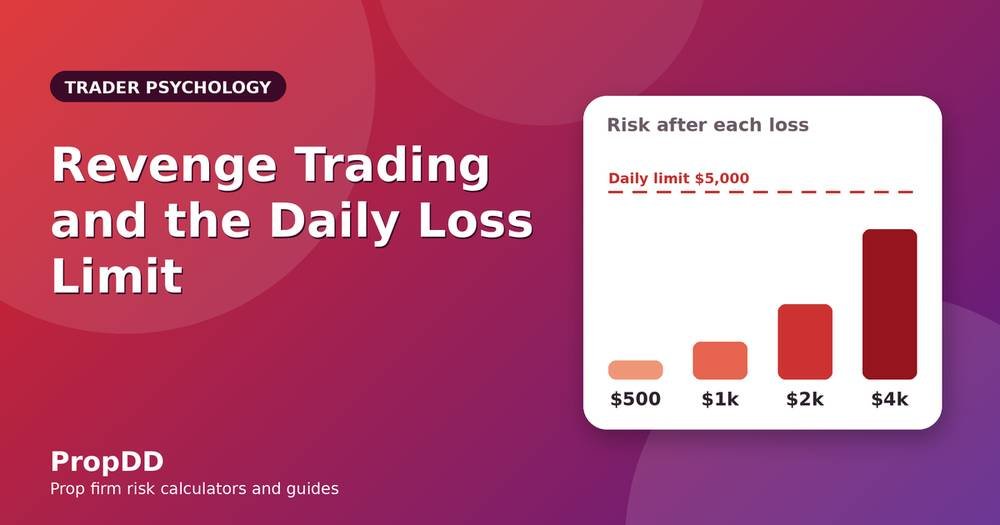
The brutal thing about increasing size after a loss is how quickly it compounds against a fixed limit. Look at what happens when risk doubles after each loss compared with staying constant.
| Loss number | Constant $500 risk | Risk doubles each loss | Used of $5,000 limit (doubling) |
|---|---|---|---|
| 1 | $500 | $500 | 10% |
| 2 | $1,000 | $1,500 | 30% |
| 3 | $1,500 | $3,500 | 70% |
| 4 | $2,000 | $7,500 | Breached |
With constant risk, four losses still leave 60% of the limit. With doubling, the third loss is already dangerous and the fourth ends the day, and the account. Nobody would plan the doubling column. Everybody drifts into it one reasonable decision at a time.
Why it’s worse on a prop account
On your own broker account, a bad day costs money and perhaps pride. On a prop account, there’s a hard wall a few percent away, and crossing it ends the whole thing. Add the fact that most firms watch live equity, as explained in balance-based versus equity-based rules, and a large revenge trade doesn’t need to lose by much to finish you. A floating dip is enough.
There’s also the sunk-cost effect of the fee. You paid for this challenge, which makes quitting for the day feel like giving up on the money. In practice, stopping early is the thing that protects it.
Warning signs you can catch in real time
- Your lot size is bigger than the plan, “just this once”.
- You’re entering without writing down the stop and target first.
- You moved or removed a stop loss.
- You switched to a different pair because “this one isn’t working”.
- You’re checking your equity more than the chart.
- You feel hot, restless or slightly sick after a loss.
- You’ve stopped counting trades.
If three or more of these match, you’re already in it. The earlier you notice, the cheaper the exit.
Common triggers
The “unfair” loss
Stopped out by two pips, then the price goes to target. This is the classic trigger, because it feels like you were right and still lost.
A near-miss on a big winner
You missed an entry and watched it run. The urge to “catch the next one” produces forced trades.
Comparison and deadlines
Seeing other traders post results, or a challenge window closing, pushes you to speed up. Rushing and revenge are close cousins.
Boredom after a quiet session
Not a loss at all, but the same impulse: you want something to happen. This is why a maximum trade count matters even on winning days.
The ten-minute reset
When you notice the urge, run this routine. It’s deliberately simple.
- Close or protect everything. Don’t leave a decision pending while you’re emotional.
- Stand up and leave the screen. Walk, drink water, step outside. Physical distance breaks the loop better than willpower.
- Write three lines: what happened, what I feel, what the plan says I may do next.
- Check the numbers. Enter today’s result in the calculator and look at the percentage of the daily limit used.
- Decide in advance: either one planned trade at normal size, or done for the day.
Ten minutes is enough for the heat to drop. Most traders who use it report that the “must trade now” feeling fades quickly, and the setup they were desperate to take looks ordinary afterwards.
Rules that make revenge trading hard
Willpower is unreliable at 10:25 on a losing morning. Rules you made last night are better.
- Two losses in a row, stop for an hour. Three losses, finished for the day.
- Maximum trades per day. Three or four, written down.
- Personal daily stop at 60% to 80% of the firm’s limit. See how to set a personal daily stop.
- Fixed risk per trade. No changing it after a loss. The method is in how much to risk per trade.
- Close the platform when you hit the stop. Not minimise, close.
Write an if-then plan
Psychologists call it an implementation intention: a specific “if this, then that” decided in advance. It works because you’ve already made the decision, so you only have to follow it. Examples:
- If I lose two trades in a row, then I close the platform for 60 minutes.
- If my equity reaches the soft stop, then I close all positions and log off.
- If I notice I want to increase size, then I write down why, and I don’t.
Put the list where you can see it. It takes five minutes and does more than a month of “being more disciplined”.
Using the calculator as a brake
Numbers calm emotions better than advice. After a loss, enter your start-of-day equity and today’s profit or loss. Watch the bar. If it’s amber or red, the calculator is telling you what your gut doesn’t want to hear: the day is already expensive. Seeing “used 62% of the limit” next to the temptation to risk 3% on one trade can be the thing that makes you shut the laptop.
If you already did it: damage control
- Close the revenge position if it breaks your rules. A small certain loss is better than a hopeful big one.
- Don’t “fix” it with another trade.
- Take a screenshot of your equity and the trade list.
- Write what triggered it, honestly, in your trading journal.
- Reduce your risk by half tomorrow, then rebuild.
The account may survive. Your habits won’t improve unless you look at what happened.
Routines that lower the odds
Sleep matters more than any indicator. Tired traders take worse trades and forgive themselves faster. Eat before the session, keep water nearby, and schedule a break every 90 minutes. Don’t trade right after an argument or bad news. If your day began badly, halve your size or sit out. It sounds soft, and it’s one of the cheapest edges available.
Journal the urge, not just the trade
Most journals record entries and exits. Add two fields: “urge to trade outside plan (0 to 10)” and “what triggered it”. After a month, patterns appear. Maybe your worst urges come after stop-outs of less than five pips, or after 2 p.m., or on Fridays. Patterns can be planned around. Feelings you never wrote down can’t.
When to take a few days off
Consider a break if you’ve broken your own rules three days in a row, if you’ve been thinking about the account when you’re away from the screen, or if a single loss ruins your mood for the evening. A short break isn’t failure. It’s maintenance, and the account will still be there. A prop trader who sits out three days loses nothing; one who breaches loses the account.
Myths worth dropping
- “I’m just taking the next valid setup.” Check if you’d take it at normal size on a winning day. If not, it’s revenge.
- “Bigger size will end the pain faster.” It ends the account faster.
- “Good traders don’t feel this.” Everyone does. The difference is the rules around it.
- “I’ll stop after one more.” The “one more” is the problem.
A word on being kind to yourself
Beating yourself up after a revenge trade makes the next one more likely, not less. Shame is just another loss to avenge. Treat the episode like a data point: name it, learn the trigger, adjust the rule and move on. Consistency comes from a boring, forgiving routine, not from perfection.
Further reading
If you’d like to go deeper on the psychology, the free lessons at BabyPips include material on trading discipline, and Investopedia’s page on risk management covers the wider framework. For tracking your own behaviour objectively, a service such as Myfxbook can show how your trade size and frequency changed after losing days.
Frequently asked questions
Is revenge trading the same as overtrading?
They overlap. Overtrading is too many trades for any reason; revenge trading is specifically driven by the wish to recover a loss. Both burn the daily limit quickly.
Does a smaller risk per trade really help?
Yes. When a loss is 0.3% of the account, it barely registers emotionally, so there’s less to avenge.
What if I only feel the urge after losses near the daily limit?
That’s common, because the stakes feel higher. Use a personal stop that triggers before you reach that zone.
Can I trade again the same day after stopping?
Many traders choose not to, to keep the rule clean. If you do, make the decision the next morning, in writing, not at the screen.
The short version
Revenge trading is a loss turning into a plan. Catch it by noticing the signs, interrupt it with a short reset, and prevent it with rules you wrote while calm. Combine that with a small fixed risk and a personal stop, and the daily limit stops being a threat and becomes just a number you rarely approach. For the full picture of how breaches happen, read why traders breach the daily loss limit, and for the basics of the rule itself, the guide to the max daily drawdown.