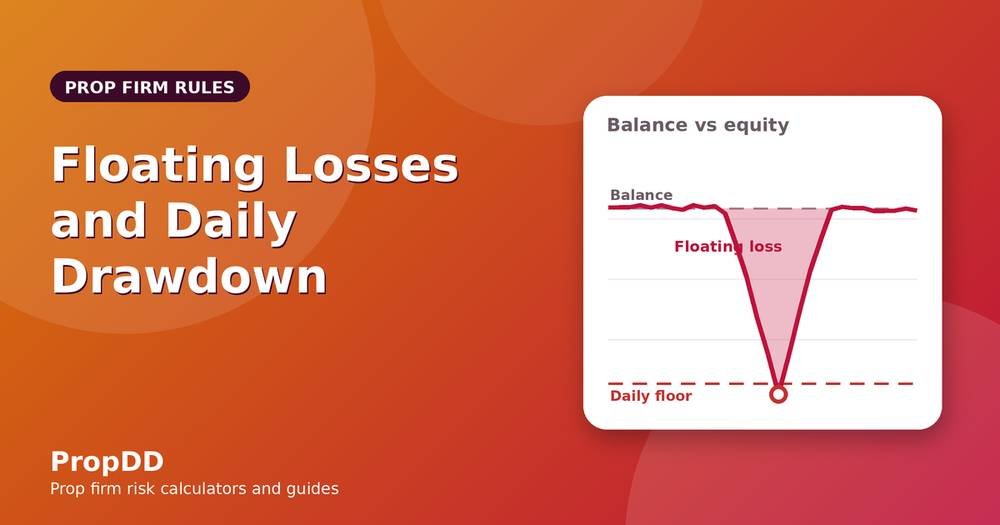
Here’s a situation that plays out more often than prop firms like to admit. A trader opens a position, the market moves against it for about ninety seconds, the account’s equity touches the daily loss floor, and the account is closed. Then the price turns around and the trade would have finished in profit. The trader never closed anything and still lost the lot.
In this article
- What "floating" means
- Why firms count it
- A breach in slow motion
- The danger isn't the trade, it's the stack
- The "it'll come back" trade
- Spreads, news and rollover
- The weekend gap
- Sizing for the worst instant, not the planned stop
- Alerts on equity, not balance
- Close early or hold?
- Partial closes and hedges
- When the dashboard disagrees with your platform
- A short pre-trade routine
- What your platform actually shows
- Why the dip matters even when you win
- Open risk by account size
- Habits worth borrowing
- A last thought on patience
- If you only change one thing
- Frequently asked questions
- The short version
It’s not unfair, exactly. It’s just a rule that a lot of people don’t realise applies to them until it’s too late. Let’s go through why floating losses count, how they sneak up on you, and what to do about it. If you want the exact figures for your own account, the drawdown calculator has a field for today’s result including open trades.
What “floating” means
A floating loss, also called an unrealised loss, is the profit or loss on a trade that’s still open. The money hasn’t left your balance yet, but your equity already reflects it. Equity is balance plus floating profit or loss, and it moves with every price tick.
So when your platform says balance $100,000 and equity $97,500, you have $2,500 of floating loss somewhere. Nothing’s been “lost” in the history tab. As far as your daily loss rule goes, though, it might as well have been.
Why firms count it
From the firm’s side it makes perfect sense. They’re protecting their capital, and the risk exists the moment the position is open. If a trader could hold a huge losing position for days and only count the loss when it closed, the daily rule would be meaningless. Counting equity closes that loophole.
Not every firm does this, and some apply it only to the overall limit, not the daily one. That’s why reading the rules matters; our article on balance-based versus equity-based drawdown shows how to work out which you’ve got. If you can’t tell, assume equity.
A breach in slow motion
Take a $100,000 account, a 5% daily limit and a floor of $95,000. A trader has closed a loss of $1,200 this morning, so equity is $98,800. Then they open a position with a 40-pip stop and a size of 3 lots on EURUSD, which is $1,200 of planned risk. Another trade, 2 lots, 30-pip stop, another $600.
Total planned risk on open trades: $1,800. Nothing wrong with that on paper: if both stops hit, equity would be $97,000, comfortably above the floor. Now add slippage on a news spike, and the stops fill 15 pips worse than planned. The real loss on the pair is 3 × 55 × $10 + 2 × 45 × $10 = $1,650 + $900 = $2,550, so equity falls to $96,250. Still above the floor, but the trader has now used 75% of the limit with a single burst of movement.
It’s worth sitting with that for a second. Neither trade was reckless on its own. Together, in a fast market, they came within a whisker of the floor.
The danger isn’t the trade, it’s the stack
One open trade is easy to track. Three is harder, and five is where people lose count. And pairs that look different often aren’t: long EURUSD, long GBPUSD and short USDCHF are all, roughly, the same bet on a weaker dollar. When the dollar jumps, all three lose at once.
The practical habit is to add up the stop distances (in dollars) of everything that’s open, every time. That total is your instant worst case, and it should sit well inside the room you have left, not on the edge of it. I’d say half of the room is a sensible ceiling.
The “it’ll come back” trade
This is where floating losses do the most psychological damage. A trade goes against you. Your stop is a few pips away, but it’s been a bad morning, and you move the stop, or remove it, because “it always comes back”. Sometimes it does. That’s the problem. Hope gets rewarded just often enough to feel like skill.
On an equity-based rule, a trade without a stop has no ceiling on how fast it can eat your day. A single no-stop position can be the entire reason for a breach. A hard stop loss is non-negotiable on a prop account; Investopedia has a clear explanation of how a stop-loss order works if you want a neutral reference.
Spreads, news and rollover
Equity can dip even when the chart price hardly moves. Spreads widen around news and around the daily rollover, and an open trade is valued at the bid or ask, so your equity takes the hit instantly. If you hold positions through those windows, assume your floating loss can be several pips worse than the chart suggests. We go through the news side in detail in news trading and daily drawdown.
The weekend gap
Holding a trade over the weekend adds a risk no stop can fully cover: the market can reopen on Sunday night at a different price, and your stop fills wherever liquidity allows. A gap like that can use a large chunk of the daily limit in a single tick. Some firms ban weekend holding for exactly this reason. If yours allows it, size down, or just don’t.
Sizing for the worst instant, not the planned stop
A technique I like: before opening a trade, ask what equity would be if every open trade, including this one, hit its stop at the same moment with a bit of slippage. Take the planned risk and add 30% to 50% for slippage. If that stressed number still leaves a comfortable gap above your floor, you can take the trade. If not, reduce the size or skip it.
| Open risk (stops) | With 40% slippage | Room left today | Verdict |
|---|---|---|---|
| $800 | $1,120 | $3,000 | Fine |
| $1,500 | $2,100 | $3,000 | Getting heavy |
| $2,200 | $3,080 | $3,000 | Too much |
Alerts on equity, not balance
Most platforms let you set an alert on price, and some on equity or account level. If yours does, set one at your personal stop level (see how to set a personal daily stop). If it doesn’t, use the dashboard’s equity display and check it whenever you have a trade open. Watching balance during an open trade is a bit like checking the speedometer of a parked car.
Close early or hold?
People argue about this, and I don’t think there’s a universal answer. Closing a trade early to avoid a floating dip is expensive if you’re regularly right about the direction. Holding through a dip is expensive if the dip crosses the floor. My view: decide in advance, based on how much room you have. With lots of room, hold if the setup says so. With little room, the setup doesn’t matter, because you can’t afford to be wrong even once. Room dictates behaviour, not the other way round.
Partial closes and hedges
Closing half of a trade banks part of the loss and leaves the rest floating, which can feel like a relief without changing the total. It’s a useful way to shrink risk, but it doesn’t remove it. Hedging, holding a buy and sell on the same instrument, freezes the floating result but not the costs, and many firms prohibit it, so check before relying on it as a way to “pause” a trade.
When the dashboard disagrees with your platform
Dashboards often update with a short delay. If the firm’s figure and your platform’s equity disagree by more than a few dollars, screenshot both, with the time visible, and ask support which one the daily rule uses. Keep their answer. It’s slightly tedious, and it’s also the kind of record that settles disputes.
A short pre-trade routine
Before each entry: check equity, not balance. Add up the stops on everything open, including the new trade. Compare the total, with a slippage allowance, to the room left. If it’s more than half, trim or skip. After the entry, make sure the stop is actually placed and set an alert. Do that every time, even when the setup is perfect. Especially then.
What your platform actually shows
On most desktop platforms, the terminal panel lists your open trades with their individual profit or loss, and a summary line with balance, equity, margin and free margin. The number to watch is equity. It’s the one that moves when a trade moves, and it’s usually the figure a prop firm’s rule engine reads. Mobile apps tend to put the same information under an “account” or “trade” tab, but the layout varies, so spend five minutes finding it before you need it in a hurry.
Why the dip matters even when you win
There’s a seductive argument that goes: if the trade finishes in profit, who cares what it did on the way? On a personal account, nobody. On a prop account with a live equity rule, the path matters as much as the destination. A trade that dips $3,000 and ends $1,000 up has still used 60% of a $5,000 daily limit at its worst moment. Strategies that look great on a closed-trade report can be unusable under that rule, because they need room to dip. If your approach involves wide stops and patience, test it against the worst floating moment of each trade, not just the final result.
Open risk by account size
As a rough guide, for a 5% daily limit, keeping total open risk to about 1% to 1.5% of the account is a sensible ceiling, because it leaves room for slippage and for the losses you’ve already taken.
| Account | 5% daily limit | Open-risk ceiling (1.5%) |
|---|---|---|
| $25,000 | $1,250 | $375 |
| $50,000 | $2,500 | $750 |
| $100,000 | $5,000 | $1,500 |
| $200,000 | $10,000 | $3,000 |
Treat the ceiling as lower once you’ve lost money today. With half the day gone, half the ceiling is plenty.
Habits worth borrowing
Place the stop in the same moment as the entry, never “after I see how it goes”. Keep one screen position for your equity so your eye goes there by habit. And write the number of open trades and total open risk on a sticky note during the session. It sounds childish and it works, because it makes a vague feeling of “I’ve got a lot on” into a figure you can compare with your room.
A last thought on patience
Being patient with a trade and being patient with the account are two different things. Patience with a trade means letting a valid setup play out. Patience with the account means never letting one trade, however good the idea, endanger the whole thing. Floating losses are where those two kinds of patience collide, and the account should always win that argument. If a position needs more room than the day can spare, make it smaller, not riskier.
If you only change one thing
Make it this: before you open any trade, look at your equity and add up every open stop. If you do nothing else from this article, that habit alone removes most of the ways floating losses can catch you out.
Frequently asked questions
Does a floating profit protect me?
It raises your equity, so it cushions you for the moment. But it can vanish as fast as it appeared, so it isn’t a safety net.
Do pending orders count?
Not until they fill. But several pending orders can fill together in a fast move, so count them as potential open risk.
Can I breach on a trade that later recovers?
Under an equity-based rule, yes. Touching the floor, even briefly, can be enough.
How is this different from the overall drawdown?
The overall limit protects the whole account over time, while the daily one resets. They can both count floating losses; see daily versus overall drawdown.
The short version
The loss that matters is the one on your equity line right now, not the one in your history. Count every open stop, add some slippage, keep the total well inside your room and never leave a trade without a stop. If you want the wider rule behind it, read the prop firm max daily drawdown explained, and for a refresher on the basics, BabyPips is a good free place to go.