Gold is popular with prop traders for good reasons. It moves, it trades nearly around the clock, and it responds to the headlines everyone is reading. Those same qualities make it one of the quickest ways to meet your daily loss limit. A habit that works on EURUSD, such as picking a lot size you’re comfortable with and placing a stop where the chart suggests, can turn into a much bigger loss on gold without you noticing until the equity line drops.
In this article
- Why gold is different from a currency pair
- Check the contract specification first
- Sizing from the stop, in dollars
- Use a smaller percentage than you would on forex
- Spreads and slippage
- News sensitivity
- Sessions and liquidity
- Where to put the stop
- Stacking gold with other trades
- Swaps and costs
- A sample day plan
- Test on a demo first
- Mistakes to avoid
- A side-by-side example
- When the market spikes
- Gold and the Friday close
- Let your own data choose the hours
- Practice drill: five gold sizing exercises
- One thing to remember
- Frequently asked questions
- The short version
This article is about trading gold inside a daily drawdown rule: how the contract works, how to size from the stop, what happens to spreads and slippage around news and how to plan a day. If you want to check your own limit first, the drawdown calculator will show your room before you decide on a size.
Why gold is different from a currency pair
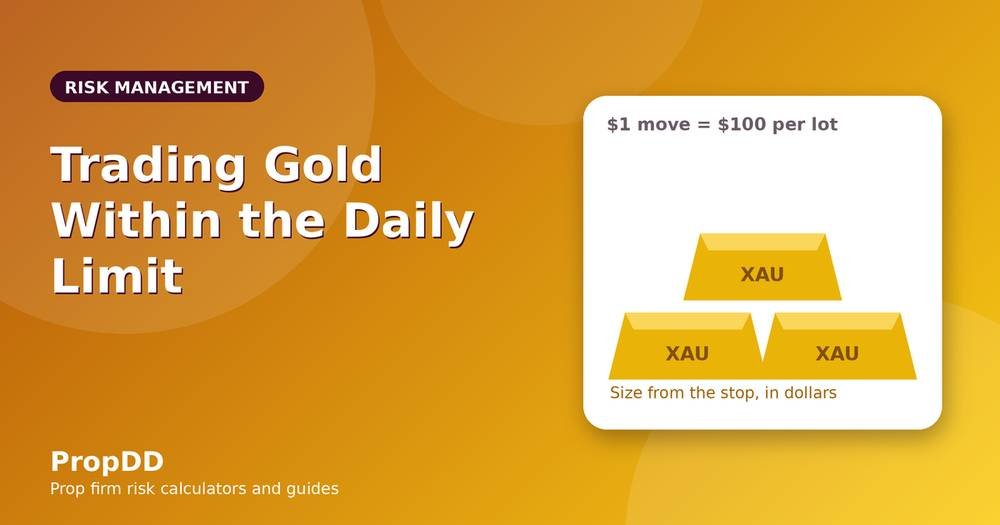
Three things set it apart. First, the price is large, thousands of dollars per ounce, so a move of a few dollars is small as a percentage but big in money terms. Second, the contract size is different from forex: on many platforms, one standard lot is 100 ounces, which means a one-dollar move in the price is worth about $100 per lot. Third, the market can move fast and in jumps, especially around economic releases and unexpected headlines.
Put those together and you can see the problem. A trader who trades “1 lot” of gold and 1 lot of EURUSD might think they’re taking a similar risk. A 20-pip move on EURUSD at one lot is $200. A $5 move on gold at one lot is $500, and gold can easily move that much in minutes.
Check the contract specification first
Brokers differ, so don’t rely on my numbers or anyone else’s. Open the contract specification for the gold symbol on your platform and write down four things: the contract size, the value of a one-dollar move per lot, the minimum lot and the lot step, and the typical spread. Also note what the platform calls a “pip” or “point” for gold, because the definition varies, and confusing them is a classic source of wrong sizing. A useful background on the general idea is Investopedia’s page on the pip.
Sizing from the stop, in dollars
The formula is the same as always: lots equals dollar risk divided by the stop distance times the value per unit of distance. For gold, work in dollars of price movement. Suppose you risk $500, the stop is $6 away and one lot loses $100 for each dollar. That’s $500 ÷ ($6 × $100) = 0.83 lots, which you’d round down to 0.8, or whatever your lot step allows.
Now widen the stop to $12 because the market is choppy. The same risk gives $500 ÷ $1,200 = 0.41, so 0.4 lots. The wider stop halves the size. Traders who keep the lot size the same when they widen the stop are doubling their risk without realising. The full method, with other instruments, is in position sizing for prop firm challenges.
Use a smaller percentage than you would on forex
Because of the speed and the jumps, many traders cut their risk per trade on gold, perhaps to half of what they’d use on a major pair. If you normally risk 0.5%, try 0.25% on gold until you know how it behaves in your sessions. The goal isn’t to be timid. It’s to keep a run of losses inside your personal stop. The reasoning is in how much to risk per trade.
Spreads and slippage
Gold spreads tend to be wider than major forex pairs, and they widen further during releases and at the daily rollover. A stop that’s meant to lose $500 can fill several dollars further away when the market gaps through your level, and at 100 ounces per lot those extra dollars add up. For a clear definition of the effect, see Investopedia’s page on slippage. Build in an allowance by sizing from a stop slightly wider than your planned one, say 20% to 50% wider on a quiet day and more around news.
News sensitivity
Gold reacts to inflation data, employment reports, central bank decisions and speeches, as well as geopolitical headlines that arrive without warning. The scheduled ones you can plan around with a calendar; the unscheduled ones you can’t. That’s one more reason to keep size modest and always have a stop in the market. If your firm restricts trading around news, read the exact window, and see news trading and daily drawdown for how slippage can break a daily limit. A live economic calendar makes the scheduled events easy to spot.
Sessions and liquidity
Gold tends to be quieter in the Asian hours and busier from London into New York, though that’s a tendency and not a rule. Pick the hours where you trade it well, and record your results by session in your journal. If your best results are in the first two hours of London, there’s no reason to sit through the rest of the day looking for trades. Fewer trades also mean lower costs and fewer chances for something to go wrong.
Where to put the stop
A stop belongs where the idea is wrong, not where the lot size is convenient. Some traders base the distance on volatility, using the average true range, for example 1.5 times the recent ATR. Others place it beyond a recent swing point. Whichever you choose, set the stop first and let the size follow. On gold, a stop that’s too tight gets hit by normal noise, and one that’s too wide forces a size so small that the trade barely matters. There’s a sweet spot, and your journal will help you find it.
Stacking gold with other trades
Gold often moves against the US dollar, so a long gold trade and a short USD trade can be two versions of the same idea. If you hold both, count the risk together. And remember that open trades count toward your equity: a floating loss on gold can use up a good deal of the day before you’ve closed anything. See floating losses and open trades for why that matters.
Swaps and costs
Holding gold overnight can attract swap charges, and commissions on some accounts are charged per lot. If your firm counts them toward the daily loss, they eat into your room. Read swaps and commissions for what to check, and add a small cost allowance to your risk.
A sample day plan
Account $100,000, daily limit 5% ($5,000), personal stop at $3,500. Risk on gold: 0.25%, which is $250. At 08:00 server time the trader checks the calendar: US inflation data at 13:30, so no trades from 13:00 to 14:00. First setup at 09:10, stop $5 away, lots = $250 ÷ ($5 × $100) = 0.5. Stopped out, down $250. Second setup at 10:20, stop $4, lots = $250 ÷ $400 = 0.62, so 0.6. Won, +$300. By 12:30 the trader is up $50, has used none of the limit and stops for the day. It’s a quiet, small and unglamorous plan, and it’s very hard to blow up.
Test on a demo first
Before going live with gold, trade it on a demo for a week at tiny size. Check that your loss on a stop-out matches your calculation, note the spread at the hours you trade, and see how often your stop fills worse than planned. It costs nothing, and it tells you whether your sizing formula and your platform agree.
Mistakes to avoid
Using the same lot size as on forex. Confusing the pip definition. Widening the stop and keeping the size. Trading through major releases at full size. Holding several dollar-correlated trades and counting them as one. Chasing a fast move after a stop-out. Each of these can use a big part of the day in a few minutes, which is why a smaller risk and a clear plan work better than skill alone.
A side-by-side example
To see how different gold is, compare the same one-lot position on the two instruments, assuming $10 per pip on EURUSD and $100 per dollar of movement on gold.
| Move against you | EURUSD, 1 lot | XAUUSD, 1 lot |
|---|---|---|
| 20 pips / $2 | $200 | $200 |
| 50 pips / $5 | $500 | $500 |
| 100 pips / $10 | $1,000 | $1,000 |
The table looks identical, and that’s the trap. A $10 move on gold happens far more easily than a 100-pip move on a quiet major pair. The same one lot gets you to the same dollars, much faster, which is why the lot size that feels comfortable on forex can be too much on gold.
When the market spikes
If a sudden move takes price through your stop, resist the urge to re-enter immediately. The spike may continue, retrace or whipsaw, and you’ll be trading at wide spreads with adrenaline in your system. A rule of thumb: after a stop-out on a spike, wait for spreads to normalise and for a clean setup, and count the loss against the day. The article on revenge trading and the daily loss limit covers why that pause matters.
Gold and the Friday close
Holding gold over the weekend adds gap risk, and gold can gap on weekend headlines. If your firm allows weekend holding, size smaller than you would midweek. If it doesn’t, plan to flatten before the cutoff. See weekend holding and gap risk for how to size for a gap.
Let your own data choose the hours
Don’t take my word, or anyone else’s, for the best time to trade gold. Record the session and result of every gold trade for a month, then sort. Many traders find that most of their profit comes from one narrow window and most of their losses from the hours outside it. If that’s true for you, the fix is free: stop trading outside the good window.
Practice drill: five gold sizing exercises
Assume one lot loses $100 per $1 of movement. Work them out first.
- $100,000 account, 0.25% risk, $5 stop.
- $50,000 account, 0.3% risk, $3 stop.
- $25,000 account, 0.4% risk, $2.50 stop.
- $200,000 account, 0.2% risk, $8 stop.
- $100,000 account, 0.25% risk, $12 stop.
Answers: (1) $250 ÷ $500 = 0.5 lots. (2) $150 ÷ $300 = 0.5 lots. (3) $100 ÷ $250 = 0.4 lots. (4) $400 ÷ $800 = 0.5 lots. (5) $250 ÷ $1,200 = 0.21, so 0.2 lots. Notice that a wider stop pushes the size down fast, which is the whole lesson.
One thing to remember
Gold doesn’t punish you for being careful. It punishes you for being casual. If you treat every gold trade as a dollar calculation, size from the stop and respect your personal stop, it can be a perfectly manageable instrument. If you trade it by feel, it will find the weak spot in your risk plan faster than anything else on the screen.
Frequently asked questions
Is gold too risky for a prop account?
Not if you size it properly. The issue is that its movements are large in money terms, so the same lot size carries more risk than on most forex pairs.
What lot size should I use on gold?
The one that makes your dollar risk equal to your plan, given your stop. Calculate it each time from the stop distance and the contract value.
Does gold have different drawdown rules?
Some firms apply different leverage or restrictions to metals, but the daily loss rule is normally the same. Check your terms for anything specific to the instruments you trade.
Should I avoid gold during news?
Many traders do. If you trade it, cut size sharply and add an allowance for slippage.
The short version
Gold moves in dollars, and each dollar is worth about a hundred per lot on many platforms. Read the contract spec, size from the stop, use a smaller percentage than on forex, plan around news and keep the personal stop in place. For the rule these numbers sit under, see the prop firm max daily drawdown explained, and for free beginner lessons, BabyPips is a good place to keep learning.