I lost $500 on Dogecoin before I had even placed a proper trade. Not because the setup was wrong. Because I sized it like EURUSD. I saw the price at $0.2000, I saw a 20-pip stop, and my hands typed 2 lots before my brain caught up. On EURUSD that stop risks $400. On Dogecoin it risked $1,000, twice my whole trade budget, and the firm’s risk desk closed the position before I could fix it.
In this article
- What Dogecoin really is on a funded account
- The contract facts that decide your size
- My sizing rule: every trade backward from 500 dollars
- The worked trade: a London-overlap long with every number shown
- When Dogecoin moves: sessions, the weekend, and the Musk problem
- The filter test: twelve trades with the London rule
- Dogecoin against its neighbours
- The five mistakes that cost me money
- Frequently asked questions
I trade a $100,000 funded account with a $5,000 daily loss limit and a 5% maximum drawdown. Dogecoin is the fifth crypto I have covered in this series, after Bitcoin, Ethereum, XRP and Solana, and it is the strangest of the five. It trades 24 hours a day, seven days a week, and it answers to a single billionaire’s timeline as much as to any chart.
What Dogecoin really is on a funded account
Dogecoin started in 2013 as a joke, a coin with a Shiba Inu dog on it. Unlike Bitcoin it has no supply cap: roughly five billion new coins are mined every year, forever. It sleeps for weeks, then doubles on a single headline, then gives half of it back. The flat stretches are where funded traders get bored and oversize. The vertical weeks are where they get wiped out.
The first fact to learn is that Dogecoin never closes. Forex pairs stop on Friday evening. Dogecoin keeps trading straight through the weekend, so there is no weekend gap to fear. But the daily drawdown never gets a quiet night either: your firm’s daily loss limit resets at server midnight, usually around 22:00 or 23:00 GMT, and Dogecoin can be moving hard at exactly that moment. On Dogecoin there is no off switch. Your risk is live at 3am on a Sunday, and your drawdown clock does not care that you are asleep.
The second fact is the leverage. Forex majors on a prop firm often come with 1:50 or 1:100 leverage. Crypto does not. Velotrade lists Dogecoin at 3x leverage on challenge accounts and 2x once funded, typical: 1:2 to 1:5, rarely more. On a $100,000 account that means $200,000 of buying power at 2x, which at $0.2000 buys 1,000,000 DOGE, or 10 standard lots. That sounds like plenty until the next section shows 10 lots is ten times what your daily limit allows. The leverage cap is not the constraint. Your $500 risk budget is.
| Fact | Dogecoin value | Why it matters on a funded account |
|---|---|---|
| Quote | Dollars per DOGE, around $0.2000 | Every price move is priced in dollars, not cents |
| One pip | 0.0001, or one hundredth of a cent | 100 to 200 pips a day is normal, not extreme |
| Pip value, 1 lot | 100,000 DOGE x 0.0001 | $10 per pip per lot, the same as EURUSD |
| Typical spread | 10 to 20 pips | About $150 of cost on a normal trade |
| Average daily range | 5 to 10%, or 100 to 200 pips | Stops must be 50 pips or wider |
| Typical leverage | 2x once funded, 3x on challenge | Buying power is not the limit, risk is |
The contract facts that decide your size
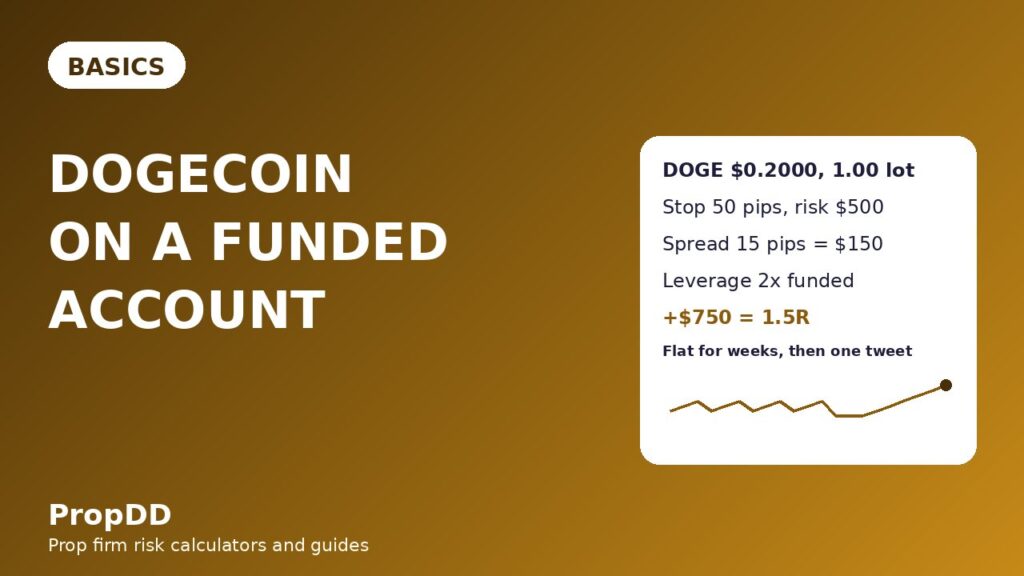
Every sizing decision starts from one formula: risk in dollars equals stop distance in pips times pip value in dollars times lots. Rearranged, lots equal risk budget divided by stop distance times pip value. With my $500 budget, a 50-pip stop and a $10 pip value, that is 500 divided by 500, which is 1.00 lot.
Read that number again: 1.00 lot on a $100,000 account, for a stop of 50 pips, which is only $0.0050 of price movement. On EURUSD the same $500 risk with a 25-pip stop is 2 lots. On Dogecoin the stop is twice as wide in pips, yet the size is half, because the pip is worth the same $10 and the coin moves in hundredths of a cent. 1.00 lot is 100,000 DOGE, worth $20,000 at $0.2000; at 2x leverage the margin is $10,000. The 1.00-lot answer is not a small trade. It is the whole trade, and every Dogecoin loss I have taken started with forgetting that.
There is a second fact hiding inside the $10 pip. The pip value does not move with the Dogecoin price, because the contract is fixed at 100,000 DOGE per lot and the pip is fixed at $0.0001. What moves instead is the daily range in pips: when Dogecoin is at $0.10, a 5% day is 50 pips; when it is at $0.40, the same 5% day is 200 pips. My personal daily stop guide explains the $500 rule, and the risk of ruin calculator shows what happens when you ignore it.
| Step | Formula | Worked number |
|---|---|---|
| 1. Contract size | 1 lot = 100,000 DOGE | 100,000 DOGE per lot |
| 2. Pip value in dollars | 100,000 x 0.0001 | $10 per pip per lot |
| 3. Risk per lot at 50-pip stop | 50 x $10 | $500 per lot |
| 4. Position size | $500 / $500 | 1.00 lots |
| 5. Actual risk check | 1.00 x 50 x $10 | $500, inside budget |
| 6. Spread cost at 15 pips | 15 x $10 x 1.00 | $150, about 30% of risk |
My sizing rule: every trade backward from 500 dollars
My rule is simple and I never break it. No single trade risks more than $500, which is 10% of my $5,000 daily loss limit and 0.5% of my $100,000 account. Two losers and I am done: $1,000 is 20% of the daily limit, and the third trade would be revenge, not a plan. The sizing grid below is taped to my monitor. I do not calculate in the moment; I read the stop distance, find the row, and trade that size.
Notice how the grid punishes tight stops. A 30-pip stop lets me trade 1.66 lots, but Dogecoin routinely moves 100 to 200 pips a day, so a 30-pip stop is inside one normal hour’s noise, and the spread alone eats half the risk. A 100-pip stop only allows 0.50 lots, but it survives a full day’s range and the spread is only 15% of the risk. On Dogecoin, the stop is measured in tens of pips, and the only question is how many tens your setup can afford.
| Stop distance | Lots (500 risk) | Actual risk | Spread cost at 15 pips |
|---|---|---|---|
| 30 pips | 1.66 | $498 | $249 |
| 40 pips | 1.25 | $500 | $188 |
| 50 pips | 1.00 | $500 | $150 |
| 60 pips | 0.83 | $498 | $125 |
| 80 pips | 0.62 | $496 | $93 |
| 100 pips | 0.50 | $500 | $75 |
The spread is the hidden tax on this coin. At 15 pips on a typical London morning it costs $150 on 1.00 lot, almost a third of the risk, and on a 30-pip stop with 1.66 lots it costs $249, half the risk. Swap, by contrast, is almost free: a few dollars a night either way. And leverage is the trap that catches traders moving from forex: at 2x funded leverage your $100,000 account commands $200,000 of Dogecoin, and the platform will happily let you buy 10 lots. Ten lots with a 50-pip stop risks $5,000, your entire daily loss limit, on a single trade. Size from the risk budget, never from the buying power.
I also keep a second guardrail that the grid does not show. If the spread at entry is wider than 20 pips, I do not take the trade at all, whatever the setup looks like. A 20-pip spread on 1.00 lot costs $200, which is 40% of my risk before the trade has moved a single pip in my favour, and a 20-pip spread is also a signal: liquidity is thin, and thin liquidity on a 24/7 meme coin means your stop can slip dozens of pips on a Sunday night. Spreads above 20 pips at the London open mean the coin is untradeable there.
The worked trade: a London-overlap long with every number shown
The trade I remember best is a London-overlap long from a Tuesday in late October. Dogecoin had drifted down for two sessions, Bitcoin was flat, and the coin printed a clean higher low just above $0.1950 as London opened. My trend pullback rules said the pullback was done. Entry at $0.2000, stop below the pullback low at $0.1950, which is 50 pips. First target at $0.2050, the previous week’s high, 50 pips away. Second target at $0.2100, 100 pips away.
Size came straight from the grid: 1.00 lot for a 50-pip stop. I split the exit into two halves, 0.50 lots at the first target and 0.50 lots at the second. The first target filled in the New York afternoon, the second the following London morning. Total profit was $750, which is 1.5 times the $500 risked. The table below shows every leg, because a worked trade without the legs is just a story.
| Leg | Price | Distance | Lots | Result |
|---|---|---|---|---|
| Entry (long) | $0.2000 | – | 1.00 | – |
| Stop loss | $0.1950 | 50 pips | 1.00 | -$500 if hit |
| Target 1 (half) | $0.2050 | 50 pips | 0.50 | +$250 |
| Target 2 (rest) | $0.2100 | 100 pips | 0.50 | +$500 |
| Total | – | – | 1.00 | +$750, 1.5R |
When Dogecoin moves: sessions, the weekend, and the Musk problem
Dogecoin has no session of its own, because it never closes. What it has instead is liquidity that comes and goes with the rest of the market. The London open at 08:00 GMT is when forex flow wakes up and spreads tighten to their best of the day. The London and New York overlap from 13:00 to 17:00 GMT adds American crypto flow, and that four-hour window is where I take most of my trades. After 21:00 GMT the pair goes quiet, and the small hours of the weekend are the thinnest books of the week.
| Window (GMT) | What happens | Trade or avoid |
|---|---|---|
| 08:00 – 12:00 | London open, spreads tightest | Trade, best window |
| 13:00 – 17:00 | London and New York overlap | Trade, second-best window |
| Saturday 02:00 – 08:00 | Thinnest book of the week | Avoid completely |
Three events matter more than everything else. United States inflation data and Federal Reserve announcements move the whole crypto market, and Dogecoin follows Bitcoin down or up within minutes. Then there is the one driver no other coin on this site has: a single social media post from Elon Musk. Dogecoin has doubled on a tweet and halved on a joke, and neither move had anything to do with a chart. I never enter a new Dogecoin trade within 30 minutes of any of these. If I am already in, I take half off or accept the stop might slip.
The filter test: twelve trades with the London rule
A filter is only worth something if it survives a test, so I ran one. I took twelve Dogecoin setups from my journal that passed my full filter: London or New York overlap only, entry after a pullback, stop at least 50 pips, spread under 20 pips at entry, and no high-impact United States data or Musk post within 30 minutes. I scored those twelve plus three the filter had rejected, fifteen trades in total, with the same $500 risk and the same 1.5R targets.
The filtered set won 8 of 12: six full wins at $750 and two partial wins at $250, against four losses at $500, for a net of $3,000. Best day $750, 25.0% of the net, inside my 30% consistency ceiling. The unfiltered set won 6 of 15 and lost $1,000. The filter was worth $4,000, and almost all of it came from the three rejected trades: two Saturday-night entries that slipped past their stops and one Musk-post entry that gapped 100 pips past its stop. The filter did not find better trades. It removed the trades that were never worth taking.
| Set | Trades | Wins | Losses | Net result |
|---|---|---|---|---|
| Filtered (London rule) | 12 | 8 (6 full, 2 partial) | 4 | +$3,000 |
| Unfiltered (all setups) | 15 | 6 (4 full, 2 partial) | 9 | -$1,000 |
| Filter value | – | – | – | About +$4,000 |
Dogecoin against its neighbours
Dogecoin is the fifth crypto instrument guide I have covered, after Bitcoin, Ethereum, XRP and Solana, and the comparison is what makes it useful. All five trade 24/7 under the same low leverage cap, and all five punish tight stops. The difference is the character: Bitcoin is the slowest mover of the five, Ethereum sits in the middle, XRP sleeps and then moves on court news, Solana is the fastest, and Dogecoin is the one that can double on a single tweet. If you want crypto exposure with the widest daily range per dollar of price and the cheapest overnight cost, Dogecoin is the coin. If you want a market that closes on Friday, it is the wrong one.
| Instrument | Typical daily move | Trades 24/7? | Typical leverage | Main character |
|---|---|---|---|---|
| Dogecoin | 5 – 10% | Yes, including weekends | 2x funded | Sleeps, then doubles on one tweet |
| Bitcoin | 2 – 4% | Yes, including weekends | 1:5 | Slowest crypto, follows its own cycle |
| Ethereum | 3 – 5% | Yes, including weekends | 1:5 | Middle of the crypto range |
| XRP | 3 – 6% | Yes, including weekends | 1:5 | Sleeps, then moves 20% on one headline |
| Solana | 4 – 7% | Yes, including weekends | 1:5 | Fastest crypto, widest daily range |
The five mistakes that cost me money
Every mistake below cost me real money on Dogecoin. I keep this table next to the sizing grid, because the mistakes are the reason the grid exists.
| Mistake | What it cost me | The rule that replaced it |
|---|---|---|
| Sizing it like EURUSD | $1,000 risked, twice my budget | Always divide by the $10 pip first |
| A 20-pip stop on a 150-pip day | $500, stopped by normal noise | Stops 50 pips or wider, always |
| Trading the Saturday 3am book | $500, slipped 80 pips past my stop | No entries Saturday 02:00 to 08:00 GMT |
| A Musk post while I was asleep | $500, gapped 100 pips in minutes | Check the feed before London, never hold blind |
| Ignoring a 15-pip spread | $150 paid before the trade moved | Spread over 20 pips means no trade |
Frequently asked questions
What is the pip value of Dogecoin on a funded account?
One pip on one standard lot of DOGEUSD is worth $10: one lot is 100,000 DOGE and one pip is $0.0001. It does not move with the Dogecoin price, because both the contract size and the pip are fixed. What moves is the daily range in pips: a 5% day is 50 pips at $0.10 and 200 pips at $0.40.
How many lots can I trade with a 500-dollar risk?
Divide $500 by your stop distance in pips times $10. A 50-pip stop allows 1.00 lot, a 40-pip stop allows 1.25 lots, and a 100-pip stop allows 0.50 lots. Tighter stops allow bigger size, but a stop under 50 pips sits inside one normal hour’s range, so 50 pips is my default.
Is Dogecoin harder than Bitcoin on a funded account?
Yes, in two ways: Dogecoin can sit still for a week and then double on a single social media post, while Bitcoin moves more steadily, and Dogecoin’s spread is wider relative to its daily range. The pip value is the same $10 on both. Trade Dogecoin only in the London and New York windows, with stops of 50 pips or wider.
Can I hold Dogecoin over the weekend on a funded account?
You can, because Dogecoin trades through the weekend and there is no gap to fear. The risk is different: Saturday’s order book is the thinnest of the week, spreads widen to 30 pips or more, and a single large order can move the price 100 pips. Decide hold or flat before the weekend, and never leave a position open without a stop.
What time is best for Dogecoin?
The London open from 08:00 to 12:00 GMT, including the New York overlap from 13:00 to 17:00 GMT. Spreads are tightest, forex flow is awake, and the coin actually trends. Avoid Saturday 02:00 to 08:00 GMT completely: spreads widen to 30 pips and the coin can move 100 pips on almost no volume.
Does Dogecoin count toward consistency rules?
Yes, like every other instrument. Most firms cap your best day at 30% of total profit, and Dogecoin’s slow weeks make that easy to respect: my best day in the twelve-trade test was $750, which was 25.0% of the $3,000 net. The risk is the opposite one: a doubling week can hand you one giant day that breaks the ceiling, so bank the profit and stop trading that day.
Risk disclaimer: This article describes my own experience trading a simulated funded account. It is not financial advice. Prop firm rules, spreads, swap rates and leverage differ between firms and change without notice, so confirm every number with your own firm before you trade. Never risk money you cannot afford to lose.


2 comments
[…] 3x and 2x leverage, same 24/7 market, but a faster news cycle and a tighter spread on most feeds. Dogecoin is the wild one: same leverage band, but meme-driven spikes that can move 1,000 pips on a single […]
[…] covers the 12-dollar spread trap, and the Cardano guide covers the 15-dollar spread trap, while the Dogecoin guide covers the meme coin, where the moves are the widest in percentage terms and the stops must be the […]