My $50,000 funded account was three weeks old when I almost killed it doing the exact opposite of fading. It was a Tuesday morning, EUR/USD had been bouncing between 1.1640 and 1.1700 all night, and when price punched through the top of that range at 8:02 I chased it long like every breakout video had taught me. By 8:25 it was back inside the range. By 9:00 my long was dead at −$420. Then — the part that still embarrasses me — I flipped short at the bottom of the range, and of course that reversed too. Two breakout-chasing losses, $780 gone, and the account was down 1.6% before most people had finished breakfast.
In this article
- What a Range Fade Strategy Is — and Why It Fits Prop Firm Accounts
- The Full Rules: Setup, Entry, Stop, Target, Session Filter
- Position-Sizing Maths Under a 5% Daily Loss Limit
- I Tested It: Five Real Days on a ,000 Account
- When the Range Fade Fails — Breakouts, News and Trend Days
- How This Strategy Fits Prop Firm Consistency and Drawdown Rules
- My Pre-Session Routine and Settings Checklist
- Frequently Asked Questions
That evening I did something I should have done a year earlier: I pulled up three months of my trade history and checked what I would have made doing the reverse — fading the range edges instead of chasing them. Selling the top of the box. Buying the bottom. Stops tucked just outside, targets aimed at the middle. The backtest on my own data said I would have banked roughly $2,900 more. I have traded a mechanical version of that range fade strategy for prop firm traders ever since, and it is now the only setup I run on quiet days. No indicators on the entry, no gut calls, no chasing. Just the box, the edge, and the maths.
In this article
- What a Range Fade Strategy Is — and Why It Fits Prop Firm Accounts
- The Full Rules: Setup, Entry, Stop, Target, Session Filter
- Position-Sizing Maths Under a 5% Daily Loss Limit
- I Tested It: Five Real Days on a $50,000 Account
- When the Range Fade Fails — Breakouts, News and Trend Days
- How This Strategy Fits Prop Firm Consistency and Drawdown Rules
- My Pre-Session Routine and Settings Checklist
- Frequently Asked Questions
What a Range Fade Strategy Is — and Why It Fits Prop Firm Accounts
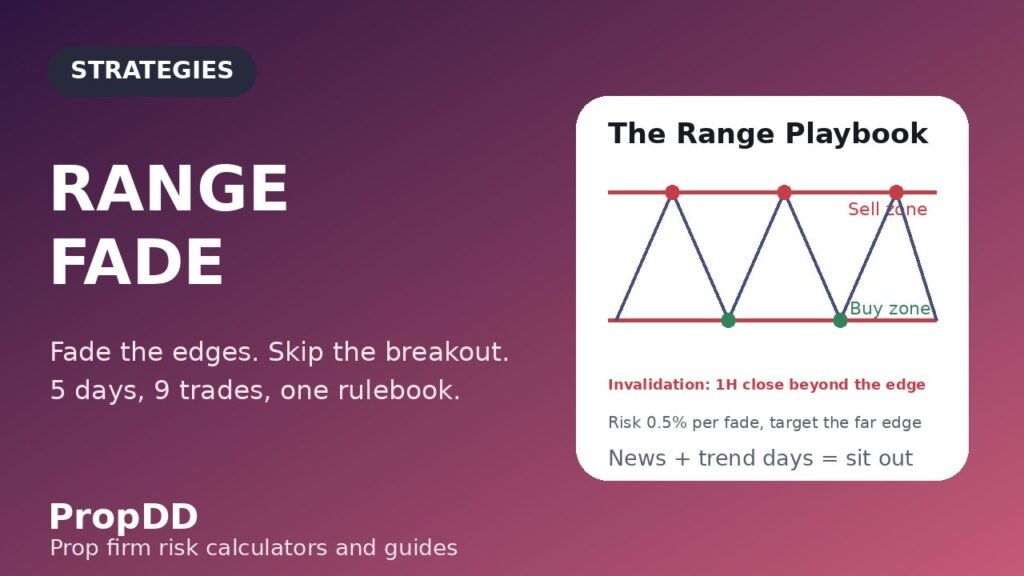
A range fade means trading against the edges of a sideways market: you sell resistance and buy support, instead of waiting for the breakout like everyone else. On a funded account this logic matters more than it does on a personal one, because prop firm rules punish exactly the things breakout-chasing creates — wide open risk during fast moves, oversized losses on reversals, and blown daily limits in a single candle.
The structure of a range gives you three numbers before you risk a cent: the range high, the range low, and the range height between them. If you want the textbook definition of what you are trading, LuxAlgo’s trading-range concept guide covers the mechanics of ranges cleanly. My version simply adds prop-firm fencing around it: the box must be fresh (formed in the last 8–12 hours), its height must sit between 40 and 90 pips on EUR/USD, and the whole thing gets cancelled if red-folder news is due within two hours.
Why does fading suit a prop-firm account specifically? Four reasons, all about capital protection. First, the stop is always small and known — 15 to 20 pips beyond the edge — so per-trade risk is trivially calculable. Second, both edges give you a trade, so you get two chances a day without overtrading; after two attempts the session is over. Third, the strategy does its work in quiet sessions, which is exactly where daily-limit breaches rarely happen. And fourth, fading naturally produces lots of small, similar-sized results — the kind of steady P/L curve that keeps you miles from the consistency-rule trap.
The Full Rules: Setup, Entry, Stop, Target, Session Filter
I trade this on EUR/USD and USD/JPY, 15-minute chart, from the Asian session through the London pre-open. The rules have not changed in five months, and I genuinely do not touch them mid-session — the whole point of a mechanical range fade is that the decisions were made yesterday evening:
| Parameter | My Rule |
|---|---|
| Range definition | Highest high and lowest low of the last 8–12 hours, marked at 00:00 London time |
| Range height filter | 40–90 pips on EUR/USD (30–80 pips on USD/JPY); ranges outside this get no trades |
| Trade direction | Sell limit at range high (within a 5-pip zone); buy limit at range low (within a 5-pip zone) |
| Stop loss | 18 pips beyond the range edge (15 pips for USD/JPY) |
| Take profit | 80% of the range height measured from entry, placed as a limit order at entry time |
| Trades per day | Maximum 2 attempts; after two fills — win or lose — no more fades that day |
| Session filter | Trade 00:00–10:00 London time only; if red-folder news lands within 2 hours, stand aside |
| Kill switch | Two full stop-outs in a day = screens off. Personal daily stop: 2% of the account |
Two rules do most of the protecting. The take-profit at 80% of the range height — not the full opposite edge — exists because range edges get front-run constantly; price touches your level, wicks a few pips short of the far side, and comes back. Grabbing 80% is the difference between a filled target and a trade that returns to scratch. And the two-trade cap is my revenge-trading antidote: the second loss of the day on a range system usually means the range is dying. If you have been choosing a trading session around small daily risk, the session filter here serves the same purpose for quiet-market setups.
Position-Sizing Maths Under a 5% Daily Loss Limit
Here is where a range fade earns its place on a funded account: the maths is clean enough to do in your head before the first order goes in. My account is $50,000 with a 5% firm daily loss limit ($2,500), and my personal daily stop sits below the firm limit at 2% — that is $1,000, screens-off territory. With two planned fades a day, each trade may risk at most $500.
Position size (lots) = risk per trade ($) ÷ (stop distance in pips × pip value per standard lot)
Worked example: $500 risk ÷ (18 pips × $10 per pip per standard lot on EUR/USD) = 2.78 standard lots. I round down to 2.7 lots and take the trade. If the fade loses, the day is −$486. If the second attempt loses too, I am −$972 — still inside my $1,000 personal stop, and nowhere near the firm’s $2,500 limit.
The full chain of numbers, so you can sanity-check your own version against it:
| Variable | Meaning | My Figures |
|---|---|---|
| Account size | Funded/challenge balance | $50,000 |
| Firm daily loss limit | Hard ceiling for the day | 5% = $2,500 |
| Personal daily stop | My own kill switch, inside the firm limit | 2% = $1,000 |
| Risk per trade | Personal stop ÷ 2 planned attempts | $500 (1% of account) |
| Stop distance | Beyond the range edge | 18 pips |
| Position size | $500 ÷ (18 × $10) | 2.7 standard lots |
| Worst realistic day | Two full stop-outs | −$972 (−1.94%) |
| Typical win | 80% of a 60-pip range = 48 pips at 2.7 lots | +$1,296 (+2.59%) |
Notice the asymmetry that makes the system work: one typical win (+$1,296) more than covers two full losses (−$972). You can win barely a third of your fades and still grow the account — the strategy survives on the risk-reward skew, not on being right. For the general principles, see my position sizing for prop firm challenges guide.
I Tested It: Five Real Days on a $50,000 Account
Talk is cheap, so here is the full week — Monday to Friday, EUR/USD only, every fade logged exactly as it happened. Account $50,000, personal daily stop $1,000 (2%), risk per trade $500, stop 18 pips, size 2.7 lots, take profit at 80% of the range height:
| Day | Range (high / low) | Edge faded | Entry → Target | Result | Day P/L | Buffer left |
|---|---|---|---|---|---|---|
| Mon | 1.1692 / 1.1631 (61 pips) | Sell 1.1692 | 1.1692 → 1.1643 (49 pips) | Win +$1,323 | +$1,323 | $3,823 |
| Tue | 1.1665 / 1.1608 (57 pips) | Buy 1.1608 | 1.1608 → 1.1654 (46 pips) | Win +$1,242 | +$1,242 | $3,742 |
| Wed | 1.1688 / 1.1624 (64 pips) | Sell 1.1688, then buy 1.1624 | Both hit the 18-pip stop | 2 losses −$486 each | −$972 | $1,528 |
| Thu | No trade | — | — | Range only 33 pips — below the 40-pip filter | $0 | $2,500 |
| Fri | 1.1705 / 1.1641 (64 pips) | Buy 1.1641 | 1.1641 → 1.1692 (51 pips) | Win +$1,377 | +$1,377 | $3,877 |
Wednesday deserves the attention, because it is the day that proves the system. The range looked perfect, both edges filled, both stopped out — classic false-comfort day. My day ended at −$972, inside my personal stop, screens off by 10:00, no attempt at a third trade. No tilt, no revenge entry, no escalation. Thursday gave me nothing — a 33-pip box is not a range worth fading, so I journaled instead of trading. That discipline is the strategy: the week finished at +$2,970 on three wins and two losses, and the worst single day cost me less than 2% of the account. After the Friday win I ran the numbers through the new profit split calculator to remind myself what the week was actually worth at an 80% split: about $2,376 of real money, earned in quiet sessions, without ever sweating the daily limit.
When the Range Fade Fails — Breakouts, News and Trend Days
Fading has one natural enemy: the day the range does not hold. You must be able to tell a fadeable range from a breakout day before you place the first limit order. Here is the checklist I run at 00:00 every day — if the market fails more than one of these tests, the range fade stays switched off and I find something else to do:
| Signal | Fadeable range day | Breakout / trend day — stand aside |
|---|---|---|
| Range height vs average | Within 40–90 pips, roughly the 14-day average | Expanding fast — already wider than yesterday’s full range by 08:00 |
| Momentum (ADX on H1) | Below 20 — no strong trend present | Above 25 and rising — the market has picked a direction |
| News calendar | No red-folder events within 2 hours of my session | NFP, CPI, central-bank decisions — ranges break on these routinely |
| Previous day’s behaviour | Previous day closed mid-range, no strong close at extremes | Yesterday closed at the day’s high/low — momentum usually carries over |
| Edge touches | Price reached the edge calmly on small candles | Price smashed through the edge with wide-range candles — that is a breakout, not a fade |
The most common failure mode is the slow bleed: price grinds to the edge, your limit fills, and instead of rejecting it keeps pushing — your stop goes, you re-fade the same edge because “it has to hold this time,” and now you have spent both attempts on a dying box. My guardrail is simple: if the first fade of the day loses, the second fade may only be taken at the opposite edge, never the same one. Two fades on the same edge means you are arguing with the market, and the market has a bigger account than you.
The second failure mode is news you did not respect. I once faded a perfect 70-pip EUR/USD range twenty minutes before a CPI print I had misread on the calendar. The stop was gone in one candle and the slippage made it worse than the maths said it would be. Ranges and red-folder news are mutually exclusive — the strategy’s session filter is the thing standing between you and the days that breach accounts.
How This Strategy Fits Prop Firm Consistency and Drawdown Rules
Range fading is unusually friendly to prop-firm rulebooks, and this is not an accident — I chose the quiet-market niche partly because the rules are easiest to satisfy there. The consistency rule is the first winner: most firms require that your best day does not exceed some share (often 30–40%) of your total profit. Fades produce lots of similar-sized results — +$1,242, +$1,323, −$972 — so no single day dominates the P/L curve. If you want the full mechanics of that rule, my consistency rule explainer shows exactly how the best-day percentage is calculated.
The daily drawdown rule is even simpler to satisfy. My worst realistic day is −1.94% against a 5% firm ceiling, and that day requires two full stop-outs back to back — which the checklist above is designed to prevent in the first place. Most losing days are single small losses: −0.9% to −1%. You would need five maximum-loss days in a row to touch the firm limit, and the two-trade daily cap plus the personal 2% stop make that sequence almost impossible unless you break the rules deliberately.
Minimum trading days also become a non-problem. Fading gives you a valid, mechanical trade on most quiet weekdays, so reaching the typical 5–10 minimum trading days happens naturally within a week or two — no forcing trades on dead days.
My Pre-Session Routine and Settings Checklist
I run the same sequence every day at 23:30 London time (the evening before the session), and it takes about fifteen minutes. Skip it once and the improvisation starts:
| Step | Action | Detail |
|---|---|---|
| 1 | Mark the box | Highest high and lowest low of the last 8–12 hours on EUR/USD and USD/JPY, 15-minute chart |
| 2 | Measure range height | Must be 40–90 pips (EUR/USD) or 30–80 pips (USD/JPY); if not, no fades tomorrow |
| 3 | Check ADX on H1 | Must be under 20; over 25 = trend day = stand aside |
| 4 | Check the news calendar | No red-folder events 00:00–12:00 London time; if one exists, no fades |
| 5 | Run the sizing maths | Personal stop ÷ 2 attempts = risk per trade; lots = risk ÷ (stop pips × pip value), rounded down |
| 6 | Set limit orders | Sell limit at range high, buy limit at range low, stops 18 pips beyond, targets at 80% of range height |
| 7 | Journal the plan | One line: box, edges, size, kill-switch level — so tomorrow’s me cannot renegotiate |
Step 7 is the one I would keep if I had to drop all the rest. Writing the plan down the night before creates a commitment that survives the morning’s emotions. The journal line from that winning Friday reads: “Box 1.1641–1.1705, buy 1.1641 @ 2.7 lots, stop 1.1623, target 1.1692, kill at −$1,000.” When price spiked toward the low that morning and my hands wanted to cancel the buy limit, the written line held me in. That single fill made +$1,377.
Frequently Asked Questions
Is range fading safe on a prop firm account?
It is one of the safer mechanical strategies, because every parameter is known before entry: a fixed small stop, a fixed target, a two-trade daily cap, and a session window that avoids news. With my rules the worst realistic day is under 2% against a 5% firm limit. That said, no strategy is safe if you break its filters — fading into red-folder news or on a trend day is how the losses get big.
What pairs work best for this range fade strategy?
I use EUR/USD and USD/JPY because they form clean overnight ranges and have tight spreads during the Asian session. Gold ranges too, but its spread and volatility make the 18-pip stop concept much less forgiving — I would not fade XAUUSD with these settings. Stick to one or two pairs until the routine is automatic.
What happens if price breaks the range after I enter?
You lose the stop — $486 in my setup — and that is a normal, priced-in cost of the strategy, not an emergency. The rules forbid fading the same edge twice in a row, so your second attempt goes at the opposite edge or not at all. Accept the loss as tuition for a false break; the risk-reward skew (one win covers two losses) absorbs it.
Can I use this range fade strategy for prop firm challenges on smaller accounts?
Yes — the maths scales linearly. On a $10,000 account with a 5% daily limit, your personal 2% stop is $100, and risk per trade is $100, so the same 18-pip stop gives about 0.55 standard lots. The percentages stay identical, which is the whole point of sizing by percentage rather than by gut feel.
How do I know when a range day is turning into a trend day?
Three tells: H1 ADX pushing above 25, the range expanding faster than its average height before mid-session, and wide-range candles smashing through the edge instead of tapping it calmly. If you see two of the three, cancel the remaining limit orders — the fade thesis is dead for the day.
Does this strategy violate the consistency rule?
No — it is one of the friendliest strategies for it. Fading produces many similar-sized wins and losses, so no single day dominates your total profit. Just do not ruin it by doubling size after a winning day “to accelerate”; keep the lots mechanical and the P/L curve stays smooth.
Risk disclaimer: trading on a funded or challenge account involves real risk of loss and account termination. The examples above are from my own experience and are not financial advice; past results never guarantee future performance. Always trade within your firm’s rules and never risk money you cannot afford to lose.



6 comments
[…] the Stochastic is a range instrument, it belongs next to a range strategy, not a trend one. My range fade strategy guide describes the exact ranging setup I pair it […]
[…] cut my trade count by more than half — which on a prop account is a feature, not a sacrifice. My range fade strategy runs on the same session logic for exactly this […]
[…] the daily routine that keeps me from seeing springs in every range. It is not the same trade as my range fade, which sells range tops and buys range bottoms without asking why price is there. A spring trade […]
[…] the daily cap, a worked EURUSD breakout, and a twelve-trade test. It is the opposite trade to the range fade strategy, which sells the top of the box and buys the bottom; here I wait for the box to fail, and I only […]
[…] itself is just a candle shape; the discipline around it is the edge. A related warning from the range fade strategy applies here too: a mean-reversion-looking pause inside a strong trend is not a reversal, and […]
[…] reversion is not the first fading strategy in this series — my range fade strategy already trades the same idea — so here is exactly how the two differ, and when I reach for each. […]