The forex market is open around the clock on weekdays, which sounds like freedom and mostly works as a trap. If any hour is a possible trading hour, it’s easy to end up trading all of them, or whichever happens to coincide with a free moment and a bad mood. On a prop account, where the daily loss limit punishes scattered attention, choosing your hours deliberately is one of the cheapest edges you can give yourself.
In this article
- The three sessions, roughly
- The Asian session
- The London session
- The New York session
- What it means for your daily limit
- Where the reset time falls
- Fatigue and the clock
- Pick one or two, not all three
- Let your data choose
- Instruments and sessions
- Spreads and costs by hour
- Sample schedules
- Weekends and Fridays
- Mistakes to avoid
- A weekly rhythm
- Sessions and the news calendar
- Adjusting risk by session
- A monthly session review
- When to change your window
- A worked day for a part-time trader
- Don't forget rest
- Frequently asked questions
- The short version
This guide looks at the main trading sessions, what tends to happen in each, how they interact with your daily limit and reset time, and how to use your own results to choose. Session times shift with daylight saving and depend on your time zone, so treat all times here as approximate and convert them yourself. A tool such as the timeanddate converter helps. Use the drawdown calculator to see how much room each session has to work with.
The three sessions, roughly
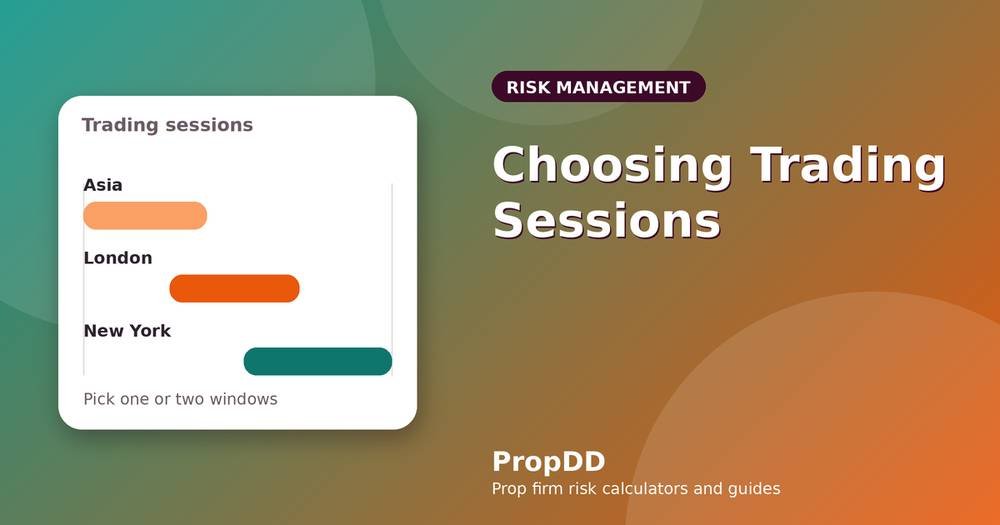
The Asian session covers the hours when Tokyo, Sydney, Singapore and Hong Kong are active. The London session starts a few hours later, when European markets open. The New York session follows, and overlaps with London for a few hours. The overlap of London and New York is often the busiest period of the trading day. Each session has its own character, but those characters are tendencies, not rules, and they change with the news and the season.
The Asian session
Often quieter for major pairs, with narrower ranges, and busier for yen and Australian or New Zealand dollar pairs. Spreads on some pairs can be wider because there’s less liquidity. Some traders like it for range-based strategies, and others find it dull and prone to false breakouts. If you live in a time zone where this session falls in your evening, it might suit a part-time schedule. Check the spreads on your platform at those hours before assuming it’s cheap.
The London session
Typically the start of the main activity for euro, pound and Swiss franc pairs, with higher volume and clearer moves. The first hour or two after the open is often when direction is set for the day, though that’s a tendency, not a promise. Spreads tend to be tight. Many traders choose this as their primary window because it’s active enough to offer setups and still manageable in size.
The New York session
Home of US data releases and the most dollar-driven activity. The overlap with London brings high volume and fast moves, which is attractive and risky in equal measure. After the overlap, activity often fades, and spreads can widen toward the daily rollover. Many major economic releases land here, so the session is where you’ll meet most of the news-driven spikes. For handling those, see news trading and daily drawdown.
What it means for your daily limit
A fast session uses up your daily room faster, for the same risk per trade, because stops are hit more often and slippage is larger. A quiet session is gentler but offers fewer setups. Neither is better by default. What matters is that your risk per trade suits the session you trade it in. Many traders cut their size slightly in the first thirty minutes of a session’s open and around major releases. The sizing approach is in how much to risk per trade.
Where the reset time falls
Your firm’s daily reset might land in the middle of one of these sessions for you, and that shapes how you plan. If it falls in the evening quiet period, it hardly matters. If it falls during your main session, you effectively get two “days” in one sitting, with a fresh allowance halfway through, which can be useful or dangerous. The details of finding yours are in the daily drawdown reset time guide.
Fatigue and the clock
The session you choose has to fit the rest of your life. A trader who works all day and trades the New York overlap at night, after dinner, is often tired, and tired traders take worse trades and forgive rule breaks. If your best window is also your most exhausted one, either shorten the session, reduce risk or find another. A good session on paper is worth little if you can’t concentrate through it.
Pick one or two, not all three
A sensible default is to choose a single window of two to three hours, trade only inside it and stop when it ends. It limits the number of decisions, makes your results easier to analyse and keeps you away from the temptation to chase a move in the next session. Add a second window only after you’ve traded the first consistently for a couple of months. Trying to cover all three sessions is a common reason new prop traders burn out.
Let your data choose
For a month, record the session in which each trade was taken, along with the result in R, the spread you paid and your mood. Then sort. Many traders find that most of their profit comes from one window and most of their rule breaks from another. The fix is free: trade the good window and skip the other. Your trading journal is the natural place for this. It doesn’t need to be elaborate, only consistent.
Instruments and sessions
Pairs involving a currency are often most active when its home markets are open: yen pairs in the Asian hours, euro and pound pairs in London, dollar pairs through New York. That tendency can help you choose what to watch. Fewer instruments, matched to your session, is easier than a long watchlist covering everything. If you trade gold or indices, check their own active hours, since they follow their own patterns; see trading gold within a daily drawdown limit for a taste of how different an instrument can be.
Spreads and costs by hour
Costs aren’t constant through the day. Spreads are usually tightest when a pair’s main session is open and widest around the daily rollover and during thin liquidity. If you trade with tight stops, check your platform’s spread at the exact times you trade, over several days. A two-pip spread against a 15-pip stop is a very different proposition from a half-pip one. The effect on your daily room is covered in swaps and commissions.
Sample schedules
A full-time trader based in a European time zone might trade from the London open until the first hour of New York, then stop. A part-time trader in South Asia, with a job during the day, might use the late-afternoon and early-evening hours, which overlap with London’s later hours and New York’s opening. A trader on the US East Coast might trade the first two hours after the New York open. None of these is better in the abstract. They work because they’re stable and fit the person.
Weekends and Fridays
Friday afternoons often see thinner markets and position-squaring before the weekend. If your firm bans weekend holding or you prefer to be flat, plan your last trade of the week with the cutoff in mind. If you do hold, see weekend holding and gap risk.
Mistakes to avoid
Trading whenever you feel like it. Copying someone else’s hours without checking your own results. Ignoring spreads at your chosen times. Picking a session that clashes with your sleep or work. Taking a full-size trade in the first minute of a session. Changing windows after every bad week instead of reviewing a month of data.
A weekly rhythm
Days of the week have personalities too. Mondays often start slowly while markets digest the weekend’s news. Midweek tends to carry the heavier data, with central bank decisions and major reports. Fridays can bring position-squaring and thinner afternoons. None of this is guaranteed, but noticing it in your own journal helps you decide when to push and when to hold back. A quiet Monday morning is a fine time for a small, careful trade, or none at all.
Sessions and the news calendar
Overlay the economic calendar on your chosen window. If a high-impact event lands in the middle of it, decide in advance whether to trade before, skip or trade after. Some traders avoid sessions where they know there’s a big release scheduled, and use the time for review. Others deliberately choose their window to avoid the usual release times for the currencies they trade. The point is to make the decision at the start of the day, not at the moment the release counts down.
Adjusting risk by session
| Situation | Suggested adjustment | Why |
|---|---|---|
| First 30 minutes of a session | Half size or wait | Fast moves and wide spreads |
| Around high-impact news | Skip or flatten | Slippage on stops |
| Quiet Asian hours, tight ranges | Normal size, smaller targets | Lower volatility |
| Late Friday | Reduce or stop | Thin liquidity and weekend gaps |
| Tired or distracted | Half size or none | Worse decisions |
Use it as a starting point and refine it from your own records.
A monthly session review
At the end of each month, sort your trades by session and answer four questions. Which window produced the most profit in R? Which produced the most rule breaks? In which was my worst day? Where did I pay the highest spreads? If one window is clearly weaker, drop it for the next month. If two are strong, keep both and watch for fatigue. This small ritual is more useful than any session chart you’ll find online, because it’s about you.
When to change your window
Change after evidence, not after a bad week. A good rule is to test a new window for a month at reduced size while keeping the old one, then compare. Moving every time a session disappoints produces a trader who never builds a track record in anything. Stability helps your habits, and your habits are what a challenge really tests.
A worked day for a part-time trader
Imagine someone who works until 17:00 and can trade between 18:00 and 20:30 local time, which happens to cover the late London hours and the start of New York for their time zone. They write the window on their plan, list the three instruments they follow, check the calendar at 17:45 and mark any event inside the window. They trade at 0.3% risk, with a limit of three trades and a personal stop at 60% of the daily limit. At 20:30 they close the platform, whether or not they’ve traded. In a month, their journal shows the average spread they paid, the share of trades that followed the plan and which of the three instruments paid best. Their whole process fits into two and a half hours a day, and it’s easy to repeat. That’s the shape of a session choice that works: boring, fixed and measurable.
Don’t forget rest
Sleep, meals and time away from screens matter more for performance than most indicators. If your chosen window forces you to skip them, shift it or shorten it. A trader who’s rested and trades for two hours will usually out-perform the same person trading six hours tired, and will certainly be safer.
Frequently asked questions
What’s the best session for a prop firm challenge?
There isn’t a single best one. The right choice is the window in which you can concentrate and in which your own results are best, with spreads and volatility that suit your risk.
Is the London and New York overlap too risky?
It’s active, which means more setups and faster stops. Many traders use smaller size there. If you prefer calmer markets, choose a different window.
How long should one session be?
Two to three hours is plenty for most people. Longer sessions tend to produce marginal trades.
Should I trade the same hours every day?
Consistency helps. It makes your results comparable and your habits stronger. You can change hours after reviewing data, not on a whim.
The short version
Pick one or two windows, match risk to the session’s speed, check spreads at your hours and let a month of records tell you which window works. For the rule that decides the size of your day, read the prop firm max daily drawdown explained, and for a refresher on market sessions, the free BabyPips lessons and a live economic calendar are good companions.