I breached a daily limit at 9:14 in the morning, and I had not even made a bad trade. I had made three ordinary trades, the kind I take every week, and I had taken all three of them on four hours of sleep. The first was a London open long that I entered a full hour before my own session filter allowed, because I was awake anyway and the chart was moving. The second was a revenge short after the first one stopped out, sized at double my normal risk because I wanted the morning back before lunch. The third was a scalp I never take, on a pair I never trade, because I was too tired to remember that I do not trade it. None of those decisions felt like decisions at the time. They felt like reflexes, and that is exactly what sleep deprivation does to a funded trader: it does not make you stupid, it makes you automatic, and automatic is how a funded account dies. The daily limit on my account was 5 percent, my personal daily stop was half of that, and I hit it before most traders had finished their coffee, on a day when my strategy had not failed once. My sleep had failed, and my sleep had taken the account with it.
In this article
- Why sleep is a drawdown rule, not a wellness tip
- The sleep-debt maths: how I decide my size each morning
- My evening routine: the 90 minutes that protect the morning
- The size ladder: what I am allowed to trade on how much sleep
- I tested it: four weeks, two states, one strategy
- The five ways a bad night breaches an account
- When the routine breaks: night shifts, travel and bad weeks
- Frequently asked questions
That morning is why I now treat my bedtime as a trading rule, not a lifestyle choice. A funded account is not judged on how clever your strategy is. It is judged on whether you can repeat the same decisions, at the same size, inside the same limits, day after day, and sleep is the one input that decides whether that repetition is even possible. This article is my sleep routine, with the exact maths I use to decide whether I trade at all on a given morning, the evening schedule that protects it, and a four-week test that shows what changed when I finally treated sleep as risk management instead of rest.
Why sleep is a drawdown rule, not a wellness tip
Most trading advice about sleep stops at telling you to get eight hours, which is useless, because it never explains what happens to your trading when you do not. Here is what happens, in funded-account terms. A tired brain overestimates its own accuracy, so it takes setups it would normally filter out. It underestimates how much a loss hurts, so it increases size after a loss instead of stopping. And it loses track of time, so a session filter that says no trades before London becomes a suggestion rather than a rule. Every one of those failures has the same shape: the trader does not break a rule on purpose, he simply forgets the rule exists for a few minutes, and a few minutes is all a funded account needs.
The funded-account version of this is simple. Your daily loss limit is a budget, and every impulsive trade is a spend against it that your rested self would never have authorised. On my $100,000 account, my normal risk is $500 per trade and my personal daily stop is $2,500, which is five losing trades at normal size, or two and a half at double size. A rested me almost never reaches that stop, because I stop after two losses and review. A tired me reached it in 74 minutes, because I traded through it. Sleep does not change your strategy, it changes who is executing it, and on a funded account, the executor is the whole trade.
The sleep-debt maths: how I decide my size each morning
I do not wake up and ask how I feel. Feelings lie after a bad night, because adrenaline covers exhaustion for the first hour of a session, which is exactly when the London open tempts you. Instead I run two numbers before I open the platform, and the numbers decide my size. The first is last night’s sleep, and the second is my rolling sleep debt, which is the total shortfall over the last four nights against a 7.5-hour target.
| Step | Formula | My breach-morning numbers |
|---|---|---|
| Target sleep | 7.5 hours every night | 7.5 hours |
| Last night’s sleep | Lights out to wake, minus time awake | 4.0 hours |
| One-night shortfall | Target minus last night | 7.5 minus 4.0 = 3.5 hours |
| Four-night sleep debt | Sum of the last four shortfalls | 1.0 plus 0.5 plus 2.0 plus 3.5 = 7.0 hours |
| Recovery rule | Repay at most 1 extra hour per night | 7.0 hours takes at least 7 nights to clear |
| Size decision | Debt under 2 hours: full size; 2 to 4 hours: half size; over 4 hours: no trading | 7.0 hours: no trading, and I traded anyway |
The debt number matters more than any single night, because one bad night is recoverable and four bad nights are not. A trader who sleeps five hours for four nights straight has lost ten hours, which is more than a full night’s sleep, and no amount of coffee repays it. The recovery rule is the part most traders get wrong: you cannot sleep twelve hours on Sunday and call the debt cleared, because the body does not bank sleep that way. One extra hour a night is the fastest honest repayment, which means a 7-hour debt costs a full week of discipline before full size returns. That week is boring, and that is the point. If you want a tool that makes the same point about limits, the max daily drawdown calculator on this site measures the distance to your floor in the same unforgiving way: it does not care how you feel, it only measures the room you actually have left.
My evening routine: the 90 minutes that protect the morning
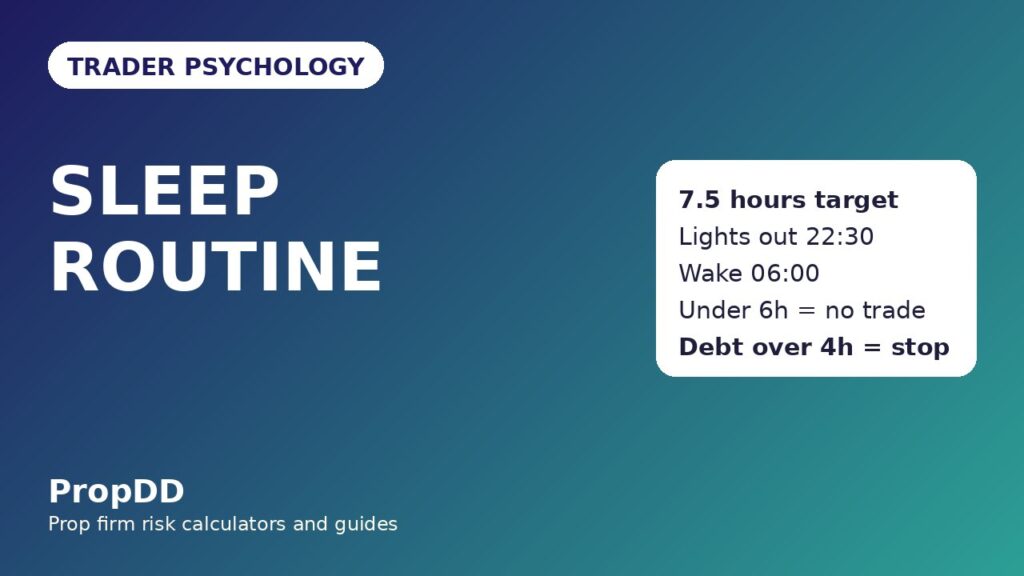
A sleep routine is not a bedtime. It is a shutdown sequence, and it starts 90 minutes before lights out, because the last thing you do before bed decides the first thing you do after waking. My routine is built backwards from a 22:30 lights-out time, which gives me a 7.5-hour window to a 06:00 wake, and every step exists to stop one specific failure I have already committed.
| Time | Step | The failure it prevents |
|---|---|---|
| 20:30 | Close all charts and the trading platform, no exceptions | The midnight chart check that turns into a trade |
| 21:00 | Write tomorrow’s plan on paper: one setup, one session, one size | Waking up and improvising a plan while half asleep |
| 21:15 | Phone out of the bedroom, on silent, charging in another room | The 2 a.m. price-alert wake that ruins the whole night |
| 21:30 | Caffeine cutoff already passed: nothing after 13:00, no exceptions | Lying awake replaying the day’s trades |
| 21:45 | Light stretch, shower, no screens, no market news | Carrying session adrenaline into bed |
| 22:30 | Lights out, room dark, cool and quiet | The shallow first hour of sleep that never restores you |
The caffeine rule deserves its own line, because it is the one traders break most casually. Caffeine has a half-life of roughly six hours, which means a 200-milligram coffee at 13:00 is still about 100 milligrams at 19:00 and about 50 milligrams at 01:00. That is not enough to keep you awake, but it is enough to keep you shallow, and shallow sleep is what makes the next morning feel like a fog even after eight hours in bed. My cutoff is 13:00, which is early enough that by lights out the caffeine is mostly gone, and late enough that I still get a morning coffee. The prop firm daily routine on this site covers the morning half of this system, and this evening routine is its mirror: the morning routine only works if the night before it was protected.
The size ladder: what I am allowed to trade on how much sleep
This is the table that actually runs my mornings, and it is taped to my monitor, because a tired trader will negotiate with anything that is not written down. The ladder has three rungs, and the middle rung is the one that saves accounts, because it gives a tired trader something to do that is not full size and not nothing.
| Last night’s sleep | Four-night debt | Allowed size | Risk per trade |
|---|---|---|---|
| 7.5 hours or more | Under 2 hours | Full size, normal setups | $500 |
| 6.0 to 7.5 hours | 2 to 4 hours | Half size, one setup only | $250 |
| Under 6.0 hours | Over 4 hours | No trading, review only | $0 |
At half size, the sizing maths stays exactly the same, only the risk changes, which keeps the table honest. A 40-pip stop at $250 risk is 0.63 lots instead of 1.25 lots, a 30-pip stop is 0.83 lots instead of 1.67, and a 50-pip stop is 0.50 lots instead of 1.00. The full grid is below, because a tired trader should never be doing division in his head before London.
| Stop distance | Full size at $500 risk | Half size at $250 risk |
|---|---|---|
| 20 pips | 2.50 lots | 1.25 lots |
| 30 pips | 1.67 lots | 0.83 lots |
| 40 pips | 1.25 lots | 0.63 lots |
| 50 pips | 1.00 lots | 0.50 lots |
| 60 pips | 0.83 lots | 0.42 lots |
The no-trading rung is the hardest to obey and the most valuable, because it is the rung I broke on my breach morning. A trader who sleeps under six hours and trades anyway is not being tough, he is spending his daily limit on decisions made by the worst version of himself. The losing streak guide on this site makes the same point from the other side: a streak is rarely a strategy problem, it is usually a state problem, and sleep is the most common state nobody checks.
I tested it: four weeks, two states, one strategy
I did not write this routine and then declare it worked. I tested it over four weeks on the same setup, the same session and the same size rules, with only my sleep changing. The first two weeks I followed the routine strictly, averaging 7.6 hours a night. The second two weeks I let it slide, averaging 5.4 hours, with late chart checks, late caffeine and a phone in the bedroom. Everything else stayed the same, including the strategy, which is why the difference is worth reading.
| Period | Average sleep | Trades | Wins and losses | Net result at $500 risk | Rule breaks |
|---|---|---|---|---|---|
| Rested weeks | 7.6 hours | 14 | 8 wins, 6 losses | Winners 12.0R minus losers 6.0R = plus 6.0R, plus $3,000 | 1 |
| Tired weeks | 5.4 hours | 14 | 5 wins, 9 losses | Winners 6.0R minus losers 9.0R = minus 3.0R, minus $1,500 | 7 |
| Difference | 2.2 hours | Same | 3 fewer wins, 3 more losses | $4,500 swing on the same strategy | 6 extra breaks |
The rule-break column is the real result, because it explains the profit column. In the rested weeks I broke one rule, a single late entry that I caught and closed at breakeven. In the tired weeks I broke seven: two entries before my session filter, three size increases after losses, one trade on a pair I do not trade, and one day where I traded through my personal daily stop instead of stopping at it. None of those breaks were strategy decisions. They were all state decisions, made by a trader who had not slept, and they cost $4,500 on the same edge. The giving back profits guide describes the same pattern after a winning streak, and sleep deprivation creates it without any winning streak at all. If you want the weekly version of this check, the funded account weekly review is where I now score my sleep alongside my profit, because a week with a good profit and bad sleep is a week that is about to reverse.
The five ways a bad night breaches an account
Every failure below is one I have committed, and they all share one shape: the tired trader does not decide to break a rule, he simply stops noticing it. Naming them in advance is what lets a rested trader catch them in a tired one.
| Failure | What it looks like | What the routine does instead |
|---|---|---|
| Trading before the session filter | Entering at 07:00 because you are already awake | Charts closed until the session, plan written the night before |
| Doubling size after a loss | Revenge trade at 2.50 lots to win the morning back | Size ladder on the monitor, half size maximum on a tired day |
| Trading a pair you do not trade | A scalp on an unfamiliar pair because it is moving | One setup, one pair, written down before bed |
| Trading through the daily stop | One more trade after the $2,500 stop is hit | Platform closed at the stop, review instead of trading |
| Checking charts at 2 a.m. | A price alert wakes you and you stay awake trading | Phone out of the bedroom, alerts off overnight |
When the routine breaks: night shifts, travel and bad weeks
A routine that only works on perfect weeks is not a routine, it is a wish, so here is how mine bends without breaking. On a travel week, I keep the same lights-out time in the new timezone, not the same clock time at home, because the body follows light, not the clock on the wall. On a week where a family emergency or a night shift destroys my sleep, I drop to the no-trading rung without arguing, because a week of no trading costs nothing on a funded account, while a week of tired trading can cost the account. And on a week where I break the routine once, I do not abandon it, I repair it the next night, because the debt maths says one bad night costs 2.5 hours, not the whole system.
The test for whether a broken week is an excuse or a reason is simple: did I choose the thing that broke my sleep, or did it choose me? A late night out is a choice, and a choice means I trade half size or not at all the next day. A sick child or a power cut is not a choice, and the same size rule still applies, because the account does not grade your reasons, it only grades your decisions. That sounds harsh, and it is meant to be, because funded accounts are harsh in exactly that way. The routine is not there to make you feel disciplined. It is there to make sure the trader who shows up at London open is the one who wrote the plan, not the one who stayed up breaking it.
The honest summary is this: my strategy did not change in four weeks, my sleep did, and my results moved by $4,500. A funded account does not pay you for being awake. It pays you for being repeatable, and repeatability starts the night before, in a dark room, with the phone somewhere else and the charts already closed. Protect the night, and the morning mostly protects itself.
Frequently asked questions
How much sleep does a funded trader actually need?
Seven and a half hours is my target, because it fits five full 90-minute sleep cycles, and it is the number my own test was built around. Some traders do well on seven, very few do well on six or less over a full week, and nobody does well on four. The target matters less than the debt rule: whatever your target is, track the four-night shortfall, and do not trade at full size while it is over two hours.
Can I trade if I slept badly but feel fine?
No, and that feeling is the trap. Adrenaline covers exhaustion for the first hour of a session, which is exactly when the London open offers its most tempting entries. I decide my size from last night’s sleep and my four-night debt, never from how I feel at the desk, because the desk feeling is the least reliable number in the whole system.
What if my session is at night and I cannot sleep at 22:30?
Keep the structure, move the clock. The routine is 90 minutes of shutdown, a fixed lights-out time, a 7.5-hour window and a fixed wake time, not the specific hour 22:30. A New York session trader who sleeps from 02:00 to 09:30 is following the same routine as a London trader who sleeps from 22:30 to 06:00, as long as the window is protected and the phone is out of the room.
Does caffeine really matter if I only drink it in the morning?
Morning caffeine is fine, and I drink it myself. The problem is afternoon caffeine, because a 200-milligram coffee at 13:00 is still about 50 milligrams at 01:00, which is enough to keep your sleep shallow even when you fall asleep on time. My cutoff is 13:00, and moving it earlier is the cheapest sleep improvement in this whole article.
Should I use price alerts overnight?
No. An overnight alert does two kinds of damage at once: it wakes you, which breaks the night’s sleep, and it invites a half-asleep trade, which is the worst decision a funded trader can make. If a level matters that much, set a pending order with a stop before bed, or accept that the level will still be there in the morning. The adequate sleep guide makes the same point from the health side: sleep is the foundation that trading performance sits on, not a luxury you trade away for one setup.
What do I do after a week of bad sleep?
Repay it slowly and trade small while you do. One extra hour a night is the fastest honest repayment, so a 7-hour debt takes a full week to clear, and during that week you trade half size at most. Do not try to sleep twelve hours on Sunday to clear it in one go, because the body does not bank sleep, and do not trade at full size on Monday because you feel rested after one good night.
Risk disclaimer: Trading funded accounts involves risk, and past results do not guarantee future results. This article describes my own routine and test, not financial advice, and you should check your firm’s rules before changing how you trade.


