Failing a challenge hurts in a way that’s slightly out of proportion to the money. The fee is gone, sure, but it’s the story you start telling yourself that does the real damage. I’m not good enough. I knew better. I was so close. And then, quite often, within a day or two, a second fee is paid, in a hurry, to prove the first wasn’t a fair test.
In this article
- The first 24 hours: do nothing expensive
- Why the quick retry usually fails
- Gather the evidence
- Find the real cause
- A post-mortem template
- Check the numbers honestly
- Decide what to do next
- Budget for several attempts
- Rebuild confidence in small steps
- Talk to someone
- When it's time to step back
- An example post-mortem
- The money question
- Stories we tell ourselves
- A two-week reset plan
- What to tell yourself
- If you're reading this right after a failure
- Keep the good parts
- Frequently asked questions
- The short version
That second attempt, bought on emotion, has a poor record. This article is about what to do instead: a short, calm sequence for the first day, a post-mortem that actually finds the cause, and a way to decide whether to try again, practise first or change firms. If you want to check the numbers of your failed day, the calculator can help you rebuild how much of the limit each trade used.
The first 24 hours: do nothing expensive
Don’t buy a reset. Don’t buy a new challenge. Don’t change your strategy. Don’t post an angry thread. The first day is for letting the heat drop, and the only task is to write down what happened while it’s still fresh: the time of the first trade, the number of trades, your equity at each step, what you were feeling. Five minutes, plain language, no analysis yet. This is raw material, and it’s easy to lose once the story hardens into “it was the news” or “it was bad luck”.
Why the quick retry usually fails
A challenge bought in the heat of the moment tends to be traded in the same state. The motive is to get even, and the plan is to be more careful, which usually lasts about a day. Meanwhile nothing about the process has changed: same risk per trade, same habits around losses, same blind spots. You’ve bought a second ticket to the same outcome. It isn’t weakness to wait. It’s the cheapest improvement you can make.
Gather the evidence
After a day or two, open your records: the trade history, the equity curve, your journal if you kept one, and the dashboard’s breach details. Write the sequence of trades with their risk in dollars and the percentage of the daily or overall limit used at each point. If you don’t have a journal, reconstruct it from the history tab. It’s tedious, and it’s the first time many people see their own behaviour laid out in order. If you had no journal, start one now; trading journal for prop firm traders shows a layout that’s quick enough to keep.
Find the real cause
Most failures fall into a few buckets, and it helps to name which one you’re in.
Rules misunderstood. The base amount, the reset time, floating losses or costs weren’t what you assumed. The cure is reading and notes; see daily drawdown rules: what to check before you buy.
Risk too big. The numbers didn’t allow for a normal losing run. The cure is smaller size, worked out from the limit, as in how much to risk per trade.
Behaviour. Moved stops, revenge trades, extra trades, trading tired. The cure is rules written in advance; see why traders breach the daily loss limit.
Strategy. The method itself had no edge, or lost it in the live market. This is the least common cause, and the one people most readily blame. The way to check is the data: if the trades that followed your rules were profitable and the failures came from breaking them, it wasn’t the strategy.
Events. News or a gap did something unusual. It happens, but ask honestly whether the account would have survived with smaller size, because it usually would.
A post-mortem template
Write answers to these in a document: What was my equity at the start of the day or week? How many trades did I take, and how many followed my plan? When did the first rule break? What was I feeling at that moment? Which of the causes above applies? What’s one rule that would have prevented it? What would have been the cost of following that rule? Seven questions, thirty minutes. The last two matter most, because they turn a painful event into a specific change.
Check the numbers honestly
Look at how close you actually were before the breach. If you finished most days under 30% of the daily limit and failed on one chaotic day, the issue is the chaos, not the strategy. If you were regularly above 60%, you were living on the edge, and a breach was just a matter of time. Using a calculator to replay the day is a simple way to see it. Enter the start-of-day equity and each trade’s result in turn and watch the bar.
Decide what to do next
You’ve got three honest options.
Practise first. Take two to four weeks on a demo or a very small live account, following a written plan, aiming to finish each week with the daily limit use under 40% and zero rule breaks. If you can do that, you’ve demonstrated the habit that the challenge requires.
Retry with changes. If your post-mortem points to one or two clear fixes, such as smaller risk and a personal stop, make them, write the plan down and then buy the new attempt. See the risk management plan template for a one-page version.
Change firm. If the failure came from a rule that doesn’t suit your style, such as a ban on weekend holding when you swing trade, a different firm may fit better. Compare the rules, don’t chase a discount.
Budget for several attempts
It’s realistic to think of a challenge as something that may take more than one go, and to decide in advance how much you’re willing to spend in total. A fixed budget of, say, two or three attempts takes the desperate edge off each one. Without a budget, every failure feels like a reason to spend again, and a hobby slowly becomes a leak in your finances. Decide the number while you’re calm, write it down and stick to it.
Rebuild confidence in small steps
Confidence isn’t restored by a single big win. It comes back from a run of boring weeks in which you did what you said you’d do. Set small, process-based goals: five days in a row of finishing under 40% of the limit, ten trades with no rule breaks, a journal entry every day. Tick them off. When you’ve done a month of them, the next challenge will feel very different, because you’ll have shown yourself that you can follow the plan under mild pressure.
Talk to someone
A trading friend, a group or even a notebook helps. Explaining what happened out loud, in order, tends to expose the weak points. Be wary of forums where every failure is blamed on the firm, because that story is comfortable, and often untrue. Ask for questions, not sympathy.
When it’s time to step back
If trading is affecting your sleep, your relationships or your finances, or if you’re borrowing to pay for attempts, that’s a signal to take a longer break. There’s nothing shameful about it. Markets will still be there in three months, and a clear head is worth more than another fee. Trading is one way to use your time and money, not the only one.
An example post-mortem
Imagine a trader who failed a $50,000 challenge on day nine. The records show seven trades that day: the first three followed the plan, for a total loss of $750 (30% of the limit). The fourth was taken ten minutes later, outside the plan, at double size. The fifth, sixth and seventh were all larger still, and the last had no stop. The cause: behaviour, triggered by an “unfair” third stop-out. The rule that would have prevented it: three losses mean stop for the day. The cost of following it: a $750 loss and a free afternoon. The next step: three weeks of demo with that rule, then a retry. It’s a short story, and a useful one.
The money question
Be honest about what the failed attempt cost, not only the fee. Add the time, the stress and the opportunity cost of what you could have done with the money. Then decide, calmly, what you’re willing to spend on this over the next year. Many traders find that setting the number gives them a strange relief, because it turns an open-ended chase into a defined project. A project can be run well. A chase can’t.
It also helps to separate “how much would I spend to learn this skill?” from “how much do I need to earn from it?”. The first is a hobby budget. The second is a business plan, and a failed challenge is a bad moment to write one.
Stories we tell ourselves
“The firm cheated me.” Sometimes a firm’s rules are unclear, and it’s worth checking that, but most breaches are explained by the numbers in your own history tab. “It was just bad luck.” Luck plays a part, but sizing decides how much bad luck you can survive. “I was so close to the target.” Close to the target is not close to passing, because the limit decides first. “I’ll make it back on the next one.” This is revenge, dressed in optimism.
Notice which one you’re telling. Naming the story weakens it.
A two-week reset plan
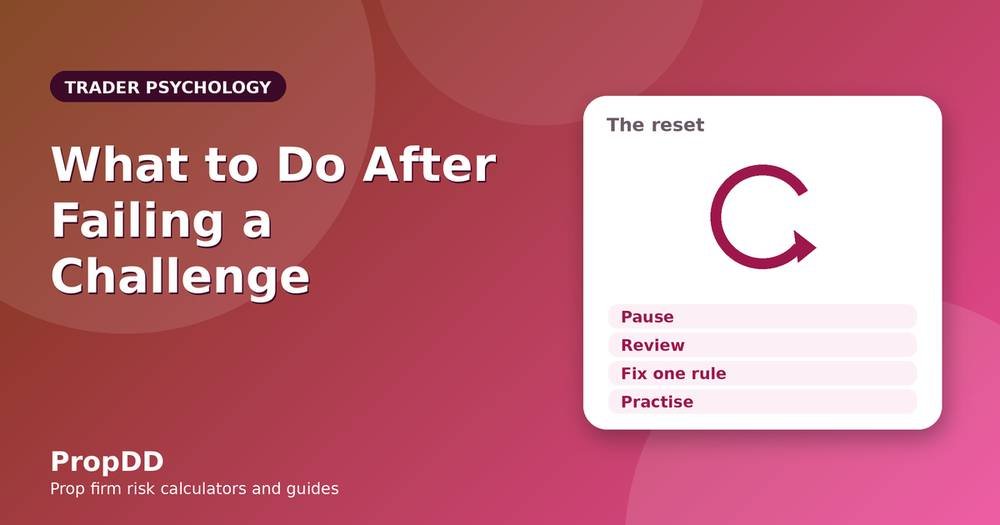
Days one to three: rest, write the raw timeline, don’t trade. Days four to six: build the post-mortem and write one new rule. Days seven to ten: write or update your one-page plan, using the risk management plan template. Days eleven to fourteen: demo trading with the plan, tiny size, journal every trade. At the end of the fortnight, decide: retry, extend the practice or change firms. It’s slower than the impulse buy, and it gives the next attempt a much better start.
What to tell yourself
Failing a challenge is a result, not a verdict. It tells you something specific about your process on a specific day, and you can use it. The traders who eventually get funded aren’t the ones who never fail. They’re the ones who learn something concrete each time and don’t pay for the same lesson twice.
If you’re reading this right after a failure
Close the tab with the checkout page. Make a cup of tea, or go for a walk. Write five lines about what happened. Then come back in a day or two and start the post-mortem. It’s slower than the urge in your chest wants it to be, and it’s the version that changes your results. Whatever the number on the dashboard said, you haven’t lost your ability to learn, and that’s the asset that matters most.
Keep the good parts
A failed attempt isn’t all loss. You probably have a few things that worked: a setup that paid, a routine you stuck to for a week, a sizing habit that kept most days calm. Write those down too. A post-mortem that lists only mistakes is a recipe for starting over from nothing, while one that keeps the good parts lets you start the next attempt from a better place.
Frequently asked questions
Should I buy a reset straight away?
Wait at least a day or two. A reset bought in the heat of the moment is usually traded in the same state.
How do I know if the strategy is the problem?
Look at the trades that followed your rules. If they were profitable on balance, the strategy probably works and the failure came from rule-breaking.
Is it normal to fail more than once?
Yes, and many traders do. The useful thing is to learn something specific each time.
Should I switch firms after a failure?
Only if the cause was a rule that doesn’t fit your style. Otherwise the same habits will follow you to the next firm.
The short version
After a failed challenge, wait, write down what happened, find the real cause, change one thing and practise before you pay again. Set a budget for attempts and rebuild confidence with small, boring wins. For the rule that probably decided it, read the prop firm max daily drawdown explained, and for a neutral look at risk, see Investopedia’s page on risk management and the free BabyPips lessons.