Nobody sets out to overtrade. It creeps in through a quiet session, a missed move or a loss that needs “one more try”. By the time it’s obvious, you’ve taken nine trades before lunch, each of them defensible on its own and none of them part of the plan. Overtrading is one of the most common reasons a daily loss limit gets close, and one of the least discussed, because it feels like effort rather than recklessness.
In this article
- What overtrading means
- Why it's especially costly on a prop account
- Experiment: how a trade cap changes the odds
- Experiment: adding a personal stop
- Why we overtrade
- How to set your own cap
- Other kinds of cap
- Make the cap hard to break
- Use quiet time on purpose
- Check your own numbers
- Mistakes to avoid
- What a good day looks like with a cap
- What a bad day looks like without one
- Cost is a hidden argument for fewer trades
- Review your busiest days
- A short pre-session routine against overtrading
- Frequently confused: overtrading versus active trading
- Frequently asked questions
- The short version
This article defines overtrading, explains why it’s especially costly on a prop account and, unusually, puts numbers on it. We simulated what a daily trade cap does to the odds of breaching a 5% daily limit, with and without a personal stop. The results are a good argument for writing a cap into your plan. If you’d like to see your own room first, open the drawdown calculator.
What overtrading means
Overtrading is taking more trades than your plan allows, or trades that don’t meet your criteria, usually because of boredom, frustration, excitement or a wish to recover a loss. It isn’t defined by a specific number. For one trader, six trades is a normal busy day. For another, who plans three, it’s overtrading. What matters is the gap between the plan and the behaviour.
Why it’s especially costly on a prop account
Each extra trade has a cost in spread and commission, uses a slice of your daily room and adds another chance to make a rule-breaking mistake. On a personal account, an overtrading day costs money. On a prop account, a hard wall sits a few percent away, and every extra trade moves you toward it. It also tends to produce lower-quality trades, taken for emotional reasons, which have worse odds than the setups you wrote down in your plan.
Experiment: how a trade cap changes the odds
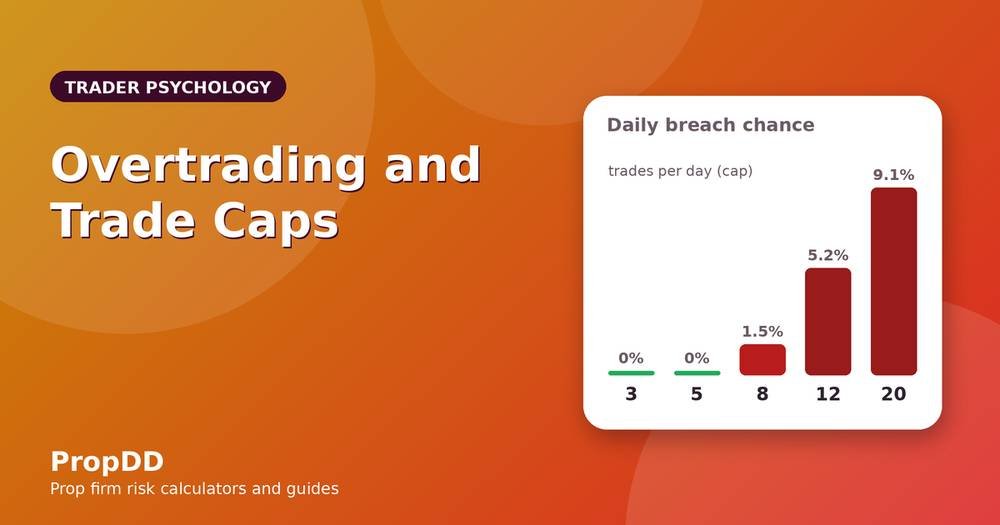
We simulated a single trading day for a strategy that wins 45% of the time with 1.8R winners (a modest edge of +0.26R per trade before a cost of 0.05R). Risk per trade was 0.75% of the account, and the daily limit was 5%. For each trade cap we ran 200,000 days and counted how often the day ended at or beyond the limit, based on closed trades only.
| Max trades per day | Chance of breaching the 5% limit | Chance of ending down 2.5% or more | Average day |
|---|---|---|---|
| 2 | 0.0% | 0.0% | +0.31% |
| 3 | 0.0% | 0.0% | +0.47% |
| 5 | 0.0% | 5.1% | +0.78% |
| 8 | 1.5% | 6.3% | +1.26% |
| 12 | 5.2% | 13.7% | +1.87% |
| 20 | 9.1% | 14.6% | +3.06% |
The breach column is the point. With a cap of five trades, a breach was impossible in this model, because five losses cost about 4.0%. At eight trades it’s 1.5% of days, at twelve more than 5% and at twenty about one day in eleven. The same strategy, the same edge, the same risk per trade. Only the number of attempts changed.
A caution about the average-day column
The average day rises with more trades, which might make overtrading look attractive. It’s an artefact of the simulation, which assumes every trade has the same edge. In real life, the tenth trade of the day usually has a worse edge than the first, because it’s taken out of boredom or frustration. If later trades had no edge at all, the extra trades would add only costs and risk. Treat the breach column as an optimistic floor, and the average-day column with scepticism.
Experiment: adding a personal stop
We repeated the runs with a personal stop: the trader stops for the day once down 3%. In every case in this model, the chance of breaching the 5% limit fell to zero, and the average day dropped only slightly (for example, +1.74% instead of +1.87% at a cap of twelve trades). A personal stop gave away a little expected profit and removed nearly all the breach risk. At a higher risk of 1.5% per trade, with no stop, a cap of five trades produced a 9% chance of a daily breach and a cap of eight, 18%. With a 3% personal stop, both were zero.
The model has important limits. It uses closed trades only, no slippage, no floating losses and independent trades, so real breaches can happen even with a stop. The lesson isn’t that these exact numbers apply to you. It’s that a cap and a stop do real, measurable work. See how to set a personal daily stop for how to choose yours.
Why we overtrade
Boredom. A quiet market and a restless mind make a mediocre setup look good. Frustration. A loss turns into a need to recover, the core of revenge trading. Excitement. A winning streak creates the feeling that you can’t lose. Pressure. A deadline, a fee or a target pushes you to force activity. Habit. Screen time becomes trading time. Naming which one is behind your overtrading tells you which rule to add.
How to set your own cap
Start from your strategy. How many valid setups does it usually offer in your session? If the answer is two or three, a cap of four gives a little slack and no more. Then check it against your daily numbers: the cap times your risk per trade shouldn’t exceed your personal stop. With 0.5% risk and a 3% personal stop, six trades would take you to the stop exactly if all lost, so a cap of four or five is comfortable. Write the cap on your daily card and treat it as final.
Other kinds of cap
A time cap: no new trades after a certain hour. A loss cap: stop after two or three losers in a row. A profit cap: stop after a day above a certain gain, as in the idea of a daily profit stop. A setup cap: only the best one or two setups per session. Combine them as you like. The simplest working rule is a combination, such as “three trades, or two losses in a row, or my personal stop, whichever comes first”.
Make the cap hard to break
Rules that rely on willpower fail when you’re annoyed. Make the cap physical: a tick-box row of three squares on paper, crossed out as you trade, or a note that says “done”. Close the platform when the cap is reached. If you need more friction, set a phone alarm for the end of your session window. The point is to create a small obstacle between you and the extra trade.
Use quiet time on purpose
If boredom is your trigger, decide in advance what you’ll do instead of trading: review yesterday’s trades, update the journal, read, take a walk. A trader who has a plan for the quiet time is less likely to fill it with trades. Some people keep a “waiting list” of setups they’d like to take if the market offers them, and only trade from the list.
Check your own numbers
Count your trades per day over the last month in your trading journal. Note the days with the most trades and compare the results with your quieter days. Many traders find that their busiest days are their worst, and that the extra trades after the third or fourth lose money on average. If your data shows the same, you have your cap.
Mistakes to avoid
Setting a cap and moving it mid-day. Counting only losing trades toward the cap. Using partial closes to dodge it. Taking several tiny trades to “stay in the game”. Ignoring the cap on winning days. Treating a quiet day as a failure.
What a good day looks like with a cap
Imagine a trader with a cap of four trades and a personal stop at 3%. The first two trades lose, down 1.5%. The third wins, up 0.9% on the day after the +1.35% gain. The fourth is stopped at breakeven. The cap is reached, the platform closes and the trader spends the rest of the day on review. The day used less than a third of the daily limit and finished slightly positive. It wasn’t glamorous, and it was the kind of day that repeated fifty times makes a funded trader.
What a bad day looks like without one
The same trader without a cap starts the same way, down 1.5% after two losses. The third trade wins, and now it feels like momentum, so a fourth and fifth follow, both at slightly larger size. They lose. Down 2.3%, the sixth, seventh and eighth trades are all attempts to get back to flat. By the time the trader looks at the dashboard, the day is at −4.1%, with 82% of the limit gone. The early part of the day was the same. The cap is the difference between two very different afternoons.
Cost is a hidden argument for fewer trades
Every trade pays spread and, on some accounts, commission. If each costs 0.05R, eight trades cost 0.4R, which on a day of three planned trades would have been 0.15R. Over twenty days, that’s several percent of account value spent on activity that probably wasn’t part of the plan. Even a strategy with a real edge has to pay for every extra trade. This is one more reason a cap isn’t a restriction on profit. It protects the edge you have from the friction you add.
Review your busiest days
Once a week, find the three days in your journal with the most trades and ask what was different. Was the market unusually active? Were you chasing a loss? Were you bored? Often the answer is a trigger you can name, and naming it is half the cure. Then write one rule that would have prevented it, and add it to your plan. The article on the risk management plan template shows where such rules fit.
A short pre-session routine against overtrading
Before you trade, write today’s cap and personal stop on your card, tick the calendar for events and note the single most likely setup. During the session, tick a box for every trade, including small ones. When the last box is ticked, stop. After the session, write one line about whether you followed the cap. That’s all. It takes minutes, and it turns an invisible habit into something you can see and measure.
Frequently confused: overtrading versus active trading
Some strategies legitimately involve many trades, such as scalping systems with strict rules. The question isn’t how many trades you take, it’s whether each one meets your rules and whether the total fits your daily limit and your attention. A scalper with a plan of twenty trades and a matching risk per trade is following a plan. A swing trader taking twenty trades is almost certainly not. Judge your behaviour against your own plan.
Frequently asked questions
How many trades a day is too many?
More than your plan allows. For many prop traders that’s three to five, but it depends on your strategy and your risk per trade.
Does a trade cap reduce my profit?
If your later trades have the same edge, slightly. In practice later trades are often worse, so a cap often costs little or nothing and reduces risk.
Should the cap be per day or per session?
Whichever matches how you trade. A per-day cap is simplest, and it protects the daily limit directly.
What if I hit the cap with a great setup still available?
Let it go. The cap exists for the moments when you feel there’s a great setup, since that feeling is the one that appears right before most rule breaks.
The short version
A trade cap and a personal stop are cheap, boring and effective. In our simulation, a cap of five trades made a daily breach impossible at 0.75% risk, while twelve trades gave more than a 5% chance, and a 3% personal stop removed nearly all of it. Pick a cap that matches your strategy, write it down and make it hard to break. For the rule it protects, read the prop firm max daily drawdown explained, and for neutral background, see Investopedia’s risk management overview and the free BabyPips lessons.