If you read enough traders describing how they lost a challenge, the stories rhyme. It’s rarely one huge mistake. It’s a chain: a slightly bigger size, a slightly looser stop, a news spike, a decision to “just get back to even”. By the time the account closes, the trader can’t point to a single moment where it all went wrong, because every step felt reasonable.
In this article
- 1. The floor was never written down
- 2. Risk per trade was too big
- 3. Trades piled up
- 4. The stop was moved or removed
- 5. Averaging down
- 6. Floating losses were ignored
- 7. News and slippage
- 8. The details were wrong
- 9. Emotion took over
- What actually works
- Do a post-mortem if it happens
- A quick self-check
- Why it's usually not strategy
- A breach, reconstructed
- Tiredness and distraction
- Notifications and multitasking
- The first trade of the day sets the tone
- Why rules written in advance work
- How the firm sees it
- The small habit that catches most of it
- Learning from other people's breaches
- Make one change this week
- Frequently asked questions
- The short version
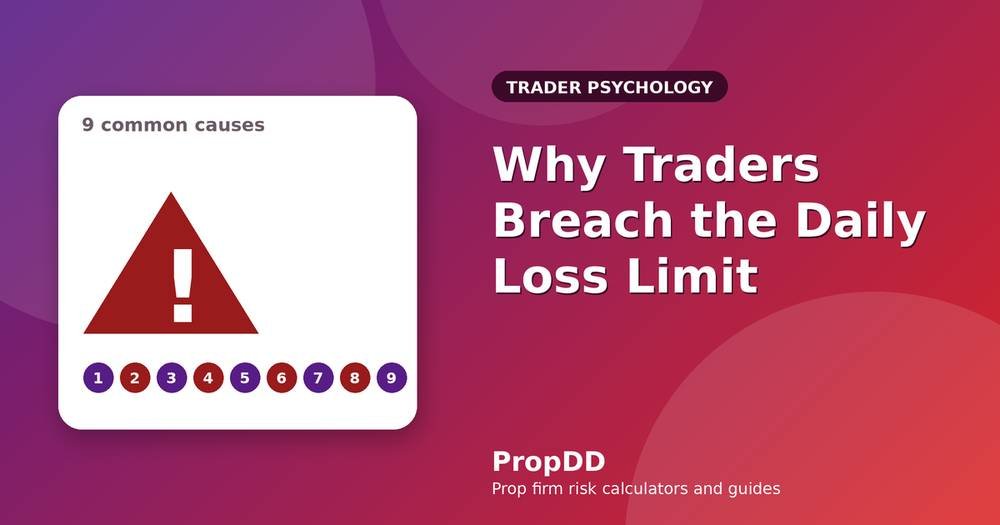
This article goes through nine causes that show up again and again, with a way to stop each. They aren’t ranked, and most breaches involve more than one. If you want to know how close you are to the wall right now, the drawdown calculator will tell you, and then these nine will tell you why you might be standing there.
1. The floor was never written down
“I think it’s about 95k.” That sentence has ended accounts. If the number lives in your head, it moves with your mood, and on a bad day the wall always seems a bit further away than it is. The fix takes thirty seconds: before the first trade, calculate the floor and write it where you can see it. The steps are in how to calculate max daily loss.
2. Risk per trade was too big
If a single trade risks 2% and the daily limit is 5%, three losses end the day, and a fourth the account. Nobody plans that, they simply never did the division. When the arithmetic says you can absorb three losses, an ordinary bad morning can produce them. The cure is smaller risk, set by working backwards from the limit, as described in how much to risk per trade.
3. Trades piled up
Each trade looks fine alone. Three correlated trades are one large bet. A trader can be “within risk” on every ticket and still exposed to twice the intended loss if one move hits all of them. Add up open risk, in dollars, before every entry, and treat pairs that move together as one position.
4. The stop was moved or removed
This one’s about hope. A trade goes against you, the stop is close, and moving it a little further seems harmless. Then a little further. A stop that moves isn’t a stop, it’s a suggestion. On an equity-based rule, a trade with no stop is a breach waiting for a news candle. Make it a rule you can’t break: stops can be tightened, never loosened.
5. Averaging down
Adding to a loser turns a controlled loss into an open-ended one, and it does so at exactly the moment your judgement is worst. The floating loss gets bigger faster than the average entry improves. If a trade fails, the right response is to exit, not to deepen the position.
6. Floating losses were ignored
The history tab says you’ve lost $1,000. The equity line says $2,900, because open trades are floating. Many firms use equity. The gap between the two is where the surprises live. Check equity, not just closed results. See floating losses and open trades for a closer look.
7. News and slippage
A stop is a plan, not a guarantee. On a major release, spreads widen and fills can land far from your level, so a $500 loss becomes $900. If you’re near the limit already, that gap is the difference between a bad day and a closed account. Skip the event or size for the worst case; news trading and daily drawdown explains how.
8. The details were wrong
The base amount was the initial size and the trader assumed start-of-day equity. The reset time was a different clock than expected. Commissions counted and the trader thought they didn’t. These are boring mistakes and they end accounts all the same. The cure is reading the rulebook once, carefully, and keeping notes. Our checklist in daily drawdown rules: what to check before you buy a challenge helps.
9. Emotion took over
The most human one. A loss, a bit of anger, a wish to be even. Size creeps up, patience falls, rules slip. It looks like trading and it’s not. Everything that comes after a loss in that state is revenge, and the best defence is a set of rules written while calm. The full story, with a ten-minute reset, is in revenge trading and the daily loss limit.
What actually works
A personal stop under the firm’s limit, usually 60% to 70% of it, with a rule that you stop trading when it triggers. A maximum number of trades per day. Fixed risk per trade that doesn’t change after a loss. An alert on equity, not balance. A daily routine that starts with the floor and ends with a journal note. None of it is clever. All of it is dull, and the dullness is the point. We cover the first in how to set a personal daily stop.
Do a post-mortem if it happens
If you do breach, write the story the same day. What time did the day start going wrong? Which rule did I break first? What was I feeling? Which of the nine causes above applied? Then write one rule that would have prevented it. People skip this because it hurts. It’s also the only part of a failed attempt that has real value, and it costs nothing.
A quick self-check
Ask yourself five things: do I know my floor right now to the dollar? Is my risk per trade small enough to absorb five losses? Do I have a hard stop on every trade? Do I know my reset time and what counts? Do I have a rule for what I do after two losses? If any answer is no, that’s the first thing to fix, before any strategy tweak.
Why it’s usually not strategy
When a challenge fails, it’s tempting to blame the strategy and look for a new one. Sometimes that’s right. More often the strategy was fine, and the failure was in position size, in stop discipline or in emotion. Switching strategies without fixing those is like changing the car when the problem is how you drive. Keep a record, and let the data show whether it’s the method or the habits.
A breach, reconstructed
Here’s an imaginary but typical case. A trader has a $50,000 account, a $2,500 daily limit and a plan of $250 per trade, three trades a day. The first two trades lose, down $500. The third is stopped out by three pips and then goes to target: down $750. Annoyed, the trader takes a fourth trade at $500, outside the plan, and loses it: down $1,250. A fifth, at $750, because “one good trade fixes the day”. It loses: down $2,000, with 80% of the limit used.
Now there’s $500 left. The trader opens a sixth with no stop, thinking it can’t go much lower. A news candle arrives, the spread widens, the floating loss reaches $600, and the equity touches the floor. Done. In total, five of the six trades were reasonable-looking decisions in the moment. The plan ended at trade three. Everything after was something else.
Tiredness and distraction
Hardly anyone lists fatigue as a cause of a breach, yet it’s behind a lot of them. A tired trader reads charts less carefully, forgives rule breaks faster and tolerates larger losses emotionally. Late-night sessions after a full day’s work are a common time for oversized risk. If you can only trade when you’re tired, trade smaller or not at all. The account will still be there tomorrow, and you’ll be sharper.
Notifications and multitasking
Trading while chatting, watching videos or answering messages doesn’t work as well as it feels like it should. Attention is the resource that stops you from missing the third, fourth and fifth warning signs. Put the phone in another room during your session, close the chat apps and keep one screen for the chart and one for the numbers. If a session needs your full attention to be safe, give it your full attention, or skip it.
The first trade of the day sets the tone
A loss on the first trade has an outsized effect on mood, and a win has a similar effect on confidence. Both can push you off plan. A habit some traders find useful is to make the first trade a deliberately small one, or to wait for a second confirmation before trading at all. The purpose isn’t to improve the first trade. It’s to take the emotional weight off it so it doesn’t colour the next five.
Why rules written in advance work
When you’re in the middle of a losing run, your brain isn’t a neutral advisor. It wants relief, and it will generate convincing reasons to get it. A rule written the night before wasn’t written by that brain. It was written by the calmer version of you, with the whole day in mind. Following it is a matter of obeying a decision you’ve already made, not of finding willpower on the spot. That’s why the dullest rules are often the most protective.
How the firm sees it
From the firm’s side, the daily limit is a circuit breaker, and a breach is a data point. They aren’t judging you personally. They’re running a numbers game across thousands of accounts, and the traders who last are those whose behaviour is predictable and small. Seen that way, your aim isn’t to impress anyone. It’s to be boring in a profitable way, for long enough that boring turns into funded.
The small habit that catches most of it
If I had to pick one habit to prevent breaches, it would be a quick check of the equity figure before every single entry. Not balance, equity. Look at it, compare it to the floor, add up your open stops. It takes ten seconds, and it interrupts the autopilot that drives most breaches. Plenty of traders who get into trouble weren’t careless about risk in general. They just stopped looking at the number that matters, for a few critical minutes, while something else had their attention. Put a note next to your monitor if you need to. It’s a cheap way to protect an expensive account.
Learning from other people’s breaches
Read the stories traders share about failed attempts, with a skeptical eye for the details. Notice how often the cause is one of the nine above, and how rarely it’s “the market did something nobody could have predicted”. Even when the market did something surprising, the account usually survived or died by how much was at risk when it happened. That’s the part you control, and it’s the part that’s worth studying.
Make one change this week
Don’t try to fix all nine at once. Pick the one you recognise most from your own trading, write the rule that would stop it, and follow it for a week. If it works, add the next. Small, specific changes survive. Grand resolutions rarely last past the first bad day.
Frequently asked questions
What’s the most common cause of a daily breach?
Oversized risk combined with a cluster of losses, often made worse by emotion after the second or third loss.
Can I recover after a breach?
You can’t recover that account, but you can recover the process. A post-mortem and one new rule usually matter more than the next strategy.
Does a stop loss prevent a breach?
It limits the intended loss. Slippage, gaps and stacked positions can still produce a bigger one than planned.
How low should risk per trade be?
Low enough that five or more consecutive losses leave you well inside the limit. For many people that’s 0.25% to 0.5%.
The short version
Breaches come from ordinary mistakes stacked together: no written floor, big risk, clustered trades, moved stops, averaging down, ignored floating losses, news slippage, wrong assumptions and emotion. Each has a dull, practical fix. For the rule itself, read the prop firm max daily drawdown explained, and for a neutral background on controlling losses, see Investopedia’s page on the stop-loss order, and the free lessons at BabyPips.